
How Neuroarchitecture and Biophilic Design Are Rewiring Our Brains
Architects are increasingly using neuroscience to design buildings that actively lower stress hormones and boost cognitive function through a deep integration with nature.
By Factlen Editorial Team
- Neuro-Architects & Researchers
- Focus on empirical data and physiological responses to optimize spatial design.
- Public Health Advocates
- View the built environment as a critical tool for preventative healthcare and recovery.
- Urban Planners & Developers
- Balance the psychological benefits of nature integration with the practicalities of dense city development.
What's not represented
- · Low-income urban residents who lack access to restorative green spaces
- · Neurodivergent individuals whose sensory processing needs differ from the baseline
Why this matters
As humans spend up to 90% of their lives indoors, the physical spaces we inhabit are silently shaping our cognitive function, stress levels, and emotional resilience. Understanding neuroarchitecture empowers individuals and organizations to demand environments that actively protect their mental health rather than quietly draining it.
Key points
- Neuroarchitecture uses EEG and fMRI data to measure how buildings physically alter human brainwaves.
- Biophilic design integrates natural elements to lower cortisol and activate the parasympathetic nervous system.
- Nature-inspired offices have been shown to boost employee productivity by up to 15 percent.
- Salutogenic hospital designs reduce the need for pain medication and shorten patient recovery times.
- Urban planners are scaling these concepts to city grids to combat the psychological toll of density.
- Advocates are pushing to democratize biophilic design beyond luxury developments into public housing and schools.
Modern humans are an indoor species. We spend roughly 90 percent of our lives inside constructed boxes, sealed off from the natural environments our brains evolved to navigate. This profound mismatch between our evolutionary biology and our modern habitats is increasingly recognized as a silent driver of chronic stress, cognitive fatigue, and emotional burnout. For decades, architecture was judged primarily on its aesthetic appeal and functional efficiency. But a quiet revolution is shifting the paradigm, treating buildings not just as shelters, but as active participants in our neurological health.[6]
This shift is driven by the emerging field of neuroarchitecture, an interdisciplinary science that merges neuroscience, environmental psychology, and architectural design. Rather than relying on subjective feelings about a space, neuroarchitecture seeks empirical evidence of how the built environment physically alters our brainwaves and biological functions. Researchers are utilizing wearable electroencephalogram (EEG) monitors, functional magnetic resonance imaging (fMRI), and eye-tracking software to measure exactly how humans respond to spatial qualities like ceiling height, natural light, acoustics, and geometric proportions.[1][5]
The data reveals that our brains are constantly processing architectural stimuli, even when we are not consciously aware of it. When we enter a room, specific neural pathways light up. The anterior cingulate cortex and the parahippocampal place area work in tandem to map the environment, assess safety, and regulate our emotional response. If a space is dark, cramped, or acoustically chaotic, the brain perceives a subtle but continuous threat, triggering a low-level fight-or-flight response that slowly drains cognitive resources.[1][3]
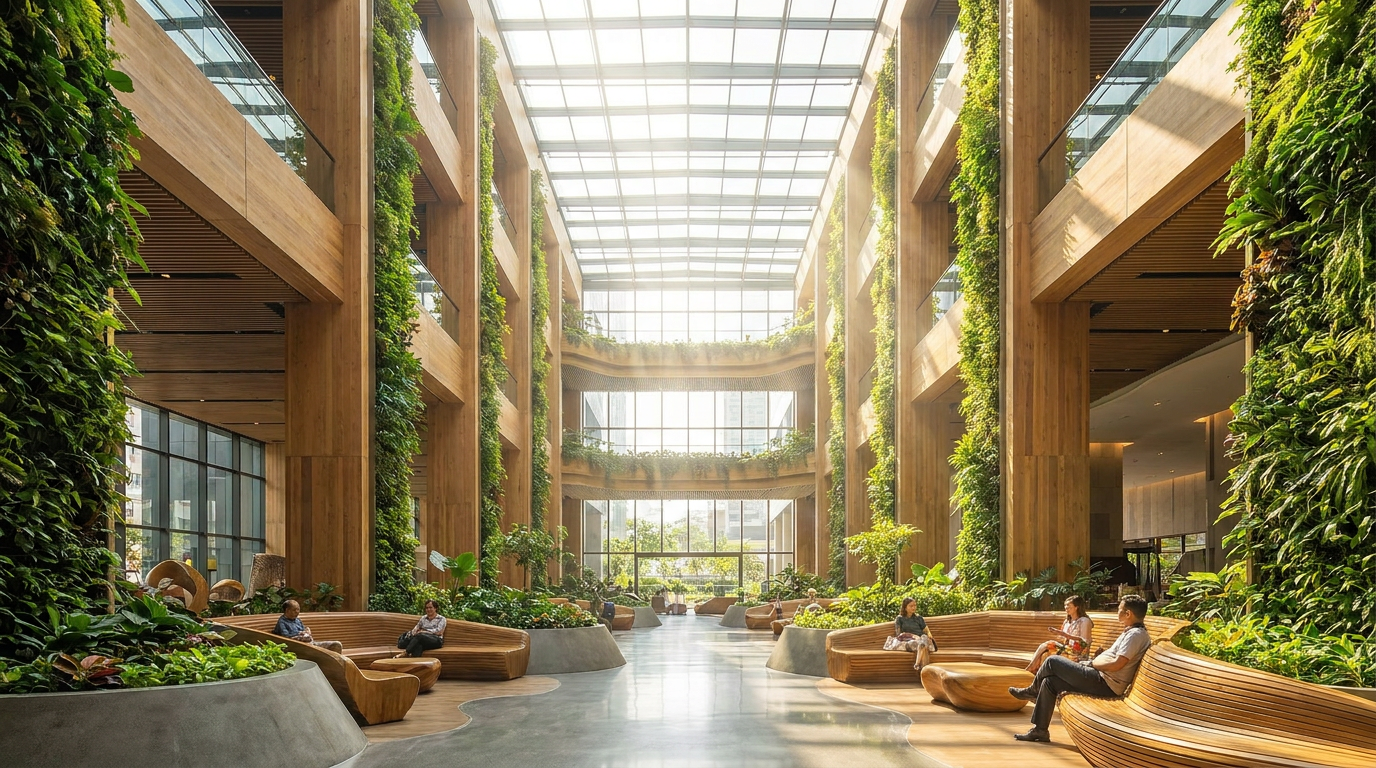
To counteract this spatial stress, designers are increasingly turning to biophilic design, the most prominent applied strategy within neuroarchitecture. Biophilic design is rooted in the biophilia hypothesis, which posits that humans have an innate, evolutionary need to affiliate with natural systems. It goes far beyond simply placing a potted plant on a desk. True biophilic design weaves natural elements—such as dynamic daylighting, flowing water, organic textures, and fractal patterns—into the very fabric and syntax of a building.[1][2]

The physiological response to these natural interventions is immediate and measurable. Exposure to biophilic environments has been shown to rapidly lower cortisol, the body’s primary stress hormone, while activating the parasympathetic nervous system, which controls our 'rest and digest' functions. By reducing allostatic load—the cumulative wear and tear on the body from chronic stress—these spaces act as a passive form of preventative healthcare, stabilizing heart rates and lowering blood pressure simply through spatial immersion.[2][5]
One of the most fascinating evolutionary concepts applied in neuroarchitecture is the principle of 'refuge and prospect.' Evolutionary psychology suggests that early humans felt safest in environments where they had a protected back (refuge) and a clear, expansive view of their surroundings to spot potential threats or resources (prospect). Modern architects are translating this savanna survival instinct into office and residential designs by creating cozy, enclosed alcoves that look out over open, light-filled atriums.[2][4]
When employees are given spaces that satisfy these deep-seated biological needs, their cognitive performance demonstrably improves. The mechanism behind this is explained by Attention Restoration Theory, which argues that urban, artificial environments require exhausting 'directed attention,' while natural environments engage 'soft fascination,' allowing the brain's directed attention reserves to replenish. A workspace that mimics nature gives the brain micro-breaks throughout the day, preventing the afternoon cognitive slump.[2][6]
When employees are given spaces that satisfy these deep-seated biological needs, their cognitive performance demonstrably improves.
The empirical results of these design choices are striking. Research comparing conventional office spaces to green-certified buildings heavily utilizing biophilic principles found that occupants in the nature-inspired environments scored significantly higher on cognitive function tests. Another landmark study demonstrated that simply introducing comprehensive greenery and natural light into a previously barren office space increased overall employee productivity by 15 percent, while simultaneously reducing reported rates of absenteeism and burnout.[2]

Beyond the corporate world, neuroarchitecture is fundamentally reshaping healthcare facilities through the concept of salutogenic design. While traditional hospitals were designed around the efficiency of medical equipment and staff, often resulting in sterile, anxiety-inducing environments, salutogenic design focuses on environments that actively support the patient's recovery. This means prioritizing natural light, views of nature, and sound-absorbing materials to create a calming atmosphere.[2]
The medical outcomes of these healing environments are profound. Patients in hospital rooms with expansive windows looking out on trees or gardens have been shown to require fewer analgesic pain medications and experience shorter postoperative hospital stays compared to patients in rooms facing brick walls. By lowering the patient's baseline stress, the architecture itself becomes an adjunctive therapy, freeing up the immune system to focus entirely on physical healing.[2]

The principles of neuroarchitecture are now scaling up from individual buildings to entire city grids, a movement known as neuro-urbanism. Urban planners are recognizing that the dense, concrete-heavy design of the 20th-century metropolis is fundamentally hostile to human psychology. Cities like Singapore have pioneered the 'Garden City' model, integrating massive ecological corridors, vertical forests, and biophilic skyscrapers that weave biodiversity directly into the urban fabric.[3][4]
These neuro-urban interventions do more than just beautify a city; they actively mitigate the psychological toll of urban density. Access to restorative green spaces and biophilic public infrastructure has been linked to lower rates of urban anxiety and depression. Furthermore, the strategic use of lighting, clear sightlines, and natural wayfinding in public spaces significantly enhances the psychological perception of safety, encouraging community interaction and social cohesion.[3][4]
Despite the overwhelming evidence supporting neuroarchitecture, the field still faces significant challenges. Much of the foundational research has relied on virtual reality simulations or relatively small, homogenous population samples, prompting calls for more expansive, real-world longitudinal studies. Researchers are working to gather more diverse data to understand how different demographics, neurodivergent individuals, and various age groups uniquely process architectural stimuli.[1]
There is also the pressing challenge of equity. Currently, the most advanced biophilic and neuroarchitectural designs are largely concentrated in luxury residential developments, high-end corporate headquarters, and elite private clinics. Public health advocates argue that if architecture can function as preventative medicine, then access to restorative, biophilic environments must be democratized and integrated into affordable housing, public schools, and community centers in historically marginalized neighborhoods.[1][6]

Furthermore, the industry must guard against 'greenwashing,' where developers use superficial natural elements to market a building as biophilic without addressing its fundamental spatial flaws. Slapping a living wall onto a windowless, poorly ventilated, and acoustically harsh room does not constitute neuroarchitecture. True implementation requires a holistic approach, where the biological needs of the occupant dictate the structural design from the very first blueprint.[6]
Looking ahead, the future of neuroarchitecture lies in adaptive, intelligent environments. Researchers are exploring how buildings can integrate biometric sensors to monitor the collective physiological state of their occupants in real-time. If a room detects rising stress levels or cognitive fatigue, the building could autonomously adjust the color temperature of the lighting, alter the acoustics, or increase the flow of fresh air, creating a dynamic, responsive habitat.[1][3]
We are standing at the threshold of a new era in design. By bridging the gap between the hard data of neuroscience and the creative intuition of architecture, we are finally learning how to build habitats that honor our biology. The buildings of the future will not merely be passive containers in which we live and work; they will be active, nurturing partners in our lifelong pursuit of cognitive health and emotional well-being.[5][6]
How we got here
1984
Biologist E.O. Wilson popularizes the 'biophilia hypothesis,' suggesting humans possess an innate, evolutionary tendency to seek connections with nature.
Early 2000s
Neuroarchitecture emerges as a distinct discipline, utilizing early fMRI and EEG technology to empirically study human spatial perception.
2010s
Major technology companies pioneer biophilic office designs, integrating living walls and natural light to boost employee retention and productivity.
2020
The global pandemic forces a massive reevaluation of indoor spaces, accelerating the demand for health-centric residential and commercial design.
2026
Neuro-urbanism begins scaling these concepts to city planning, integrating adaptive, sensor-driven environments into public infrastructure.
Viewpoints in depth
Neuro-Architects & Researchers
Focus on empirical data and physiological responses to optimize spatial design.
This camp argues that architecture must move beyond subjective aesthetics and rely on hard biological data. By utilizing EEG scans, eye-tracking, and fMRI technology, researchers aim to quantify exactly how spatial dimensions, lighting, and acoustics alter brainwaves. They advocate for building codes and design standards that are fundamentally rooted in human neuroscience, ensuring that spaces actively support cognitive function rather than inadvertently causing sensory fatigue.
Public Health Advocates
View the built environment as a critical tool for preventative healthcare and recovery.
Public health experts emphasize the medical outcomes of biophilic and salutogenic design. They point to data showing that patients in nature-inspired hospital rooms require less pain medication and recover faster. For this group, the integration of nature into daily environments is not a luxury amenity but a necessary public health intervention to combat the rising tide of urban burnout, chronic stress, and allostatic load across the general population.
Urban Planners & Developers
Balance the psychological benefits of nature integration with the practicalities of dense city development.
While acknowledging the profound benefits of neuroarchitecture, urban planners focus on the logistical and economic realities of implementing these designs at scale. They grapple with the challenges of retrofitting aging infrastructure, the high initial costs of integrating complex biophilic systems, and the need to maximize square footage in densely populated cities. Their goal is to find cost-effective, scalable solutions that bring neuro-inclusive design to public spaces without exacerbating housing costs.
What we don't know
- How different demographic groups and neurodivergent individuals uniquely process specific architectural stimuli.
- The long-term clinical outcomes of biophilic interventions compared to traditional medical therapies.
- How to effectively scale and fund neuro-inclusive urban design in historically marginalized, low-income neighborhoods.
Key terms
- Neuroarchitecture
- An interdisciplinary field that merges neuroscience, psychology, and architecture to study how the built environment physically affects the human brain and body.
- Biophilic Design
- An architectural approach that seeks to connect building occupants more closely to nature by integrating natural lighting, ventilation, landscape features, and organic materials.
- Salutogenic Design
- An approach to healthcare architecture focused on creating environments that actively support and accelerate a patient's physical and psychological recovery.
- Allostatic Load
- The cumulative physiological wear and tear on the body caused by chronic stress and the constant activation of the fight-or-flight response.
- Attention Restoration Theory
- A psychological theory suggesting that exposure to natural environments allows the brain to recover from cognitive fatigue caused by the intense focus required in urban settings.
Frequently asked
What is the difference between biophilic design and decorating with plants?
While adding houseplants is beneficial, true biophilic design integrates natural elements into the fundamental structure of a space. This includes maximizing dynamic natural light, using organic materials like mass timber, incorporating flowing water, and designing spatial layouts that mimic natural landscapes.
How do researchers measure a building's effect on the brain?
Neuroarchitects use empirical tools like wearable EEG monitors to track brainwaves, fMRI scans to observe neural activity, and eye-tracking software to see how people visually navigate a space. They also measure physiological markers like heart rate and cortisol levels.
Can architecture really lower stress hormones?
Yes. Studies show that exposure to biophilic environments rapidly lowers cortisol (the primary stress hormone) and activates the parasympathetic nervous system, which controls the body's 'rest and digest' functions, effectively reducing physical wear and tear.
Is neuroarchitecture only for luxury corporate buildings?
Currently, high-end developments are the primary adopters due to costs. However, public health advocates and urban planners are increasingly pushing to democratize these principles, integrating them into affordable housing, public schools, and community hospitals.
Sources
Source coverage
6 outlets
3 viewpoints surfaced






[1]MDPINeuro-Architects & Researchers
Neuroarchitecture and Biophilic Design for Human Well-Being
Read on MDPI →[2]National Institutes of HealthPublic Health Advocates
Biophilic Design as an Adjunctive Therapy
Read on National Institutes of Health →[3]ResearchGateNeuro-Architects & Researchers
Neurobiophilic Architecture: Integrating Biophilic Design and Neuroscience for Urban Mental Health Enhancement
Read on ResearchGate →[4]ArchDailyUrban Planners & Developers
Neuroarchitecture and the Perception of Safety in Urban Spaces
Read on ArchDaily →[5]NeuroauNeuro-Architects & Researchers
What Emotions Are Our Buildings Evoking?
Read on Neuroau →[6]Factlen Editorial TeamPublic Health Advocates
Synthesis by Factlen editorial team
Read on Factlen Editorial Team →


Every angle. Every day.
Get culture stories with full source coverage and perspective breakdowns delivered to your inbox.