
How Fracking Tech is Unlocking Limitless 24/7 Clean Energy Beneath Our Feet
Next-generation geothermal systems are borrowing horizontal drilling techniques from the oil and gas industry to tap into the Earth's heat almost anywhere, promising a massive new source of firm, carbon-free power.
By Factlen Editorial Team
- Clean Energy Advocates
- Focus on EGS as the essential firm-power complement to intermittent solar and wind.
- Geothermal Developers & Researchers
- Focus on proving the physics, reducing drilling costs, and scaling the technology.
- Energy Policy Analysts
- Analyze the economic transition, regulatory hurdles, and workforce pivot from fossil fuels.
What's not represented
- · Local communities living near proposed EGS sites
- · Water rights regulators in arid western states
Why this matters
As AI data centers and mass electrification strain the power grid, the world desperately needs clean energy that runs 24/7. Enhanced Geothermal Systems (EGS) could solve this by turning the hot rock beneath our feet into a near-limitless battery, fundamentally altering the global energy landscape.
Key points
- Enhanced Geothermal Systems (EGS) use fracking technology to extract heat from dry rock, removing the need for natural hot springs.
- EGS provides 24/7 'firm' clean power, making it an ideal complement to intermittent solar and wind energy.
- Fervo Energy's Project Red in Nevada successfully operated for over 600 days, proving the technology works at commercial scale.
- The U.S. Department of Energy estimates EGS could unlock 5,500 gigawatts of potential capacity nationwide.
- The geothermal industry is absorbing workers and technology directly from the oil and gas sector.
- Water consumption and slow federal permitting remain the primary hurdles to widespread deployment.
The global transition to clean energy has a massive, looming math problem. Solar and wind power are cheap and abundant, but they are inherently intermittent—the sun sets, and the wind stops blowing. Meanwhile, the demand for electricity is skyrocketing, driven by the electrification of transportation and the explosive growth of power-hungry artificial intelligence data centers. To keep the grid stable, operators need "firm" power: energy that can be dispatched 24 hours a day, seven days a week, regardless of the weather.[4][7]
Historically, that baseload role has been filled by coal, natural gas, and nuclear power. Conventional geothermal energy—tapping into naturally occurring underground reservoirs of hot water and steam—is also a perfect source of firm, clean power. But conventional geothermal comes with a severe geographic limitation: it requires a rare combination of subterranean heat, fluid, and permeable rock, restricting its use to volcanic regions like Iceland, Kenya, and a few pockets in the western United States. Today, geothermal supplies less than 1 percent of the world's electricity.[5][7]
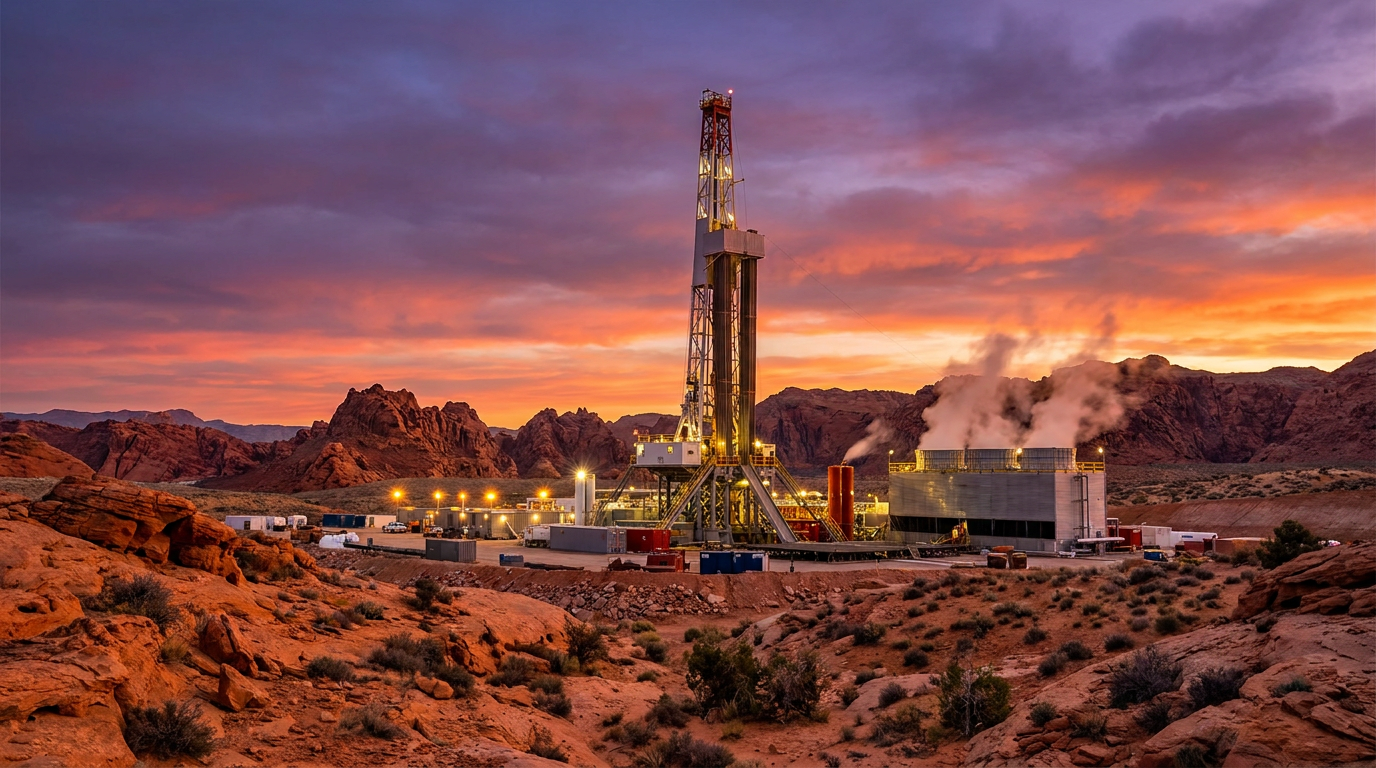
That is rapidly changing thanks to a technological breakthrough known as Enhanced Geothermal Systems (EGS). Instead of hunting for rare natural hot springs, EGS engineers create their own. By borrowing advanced horizontal drilling and hydraulic fracturing techniques honed over the last two decades by the oil and gas industry, EGS can access the virtually limitless heat trapped in dry, impermeable rock deep beneath the Earth's surface.[1][5]
The mechanism is elegantly simple in concept, though highly complex in execution. Engineers drill an injection well thousands of meters down into hot, solid rock. They then pump cold water down at high pressure to create a network of millimeter-thin fractures—a process known as hydro-shearing. A second "production" well is drilled nearby to intersect those fractures. As the cold water circulates through the newly created underground radiator, it absorbs the Earth's heat. The superheated fluid is then drawn up the production well to the surface, where it drives a turbine to generate electricity before being cooled and reinjected in a closed loop.[1][4]

This approach effectively decouples geothermal energy from geography. Because the Earth's crust gets hotter the deeper you go, EGS technology means that a clean, 24/7 power plant could theoretically be built almost anywhere on the planet, provided the drilling equipment can reach the necessary depths. The U.S. Department of Energy estimates that next-generation geothermal technologies expand the nation's resource potential to a staggering 5,500 gigawatts—roughly 140 times the capacity of conventional geothermal resources.[1][5]
The technology is no longer just theoretical. Houston-based Fervo Energy has emerged as the industry leader, proving that EGS can operate reliably at a commercial scale. At its Project Red facility in Nevada, Fervo successfully operated a horizontal EGS well system for over 600 days. The system performed flawlessly, requiring zero workovers or chemical treatments, and provided a rigorous, real-world dataset validating the fundamental physics of engineered geothermal reservoirs.[2][4]
Houston-based Fervo Energy has emerged as the industry leader, proving that EGS can operate reliably at a commercial scale.
Fervo is now rapidly scaling up. The company is currently developing Cape Station in Beaver County, Utah, which is slated to become the largest EGS development in the world. Phase I of the project, expected to bring 100 megawatts online in 2026, involves drilling 24 wells. The full facility is projected to reach 500 megawatts by 2028. Crucially, as the company drills more wells, it is experiencing a steep learning curve: Fervo has slashed drilling costs by nearly half and cut completion times by 70 percent over a two-year period.[3][4]
These rapid advancements are being fueled by intense research and development, much of it backed by the federal government. Just down the road from Fervo's Cape Station is the Utah FORGE (Frontier Observatory for Research in Geothermal Energy) project, a dedicated field laboratory funded by the Department of Energy. At FORGE, researchers from institutions like Sandia National Laboratories and Berkeley Lab are testing cutting-edge tools, such as polycrystalline diamond compact (PDC) drill bits and fiber-optic sensors, designed specifically to withstand the extreme temperatures and hard crystalline rock of geothermal environments.[6][7]

The synergy between the fossil fuel industry and next-generation geothermal is one of the most promising aspects of the EGS boom. The transition to clean energy has long raised concerns about the displacement of millions of workers in the oil and gas sector. EGS offers a direct pivot. The skills, equipment, and supply chains required to drill a horizontal EGS well are nearly identical to those used in shale fracking. Geologists, rig operators, and petroleum engineers can transition seamlessly into the geothermal sector, turning the architects of the fossil fuel era into the builders of a decarbonized grid.[3][5]
Despite its massive potential, EGS faces several significant hurdles before it can achieve widespread commercial liftoff. The first is water consumption. Creating and maintaining the subsurface fracture networks requires millions of gallons of water. Because many of the highest-potential EGS sites in the United States are located in the arid, water-stressed West, developers will need to innovate highly efficient, closed-loop systems and explore the use of non-potable or brackish water to avoid straining local resources.[5][7]
Capital costs also remain a barrier. Drilling deep into hard, hot rock is expensive. Early EGS projects have seen capital expenditures around $15,000 per kilowatt of capacity—significantly higher than the upfront costs of solar or wind installations. However, because geothermal plants operate around the clock, their "levelized cost of energy" over a multi-decade lifespan is highly competitive. As drilling times continue to fall and the technology scales, industry analysts expect EGS to reach price parity with fossil fuels and cheap renewables.[3][4]
Regulatory friction presents another bottleneck. In the United States, geothermal resources are disproportionately located on federal lands, subjecting projects to lengthy environmental reviews and complex permitting processes. While oil and gas drilling on federal land benefits from certain statutory exemptions that expedite approvals, geothermal projects currently do not. Bipartisan bills are moving through Congress to streamline geothermal permitting, but developers warn that faster approvals are essential to meet the surging demand for clean power.[4][7]

If these obstacles can be overcome, the payoff will be transformative. The Department of Energy projects that U.S. geothermal capacity could cost-effectively grow from 4 gigawatts today to 90 gigawatts by 2050, expanding from a niche resource in seven states to a major grid contributor across at least 18 states. Under aggressive deployment scenarios, that number could reach 300 gigawatts, supplying roughly a quarter of the country's total electricity needs.[1][5]
For decades, geothermal energy was the forgotten stepchild of the renewable energy family—reliable but geographically trapped. By looking downward and applying the brute-force ingenuity of the shale revolution, engineers have finally picked the lock. Enhanced Geothermal Systems are poised to turn the Earth itself into a universal, always-on battery, providing the firm foundation required to fully decarbonize the global economy.[4][7]
How we got here
1970s
The U.S. Department of Energy funds the first EGS research at the Fenton Hill project in New Mexico.
2018
The DOE launches the Utah FORGE project to serve as a dedicated field laboratory for EGS technology.
2023
Fervo Energy begins electricity production at Project Red in Nevada, proving commercial-scale EGS viability.
2025
Fervo Energy files a landmark patent for commercial-scale EGS architectures, signaling the technology's transition from pilot to deployment.
2026
Phase I of Fervo's Cape Station in Utah is scheduled to come online, adding 100 megawatts to the grid.
2028
Cape Station is projected to reach its full 500-megawatt capacity, becoming the largest EGS facility in the world.
Viewpoints in depth
Clean Energy Advocates
View EGS as the missing puzzle piece for a fully decarbonized grid.
For climate scientists and renewable energy advocates, the "intermittency problem" of solar and wind has always been the primary hurdle to retiring coal and natural gas plants. They view EGS as the ultimate solution: a clean energy source that provides the "firm," dispatchable baseload power required to keep the grid stable 24/7. Because EGS has a remarkably small surface footprint compared to sprawling solar farms, advocates also praise its low land-use intensity.
The Oil and Gas Industry
Sees EGS as a highly profitable pivot that utilizes their existing expertise.
Fossil fuel executives and petroleum engineers are increasingly championing next-generation geothermal because it relies on the exact technologies they spent decades perfecting: horizontal drilling, hydraulic fracturing, and subsurface reservoir modeling. For the oil and gas sector, EGS represents a massive new market opportunity that allows them to transition their workforce, equipment, and capital into the green energy economy without abandoning their core competencies.
Water Conservationists
Support the clean energy goals but raise alarms about the water intensity of EGS.
Environmental groups focused on water rights are cautious about the rapid scale-up of EGS, particularly in the American West. Creating artificial underground reservoirs requires injecting millions of gallons of water under high pressure. In states already facing historic droughts and depleted aquifers, conservationists argue that EGS developers must prove they can operate using non-potable, brackish, or recycled water, rather than competing with agriculture and municipalities for scarce freshwater resources.
What we don't know
- How quickly capital costs will fall as EGS moves from pilot projects to widespread commercial deployment.
- Whether developers can secure enough non-potable water to sustain large-scale EGS operations in drought-stricken western states.
- If Congress will pass legislation granting geothermal energy the same permitting exemptions currently enjoyed by oil and gas drilling on federal lands.
Key terms
- Enhanced Geothermal Systems (EGS)
- A technology that creates artificial underground reservoirs by injecting water into hot, dry rock to extract the Earth's heat for electricity generation.
- Firm Power
- Electricity that can be reliably generated and dispatched to the grid 24 hours a day, regardless of weather conditions.
- Hydro-shearing
- A technique similar to hydraulic fracturing that uses high-pressure fluid to open and expand existing millimeter-thin fractures in deep underground rock.
- Closed-loop System
- A power generation setup where the fluid used to extract heat is continuously recirculated between the underground reservoir and the surface facility, minimizing water loss.
- Levelized Cost of Energy (LCOE)
- A metric that calculates the total cost of building and operating a power plant over its entire lifespan, allowing for direct price comparisons between different energy sources.
Frequently asked
How is EGS different from conventional geothermal energy?
Conventional geothermal relies on finding rare, naturally occurring underground pools of hot water. EGS creates its own reservoirs by drilling into hot, dry rock and injecting water to absorb the heat, meaning it can be built almost anywhere.
Does EGS use the same fracking technology as oil and gas?
Yes, EGS borrows horizontal drilling and hydraulic fracturing techniques from the fossil fuel industry, but it uses them to circulate water and extract heat rather than to extract oil or methane.
Why is geothermal energy considered 'firm' power?
Unlike solar and wind, which only generate electricity when the sun shines or the wind blows, the heat inside the Earth is constant. Geothermal plants can run 24/7, providing a stable baseload for the power grid.
Will EGS cause earthquakes?
While injecting fluid underground can cause micro-seismicity, EGS projects are heavily monitored and engineered to avoid large fault lines. The hydro-shearing process generally produces tremors too small to be felt on the surface.
Sources
Source coverage
7 outlets
3 viewpoints surfaced







[1]U.S. Department of EnergyGeothermal Developers & Researchers
Enhanced Geothermal Systems
Read on U.S. Department of Energy →[2]Fervo EnergyGeothermal Developers & Researchers
Project Red: Validating the Physics of EGS at Field Scale
Read on Fervo Energy →[3]Center on Global Energy PolicyEnergy Policy Analysts
The Potential Contribution of Enhanced Geothermal Systems to Future Power Supply
Read on Center on Global Energy Policy →[4]Information Technology and Innovation FoundationClean Energy Advocates
Accelerating Advanced Geothermal
Read on Information Technology and Innovation Foundation →[5]World Resources InstituteClean Energy Advocates
Next-Generation Geothermal Energy Could Spark a Clean Power Renaissance
Read on World Resources Institute →[6]Utah FORGEGeothermal Developers & Researchers
Advancing Enhanced Geothermal Systems
Read on Utah FORGE →[7]Factlen Editorial TeamEnergy Policy Analysts
Synthesis by Factlen editorial team
Read on Factlen Editorial Team →


Every angle. Every day.
Get guides stories with full source coverage and perspective breakdowns delivered to your inbox.