
House Passes Bipartisan 'Faster Labor Contracts Act' to Mandate Timelines for Union Deals
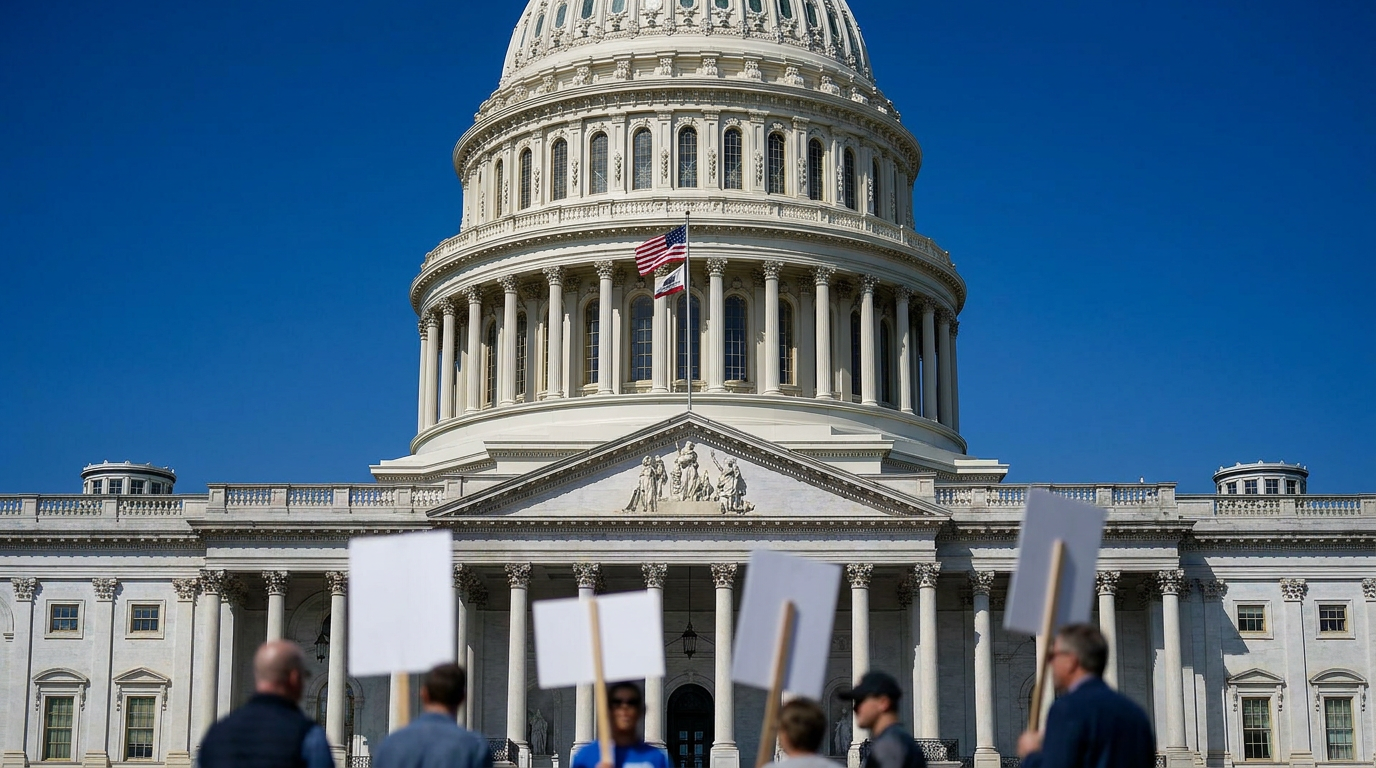
In a surprise bipartisan move, the U.S. House of Representatives passed legislation that would force employers and newly formed unions into binding arbitration if they fail to reach a first contract within 120 days. The bill, forced to the floor via a rare discharge petition, now faces an uncertain future in the Republican-controlled Senate.
By Factlen Editorial Team
- Labor Advocates
- View the bill as a necessary fix to a broken system that allows employers to stall negotiations indefinitely.
- Business & Management
- Argue the bill imposes draconian government overreach into private business operations and strips companies of their negotiating rights.
- Populist Conservatives
- Support the measure as part of a broader political realignment to back blue-collar workers over corporate interests.
What's not represented
- · Non-unionized workers
- · Small business owners
Why this matters
Currently, newly formed unions wait an average of 461 days to secure their first contract, a delay that often drains momentum and resources. If enacted, this legislation would fundamentally shift the balance of power in American workplaces by guaranteeing a contract within four months, removing an employer's ability to indefinitely stall negotiations.
Key points
- The House passed the Faster Labor Contracts Act 230-193, with 20 Republicans joining Democrats.
- The bill requires employers and newly formed unions to reach a first contract within 120 days.
- If negotiations fail, a federal panel will impose a binding two-year contract via arbitration.
- Labor advocates say the bill prevents employers from stalling to bleed unions dry.
- Business groups argue the legislation is a draconian overreach into private enterprise.
- The bill now faces an uncertain future in the Republican-controlled Senate.
The U.S. House of Representatives has passed the Faster Labor Contracts Act in a surprise 230-193 vote, marking one of the most significant potential shifts in American labor law in decades. The bipartisan legislation aims to fundamentally alter how employers and newly certified unions negotiate their first collective bargaining agreements. By imposing strict deadlines and the threat of binding arbitration, the bill seeks to close a longstanding loophole that labor advocates say allows companies to stall negotiations indefinitely.[1][2]
The procedural path to passage was highly unusual. Representative Donald Norcross, a New Jersey Democrat and former electrician, partnered with Republican Representative Pete Stauber of Minnesota to force the bill to the floor using a discharge petition. This rare maneuver bypassed the Republican House leadership, successfully gathering the 218 signatures required to compel a vote. Ultimately, 210 Democrats were joined by 20 Republicans who crossed the aisle, signaling a growing populist fracture within the GOP regarding traditional pro-business orthodoxies.[1][6]
At the heart of the legislation is a compressed, mandatory timeline that replaces the open-ended nature of current labor law. Under the National Labor Relations Act of 1935, employers and unions are only required to bargain in "good faith," with no statutory deadline to reach an agreement. The new bill dictates that bargaining must commence within ten days of a union's certification. If the two sides cannot reach a deal after 90 days, either party can invoke federal mediation.[3][4]

The most controversial provision triggers if mediation fails after 30 days. At the 120-day mark, the dispute is handed over to a federal arbitration panel. This panel is granted the authority to dictate the economic and operational terms of the workplace—including wages, benefits, and scheduling—imposing a binding collective bargaining agreement that remains in effect for two years. This mechanism effectively strips employers of their longstanding right to unilaterally implement their "last, best, and final offer" upon reaching a bargaining impasse.[2][3][5]
For labor organizers, the bill addresses an existential threat to the modern union movement. Data compiled by Bloomberg Law indicates that it currently takes an average of 461 days for workers to ratify a first contract after successfully voting to unionize. During this protracted period, employee turnover, legal attrition, and waning momentum often erode the union's leverage, sometimes leading to decertification before a single contract is ever signed.[2][4][6]
For labor organizers, the bill addresses an existential threat to the modern union movement.
Union leadership celebrated the House vote as a monumental victory. The Teamsters General President described the legislation as "one of the most consequential labor bills to come before Congress in generations." The AFL-CIO and the International Federation of Professional and Technical Engineers (IFPTE) echoed the sentiment, arguing that the right to organize is effectively meaningless if the legal framework allows corporations to bleed newly formed bargaining units dry at the negotiating table.[2][5]

Conversely, the business community and management-side legal experts have sounded the alarm, characterizing the bill as a draconian overreach. Industry groups argue that the legislation upends nearly a century of precedent built on the principle of voluntary agreement. By forcing binding arbitration, critics contend that the federal government would be empowered to micromanage private enterprises, imposing cost structures and operational rules without regard for a company's specific financial realities or market pressures.[3][4]
Opponents in the House echoed these concerns during the floor debate. Representative Tim Walberg, a Michigan Republican, derided the measure as an attempt to put American workers and businesses "under the thumb of federal bureaucrats," arguing that government-imposed contracts stifle economic flexibility. Legal analysts note that the five factors arbitrators would use to determine contract terms—which include the employer's financial status and the local cost of living—would invite unprecedented federal scrutiny into private corporate ledgers.[1][3]
The Republican votes in favor of the bill highlight a shifting dynamic within conservative politics. A faction of the GOP has increasingly sought to court blue-collar workers and organized labor, breaking away from the Chamber of Commerce alignment that defined the party for decades. This mirrors recent Republican support for other labor-backed initiatives, such as the Railway Safety Act, indicating that populist economic appeals are gaining traction among certain conservative lawmakers.[4]
The Faster Labor Contracts Act now heads to the Senate, where its fate remains highly uncertain. Republicans hold a 53-47 majority in the upper chamber, presenting a steep hurdle for labor advocates. However, a companion version of the bill has already been introduced by Republican Senator Josh Hawley of Missouri, who has consistently made overtures to organized labor, alongside Democratic Senator Cory Booker.[1][2][4]
Even if the legislation manages to navigate the Senate, it faces the ultimate test of a presidential veto. President Donald Trump's labor record is complex; while his administration has recently reclassified thousands of federal workers to Schedule P/C roles to strip them of civil service protections, he has also actively courted private-sector union voters in key swing states. Whether he would sign a bill that so fundamentally restricts corporate negotiating power remains a critical unknown as the legislation advances.[7]
How we got here
1935
The National Labor Relations Act establishes the duty to bargain in 'good faith' but sets no statutory deadlines for reaching a contract.
2021–2025
A surge in unionization efforts at major corporations highlights the difficulty of securing first contracts, with average wait times exceeding 460 days.
May 2026
A bipartisan coalition in the House successfully gathers 218 signatures on a discharge petition to force a floor vote on the Faster Labor Contracts Act.
June 9, 2026
The House passes the bill 230-193, with 20 Republicans joining Democrats in support.
Viewpoints in depth
Labor Organizers
Argue that the current open-ended bargaining process allows employers to stall indefinitely.
Labor advocates contend that the right to organize is effectively meaningless if there is no guaranteed path to a contract. They point to data showing that the average wait for a first contract is 461 days, a period during which employers often use legal attrition and employee turnover to erode a union's leverage. By mandating a strict 120-day timeline, organizers believe the legislation restores balance to a system that currently heavily favors corporate management.
Business and Management
Argue that binding arbitration strips private companies of their right to freely negotiate economic terms.
Management-side legal experts and industry groups view the legislation as a profound government overreach. They argue that forcing binding arbitration hands control over wages, benefits, and operational rules to unelected federal bureaucrats who lack insight into a company's specific financial realities. Critics also note that the bill removes an employer's longstanding right to implement their 'last, best, and final offer' upon reaching a genuine bargaining impasse, fundamentally altering nearly a century of labor precedent.
Pro-Labor Republicans
View supporting blue-collar union workers as essential to the party's populist realignment.
A growing faction within the GOP is breaking away from the party's traditional Chamber of Commerce orthodoxy to support pro-worker legislation. Lawmakers in this camp argue that conservative economic populism must include tangible support for organized labor and working-class Americans. Their willingness to cross the aisle on bills like the Faster Labor Contracts Act and the Railway Safety Act indicates a strategic shift aimed at cementing blue-collar voters into the Republican base.
What we don't know
- Whether the Republican-controlled Senate will bring the companion bill to the floor for a vote.
- If President Trump would sign or veto the legislation given his mixed record on labor issues.
- How federal arbitration panels would practically weigh an employer's financial status against the local cost of living when imposing contract terms.
Key terms
- Discharge Petition
- A procedural maneuver in the House of Representatives that allows a simple majority of members to bring a bill to the floor for a vote, bypassing committee leadership.
- Binding Arbitration
- A process where an impartial third party hears both sides of a dispute and imposes a legally enforceable decision, in this case, the terms of a labor contract.
- Good Faith Bargaining
- The current legal standard requiring employers and unions to meet and negotiate with a genuine intent to reach an agreement, though neither side is forced to make concessions.
Frequently asked
Does this bill apply to all union contracts?
No, the legislation specifically targets the negotiation of a 'first contract' after a newly formed union is certified by the National Labor Relations Board.
What happens if the 120-day deadline passes?
A federal arbitration panel would step in to determine the terms of the collective bargaining agreement, which would then be legally binding on both the employer and the union for two years.
Will the Senate pass the bill?
Its future is highly uncertain in the Republican-controlled Senate, though a companion bill has been introduced with bipartisan support from Senators Josh Hawley and Cory Booker.
Sources
Source coverage
7 outlets
3 viewpoints surfaced







[1]NJ Spotlight NewsPopulist Conservatives
Norcross wins House passage for labor bill to streamline union talks
Read on NJ Spotlight News →[2]OnLaborLabor Advocates
News & Commentary: June 11, 2026
Read on OnLabor →[3]BeneschBusiness & Management
The Faster Labor Contracts Act Would Permit Federal Government To Impose Union Contract Terms On Employers
Read on Benesch →[4]Epstein Becker GreenBusiness & Management
House Passes the Faster Labor Contracts Act: What Employers Need to Know
Read on Epstein Becker Green →[5]IFPTELabor Advocates
IFPTE Urges “Yes” vote on Faster Labor Contracts Act in House
Read on IFPTE →[6]Bloomberg Law
House Passes Faster Labor Contracts Act
Read on Bloomberg Law →[7]AFGE
Trump Strips Due Process Rights from Thousands of Federal Workers
Read on AFGE →

More in news politics
See all 154 stories →Media Consolidation
DOJ Approves $111 Billion Paramount-Warner Bros. Merger, Reshaping Media Landscape
9 sources
Tren de Aragua
U.S. Military Strike in Venezuela Kills Tren de Aragua Leader Niño Guerrero
7 sources

Tren de Aragua
U.S. Military Strike in Venezuela Kills Tren de Aragua Leader Niño Guerrero
7 sources

Information Integrity
The 'Mind Vaccine': How Prebunking is Winning the War Against Misinformation
6 sources

Every angle. Every day.
Get news politics stories with full source coverage and perspective breakdowns delivered to your inbox.