
Fox Acquires Roku for $22 Billion to Create Streaming Powerhouse
Fox Corporation has agreed to purchase streaming platform Roku in a $22 billion cash-and-stock deal, combining Fox's live sports and news with Roku's 100 million global households. The acquisition will make the combined entity the third-largest player in U.S. television viewership.
By Factlen Editorial Team
- Corporate Leadership
- Focuses on the strategic synergies of combining premium live content with a massive distribution platform.
- Financial Markets
- Evaluates the deal based on share premiums, stock dilution, and advertising revenue potential.
- Consumer & Industry Watchdogs
- Raises concerns about platform neutrality, media consolidation, and the future of independent streaming hardware.
What's not represented
- · Independent app developers who rely on Roku's neutral platform
- · Hardware competitors like Amazon (Fire TV) and Google (Chromecast)
Why this matters
This $22 billion merger reshapes the living room by combining one of America's largest producers of live sports and news with the hardware and interface that 100 million households use to stream television. For consumers, it signals further consolidation of the streaming market, potentially altering how free ad-supported content is delivered and discovered.
Key points
- Fox Corporation has agreed to acquire streaming platform Roku in a cash-and-stock deal valued at $22 billion.
- The merger combines Fox's live sports and news portfolio with Roku's 100 million global streaming households.
- The combined entity will become the third-largest player in U.S. television based on share of viewing.
- Roku CEO Anthony Wood will join the Fox board, and the company promises to keep Roku an open, partner-friendly platform.
- The acquisition is expected to close in the first half of 2027, pending shareholder and regulatory approvals.
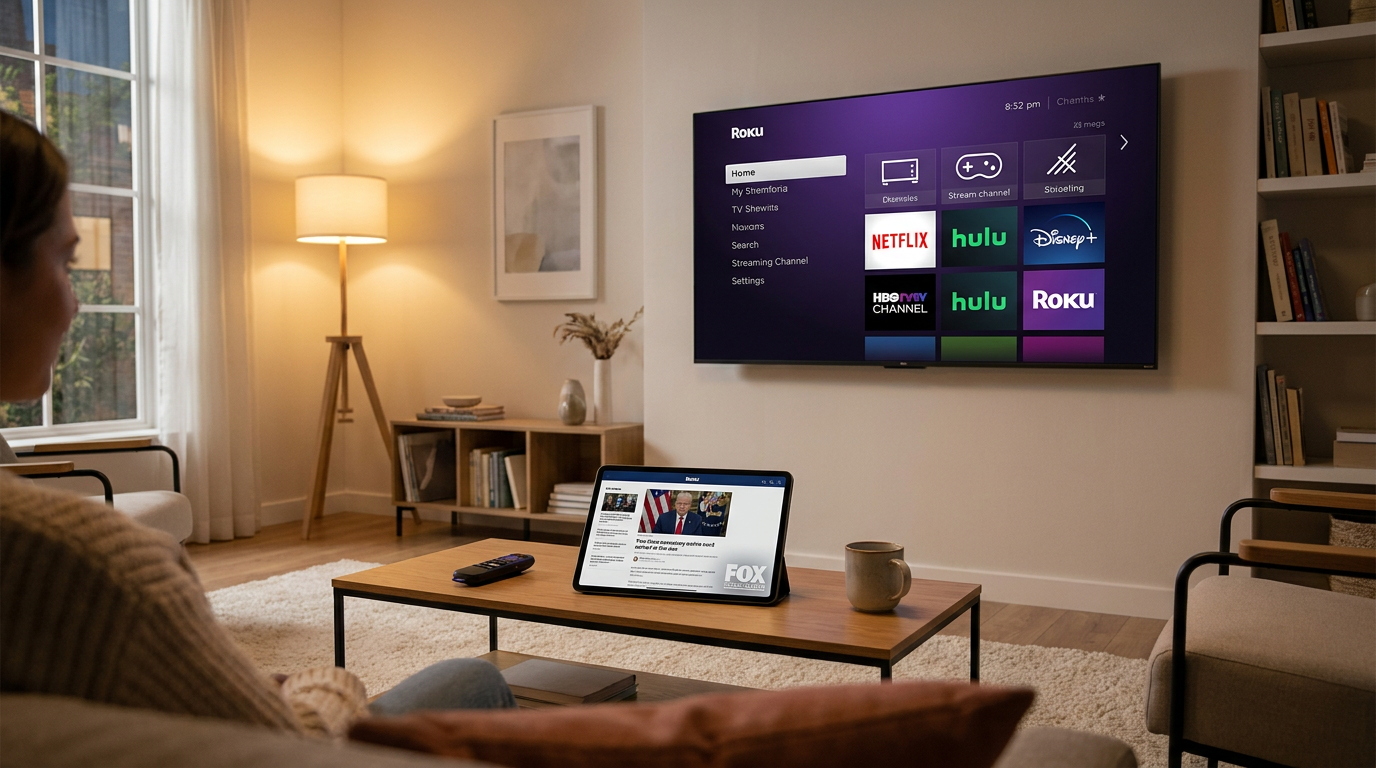
The landscape of the American living room shifted dramatically on Monday as Fox Corporation announced a definitive agreement to acquire the streaming platform Roku. The cash-and-stock transaction, valued at approximately $22 billion, marks one of the most significant media consolidations of the decade, bridging traditional television broadcasting with the digital hardware that powers modern viewing. By purchasing Roku at $160 per share, Fox is securing direct access to the interface used by millions to navigate the fragmented streaming ecosystem. The move instantly transforms Fox from a content provider into a dominant gatekeeper of digital distribution, fundamentally altering the balance of power among major entertainment conglomerates.[1][4][6]
The financial mechanics of the buyout reflect a massive bet on the future of connected television. Under the terms of the agreement, Fox will pay $96 in cash alongside 0.9693 of its Class A shares for every outstanding share of Roku. This valuation represents an 11.4 percent premium over Roku’s closing price the previous Friday. Once the transaction is finalized—currently projected for the first half of 2027—existing Fox shareholders will retain approximately 73 percent ownership of the newly combined company, while Roku shareholders will hold the remaining 27 percent. Fox executives noted that the acquisition will be funded through a combination of cash on hand and new debt, maintaining the company's investment-grade balance sheet while executing the historic merger.[3][4][7]

For Fox, the acquisition represents the culmination of a deliberate, decade-long strategy to insulate itself against the decline of traditional cable. Fox CEO Lachlan Murdoch described the merger as a "defining moment" for the corporation, noting that the company had intentionally reoriented its focus around live news and sports programming in 2019. By bringing together Fox's highly lucrative live content portfolio with Roku's preeminent streaming platform, Murdoch argues the company is positioning itself at the exact intersection of video consumption's two most powerful forces: the enduring primacy of live events and the unstoppable rise of streaming.[2][4][5]
A central pillar of the deal's strategic logic is the integration of free ad-supported streaming television, commonly known as FAST. Fox already owns Tubi, a highly successful FAST platform it acquired in 2020, which has steadily grown its market share. Merging Tubi's vast content library and advertising infrastructure with The Roku Channel—Roku's own native FAST service—creates an immediate advertising juggernaut. According to corporate projections, this combination will instantly elevate the new Fox-Roku entity to the position of the third-largest player in U.S. television by share of viewing, granting it unprecedented scale across broadcast, cable, and connected TV environments.[1][4][8]

A central pillar of the deal's strategic logic is the integration of free ad-supported streaming television, commonly known as FAST.
From Roku's vantage point, the acquisition provides the financial muscle necessary to compete in an increasingly hostile hardware market dominated by tech titans like Amazon, Google, and Apple. Roku founder and CEO Anthony Wood, who will take an ongoing role at the merged company and join the Fox board of directors, framed the deal as an extraordinary opportunity to scale faster and innovate more aggressively. Roku, which recently rolled out its first major home screen update in a decade to enhance personalization, will now have the backing of a legacy media giant to expand its hardware footprint, deepen its direct relationships with over 100 million global streaming households, and enhance its first-party data collection.[2][5]
Wall Street's reaction to the blockbuster announcement was swift and sharply divided, illustrating the complex dynamics of cash-and-stock acquisitions. Roku's stock immediately rallied to a four-year high in premarket trading, surging on the news of the premium valuation before settling slightly below the $160 deal price. Conversely, Fox shares sank nearly 13 percent in early trading. Financial analysts noted that investors in acquiring companies frequently penalize deals that involve issuing new stock, as increasing the total number of shares outstanding dilutes the ownership percentage and earnings power of current shareholders, despite the long-term strategic benefits of the acquisition.[3]
The Fox-Roku merger arrives amid a tidal wave of consolidation across the entertainment and media sectors, as legacy networks scramble to achieve the scale necessary to survive the streaming wars. The announcement comes just days after the Justice Department cleared the $110 billion merger between Paramount Skydance and Warner Bros. Discovery, and follows Walt Disney's full integration of Hulu into its flagship streaming app. Industry experts point out that as media companies compete for viewers migrating away from traditional pay-TV bundles, acquiring the actual platforms and interfaces where those viewers spend their time has become just as critical as producing the shows they watch.[7]

Despite the corporate optimism, the merger has ignited immediate concerns regarding platform neutrality. Historically, Roku has thrived by positioning itself as the "Switzerland" of streaming—an open, independent ecosystem that treats rival apps like Netflix, Disney+, and Prime Video equally. While Fox has publicly committed to operating Roku as an "open, partner-friendly platform," industry watchdogs and analysts warn that ownership by a major media conglomerate could inevitably taint that neutrality. Skeptics question whether Fox will be able to resist the temptation to prioritize its own programming, particularly Fox News and Tubi, on Roku's highly trafficked home screen.[2][3]
Looking ahead, the $22 billion transaction must clear significant regulatory hurdles and secure approval from the shareholders of both companies. While the current regulatory environment has shown leniency toward recent media mega-mergers, consumer advocates are raising alarms that this hyper-consolidation could ultimately depress industry wages and raise costs for American consumers by limiting competitive choices. As the streaming landscape continues to contract into the hands of a few massive conglomerates, the Fox-Roku deal stands as a stark reminder that the battle for the living room is no longer just about content—it is about owning the screen itself.[5][7]
How we got here
2019
Fox reorients its corporate strategy to focus heavily on live news and sports programming.
2020
Fox acquires the free ad-supported streaming service Tubi to enter the digital video market.
May 2026
Roku rolls out its first major home screen update in a decade, adding personalization features.
June 12, 2026
The Justice Department clears the $110 billion Paramount-Warner Bros. Discovery merger, signaling leniency for media consolidation.
June 15, 2026
Fox and Roku officially announce their $22 billion cash-and-stock merger agreement.
Viewpoints in depth
Fox & Roku Leadership
Executives argue the merger creates a necessary, scaled competitor in the modern video landscape.
Fox CEO Lachlan Murdoch and Roku CEO Anthony Wood view the $22 billion deal as a perfect synergy of content and distribution. By combining Fox's live sports, news, and Tubi platform with Roku's 100 million households and first-party data, they argue the new entity will dominate the free ad-supported streaming market and provide unparalleled value to advertisers.
Financial Analysts
Wall Street is weighing the strategic benefits against the immediate cost of dilution.
Market analysts acknowledge the long-term strategic brilliance of Fox securing its own distribution pipeline, but investors reacted sharply to the short-term mechanics. Because Fox is issuing new Class A shares to fund the purchase, current Fox shareholders face dilution, prompting a nearly 13% drop in Fox's stock price even as Roku shares surged to a four-year high.
Industry Watchdogs
Observers worry about the loss of a neutral streaming platform and further media consolidation.
Roku's historical strength has been its status as an independent 'Switzerland' of streaming, treating all apps equally on its home screen. Analysts like Barton Crockett warn that Fox's ownership could compromise this neutrality. Furthermore, consumer advocates point to this deal—alongside the Paramount-WBD merger—as evidence of hyper-consolidation that could eventually reduce consumer choice and raise prices.
What we don't know
- How federal regulators will view the merger, given recent scrutiny of media consolidation.
- Whether Fox will prioritize its own content, such as Tubi and Fox News, on Roku's historically neutral home screen.
- How competitor streaming platforms and hardware manufacturers will respond to Fox controlling a major distribution channel.
Key terms
- FAST (Free Ad-Supported Streaming TV)
- Streaming services that offer content for free to viewers, generating revenue entirely through commercial breaks, such as Tubi and The Roku Channel.
- Connected TV (CTV)
- Televisions that are connected to the internet, either natively (smart TVs) or via external devices like Roku sticks, allowing users to stream digital video.
- Cash-and-Stock Deal
- An acquisition where the buying company pays for the target using a combination of direct cash and shares of its own stock.
- Share Dilution
- A reduction in the ownership percentage of a share of stock caused by the issuance of new shares, often occurring during acquisitions.
Frequently asked
Will my Roku device still work the same way?
Yes. Fox has stated it intends to keep Roku operating as an 'open, partner-friendly platform,' meaning you will still be able to access all your current streaming apps.
Is Fox News going to be forced onto my home screen?
While Fox content will likely see 'ubiquitous distribution,' the companies claim Roku will maintain its neutrality. However, industry analysts are watching closely to see if Fox prioritizes its own programming.
When does the merger actually happen?
The acquisition is expected to close in the first half of 2027, pending approval from shareholders and federal regulators.
Sources
Source coverage
8 outlets
3 viewpoints surfaced








[1]AxiosFinancial Markets
Fox to buy Roku for $22 billion
Read on Axios →[2]LiveNOW from FOXCorporate Leadership
Fox Corporation to acquire Roku in $22 billion deal
Read on LiveNOW from FOX →[3]MorningstarFinancial Markets
Roku's stock rallies to a four-year high after agreeing to be bought by Fox in a deal valued at $22 billion
Read on Morningstar →[4]Fox CorporationCorporate Leadership
Fox Corporation and Roku Announce Definitive Agreement
Read on Fox Corporation →[5]EngadgetConsumer & Industry Watchdogs
Fox is buying Roku for $22 billion
Read on Engadget →[6]AP NewsConsumer & Industry Watchdogs
Fox strikes a $22B deal to buy Roku, aiming to supercharge its streaming reach
Read on AP News →[7]CBS NewsConsumer & Industry Watchdogs
Fox to acquire Roku in $22 billion deal
Read on CBS News →[8]9to5MacConsumer & Industry Watchdogs
Fox is buying Roku for $22B to become 3rd-largest TV player in US
Read on 9to5Mac →

More in entertainment
See all 5 stories →Music Milestones
Taylor Swift Inducted Into Songwriters Hall of Fame Following Surprise 'Toy Story 5' Performance
0 sources

Sustainable Vinyl
The Music Industry's Toxic Vinyl Problem Finally Has a Scalable Solution
0 sources
Library Renaissance
How 'Library Hauls' and BookTok Are Driving a Gen Z Library Renaissance
0 sources

Every angle. Every day.
Get entertainment stories with full source coverage and perspective breakdowns delivered to your inbox.