
Databricks Hits $6.9 Billion Revenue as AI Agents Rewrite Software Economics
Databricks reported an 80% surge in annualized revenue driven by enterprise AI adoption, but a corresponding squeeze on profit margins highlights a structural shift in the software industry.
By Factlen Editorial Team
- Platform Providers
- Infrastructure companies prioritizing top-line growth and market share in the AI agent space.
- Market Analysts
- Financial analysts warning about the structural shift from high-margin software to lower-margin service economics.
- Enterprise Adopters
- Corporate customers demanding verifiable ROI and shifting away from paying for idle software seats.
What's not represented
- · Hardware Providers (Nvidia/AMD)
- · Human Knowledge Workers
Why this matters
The transition from human-operated software to autonomous AI agents is fundamentally changing how technology is priced and valued. As software companies absorb massive compute costs, businesses will increasingly pay for verified outcomes rather than idle software subscriptions.
Key points
- Databricks reported $6.9 billion in annualized revenue, growing over 80% year-over-year.
- The growth is driven by enterprise adoption of AI agents, which now account for $1.7 billion in revenue.
- CEO Ali Ghodsi warned that the compute-heavy nature of AI agents is pressuring gross margins.
- The software industry is shifting away from flat per-seat pricing to outcome-based models.
- Analysts suggest AI software economics are beginning to resemble tech-enabled outsourcing.
Databricks has reached a blockbuster milestone in the enterprise software sector, hitting $6.9 billion in annualized revenue with over 80% year-over-year growth. The surge is being driven by a massive corporate appetite for AI agents—autonomous software programs that execute complex, multi-step workflows rather than simply generating text.[1][2]
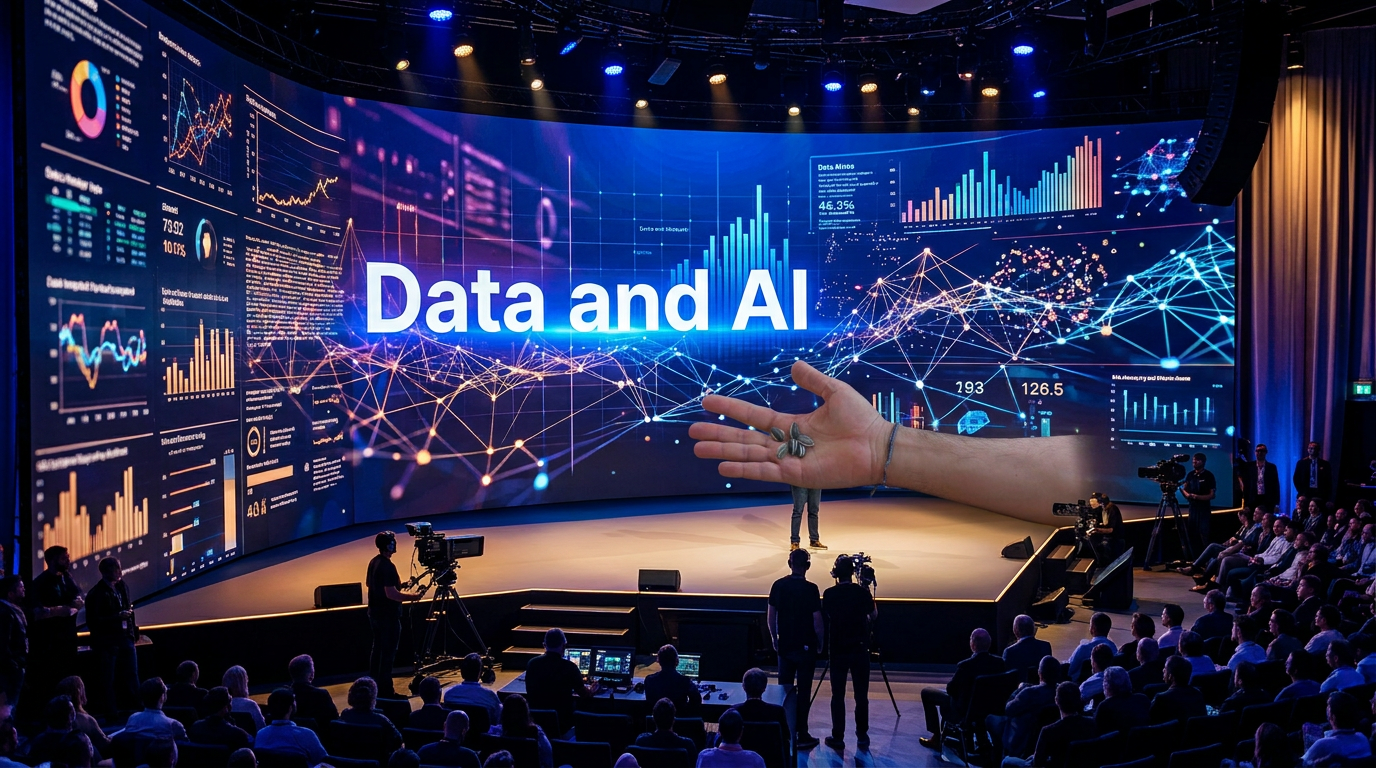
At the company's Data and AI Summit in San Francisco, CEO Ali Ghodsi revealed that AI products alone now account for $1.7 billion of Databricks' revenue, up from $1.4 billion just months prior. The platform has rapidly become the infrastructure of choice for enterprises looking to train, govern, and deploy these autonomous agents across their proprietary data.[1][2]
However, this explosive top-line growth comes with a structural catch that is reverberating across the tech industry. Ghodsi noted that the swarm of AI agents operating on the Databricks platform is significantly increasing compute costs, which will inevitably pressure the company's gross margins.[1][2]

Unlike human users who query a database occasionally and spend most of their time reading the results, AI agents run continuous, compute-heavy loops. They analyze data, trigger APIs, evaluate their own outputs, and iterate—burning through processing power at a rate that traditional software never anticipated.[1][8]
This dynamic represents a fundamental rewriting of software economics. For the past decade, the Software-as-a-Service (SaaS) industry has been defined by its lucrative 85% gross margins. Because serving an additional human user costs almost nothing once the core software is built, SaaS companies enjoyed near-infinite scalability.[3][6]
This dynamic represents a fundamental rewriting of software economics.
AI agents break that model entirely. Every autonomous action—whether resolving a customer support ticket, analyzing a financial dataset, or writing code—burns through tokens that require expensive GPU compute. Generating a single response might cost fractions of a cent, but when agents execute thousands of micro-transactions per second, those variable costs scale linearly with usage.[3][5]

Industry analysts note that selling AI outcomes is starting to resemble the economics of Business Process Outsourcing (BPO) rather than traditional software. As compute costs eat into margins, the market is realizing that the era of zero-marginal-cost software is likely over, prompting a reevaluation of how tech companies are valued.[3][6]
To adapt to this new reality, software vendors are abandoning the flat per-seat licensing models that defined the cloud era. If an AI agent does the work of ten human employees, charging a company for a single "seat" leaves the vendor absorbing massive compute costs while the customer reaps all the efficiency gains.[4][8]
Instead, the industry is rapidly moving toward hybrid and outcome-based pricing. Customer service platforms like Intercom and Sierra are now charging per resolved conversation—often around $0.99 per ticket. Customers pay only when the AI successfully achieves the desired result, aligning the vendor's revenue directly with the actual value delivered.[3][4]

For infrastructure providers like Databricks, the strategy is to capture the underlying data layer where these agents live. The company's recent $1 billion acquisition of Neon, a serverless Postgres database, was driven by the fact that over 80% of new databases on the platform were being provisioned by AI agents rather than human developers.[7][8]
Enterprise adoption of these autonomous systems is accelerating regardless of the shifting economics. Gartner forecasts that 40% of enterprise applications will include agentic AI by the end of 2026, as companies demand measurable ROI and hard-dollar cost reductions from their tech investments.[5][8]
As the software industry navigates this transition, the definition of a successful tech company is changing. The winners of the AI era will not just be those who can build the smartest models, but those who can balance explosive, agent-driven revenue growth with the heavy, unavoidable reality of their compute bills.[6][8]
How we got here
2020
Snowflake goes public in the largest software IPO to date, defining the high-margin cloud data era.
April 2023
Databricks SQL hits $100 million in annual recurring revenue, signaling its expansion beyond basic data lakes.
May 2025
Databricks acquires Neon for $1 billion to capture the operational database layer increasingly used by AI agents.
Early 2026
The software industry sees a broad shift toward outcome-based pricing for AI features to offset rising compute costs.
June 2026
Databricks reports $6.9 billion in annualized revenue, with AI products driving $1.7 billion of the total.
Viewpoints in depth
Platform Providers
Infrastructure companies prioritizing top-line growth and market share in the AI agent space.
For platform providers like Databricks and Salesforce, the immediate goal is becoming the indispensable infrastructure for the AI era. They view the current margin compression as a necessary transition phase. By capturing the data layer and the workflows where AI agents operate, these companies believe they can secure a massive, expanding total addressable market, eventually optimizing compute costs through better models and hardware efficiency.
Market Analysts
Financial analysts warning about the structural shift from high-margin software to lower-margin service economics.
Market analysts argue that Wall Street must fundamentally re-evaluate how it prices software companies. Because AI agents require continuous, expensive GPU compute, analysts warn that the era of 85% gross margins is over. They suggest that AI-heavy SaaS companies should be valued more like tech-enabled Business Process Outsourcing (BPO) firms, which historically trade at lower multiples due to their variable cost structures.
Enterprise Adopters
Corporate customers demanding verifiable ROI and shifting away from paying for idle software seats.
Enterprise customers are driving the shift toward outcome-based pricing. Having spent years paying flat monthly fees for software seats that often went unused, corporate IT buyers now want to transfer the risk to the vendor. They are willing to pay a premium for AI agents, but only if the pricing is tied to verifiable outcomes—such as a successfully resolved customer support ticket or a completed code migration—ensuring they only pay for actual labor performed.
What we don't know
- Whether hardware advancements will eventually drive AI compute costs down enough to restore traditional software margins.
- How public markets will value high-growth AI companies if their gross margins permanently settle below historical SaaS averages.
- Which outcome-based pricing models will become the standardized norm across different enterprise software verticals.
Key terms
- AI Agent
- An autonomous artificial intelligence system that can plan, use tools, and execute multi-step workflows without constant human prompting.
- Gross Margin
- The percentage of revenue a company retains after subtracting the direct costs associated with delivering its product or service.
- Outcome-Based Pricing
- A billing model where customers pay only when a specific, verifiable result is achieved, rather than paying for access to the software.
- Compute Cost
- The financial expense of the processing power, memory, and energy required to run artificial intelligence models.
- SaaS (Software-as-a-Service)
- A software distribution model where applications are hosted by a vendor and made available to customers over the internet, typically via subscription.
Frequently asked
Why are AI agents more expensive to run than traditional software?
Traditional software relies on human inputs and simple database queries, whereas AI agents continuously consume expensive GPU compute power to reason, generate text, and execute complex workflows.
What is outcome-based pricing?
Instead of paying a flat monthly fee per user, customers pay a specific rate for each task the AI successfully completes, such as resolving a customer complaint or processing an invoice.
How big is Databricks' AI business?
As of June 2026, Databricks' AI-specific products generate an annualized revenue of $1.7 billion, representing a rapidly growing segment of its overall $6.9 billion business.
Sources
Source coverage
8 outlets
3 viewpoints surfaced








[1]CNBCPlatform Providers
Databricks sales growth tops 80%, but margin are shrinking from swarm of AI agents
Read on CNBC →[2]Tech in AsiaPlatform Providers
Databricks annualized revenue rises over 80% to $6.9b
Read on Tech in Asia →[3]Second Order LabsMarket Analysts
AI Agents Turn 85% SaaS Margins Into BPO Math
Read on Second Order Labs →[4]PickaxeEnterprise Adopters
AI Agent Pricing Models Explained (2026)
Read on Pickaxe →[5]NeverminedEnterprise Adopters
AI Agent Pay-Per-Use Pricing
Read on Nevermined →[6]MediumMarket Analysts
Why AI Is Breaking the Software Business Model
Read on Medium →[7]SacraPlatform Providers
Databricks at $4B ARR growing 50% YoY
Read on Sacra →[8]Factlen Editorial TeamMarket Analysts
Synthesis by Factlen editorial team
Read on Factlen Editorial Team →
Every angle. Every day.
Get business stories with full source coverage and perspective breakdowns delivered to your inbox.