
Bilingual Brains Use a Single 'Grammatical Engine' for Multiple Languages, Study Finds
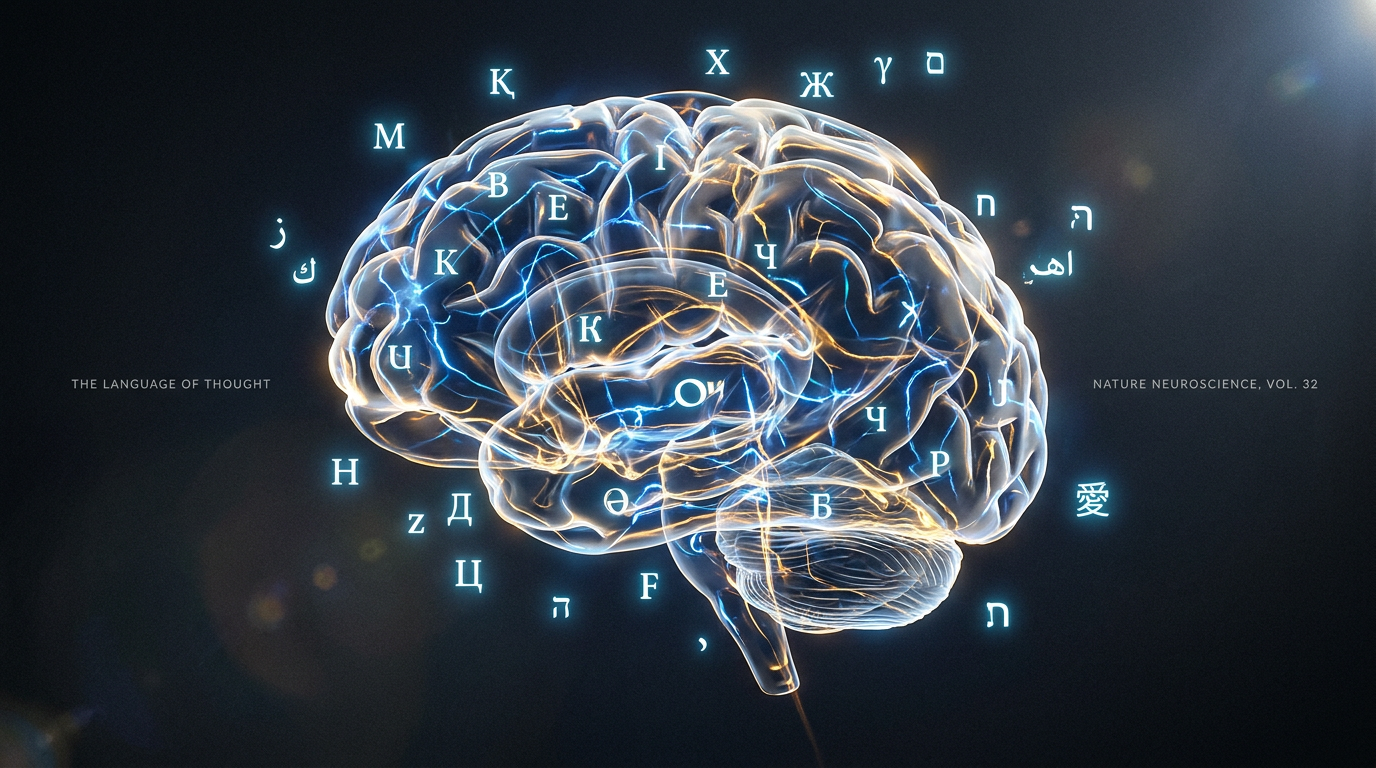
A new neuroimaging study reveals that bilingual speakers do not possess separate grammatical rulebooks for each language, but instead use a single, shared neural mechanism to process grammar.
By Factlen Editorial Team
- Cognitive Neuroscientists
- Focus on the biological efficiency of the brain's shared neural architecture.
- Language Educators & Clinicians
- Focus on the practical applications for teaching and stroke rehabilitation.
- Linguistic Skeptics
- Highlight the need to test typologically distant languages before declaring a universal rule.
What's not represented
- · Monolingual individuals learning a second language late in life
- · Speakers of non-Indo-European languages
Why this matters
Understanding how the brain organizes multiple languages could revolutionize second-language education and improve rehabilitation strategies for bilingual stroke patients. It also finally explains why bilingual speakers sometimes accidentally mix up grammar rules between their languages.
Key points
- Bilingual speakers use a single, shared neural mechanism to process grammar across different languages.
- NYU researchers used MEG scans to track brain activity millisecond-by-millisecond in Spanish-English bilinguals.
- The same brain areas activated when applying grammar rules to both English and Spanish words.
- The shared engine also applied grammatical rules to completely made-up pseudowords, proving it is a reusable computation.
- The findings could improve second-language education and aphasia rehabilitation for stroke patients.
It is a nearly universal experience among bilingual speakers: occasionally slipping up and applying the grammatical rules of one language while speaking another. A native Spanish speaker conversing in English might accidentally say "I have 20 years" instead of "I am 20," directly translating the structural logic of their mother tongue. For decades, these common language mashups have prompted a deeper neurological question. Do bilingual individuals possess separate, distinct "grammatical engines" in their brains—one that learns and applies English rules, and a completely separate one that manages Spanish? Or does the brain rely on a single, centralized system to manage the structural architecture of every language a person speaks?[1][3]
A groundbreaking new study published in the peer-reviewed journal JNeurosci has provided the clearest answer to date. Conducted by a team of neuroscientists at New York University, the research reveals that bilingualism is not powered by separate grammar engines. Instead, the brain utilizes a single, shared neural mechanism that works across multiple languages. The findings fundamentally redraw our understanding of the bilingual brain, proving that human language is built from universal neural computations that transcend any specific tongue, rather than a collection of isolated, language-specific rulebooks.[2][3][6]
Coverage of the study in The New York Times highlights how this discovery shifts the paradigm of cognitive science. Historically, some models of bilingualism suggested that learning a new language required the brain to spin up a brand-new computational motor, effectively partitioning the gray matter into distinct linguistic compartments. This new evidence dismantles that theory, suggesting instead that the brain is remarkably efficient, routing all vocabulary through the exact same structural loop regardless of which language is currently being spoken.[1][4]
To gather this evidence, the research team, led by NYU assistant professor Esti Blanco-Elorrieta and doctoral student Xuanyi Jessica Chen, utilized magnetoencephalography (MEG). This highly advanced, non-invasive neuroimaging technique measures the microscopic magnetic fields produced by the brain's natural electrical activity. Unlike standard MRI scans, which take snapshots of blood flow over seconds, MEG allows researchers to track brain activity millisecond-by-millisecond, capturing the exact moment the brain calculates a grammatical rule before the speaker even opens their mouth.[2][4]

The experimental design was elegantly simple but neurologically demanding. The researchers recruited a cohort of fluent Spanish-English bilingual speakers and asked them to perform rapid grammatical transformations. Participants would hear the singular form of a noun—such as the English word "boat" or the Spanish word "barco"—and were instructed to speak the plural version of the term ("boats" or "barcos"). As the participants processed the words and planned their speech, the MEG machine recorded the precise neural pathways firing in real time.[3][4]
The resulting data provided striking visual evidence of a shared architecture. The MEG scans revealed that the exact same network of brain areas lit up when the participants adjusted words to their grammatical context, regardless of whether they were speaking English or Spanish. The brain did not shift the computational workload to a "Spanish sector" or an "English sector." Instead, it fed both sets of vocabulary into the exact same neurological processor, proving that the grammatical engine itself is entirely language-agnostic.[2][3]
The resulting data provided striking visual evidence of a shared architecture.
However, the researchers needed to rule out a major confounding variable: rote memorization. If a participant successfully pluralized the word "boat" into "boats," critics could argue that the brain wasn't actually calculating a grammatical rule on the fly. Instead, the brain might simply be retrieving the pre-memorized word "boats" from a mental storage locker. To prove that the brain was actively computing grammar, the team had to force the engine to process vocabulary it had never seen before.[4][6]
To achieve this, the researchers introduced completely made-up words, known as pseudowords, into the experiment. Participants were asked to apply standard grammatical rules to fake words that followed the phonetic structures of English and Spanish. When the bilingual speakers were forced to pluralize these novel pseudowords, the MEG scans showed the exact same neural system activating. This provided definitive proof that the brain possesses an abstract, reusable grammatical formula that it can instantly stamp onto any new piece of vocabulary that enters its system.[2][4]

The implications of this shared-engine discovery extend far beyond the walls of the neuroscience lab, particularly for the field of language education. If the brain truly relies on one universal mechanism for language structure, it explains a phenomenon long observed by polyglots: learning a third or fourth language is often significantly easier than learning a second. Because the underlying computational engine is already built and highly active, acquiring a new language becomes a matter of feeding new vocabulary into an existing system, rather than constructing a new system from scratch.[2][5][6]
The findings also hold profound clinical promise for speech-language pathologists treating bilingual patients with aphasia—a devastating loss of language ability often caused by a stroke or traumatic brain injury. Historically, clinicians have debated whether rehabilitating a patient's primary language would help or hinder the recovery of their secondary languages. The shared-engine model strongly suggests that therapeutic exercises targeting abstract grammar in one language will automatically stimulate the exact same neural circuits required to process the other, potentially accelerating holistic recovery.[6]
Despite the strength of the MEG data, the Factlen Editorial Team notes that the study carries a transparent layer of scientific uncertainty. The researchers acknowledge a key limitation in their current dataset: both Spanish and English are Indo-European languages. While they differ in pronunciation and specific rules, they share a vast amount of structural DNA, including similar approaches to pluralization, tense, and subject-verb-object sentence order. The shared engine is clearly visible here, but the boundaries of its universality remain untested.[6]

The next frontier of evidence will require stress-testing this theory on bilingual individuals who speak typologically distant languages. Cognitive scientists must determine if this single grammatical engine operates identically when a speaker toggles between English and Mandarin, or Spanish and Arabic—languages that handle time, gender, and structural hierarchy in fundamentally different ways. If the same neural network lights up across those vast linguistic divides, the universal template theory will be cemented.[6]
Ultimately, the NYU study represents a profound shift in how we understand human communication. By proving that the brain implements grammar as a reusable computation rather than deploying multiple language-specific rulebooks, the research demystifies the bilingual experience. It reveals that beneath the surface of our diverse vocabularies and distinct cultural expressions, human language is united by a single, elegant biological mechanism working tirelessly in the dark.[3][4]
How we got here
Early 2000s
Neuroscientists establish that bilinguals use overlapping brain regions for vocabulary, but grammar processing remains debated.
Jan 2026
NYU researchers develop a mathematical calculator to precisely quantify multilingualism and language dominance.
Jun 4, 2026
The study 'A Shared Neural Mechanism for Abstract Grammatical Computations' is published in JNeurosci.
Jun 15, 2026
The New York Times and science outlets highlight the findings, bringing the 'single engine' theory to the public.
Viewpoints in depth
Cognitive Neuroscientists
Focus on the biological efficiency of the brain's shared neural architecture.
Researchers in this camp view the single grammatical engine as evidence of the brain's remarkable computational efficiency. Rather than wasting metabolic energy and neural real estate building redundant systems for every new language, the brain abstracts the concept of grammar into a universal template. This aligns with broader theories of cognitive economy, where the brain reuses existing circuits to solve new problems rather than building bespoke hardware from scratch.
Language Educators & Clinicians
Focus on the practical applications for teaching and stroke rehabilitation.
For educators, this model validates immersion and cross-linguistic teaching strategies, suggesting that strengthening a student's grasp of abstract grammar in their native tongue directly primes the engine for a second language. Speech-language pathologists view the shared-engine theory as a roadmap for treating aphasia, hypothesizing that therapy in a patient's dominant language will automatically stimulate the grammatical circuits needed to recover their secondary languages.
Linguistic Skeptics
Highlight the need to test typologically distant languages before declaring a universal rule.
While praising the MEG methodology, skeptical linguists point out that English and Spanish share significant structural DNA, including similar approaches to pluralization and sentence order. They argue that the 'single engine' theory must be stress-tested on bilinguals who speak radically different languages—such as English and Mandarin, or Spanish and Arabic—to prove that the brain doesn't spin up a separate computational loop for entirely different grammatical paradigms.
What we don't know
- Whether this single grammatical engine operates identically for bilinguals speaking typologically distant languages, such as English and Mandarin.
- How the brain determines which language's vocabulary to feed into the grammatical engine during rapid code-switching.
- At what exact age or proficiency level a second language fully integrates into this shared grammatical system.
Key terms
- Magnetoencephalography (MEG)
- A non-invasive brain imaging technique that measures the microscopic magnetic fields produced by electrical activity in the brain.
- Pseudowords
- Completely made-up words that follow the phonetic rules of a language, used by researchers to test how the brain applies grammar to unfamiliar vocabulary.
- Aphasia
- A language disorder, often caused by a stroke or brain injury, that affects a person's ability to communicate.
- Typologically distant languages
- Languages that belong to different language families and have fundamentally different grammatical structures, such as English and Mandarin.
Frequently asked
Why do bilinguals sometimes mix up grammar rules?
Because the brain uses a single, shared engine to process all languages, a grammatical rule from one language can occasionally overlap or misfire when speaking another.
Does this mean learning a third language is easier?
Yes. The study suggests that once the brain's grammatical engine is built, learning subsequent languages may be easier because the underlying computational mechanism is already in place.
Did the study test people who speak languages other than English and Spanish?
No. The current study focused specifically on Spanish-English bilinguals, though researchers hypothesize the mechanism is universal.
Sources
Source coverage
6 outlets
3 viewpoints surfaced






[1]The New York TimesLanguage Educators & Clinicians
How Does One Brain Speak Two Languages?
Read on The New York Times →[2]JNeurosciCognitive Neuroscientists
A Shared Neural Mechanism for Abstract Grammatical Computations Across Languages in Bilinguals
Read on JNeurosci →[3]New York UniversityCognitive Neuroscientists
Bilingualism is Driven by a Single Neurological “Grammar Engine”
Read on New York University →[4]Neuroscience NewsCognitive Neuroscientists
Bilingual Brains Use a Single Shared Engine for Grammar
Read on Neuroscience News →[5]News MedicalCognitive Neuroscientists
Bilingual speakers use same brain areas for different languages
Read on News Medical →[6]Factlen Editorial TeamLinguistic Skeptics
Synthesis by Factlen editorial team
Read on Factlen Editorial Team →
Every angle. Every day.
Get health stories with full source coverage and perspective breakdowns delivered to your inbox.