
Why Olympic Weightlifting Derivatives Are the New Frontier in Aging and Fall Prevention
Sports scientists and physical therapists are increasingly using modified Olympic weightlifting movements to help older adults build explosive power, prevent falls, and increase bone density.
By Factlen Editorial Team
- Geriatric Physical Therapists
- Advocate for power training as the missing link in rehabilitation, emphasizing its role in fall prevention and functional independence.
- Traditional Strength Coaches
- Emphasize the necessity of building a foundation of slow, controlled strength before introducing high-velocity movements to protect joints.
- Sports Biomechanists
- Focus on the mechanical advantages of the triple extension and how high-velocity stimulus recruits fast-twitch muscle fibers.
What's not represented
- · General Practitioners
- · Insurance Providers
Why this matters
Maintaining independence in later life requires more than just basic strength; it requires the explosive power to catch yourself from a fall or stand up quickly. By adopting velocity-based training, older adults can specifically target the fast-twitch muscle fibers that prevent catastrophic injuries and preserve mobility.
Key points
- Muscle power declines at 3-4% per year after age 60, significantly faster than absolute muscle strength.
- Loss of power is a primary driver of falls, as catching a stumble requires rapid force production.
- Weightlifting derivatives, such as high pulls, train explosive movement without the technical risks of full Olympic lifts.
- Power training utilizes light loads (20-30% of maximum) moved at high velocities to target fast-twitch muscle fibers.
- The mechanical stress of rapid barbell acceleration stimulates bone-building cells, improving bone mineral density.
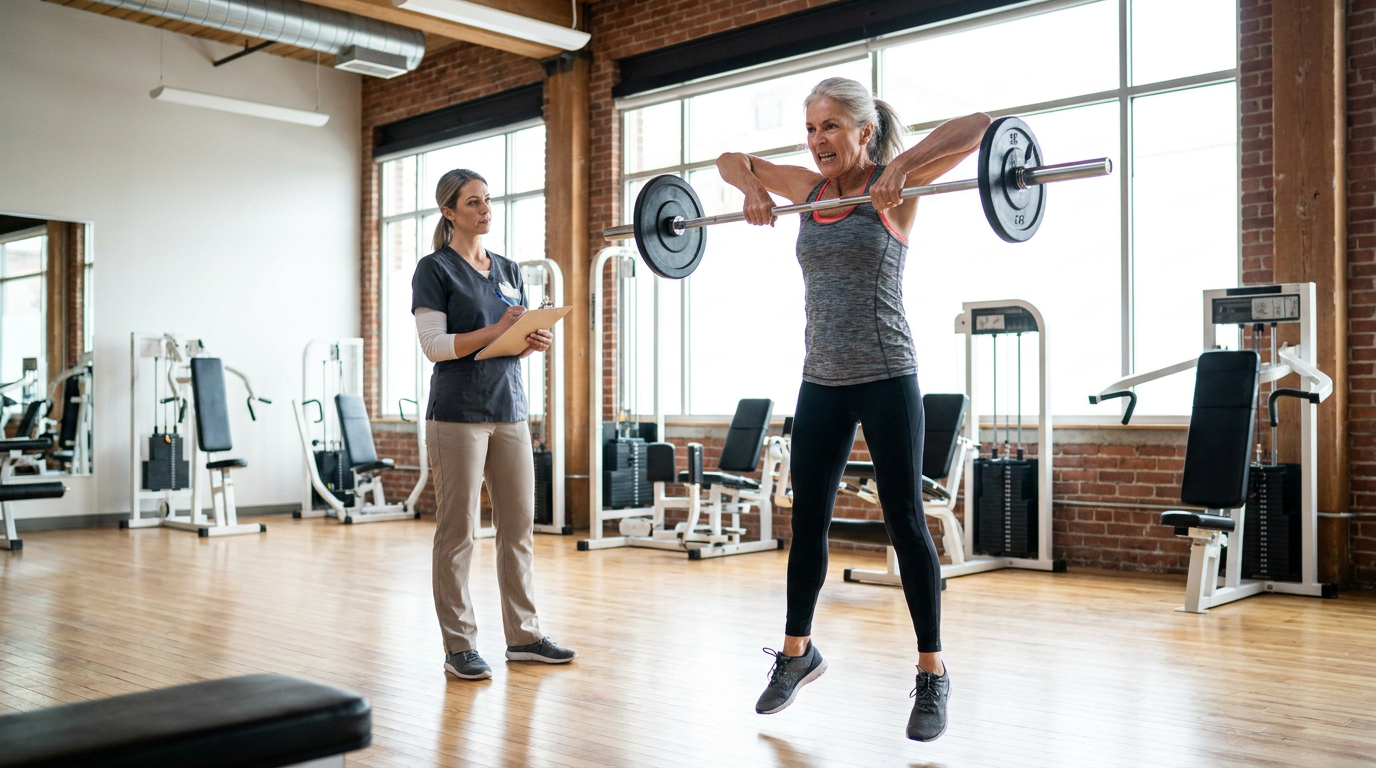
The image of an 80-year-old performing an Olympic weightlifting routine might seem like a recipe for disaster to the untrained eye. For decades, fitness advice for seniors centered on low-impact aerobics, light dumbbells, and seated machine exercises designed to minimize joint stress.[6]
However, a quiet revolution is reshaping geriatric physical therapy and longevity science. Researchers are discovering that the key to maintaining independence in later life isn't just about building muscle mass—it is about cultivating explosive physical power.[1]
To understand this shift, one must differentiate between strength and power. Strength is the absolute capacity to move a heavy load, regardless of how long the movement takes. Power, on the other hand, is the ability to move a load quickly; mathematically, it is force multiplied by velocity.[3]
As the human body ages, it loses both attributes, but not at the same rate. After the age of 60, muscle strength declines by roughly 1% to 2% per year. Muscle power, however, plummets at a much faster rate of 3% to 4% annually, driven by the rapid atrophy of fast-twitch muscle fibers.[3]

This rapid loss of power has severe real-world consequences. Catching yourself when you trip on a sidewalk does not require a massive amount of absolute strength, but it does require an instantaneous, explosive reaction. When power fades, the risk of catastrophic falls skyrockets.[3][4]
Enter Olympic weightlifting. The sport, famous for the snatch and the clean and jerk, represents the ultimate expression of human power. But performing these full lifts requires immense technical proficiency, extreme joint mobility, and years of practice—barriers that make them impractical and potentially unsafe for most older adults.[5][6]
To bridge this gap, sports scientists and physical therapists are turning to "weightlifting derivatives." These are modified exercises that isolate the explosive pulling phases of the Olympic lifts while eliminating the complex and risky "catch" phase, where the barbell is received on the shoulders or overhead.[5]
Common derivatives include the high pull, the jump shrug, and the clean pull. In these movements, the lifter rapidly accelerates the barbell upward, focusing entirely on the speed of the movement rather than the absolute weight on the bar.[1][5]
Common derivatives include the high pull, the jump shrug, and the clean pull.
The biomechanical magic of these derivatives lies in a concept called "triple extension." This is the simultaneous, explosive opening of the hip, knee, and ankle joints, which generates maximum upward force.[5]

Triple extension is the exact mechanical sequence the human body uses to jump, sprint, or rapidly stand up from a seated position. By training this specific motor pattern with light resistance, older adults are effectively practicing the exact physical skills required to maintain their daily independence.[3][5]
The clinical evidence supporting this approach is robust. A 2022 systematic review and meta-analysis by el Hadouchi and colleagues examined 15 randomized controlled trials involving nearly 600 older adults to compare power training against traditional strength training.[2]
The researchers found that power training yielded statistically significant improvements in functional fitness, movement speed, and generic activity-based tests compared to traditional, slow-tempo strength training, proving that velocity matters just as much as resistance.[2]

Beyond fall prevention, explosive weightlifting derivatives offer profound benefits for skeletal health. The rapid acceleration of the barbell creates high-magnitude mechanical stress on the bones, which is a key driver of skeletal adaptation.[4]
This mechanical stress triggers a biological response, activating cells known as osteoblasts. These cells rush to deposit new calcium and minerals in the stressed areas, accelerating bone remodeling and increasing bone mineral density—a critical defense against osteoporosis.[4]

Despite the benefits, the application of velocity-based training in older populations carries inherent uncertainties. Traditional strength coaches caution that moving weights quickly introduces higher peak forces on connective tissues, which could increase injury risk if applied prematurely.[3][6]
Consequently, experts emphasize that older adults must build a baseline of slow, controlled strength before introducing power elements. When derivatives are introduced, the loads are kept remarkably light—often just 20% to 30% of the individual's one-repetition maximum—to prioritize speed and safety over heavy lifting.[1][3]
The paradigm of aging fitness is fundamentally shifting. By safely adapting the training methods of elite Olympic weightlifters, older adults are discovering that the best defense against the physical decline of aging is not to slow down, but to learn how to move fast.[6]
Viewpoints in depth
Geriatric Physical Therapists
Advocate for power training as the missing link in rehabilitation.
Physical therapists focused on aging argue that the traditional model of low-impact, slow-tempo exercise is insufficient for maintaining true independence. They point out that real-world hazards—like tripping on a rug or slipping on ice—do not afford the luxury of slow, controlled movement. By incorporating weightlifting derivatives, therapists can safely train the nervous system to fire fast-twitch muscle fibers instantly, directly translating to a reduced risk of catastrophic falls.
Traditional Strength Coaches
Emphasize the necessity of building a foundation of slow, controlled strength first.
While acknowledging the benefits of power, traditional strength and conditioning professionals caution against rushing into velocity-based training. They argue that older adults must first develop a baseline of absolute strength and tissue resilience through slow, heavy lifting. Moving a load rapidly exponentially increases the peak forces placed on tendons and ligaments; without a pre-existing foundation of strength, this sudden mechanical stress could lead to joint injuries rather than adaptations.
Sports Biomechanists
Focus on the mechanical advantages of the triple extension and motor unit recruitment.
Biomechanics experts view weightlifting derivatives as the most efficient tool for training the 'triple extension'—the coordinated opening of the hips, knees, and ankles. They note that seated machine exercises isolate muscles in ways that rarely occur in nature. In contrast, derivatives force the body to recruit multiple motor units simultaneously in a closed kinetic chain, perfectly mimicking the biomechanics required to stand up from a deep chair or climb a steep flight of stairs.
What we don't know
- The optimal frequency and dosing of power training for the 'oldest-old' (adults over 85) remains under-researched.
- Long-term adherence rates for velocity-based barbell training outside of supervised clinical trial environments are not well documented.
- It is unclear if the cognitive benefits associated with complex motor learning in weightlifting derivatives exceed those of traditional resistance training.
Key terms
- Muscle Power
- The ability to exert force quickly; mathematically defined as force multiplied by velocity.
- Weightlifting Derivatives
- Modified exercises that isolate the pulling phases of Olympic lifts (like the snatch) without the complex catching phase.
- Triple Extension
- The simultaneous, explosive straightening of the hip, knee, and ankle joints used in jumping and lifting.
- Osteoblasts
- Specialized cells responsible for the formation of new bone tissue, which are stimulated by mechanical stress.
- Rate of Force Development
- A measure of how quickly an individual can generate muscle force from a resting state.
Frequently asked
Is Olympic weightlifting safe for older adults?
Full Olympic lifts are rarely recommended due to their technical complexity, but modified 'derivatives' like high pulls are safe when performed with light weights under professional supervision.
How much weight should be used for power training?
Research suggests using very light loads—typically 20% to 30% of a person's one-repetition maximum—to allow the movement to be performed as fast as possible.
Does power training replace regular strength training?
No. Experts recommend building a foundation of traditional, slow-tempo strength before introducing explosive power movements to ensure joint stability.
How does this type of training prevent falls?
Catching yourself from a stumble requires a rapid, explosive muscle contraction. Power training specifically conditions the nervous system and fast-twitch muscle fibers to react instantly.
Sources
Source coverage
6 outlets
3 viewpoints surfaced





[1]ProBiologistsGeriatric Physical Therapists
Power training in older adults: A pilot and feasibility study
Read on ProBiologists →[2]TRAINFITNESSGeriatric Physical Therapists
Power Training vs. Traditional Strength Training on Physical Function in Older Adults
Read on TRAINFITNESS →[3]Zero Point One Physical TherapyTraditional Strength Coaches
Strength vs. Power Training: What You Need to Know to Boost Performance and Longevity
Read on Zero Point One Physical Therapy →[4]William Newton HospitalTraditional Strength Coaches
Resistance Training: A Key to Improving Bone Density in Older Adults
Read on William Newton Hospital →[5]ResearchGateSports Biomechanists
Training With Weightlifting Derivatives: The Effects of Force and Velocity Overload Stimuli
Read on ResearchGate →[6]Factlen Editorial TeamSports Biomechanists
Synthesis by Factlen editorial team
Read on Factlen Editorial Team →

More in sports
See all 11 stories →Injury
Orlando Pride and Zambia Receive Major Boost as Barbra Banda's Injury Deemed Minor
0 sources

Hockey Strategy
How the PWHL's Innovative Rules Are Revolutionizing Hockey Strategy
0 sources

Youth Sports
Global 'Silent Sidelines' Movement Transforms Youth Soccer, Drastically Reducing Referee Abuse
0 sources
Standings
NWSL Mid-Season Standings: San Diego Wave Cling to Top Spot in League's Tightest Race Yet
0 sources

Every angle. Every day.
Get sports stories with full source coverage and perspective breakdowns delivered to your inbox.