
The Science of the Maillard Reaction: Why Browned Food Tastes Better
The complex chemical reaction between amino acids and sugars is responsible for the savory flavors of seared steak, roasted coffee, and baked bread. Understanding how to control heat, moisture, and pH can transform everyday cooking.
By Factlen Editorial Team
- Culinary Educators
- Chefs and instructors who translate chemical principles into practical techniques for the kitchen.
- Food Science Researchers
- Scientists who study the molecular pathways, flavor compounds, and health implications of chemical browning.
- Practical Home Cooks
- Everyday cooks looking for reliable shortcuts to achieve deep flavor without spending hours at the stove.
What's not represented
- · Vegetarian/Vegan Chefs adapting browning techniques to plant-based proteins
- · Industrial Food Manufacturers scaling the reaction for packaged goods
Why this matters
Understanding the chemistry behind browning allows home cooks to stop guessing and start controlling their results. By mastering temperature, moisture, and pH, you can consistently replicate restaurant-quality flavors in your own kitchen.
Key points
- The Maillard reaction is a chemical process between amino acids and sugars that creates savory flavor compounds.
- The reaction requires temperatures above 285°F, meaning surface moisture must evaporate before browning can begin.
- Alkaline environments speed up the reaction, allowing baking soda to drastically cut the time needed to caramelize onions.
- Unlike caramelization, which only involves sugars, the Maillard reaction requires proteins to produce its signature roasted flavors.
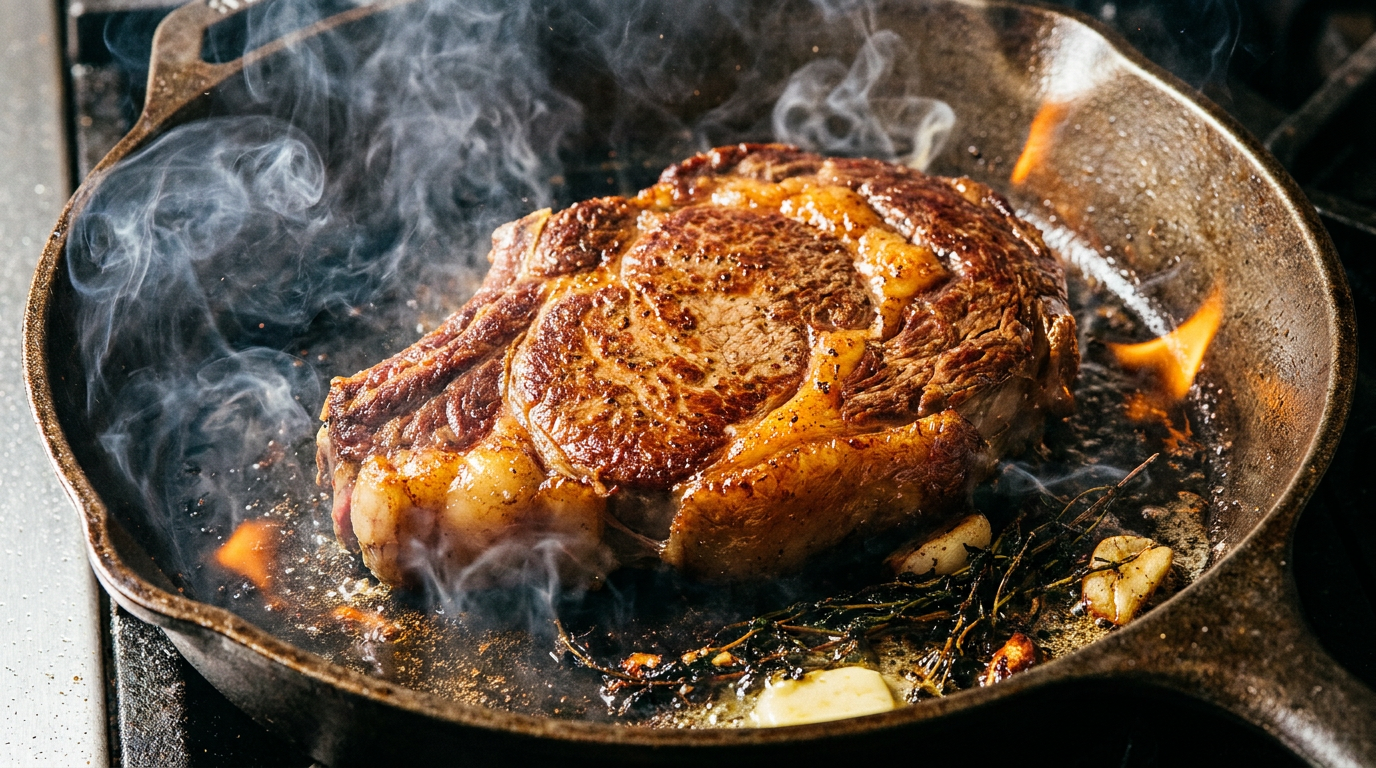
The difference between a pale, boiled piece of meat and a deeply seared, crusty ribeye is one of the most profound transformations in the culinary world. The aroma of baking bread, the rich depth of roasted coffee, and the savory crunch of a fried dumpling all share a common origin. This transformation is not magic, nor is it simply the result of food getting hot. It is the product of a specific, highly complex chemical process that dictates the flavor of almost everything we cook.[8]
Known as the Maillard reaction, this process is widely considered the most important chemical equation in the kitchen. It is responsible for taking raw, relatively flavorless ingredients and coaxing out the deep, savory, and complex notes that humans are biologically wired to crave. Without it, our diets would consist entirely of the bland, soft profiles of boiled and steamed foods.[1]
The reaction was first formally described in 1912 by Louis-Camille Maillard. Interestingly, Maillard was not a chef or a food scientist; he was a French chemist attempting to understand biological protein synthesis and how amino acids behave in living organisms. While his research was aimed at human biology, his observations perfectly explained the culinary alchemy that happens in ovens and skillets around the world.[7]
At its core, the Maillard reaction is a form of non-enzymatic browning. It occurs when amino acids—the fundamental building blocks of proteins—collide with reducing sugars under the application of heat. When these two components react, they form an unstable intermediate known as an Amadori compound.[6][7]
This initial compound is just the beginning of a cascading chemical waterfall. The Amadori compound rapidly breaks down and recombines, splintering into hundreds of new, highly volatile flavor and aroma compounds. The specific flavors produced depend entirely on the exact amino acids and sugars present in the raw ingredient, which is why roasted coffee tastes completely different from a seared steak, even though both are products of the exact same reaction.[7]

As the reaction progresses into its final stages, these smaller flavor compounds begin to link together into massive, complex polymer chains called melanoidins. These melanoidins act as pigments, providing the signature golden-brown to dark-brown colors that signal a food is perfectly cooked.[1][7]
While the Maillard reaction can technically occur at room temperature over a period of months or years—such as in the darkening of aging balsamic vinegar—it requires high heat to happen at a speed useful for cooking. The reaction only begins to accelerate noticeably when the surface temperature of the food reaches approximately 285°F (140°C).[6]
This temperature threshold introduces the greatest enemy of culinary browning: moisture. Water boils and turns to steam at exactly 212°F (100°C). As long as there is liquid water present on the surface of a piece of food, the temperature of that surface cannot rise above the boiling point. The thermal energy from the pan is entirely consumed by the process of evaporating the water.[1][6]

This temperature threshold introduces the greatest enemy of culinary browning: moisture.
This principle explains why boiled, poached, or steamed foods never develop a crust or a roasted flavor profile. The surface simply never gets hot enough to trigger the Maillard cascade. It is also why professional chefs are obsessive about moisture control, routinely patting meats completely dry with paper towels before they ever touch a hot skillet.[1][2]
Advanced culinary techniques, such as dry brining, leverage this exact science. By salting a steak and leaving it uncovered in the refrigerator overnight, the salt draws out surface moisture, which then evaporates in the dry air of the fridge. When the meat finally hits the pan, the Maillard reaction can begin almost instantly, resulting in a superior crust without overcooking the interior.[2][6]
Beyond temperature and moisture, the Maillard reaction is highly sensitive to the pH level of the cooking environment. The chemical bonding between the amino acids and sugars occurs much more rapidly in an alkaline, or basic, environment. By raising the pH of a food, cooks can dramatically accelerate the browning process.[5][7]
This quirk of chemistry has led to several ingenious kitchen hacks. Caramelizing onions traditionally requires 45 minutes of low-and-slow stirring to properly break down the structure and brown the sugars and proteins. However, adding a mere quarter-teaspoon of baking soda—a mild alkaline powder—per pound of raw onions raises the pH enough to achieve deep browning in just 10 minutes.[4][5]

The alkaline trick is utilized across various global cuisines. Chinese culinary traditions frequently employ marinades containing baking soda or egg whites (which are naturally alkaline) to ensure meat browns rapidly during the brief, high-heat window of a wok stir-fry. Similarly, the deep, glossy brown crust of a traditional soft pretzel is achieved by dipping the raw dough in a highly alkaline lye bath before baking.[1][5][7]
Despite its prevalence, the Maillard reaction is frequently confused with caramelization. While both processes result in browning and require high heat, they are chemically distinct. Caramelization is the thermal breakdown of sugars alone, requiring no proteins. It produces sweet, nutty, and buttery flavors, whereas the Maillard reaction produces savory, meaty, and roasted profiles.[2][3]
The confusion stems from the fact that the two reactions frequently occur side-by-side in the same pan. When cooking onions or roasting carrots, the natural sugars undergo caramelization, while the proteins and sugars simultaneously engage in the Maillard reaction. The resulting flavor profile is a complex hybrid of both chemical pathways.[2][5]

However, cooks must be careful not to push the temperature too high. If the surface heat exceeds 355°F (180°C), the Maillard reaction ceases and a new chemical process takes over: pyrolysis. Commonly known as burning, pyrolysis is the thermal decomposition of organic material.[1][6]
During pyrolysis, molecules are destroyed rather than created. The complex, savory flavor compounds combust, leaving behind pure carbon and harsh, acrid, bitter flavors that can ruin a dish. Managing the heat to stay within the 285°F to 355°F window is the hallmark of skilled cooking.[1][7]
Ultimately, understanding the Maillard reaction transforms cooking from a series of guessed steps into applied science. By actively managing surface moisture, controlling pan temperatures, and occasionally manipulating pH, anyone can consistently unlock the deep, complex flavors that define the world's best food.[8]
How we got here
Prehistory
Early humans discover that roasting meat over an open flame vastly improves its flavor, unknowingly utilizing the Maillard reaction.
1912
French chemist Louis-Camille Maillard formally describes the chemical reaction between amino acids and sugars.
1953
Chemist John E. Hodge publishes a definitive paper outlining the complex, multi-step mechanism of the Maillard reaction.
2000s
The rise of molecular gastronomy brings the precise temperature and pH control of the Maillard reaction into mainstream culinary education.
Viewpoints in depth
Food Science Researchers
Scientists who study the molecular pathways, flavor compounds, and health implications of chemical browning.
For food chemists, the Maillard reaction is a cascading waterfall of complexity. They focus on how the initial bonding of an amino acid and a reducing sugar forms an Amadori compound, which then splinters into hundreds of volatile aromatics. Researchers also study the health implications of the reaction, noting that pushing the temperature too high in starchy foods can generate acrylamide, a probable carcinogen. Their goal is to map the exact flavor profiles produced by different amino acid combinations.
Culinary Educators
Chefs and instructors who translate chemical principles into practical techniques for the kitchen.
Culinary educators view the Maillard reaction as the foundational secret to good cooking. They emphasize temperature and moisture control, teaching students that 'wet food doesn't brown.' By explaining the science behind why a steak must be patted dry or why a pan must be preheated, they replace culinary superstition with reliable, repeatable physics. For this camp, understanding the 285°F threshold is the difference between a mediocre meal and restaurant-quality flavor.
Practical Home Cooks
Everyday cooks looking for reliable shortcuts to achieve deep flavor without spending hours at the stove.
For the home cook, the science is most valuable when it saves time. This perspective embraces chemical 'hacks,' such as using a pinch of baking soda to rapidly caramelize onions or applying a baking powder dry-rub to chicken wings to achieve crispy skin. They are less concerned with the molecular structure of melanoidins and more focused on how manipulating pH and moisture can get a deeply flavorful dinner on the table on a busy weeknight.
What we don't know
- Chemists have yet to map every single flavor compound produced by the Maillard reaction, as the combinations of amino acids and sugars create thousands of unique volatile molecules.
- The exact long-term health impacts of consuming high levels of melanoidins and other Maillard byproducts remain an active area of nutritional research.
Key terms
- Amino Acids
- The organic molecules that serve as the building blocks of proteins, essential for the Maillard reaction.
- Reducing Sugars
- Simple sugars, such as glucose and fructose, that act as chemical reducing agents and react with amino acids.
- Melanoidins
- Large, complex polymer molecules formed at the end of the Maillard reaction that give browned foods their dark color.
- Pyrolysis
- The chemical decomposition of organic materials at highly elevated temperatures, commonly known in the kitchen as burning or charring.
- Amadori Compound
- An unstable intermediate compound formed in the early stages of the Maillard reaction before breaking down into flavor molecules.
Frequently asked
Can the Maillard reaction happen at room temperature?
Yes, it can occur slowly over months or years, such as in the aging of balsamic vinegar or the darkening of dried fruits, but high heat is required for rapid browning.
Is the Maillard reaction the same as caramelization?
No. Caramelization involves only the breakdown of sugars under heat, while the Maillard reaction requires both sugars and amino acids (proteins).
Why doesn't boiled meat turn brown?
Water boils at 212°F, which caps the surface temperature of the food. The Maillard reaction requires temperatures around 285°F to occur rapidly.
Does the Maillard reaction produce acrylamide?
Yes, cooking certain starchy foods at very high temperatures can produce acrylamide, a probable carcinogen. This is often seen in heavily fried potatoes or burnt toast.
Sources
Source coverage
8 outlets
3 viewpoints surfaced








[1]Modernist CuisineFood Science Researchers
The Maillard Reaction
Read on Modernist Cuisine →[2]Serious EatsCulinary Educators
The Food Lab: The Science of the Maillard Reaction
Read on Serious Eats →[3]America's Test KitchenCulinary Educators
The Science of Good Cooking: Browning
Read on America's Test Kitchen →[4]The TakeoutPractical Home Cooks
How to caramelize onions in 10 minutes with baking soda
Read on The Takeout →[5]Food52Practical Home Cooks
What the Heck is the Maillard Reaction?
Read on Food52 →[6]Escoffier School of Culinary ArtsCulinary Educators
How Does the Maillard Reaction Work?
Read on Escoffier School of Culinary Arts →[7]WikipediaFood Science Researchers
Maillard reaction
Read on Wikipedia →[8]Factlen Editorial TeamCulinary Educators
Synthesis by Factlen editorial team
Read on Factlen Editorial Team →
Every angle. Every day.
Get food drink stories with full source coverage and perspective breakdowns delivered to your inbox.