
The Science of No-Dig Gardening: Why Leaving Soil Undisturbed Increases Yields
A growing movement of regenerative home gardeners is abandoning the spade. Evidence shows that leaving soil undisturbed preserves vital microbial networks, sequesters carbon, and consistently out-produces traditional tilling.
By Factlen Editorial Team
- Regenerative Advocates
- Focus on restoring soil health, fostering biodiversity, and eliminating synthetic inputs.
- Horticultural Scientists
- Focus on empirical yield data, moisture retention metrics, and plant vigor trials.
- Climate-Conscious Gardeners
- Focus on the environmental footprint of gardening and turning yards into carbon sinks.
What's not represented
- · Commercial Fertilizer Manufacturers
- · Large-Scale Industrial Farmers
Why this matters
Adopting no-dig methods allows home gardeners to significantly reduce backbreaking labor and weeding while actively turning their backyards into carbon sinks. By working with the soil's natural microbiome, growers can produce higher yields with fewer synthetic fertilizers and less water.
Key points
- No-dig gardening replaces traditional tilling with top-down layering of organic compost and mulch.
- Leaving soil undisturbed protects delicate mycorrhizal fungi networks that act as secondary root systems for plants.
- Long-term trials show no-dig beds consistently yield 5% to 15% more produce than traditionally dug beds.
- Tilling oxidizes soil carbon into the atmosphere, whereas no-dig methods lock carbon underground.
- The thick compost layer acts as a sponge, drastically reducing the need for watering during dry spells.
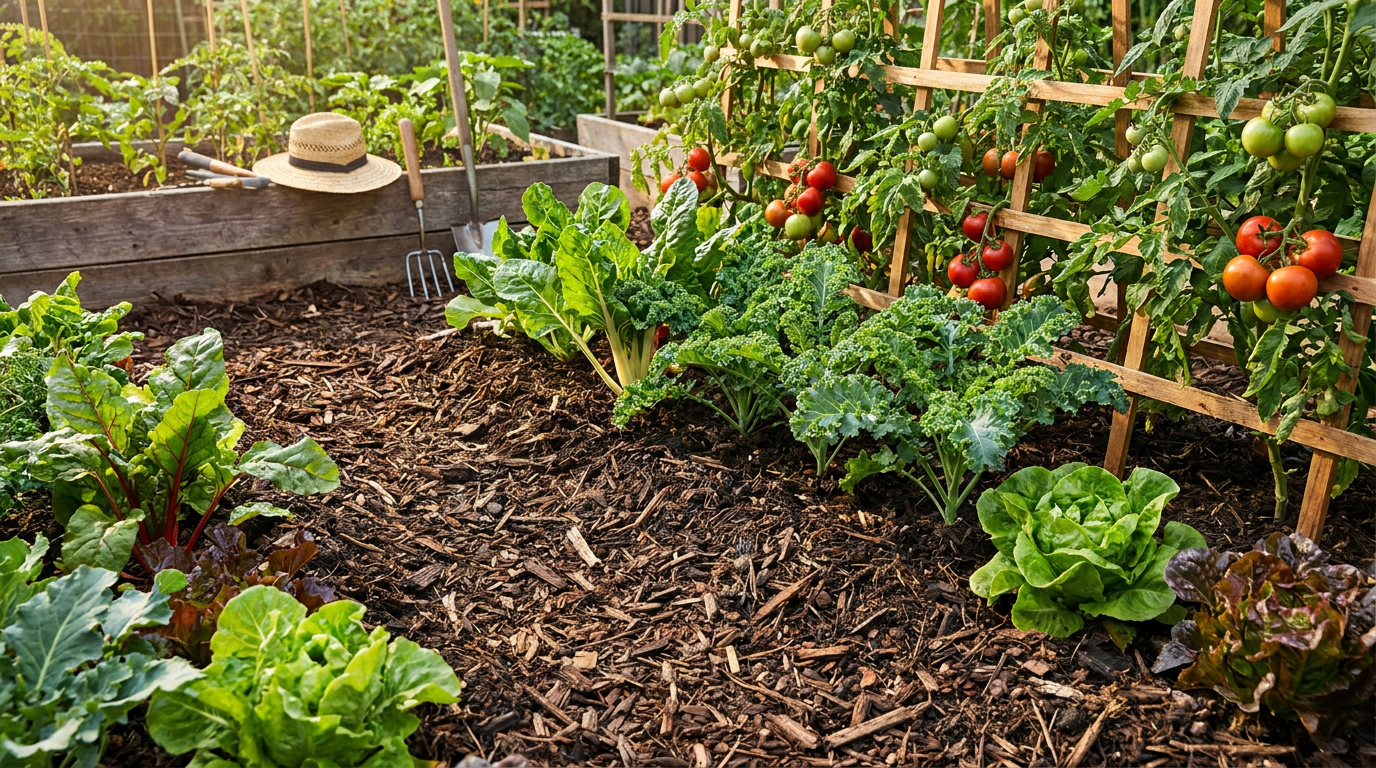
For generations, the quintessential image of a dedicated gardener involved a spade, a strong back, and the grueling spring ritual of turning over the earth. Cultivating the soil was considered the non-negotiable first step to a bountiful harvest. However, a quiet revolution is taking root in backyards and market farms across the globe, challenging this centuries-old orthodoxy. The "no-dig" or "no-till" movement advocates for leaving the soil entirely undisturbed, replacing the spade with thick layers of organic mulch. By mimicking the natural accumulation of organic matter found on a forest floor, this regenerative approach promises not only to save gardeners from backbreaking labor but to fundamentally rebuild the biological engine of the soil.[4][7]
The practice of deep digging and rototilling gained prominence during the agricultural and industrial revolutions, driven by the belief that loosening the earth was necessary to aerate the roots and bury surface weeds. Some horticultural historians even joke that the obsessive double-digging of the Victorian era was largely a make-work scheme for garden apprentices to keep them warm through the winter. But modern soil science has revealed a starkly different reality. Excessive cultivation physically destroys the microscopic architecture of the soil, collapsing natural drainage channels and pulverizing the fragile ecosystems that plants rely on to thrive.[1][5]
At its core, the no-dig method is an exercise in restraint and layering. Rather than breaking ground, gardeners smother existing vegetation—often using a biodegradable barrier like untreated cardboard—and top it with 10 to 15 centimeters of rich, well-rotted compost. Seeds and seedlings are planted directly into this surface mulch. Over time, this organic layer decomposes and integrates into the earth below, creating a nutrient-dense, sponge-like growing medium. The fundamental rule is simple: feed the soil from the top down, and let nature do the heavy lifting of incorporation.[1][5][6][7]
The secret to the success of undisturbed soil lies in the garden microbiome—a bustling, microscopic metropolis of bacteria, nematodes, and fungi. When soil is left intact, it develops a complex, living structure. Tilling the earth is akin to running a bulldozer through this metropolis, tearing apart the biological networks that have spent months or years establishing themselves. By adopting a no-till approach, gardeners preserve these microbial communities, allowing them to continuously digest organic matter and convert it into bioavailable nutrients that plant roots can easily absorb.[5][6]

The most critical casualties of the spade are mycorrhizal fungi. These microscopic, thread-like organisms form symbiotic relationships with the vast majority of plant species. The fungi attach to plant roots, effectively acting as a massive secondary root system that reaches far beyond the plant's own physical limitations. In exchange for sugars produced by the plant through photosynthesis, the fungal network scavenges for water and essential minerals—particularly phosphorus—and delivers them directly to the host. Cultivating the soil severs these delicate white strands, instantly depriving plants of their underground support network.[1][4]
Beyond the microscopic realm, no-dig gardening relies heavily on the tireless work of earthworms and other macro-organisms. In a traditional dug garden, the mechanical fracturing of the soil is temporary; the earth inevitably settles and compacts after the first heavy rain. In a no-dig system, earthworms travel vertically to feed on the surface compost, pulling organic matter down into the lower soil horizons. Their continuous movement creates permanent, mucus-lined tunnels that provide superior, long-lasting aeration and drainage without a single thrust of a garden fork.[1][7]
Beyond the microscopic realm, no-dig gardening relies heavily on the tireless work of earthworms and other macro-organisms.
The benefits of undisturbed soil extend far beyond the boundaries of the backyard, playing a surprisingly vital role in climate mitigation. Soil is one of the planet's largest carbon sinks, storing vast amounts of carbon in the form of decaying organic matter and microbial biomass. Every time a gardener or farmer tills the earth, they expose these buried carbon stores to excess oxygen and sunlight. This sudden exposure triggers a feeding frenzy among soil bacteria, which rapidly oxidize the carbon and release it into the atmosphere as carbon dioxide.[3][5]
By laying down the spade, home gardeners can actively reverse this process. The continuous application of compost and the elimination of soil disturbance locks carbon underground. Mature no-dig beds can achieve remarkable carbon concentrations; some long-term trials have recorded soil carbon levels as high as 18%, compared to the 2% to 5% typically found in conventionally farmed soils. When multiplied across millions of residential gardens, this shift in methodology transforms the humble vegetable patch from a minor source of emissions into a decentralized network of carbon sequestration.[3][7]

For many growers, the ultimate test of any agricultural method is the harvest. The empirical evidence heavily favors the undisturbed approach, largely thanks to the meticulous, decade-long trials conducted by horticulturalist Charles Dowding at his Homeacres market garden in Somerset, England. By maintaining side-by-side comparison beds—one dug, one no-dig, both receiving the exact same volume of compost—Dowding has generated a compelling dataset. Year after year, the no-dig beds consistently outperform their cultivated counterparts, yielding between 5% and 15% more produce by weight.[2]
This yield advantage is particularly pronounced in thirsty, nutrient-demanding crops like leafy greens, tomatoes, and brassicas. The undisturbed soil structure, combined with the thick compost mulch, creates an environment with vastly superior moisture retention. During dry spells, the no-dig beds act like a reservoir, keeping roots hydrated long after the dug beds have baked dry and cracked. Furthermore, the intact fungal networks provide these plants with a steady stream of nutrients, resulting in visibly more vigorous growth and a higher resistance to pests and diseases.[1][2][4][6]
There is, however, a nuanced caveat when it comes to root vegetables. In the very first year of transitioning to a no-dig system, traditional digging can sometimes produce a 10% to 20% higher yield for crops like potatoes and carrots, as the artificially loosened soil allows for rapid, unimpeded root expansion. But this advantage is fleeting. By the second or third year, as the natural soil structure improves and earthworm activity peaks, the no-dig beds catch up and often surpass the dug plots, provided a sufficiently deep layer of compost is maintained.[2]

Perhaps the most celebrated day-to-day benefit of the no-till method is the dramatic reduction in weeding. A common gardening myth suggests that digging is necessary to bury and destroy weeds. In reality, soils are packed with millions of dormant weed seeds waiting for their moment in the sun. Turning the earth acts as a massive germination trigger, bringing a fresh crop of seeds to the surface where light and oxygen prompt them to sprout. By leaving the soil unturned and capping it with a light-blocking mulch, gardeners keep these dormant seeds buried indefinitely.[1][5]
Transitioning to a regenerative, no-dig model does require a shift in expectations and, initially, a modest investment in materials. Establishing a new bed demands a significant volume of compost to achieve the necessary 10 to 15-centimeter starting depth. Furthermore, while the reduction in labor is immediate, the biological benefits take time to compound. Agronomists note that it typically takes one to three years for the soil microbiome to fully stabilize and for the natural structure to reach its peak potential.[1][2][6]
Ultimately, the no-dig movement represents a profound philosophical shift in how we interact with the earth. It moves the gardener away from the role of a mechanic trying to force productivity through physical manipulation and synthetic inputs, and toward the role of an ecologist fostering a self-sustaining habitat. By choosing to feed the soil rather than the plant, and by trusting the microscopic workforce beneath our feet, we can cultivate gardens that are more resilient, more productive, and vastly more forgiving.[1][6][7]
Viewpoints in depth
Regenerative Advocates
Focus on restoring soil health, fostering biodiversity, and eliminating synthetic inputs.
For regenerative advocates, the primary goal of no-dig gardening is ecological restoration. They argue that traditional tilling treats soil as an inert medium rather than a living ecosystem. By eliminating physical disturbance and synthetic fertilizers, this camp emphasizes that gardeners can rebuild the soil microbiome, encourage biodiversity, and create a self-sustaining environment that naturally resists pests and disease.
Horticultural Scientists
Focus on empirical yield data, moisture retention metrics, and plant vigor trials.
Horticultural scientists and agronomists evaluate no-dig methods through the lens of measurable outcomes. They point to long-term comparative trials showing that undisturbed soil structures offer superior water retention and nutrient availability, leading to consistent 5% to 15% yield increases. While they acknowledge a transition period where root crops may initially underperform, the data strongly supports the long-term productivity of the no-till approach.
Climate-Conscious Gardeners
Focus on the environmental footprint of gardening and turning yards into carbon sinks.
This perspective views gardening as a localized tool for climate action. Climate-conscious growers highlight that tilling exposes buried organic matter to oxygen, releasing carbon dioxide into the atmosphere. By adopting no-dig practices, they argue that the millions of acres of residential gardens and lawns can be transformed from minor emission sources into active carbon sinks, locking carbon safely underground.
What we don't know
- The exact upper limit of carbon sequestration potential in residential no-dig gardens across different global climate zones.
- How rapidly commercial-scale agriculture can adopt no-till methods without facing short-term yield drops during the transition phase.
Key terms
- Mycorrhizal Fungi
- Microscopic fungal networks that form a symbiotic relationship with plant roots, helping them absorb water and nutrients.
- Sheet Mulching
- A no-dig technique where layers of cardboard and organic matter are placed directly over grass or weeds to create a new planting bed.
- Soil Microbiome
- The complex community of bacteria, fungi, nematodes, and other microorganisms living in the soil.
- Carbon Sequestration
- The process of capturing and storing atmospheric carbon dioxide, which in gardening is achieved by keeping organic matter locked in undisturbed soil.
Frequently asked
Can I grow root vegetables like carrots in a no-dig garden?
Yes. While root crops may yield slightly less in the very first year until the soil structure naturally softens, they thrive in mature no-dig beds by year two or three.
Do I need to buy massive amounts of compost every year?
No. While the first year requires a thick 10-15cm layer to establish the bed, subsequent years only require a light 2-3cm top-up to maintain fertility.
How do I deal with existing weeds before starting a no-dig bed?
You don't need to pull them. Simply mow them down, cover the area with overlapping cardboard to block the light, and pile your compost directly on top.
Does no-dig gardening work on heavy clay soils?
Yes, it is highly effective for clay. Instead of struggling to dig heavy clay, the compost layer on top gradually encourages worms to aerate the clay from above, improving drainage over time.
Sources
Source coverage
7 outlets
3 viewpoints surfaced







[1]Royal Horticultural SocietyHorticultural Scientists
No-dig gardening: caring for your soil
Read on Royal Horticultural Society →[2]Gardens IllustratedHorticultural Scientists
Charles Dowding on the benefits of no-dig gardening
Read on Gardens Illustrated →[3]AudubonClimate-Conscious Gardeners
How to Turn Your Yard Into a Carbon Sink
Read on Audubon →[4]Soil AssociationRegenerative Advocates
What is no-dig gardening?
Read on Soil Association →[5]Maine Organic Farmers and GardenersRegenerative Advocates
Building Healthy Soil Through No-Till Mulching
Read on Maine Organic Farmers and Gardeners →[6]The PackerRegenerative Advocates
Resilience in the Concrete Jungle: Regenerative Gardening
Read on The Packer →[7]Factlen Editorial TeamHorticultural Scientists
Synthesis by Factlen editorial team
Read on Factlen Editorial Team →
More in home
See all 33 stories →HVAC Tech
How to Optimize Your Heat Pump for Maximum Efficiency and Lower Bills
8 sources
Home Electrification
The Economics and Mechanics of the Zero-Emission Home Retrofit
6 sources

Appliance Tech
How Induction Cooking Works: The Science and Stakes Behind the Kitchen Transition
8 sources

Neuroaesthetics
The Science of the 'Sensory Sanctuary': How Interior Design Literally Rewires Your Brain
6 sources

Every angle. Every day.
Get home stories with full source coverage and perspective breakdowns delivered to your inbox.