
The Science of Neuroaesthetics: How Your Living Space Shapes Your Brain
Emerging neuroscience proves that interior design is not just about aesthetics—elements like natural light, curved lines, and wood textures actively alter our brain chemistry to reduce stress and improve mental health.
By Factlen Editorial Team
- Neuroscientists & Researchers
- Focuses on the measurable biological and chemical reactions to spatial stimuli.
- Architects & Designers
- Focuses on translating clinical data into functional, beautiful living spaces.
- Environmental Psychologists
- Emphasizes the evolutionary basis of our preference for nature and spatial coherence.
- Public Health Advocates
- Views intentional design as a form of preventative healthcare and stress reduction.
What's not represented
- · Neurodivergent individuals who may process spatial and sensory stimuli differently than neurotypical baselines.
Why this matters
For decades, interior design was treated as a superficial luxury. Understanding that the shapes, lighting, and textures in our homes directly alter our brain chemistry turns intentional design into a powerful, accessible tool for daily mental health and stress recovery.
Key points
- Neuroaesthetics proves that interior design triggers measurable biological responses, including changes in heart rate and cortisol levels.
- Viewing beautiful, coherent spaces activates the brain's reward system, increasing blood flow and releasing dopamine.
- Biophilic design, which incorporates nature into the built environment, is linked to faster healing and higher productivity.
- Curvilinear shapes and exposed wood grain naturally relax the autonomic nervous system.
- Visual clutter overloads sensory bandwidth, elevating stress hormones and reducing focus.
Have you ever walked into a room and felt your shoulders instantly drop? Or, conversely, stepped into a space that made you inexplicably anxious? For decades, the design industry attributed these reactions to subjective taste. But a rapidly growing scientific discipline is proving that our response to the built environment is not just aesthetic—it is deeply biological.[1]
Welcome to the era of neuroaesthetics, the scientific study of how the brain responds to beauty, art, and spatial design. By bridging neuroscience, psychology, and architecture, researchers are mapping exactly what happens to our nervous systems when we cross a threshold. The findings are fundamentally shifting how we think about our homes, transforming interior design from a decorative luxury into a form of preventative healthcare.[1][5]
Neuroaesthetics reveals how beauty affects the brain through measurable, objective biological responses. When we encounter a space our brain perceives as beautiful or harmonious, heart rates slow, blood pressure drops, and stress hormones like cortisol decrease. Simultaneously, the brain releases serotonin and dopamine, creating the biological foundation for feeling genuinely at ease in a room.[5]
The mechanics of this response are rooted in our evolutionary history. Researchers at the Penn Center for Neuroaesthetics have used functional magnetic resonance imaging (fMRI) to study how specific architectural features affect neural processes. Their research reveals that when participants view spaces they find beautiful, it activates the ventromedial prefrontal cortex—a key node in the brain's reward system.[2]

Interestingly, the brain's reward system reacts to a well-designed room much like it does to a beautiful piece of music or a loved one's face. Studies indicate that engaging with a highly aesthetic space can increase blood flow to the brain by up to 10 percent. This vascular response is accompanied by a tangible reduction in physiological stress, proving that our surroundings are constantly modulating our internal state.[2][5]
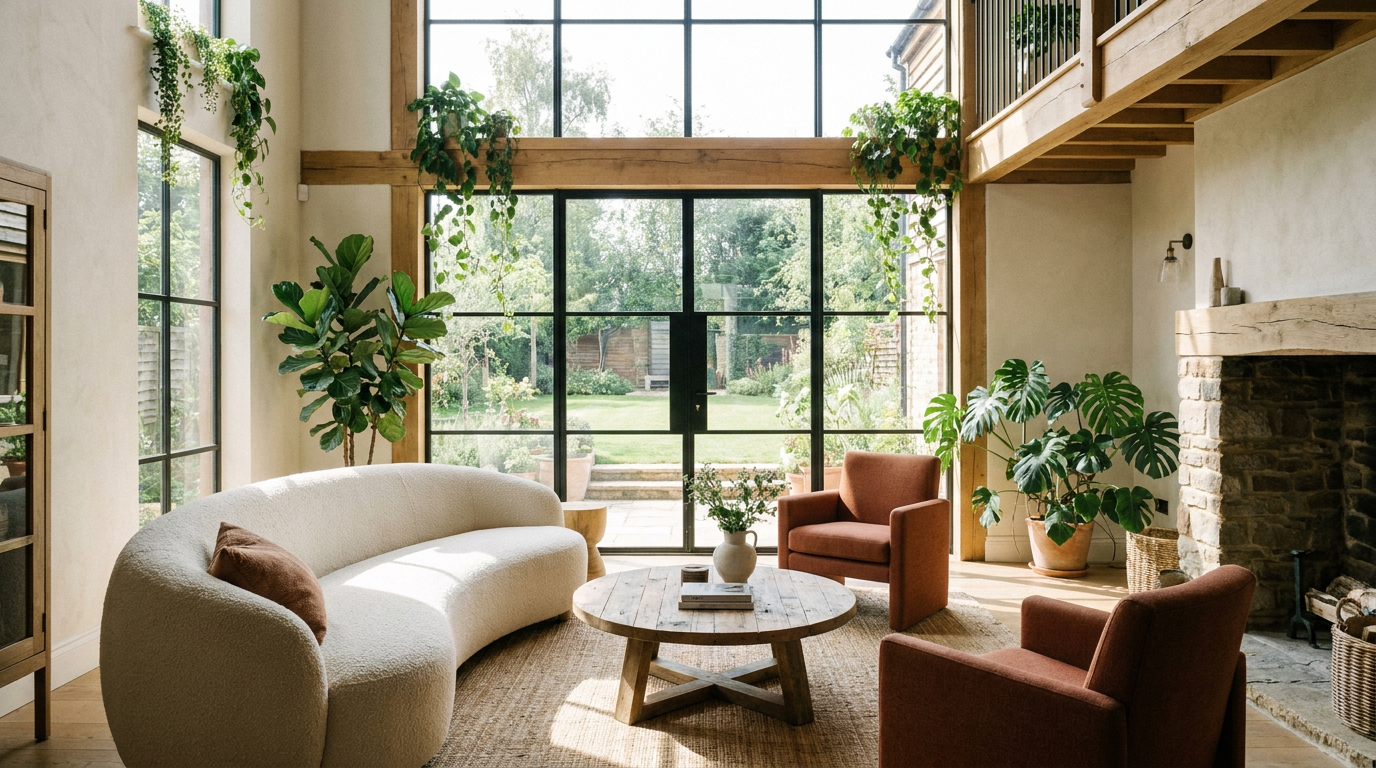
One of the most potent applications of neuroaesthetics is biophilic design, an evidence-based approach that integrates elements of nature into the built environment. Coined by biologist E.O. Wilson, biophilia suggests that humans possess an innate tendency to seek connections with nature. In interior design, this translates to maximizing natural light, incorporating plant life, and utilizing natural materials.[3][7]
The health benefits of biophilic design are extensively documented. According to environmental researchers who developed the 14 Patterns of Biophilic Design, integrating nature into spaces can significantly improve cognitive function and expedite healing. Their research shows that visual connections with nature lower blood pressure and heart rate while improving mental engagement and overall happiness.[3]
It is not just about adding a few potted plants; the materials themselves communicate with our nervous system. Researchers have discovered that exposed wood grain has a unique ability to relax the autonomic nervous system. People tend to feel more comfortable and welcomed around wood or woven fabrics because these textures stimulate the somatosensory cortex, producing feelings of warmth and belongingness.[3][6]

It is not just about adding a few potted plants; the materials themselves communicate with our nervous system.
Lighting is another critical lever in neuroaesthetic design. Natural light acts as a primary cue for circadian entrainment, regulating our sleep-wake cycles. Studies on interior design and mental health show that abundant sunlight triggers serotonin production, lifting mood and enhancing focus. When natural light is scarce, mimicking it with warm-toned, dynamic LED lighting can prevent the biological confusion caused by harsh, static fluorescent bulbs.[4][6]
Beyond materials and light, the physical geometry of a room dictates our psychological comfort. In fMRI studies, researchers found that participants consistently preferred spaces with high ceilings, rounded shapes, and ample windows. Curvilinear spaces—rooms that feature arches, rounded furniture, or soft corners—activate areas of the brain related to pleasure and comfort, making inhabitants feel calmer than they do in spaces dominated by sharp, jagged angles.[2]
This preference for curves is likely evolutionary. Sharp angles in nature often signal danger, such as thorns or jagged rocks, whereas curves suggest organic, safe forms. By softening the edges of a living space, designers can subtly signal to the brain's amygdala—the fear center—that the environment is safe, allowing the nervous system to downregulate and relax.[2][7]
The concept of coherence is equally vital. In neuroaesthetics, coherence refers to the ease with which the brain can organize and comprehend a scene. A cluttered, visually chaotic room overloads the brain's sensory bandwidth. Every pile of laundry or mismatched pattern acts as an open tab in a web browser, draining cognitive resources and elevating stress hormones.[2][5]

Designing for coherence does not mean embracing sterile minimalism. It means creating spaces where the visual information is organized and purposeful. When a room balances coherence with fascination—a level of informational richness that generates interest without overwhelming the senses—it achieves what researchers call hominess, a distinct psychological dimension of personal ease and comfort.[2]
The implications of this research extend far beyond residential living rooms. Biophilic and neuroaesthetic principles are actively reshaping commercial real estate, workplaces, and healthcare facilities. In hospitals, patients with views of nature or access to biophilic design elements experience reduced hospitalization times, lower pain levels, and decreased mortality rates.[4][6]
In the workplace, the return on investment for neuroaesthetic design is highly measurable. Employees in biophilic offices report up to 15 percent higher productivity and significantly lower fatigue. Psychologists have found that simply adding plants to an office environment can increase self-reported well-being by 47 percent and creativity by 45 percent, proving that human flourishing is deeply tied to spatial harmony.[4][7]

Despite the robust data, researchers acknowledge the complexities of applying neuroaesthetics universally. The field is still grappling with the reality of neurodivergence; a spatial layout or sensory input that feels calming and coherent to one person might feel under-stimulating or distracting to another. Personalizing these principles remains a frontier for both scientists and designers.[1][5]
Furthermore, while laboratory fMRI studies provide precise data on immediate reactions to spatial stimuli, measuring the longitudinal effects of design on mental health in the real world is inherently difficult. Isolating the impact of a room's architecture from other lifestyle factors—such as diet, sleep, and social relationships—requires complex, long-term epidemiological studies that are only just beginning.[1][2]
Ultimately, the convergence of neuroscience and interior design offers an empowering new lens for how we build our lives. By understanding that our brains are in a constant, subconscious dialogue with our surroundings, we can stop viewing home decor as a superficial pursuit. Instead, we can intentionally craft spaces that serve as allies in our mental health, using light, texture, and form to build a foundation for daily well-being.[1][6][7]
How we got here
1984
Roger Ulrich publishes a landmark study showing hospital patients recover faster with views of nature.
Early 2000s
Neurobiologist Semir Zeki coins the term 'neuroaesthetics' to describe the neural mechanisms of aesthetic experiences.
2014
Terrapin Bright Green publishes the '14 Patterns of Biophilic Design,' creating a framework for architects.
2021
fMRI studies confirm that curvilinear architectural spaces activate the brain's reward centers.
2026
Neuroaesthetics becomes a mainstream standard in both commercial and residential real estate development.
Viewpoints in depth
Neuroscientists' view
Focuses on the measurable biological and chemical reactions to spatial stimuli.
For neuroscientists, interior design is a series of sensory inputs that trigger specific neural pathways. They rely on fMRI scans and biometric data to prove that aesthetic experiences are not subjective, but rather predictable biological events that alter heart rate, cortisol levels, and dopamine production. To this camp, a well-designed room is a medical intervention.
Architects and Designers' view
Focuses on translating clinical data into functional, beautiful living spaces.
Design professionals view neuroaesthetics as a tool to validate their intuitive practices with hard science. They are tasked with balancing the clinical requirements of 'coherence' and 'biophilia' with the practical constraints of budget, square footage, and client preferences, turning abstract neuroscience into tangible, livable environments.
Evolutionary Psychologists' view
Argues that our spatial preferences are hardwired survival mechanisms.
This camp posits that our love for natural light, wood textures, and curved lines is deeply rooted in human evolution. They argue that we are biologically programmed to seek out environments that mimic the safety and resource-rich settings of our ancestors, making biophilic design less of a modern trend and more of a return to our natural habitat.
What we don't know
- How to perfectly adapt neuroaesthetic principles for various forms of neurodivergence.
- The exact long-term, longitudinal impact of interior design on mental health when isolated from other lifestyle factors.
Key terms
- Neuroaesthetics
- The scientific study of how the brain and nervous system respond to beauty, art, and spatial design.
- Biophilic Design
- An architectural approach that integrates natural elements, like light, plants, and wood, into the built environment.
- Ventromedial Prefrontal Cortex
- A region of the brain associated with risk, fear, and the processing of reward and pleasure.
- Circadian Entrainment
- The alignment of the body's internal biological clock with external cues, primarily natural light.
- Coherence
- In design psychology, the ease with which the brain can visually organize and comprehend a space.
Frequently asked
Do I need to buy expensive furniture to use neuroaesthetics?
No. The principles focus on maximizing natural light, decluttering for visual coherence, and incorporating affordable natural textures like house plants or exposed wood.
How does clutter actually affect the brain?
Clutter overloads the brain's sensory bandwidth, acting as visual noise that increases cortisol (stress hormone) production and reduces cognitive focus.
Why do curved lines feel more relaxing than sharp angles?
Evolutionarily, sharp angles often signal danger in nature, while curves suggest organic, safe forms, which helps downregulate the brain's fear center.
Sources
Source coverage
7 outlets
4 viewpoints surfaced







[1]Factlen Editorial TeamPublic Health Advocates
Synthesis by Factlen editorial team
Read on Factlen Editorial Team →[2]Penn Center for NeuroaestheticsNeuroscientists & Researchers
The neuroaesthetics of architectural spaces
Read on Penn Center for Neuroaesthetics →[3]Terrapin Bright GreenEnvironmental Psychologists
14 Patterns of Biophilic Design
Read on Terrapin Bright Green →[4]Global Wellness InstitutePublic Health Advocates
Biophilic Design in Architecture and Its Contributions to Health
Read on Global Wellness Institute →[5]Science in DesignNeuroscientists & Researchers
The Convergence of Neuroscience and Design
Read on Science in Design →[6]The New York TimesArchitects & Designers
How Neuroscience is Reshaping the Modern Home
Read on The New York Times →[7]Architectural DigestArchitects & Designers
Biophilic Design: Why Wellness is the Ultimate Luxury
Read on Architectural Digest →
Every angle. Every day.
Get home stories with full source coverage and perspective breakdowns delivered to your inbox.