
The Revival of 'Third Places': How Cities Are Designing Cures for the Loneliness Epidemic
As social isolation reaches historic highs, urban planners and sociologists are championing the return of 'third places'—accessible, neutral spaces outside of home and work—as essential infrastructure for public health.
By Factlen Editorial Team
- Public Health Officials
- View the decline of shared spaces as a critical medical crisis requiring intervention.
- Urban Planners & Designers
- Focus on how physical infrastructure and zoning laws dictate human connection.
- Digital & Modern Realists
- Emphasize that community infrastructure is evolving beyond traditional physical spaces.
What's not represented
- · Rural Community Advocates
- · Low-Income Housing Developers
Why this matters
As rates of social isolation and anxiety reach historic highs, understanding and rebuilding the physical spaces where communities gather is becoming a critical public health intervention that directly impacts our mental well-being and lifespan.
Key points
- Sociologists define 'third places' as neutral, accessible environments outside of home and work where people gather informally.
- The decline of these spaces, driven by strict zoning laws and rising commercial rents, has contributed to a global loneliness epidemic.
- Social isolation carries severe physical health risks, including a 29% increased risk of heart disease.
- Urban planners are now actively designing 'architecture of belonging' to reintegrate shared spaces into modern neighborhoods.
- Targeted solutions, such as 'Men's Sheds,' are emerging to address specific demographics hit hardest by the friendship recession.
In an era defined by unprecedented digital connectivity, a quiet crisis of isolation has taken root across the developed world. The statistics paint a stark picture of a fraying social fabric: by 2024, 17 percent of Americans reported having no close friends at all—a staggering increase from just one percent in 1990. In Europe, nearly 35 percent of the population now experiences loneliness at least occasionally. This "friendship recession" prompted the U.S. Surgeon General to issue a formal advisory on the epidemic of loneliness, framing social isolation not merely as a personal struggle, but as an urgent public health crisis requiring systemic intervention.[4]
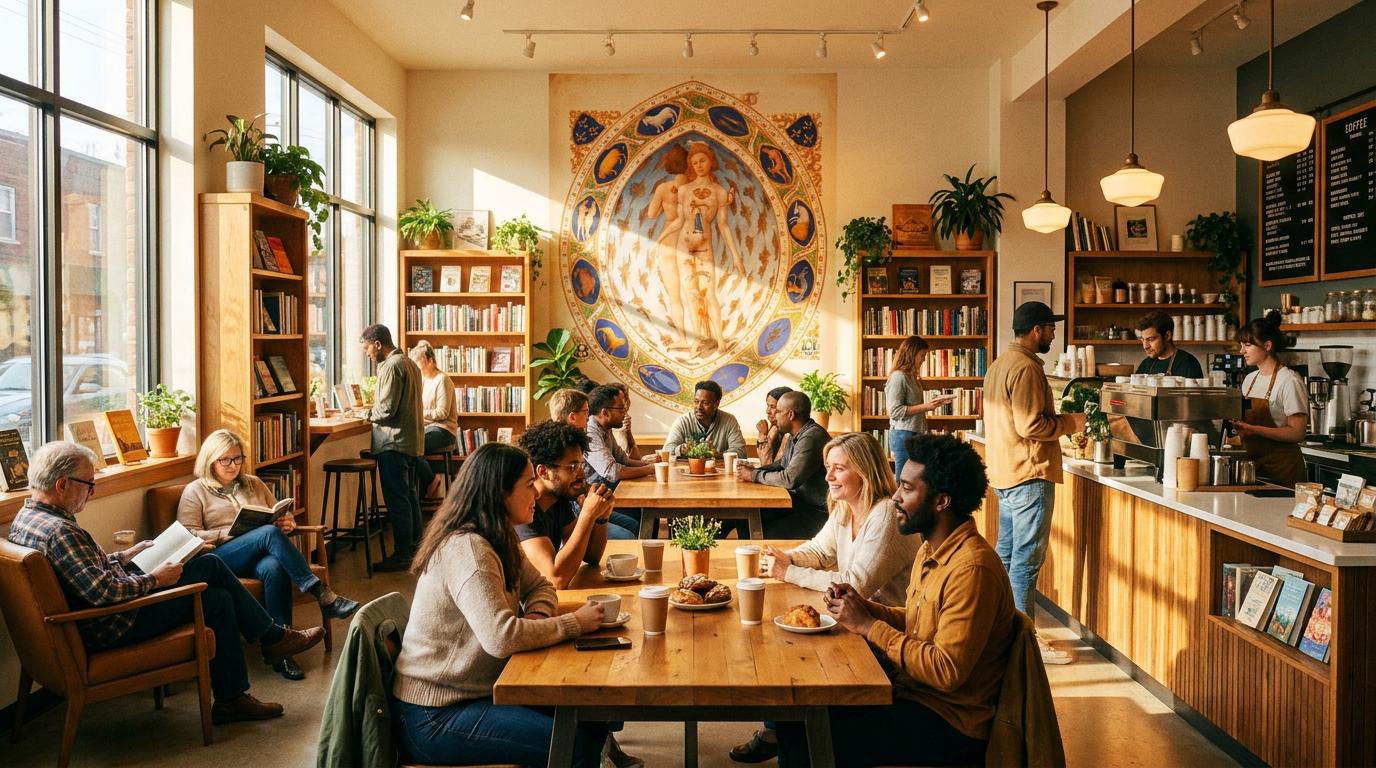
To understand how communities became so fragmented, sociologists point to the erosion of what American urban sociologist Ray Oldenburg famously termed the "third place." In his 1989 book The Great Good Place, Oldenburg proposed a simple framework for human social environments. The "first place" is the home, a private and domestic sphere. The "second place" is the workplace or school, characterized by structured hierarchies and obligations. The "third place" encompasses everything else: the neutral, accessible public spaces where people gather voluntarily, linger without pressure, and experience a sense of belonging outside their daily responsibilities.[7]
True third places share a specific set of characteristics that make them engines of community building. They operate as neutral ground where individuals can come and go as they please. They act as inclusive "levelers," meaning a person's socioeconomic status, occupation, or background holds little weight within the space. Most importantly, they are conversation-centered and sustained by a core group of "regulars" who set a welcoming tone for newcomers. Classic examples include neighborhood barbershops, public libraries, local pubs, community gardens, and traditional cafes—spaces that serve as the informal living rooms of society.[4][7]

The stakes of preserving these environments extend far beyond mere nostalgia; they are a matter of life and death. Public health experts have increasingly recognized that third places are essential medical interventions. Chronic social isolation triggers physiological stress responses that severely degrade the human body. Research indicates that prolonged loneliness can lead to a 29 percent increase in the risk of heart disease and a 32 percent increase in the risk of stroke. In terms of mortality, the health impact of severe isolation is frequently compared to smoking 15 cigarettes a day.[3][5]
Despite their critical importance, third places have been systematically dismantled in many modern cities. The decline is driven by a confluence of economic and architectural shifts. Strict municipal zoning laws have increasingly separated residential neighborhoods from commercial districts, making it illegal to build a corner cafe or local pub within walking distance of homes. Simultaneously, soaring commercial rents have forced out low-margin, independent businesses that traditionally served as community hubs, replacing them with high-turnover corporate chains that prioritize efficiency over lingering.[4][8]
Even when physical spaces survive, their social function has often been hollowed out by the digital economy. The rise of remote work has transformed many coffee shops into silent, ad-hoc offices. A cafe filled with individuals wearing noise-canceling headphones and staring at laptops may technically be a public space, but it lacks the spontaneity and warmth of a true third place. Sociologists refer to this as the "hollow effect"—patrons are physically present in a shared environment, but they remain socially isolated, absorbed in their remote connections rather than engaging with the people around them.[7][8]

Even when physical spaces survive, their social function has often been hollowed out by the digital economy.
The disappearance of third places has had a particularly devastating impact on male socialization, fueling what researchers call the male loneliness epidemic. Historically, male social life was heavily anchored in shared physical spaces and collective activities. For generations, men found community in bowling leagues, fraternal organizations, trade unions, and neighborhood bars. These environments provided low-stakes social interaction where friendships could develop naturally over time. As these institutions vanished, many men were left with only the domestic and professional spheres, leaving them highly vulnerable to isolation if they experienced a layoff or divorce.[6]
Addressing this specific demographic crisis requires understanding how different groups build connections. While some demographics thrive in face-to-face, conversation-heavy environments, many men prefer "shoulder-to-shoulder" friendships formed through shared tasks. This has led to the rise of initiatives like "Men's Sheds"—community-based workshops where individuals can collaborate on woodworking, electronics, or gardening projects. By providing a productive, non-threatening environment, these spaces bypass the awkwardness of traditional support groups, proving that targeted third places can successfully rebuild lost social infrastructure.[6]
Recognizing the profound cost of this isolation, a new movement among urban planners and architects is prioritizing the "architecture of belonging." This approach argues that public spaces must stop being mere transit corridors and instead become destinations designed for wandering, connection, and exchange. Thoughtful urban design can actively enhance social ties by widening pedestrian pathways, integrating communal seating, and ensuring that neighborhoods are built at a human scale rather than an automotive one. The way a space is designed subtly signals who is welcome and encourages the "light chaos" of overlapping conversations and spontaneous encounters.[5]

Within this architectural revival, public libraries have emerged as the ultimate resilient third place. Unlike commercial venues that require patrons to purchase a coffee or a pint to justify their presence, libraries remain one of the few indoor public spaces that are entirely free and open to all demographics. Modern libraries are evolving beyond quiet study halls; they now host community workshops, rent out event spaces, and provide comfortable refuge for individuals seeking connection without financial pressure. They serve as vital touchpoints where citizens feel seen and included in the broader civic culture.[2][5]
Looking to the future, experience designers are experimenting with the concept of "fourth spaces"—environments that blend the physical accessibility of a third place with the programmable, interactive elements of immersive design. Rather than just enchanting the senses with digital art, these spaces are engineered to be relational infrastructure. By embedding meetups, gamified civic participation, and shared spectacles into public plazas and cultural institutions, designers hope to create environments where audiences must react and collaborate, turning passive observation into genuine human interaction.[4]

Ultimately, the revival of third places requires a fundamental shift in how societies value physical space. For decades, urban development has been driven primarily by metrics of economic efficiency and gross domestic product. However, third places contribute more to the qualitative health and resilience of a community than they do to the GDP. They are the essential social levelers where trust is built, civic engagement is fostered, and the daily frictions of urban life are smoothed over by familiar faces.[3][9]
Reintegrating these shared spaces into the fabric of daily life will require deliberate civic investment, from revising outdated zoning laws to providing public grants for community centers. The loneliness epidemic has proven that human connection cannot be sustained purely through digital networks or isolated nuclear households. Community is not created by accident; it is built through shared space, intentional design, and the simple, profound act of giving people a welcoming place to be together.[1][9]
How we got here
1989
Sociologist Ray Oldenburg coins the term 'third place' in his influential book The Great Good Place.
2021
The COVID-19 pandemic forces global lockdowns, severely disrupting access to physical gathering spaces and accelerating social isolation.
2023
The U.S. Surgeon General issues a formal public health advisory on the epidemic of loneliness and isolation.
2024
Census data reveals that 17 percent of Americans report having no close friends, up from just one percent in 1990.
2026
Urban planners increasingly adopt 'architecture of belonging' frameworks to intentionally rebuild social infrastructure in modern cities.
Viewpoints in depth
Urban Planners & Architects
Focus on how physical infrastructure and zoning laws dictate human connection.
This camp argues that the loneliness epidemic is fundamentally a design and policy failure. By strictly separating residential zones from commercial hubs and prioritizing automotive traffic over pedestrian pathways, modern cities have engineered isolation into the built environment. They advocate for an 'architecture of belonging'—revising zoning laws to allow mixed-use neighborhoods, widening sidewalks, and funding accessible public plazas that naturally encourage spontaneous interaction.
Public Health Officials
View the decline of shared spaces as a critical medical crisis.
For medical professionals and sociologists, third places are not just pleasant amenities; they are essential preventative healthcare. This perspective highlights the physiological toll of chronic isolation, noting that the stress of loneliness degrades cardiovascular health and accelerates mortality. They argue that funding community centers, public libraries, and targeted interventions like 'Men's Sheds' should be viewed through the same public health lens as anti-smoking campaigns or vaccination drives.
Digital & Modern Realists
Emphasize that community infrastructure is evolving beyond traditional physical spaces.
While acknowledging the value of physical third places, this camp points out that modern life has fundamentally shifted. With the rise of remote work and digital socialization, they argue that forcing a return to 1980s-style community hubs may be unrealistic. Instead, they focus on optimizing hybrid environments—such as coworking spaces and 'fourth spaces' that blend digital immersion with physical presence—while warning against the 'hollow effect' of being physically near others but socially absorbed in a screen.
What we don't know
- Whether new 'fourth spaces' can genuinely replicate the organic, low-stakes community feel of traditional third places.
- How municipalities will balance the need for affordable community spaces with soaring commercial real estate costs.
- The long-term effectiveness of digital or hybrid third places in mitigating the physiological impacts of loneliness.
Key terms
- Third Place
- A social environment outside of home and work that fosters informal community gathering and spontaneous interaction.
- Architecture of Belonging
- An urban design philosophy that prioritizes human-scale development, walkable neighborhoods, and accessible public spaces to encourage social ties.
- Hollow Effect
- A phenomenon where people are physically present in a shared space, like a cafe, but remain socially isolated due to remote work or digital devices.
- Shoulder-to-Shoulder Friendship
- Bonds formed through shared activities or collaborative tasks rather than direct, face-to-face conversation.
Frequently asked
What exactly is a third place?
Coined by sociologist Ray Oldenburg, a third place is a neutral, accessible social environment separate from the home (first place) and the workplace (second place) where people gather informally.
Why are third places disappearing?
Their decline is largely driven by strict residential zoning laws, rising commercial real estate rents, and the shift toward digital socialization and remote work.
How does loneliness affect physical health?
Chronic social isolation triggers physiological stress that can increase the risk of heart disease by 29 percent and stroke by 32 percent, carrying a mortality risk similar to smoking 15 cigarettes a day.
What is a 'fourth space'?
A fourth space is an emerging design concept that blends the physical accessibility of a traditional third place with programmable, interactive elements to actively spark human connection.
Sources
Source coverage
9 outlets
3 viewpoints surfaced








[1]Factlen Editorial TeamDigital & Modern Realists
Synthesis by Factlen editorial team
Read on Factlen Editorial Team →[2]Boston UniversityPublic Health Officials
Why 'Third Places' Are So Important to Student Mental Health
Read on Boston University →[3]Choices MagazinePublic Health Officials
Third Places and Community Resilience
Read on Choices Magazine →[4]Stir WorldUrban Planners & Designers
Can immersive design help cure loneliness?
Read on Stir World →[5]DormakabaUrban Planners & Designers
Designing Cities of Belonging
Read on Dormakaba →[6]Sociology.orgPublic Health Officials
Male Loneliness Epidemic: Causes, Consequences, and Solutions
Read on Sociology.org →[7]WikipediaDigital & Modern Realists
Third place
Read on Wikipedia →[8]Association for Women in Architecture + DesignUrban Planners & Designers
The Search for the Third Place
Read on Association for Women in Architecture + Design →[9]Longboard Architectural ProductsDigital & Modern Realists
Third Places: Fostering Community Beyond Home and Work
Read on Longboard Architectural Products →

More in lifestyle
See all 53 stories →Skincare Science
The Science of Skin Barrier Repair: How Ceramides and Microbiome Care Replaced Harsh Exfoliants
8 sources

Circular Dining
How Zero-Waste Restaurants Actually Work: The Mechanics of Circular Dining
8 sources
Flavor Chemistry
The Science of Synergistic Umami: How to Multiply Savory Flavors in Home Cooking
7 sources

Social Infrastructure
The New Third Place: How Gen Z and Millennials Are Rebuilding Real-World Community
7 sources
Every angle. Every day.
Get lifestyle stories with full source coverage and perspective breakdowns delivered to your inbox.