
The 'Great Re-Bundling' Arrives: How Mega-Bundles Are Finally Curing Streaming Fatigue
After years of fragmented apps and rising costs, a new wave of cross-platform streaming bundles from Disney, Warner Bros. Discovery, and major telecom carriers is successfully lowering monthly bills and simplifying the viewing experience.
By Factlen Editorial Team
- Cost-Conscious Consumers
- Viewers who prioritize lowering their monthly entertainment bills and simplifying their app management.
- Studio Executives
- Media companies focused on reducing subscriber churn and stabilizing long-term recurring revenue.
- Telecom & Tech Aggregators
- Carriers and platform owners using streaming discounts to lock users into broader service ecosystems.
What's not represented
- · Independent Filmmakers
- · Niche Streaming Services
Why this matters
The era of paying $100+ a month for a dozen separate streaming apps is ending. By taking advantage of new cross-studio alliances and carrier perks, households can now access premium content for a fraction of the a la carte cost while managing it all in fewer places.
Key points
- Major studios like Disney and Warner Bros. Discovery have partnered to offer discounted 'mega-bundles' of their streaming services.
- Telecom giants including Comcast and Verizon are offering heavily subsidized streaming packages to retain internet and mobile customers.
- Consumers switching from a la carte subscriptions to optimized bundles are saving an estimated $400 to $700 annually.
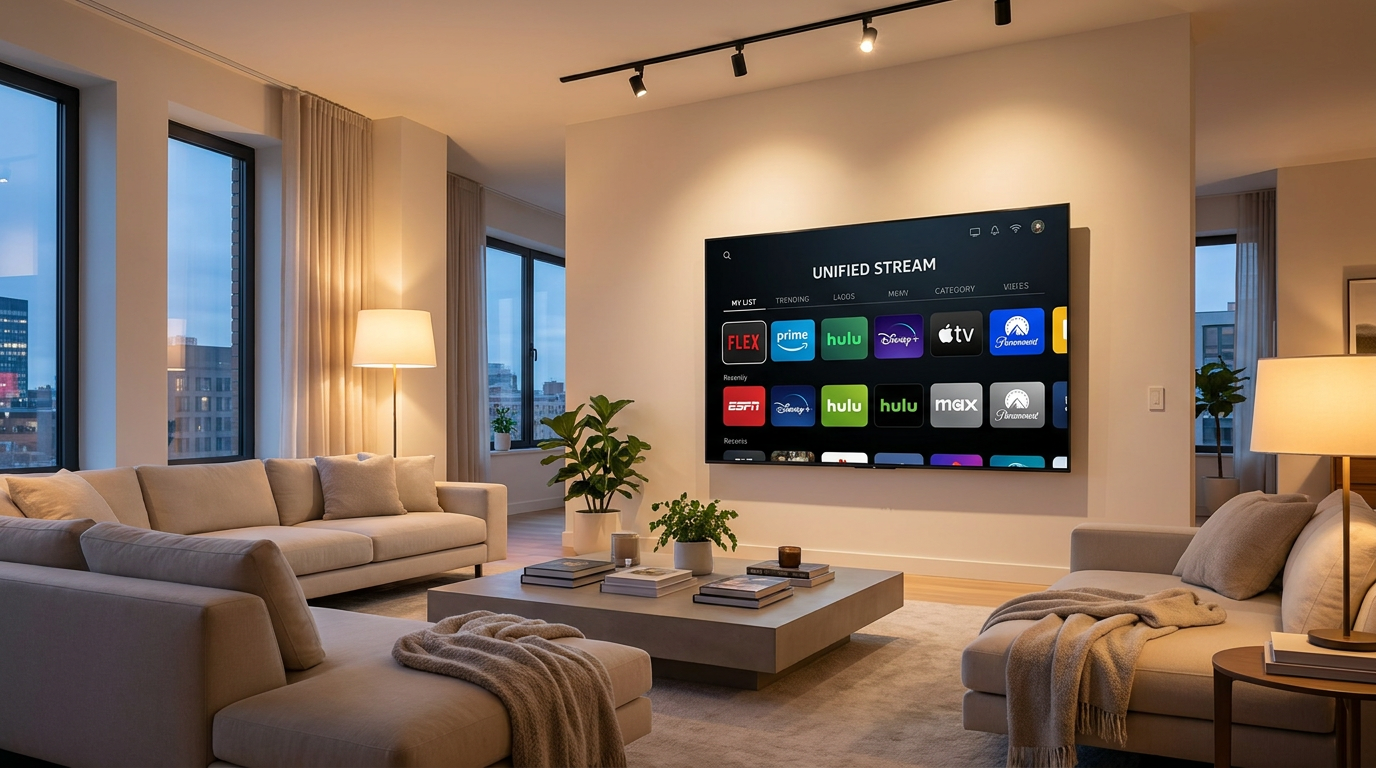
- New universal search features are reducing 'app fatigue' by allowing users to browse multiple platforms from a single interface.
For the better part of a decade, the streaming revolution felt like a bait-and-switch. What began as a cheap, unified alternative to cable television rapidly fractured into a dozen different apps, each demanding its own monthly fee. By late 2024, the average household was juggling multiple logins and facing a collective bill that often rivaled the legacy cable packages they had cut. But in 2026, the industry has officially pivoted. The "Great Re-Bundling" has arrived, and it is finally curing the app fatigue that has plagued viewers for years.[1][2]
The shift is being driven by unprecedented cooperation between rival media conglomerates. Rather than fighting a zero-sum war for standalone subscribers, giants like Disney, Warner Bros. Discovery, and Comcast have realized that joining forces is the only way to keep viewers from constantly canceling. The result is a wave of cross-platform "mega-bundles" that offer massive libraries at steeply discounted rates.[3][4]
The crown jewel of this new era is the Disney+, Hulu, and Max bundle. Initially launched as an experiment, the tri-service package has become a dominant force in the market. Industry analysts report that the Disney-Max alliance is currently "crushing it" in subscriber retention, boasting loyalty rates that are sending a wake-up call across the entertainment sector. By combining Marvel, Star Wars, HBO prestige dramas, and reality TV into one discounted package, the studios have created a formidable offering that viewers rarely pause.[5]

The financial relief for households is substantial. Consumers opting for the ad-free version of the Disney/Hulu/Max bundle pay roughly $32.99 per month—a nearly 42% savings compared to subscribing to each service individually. For those willing to watch advertisements, the cost drops even further to $19.99. Financial tracking platforms estimate that by migrating from a la carte subscriptions to optimized bundles, an average family can save between $400 and $700 annually.[1][4]
Telecom providers have aggressively entered the fray, acting as the new gatekeepers of digital entertainment. Comcast's "StreamSaver" add-on, for example, packages Netflix, Peacock, and Apple TV+ for just $15 a month, shaving $11 off the standard retail price. Similarly, Verizon's myPlan perks allow users to bundle Netflix and Max for a flat $10. These carriers are leveraging streaming discounts as a powerful tool to prevent customers from switching their mobile or internet providers.[1][2]
Telecom providers have aggressively entered the fray, acting as the new gatekeepers of digital entertainment.
Beyond the pricing relief, the actual user experience is finally catching up to the promise of the streaming age. The friction of remembering which show lives on which app is being smoothed over by universal search features. Amazon Prime Video, for instance, is rolling out cross-platform search capabilities designed to make its interface a default viewing hub, even for content hosted outside the Amazon ecosystem.[3]
This technological convergence is supported by rapid advancements in artificial intelligence. Streaming platforms in 2026 are deploying AI not just for personalized recommendations, but to dynamically optimize video quality and adaptive bitrates. This ensures that whether a user is watching a live sports broadcast on Peacock or a 4K movie on Netflix, the transition is seamless and buffer-free.[6]

For viewers who want to cut costs entirely, the rise of Free Ad-Supported Television (FAST) has provided a robust safety net. Platforms like Tubi, Pluto TV, and the Roku Channel have vastly improved their libraries, offering thousands of hours of premium movies and classic television at no cost. Combined with a single paid mega-bundle, these free services allow consumers to build a comprehensive entertainment package that fits almost any budget.[6]
The irony of the streaming industry reinventing the "cable bundle" is not lost on consumers, but the 2026 iteration comes with crucial upgrades. Unlike legacy cable, there are no hardware rental fees, no hidden broadcast surcharges, and no multi-year lock-in contracts. Users can still cancel with a single click—they just finally have a financial incentive not to.[4][5]
As the entertainment landscape settles into this new, cooperative equilibrium, the ultimate winner is the audience. The days of endlessly scrolling through fragmented apps and managing a spreadsheet of subscription costs are fading. By prioritizing retention over raw subscriber acquisition, the streaming industry has accidentally built exactly what viewers asked for in the first place: everything in one place, for a reasonable price.[2][3]

The integration of live sports is the final frontier for these mega-bundles. Historically the main reason viewers clung to traditional cable, live athletics are now fully embedded in the streaming ecosystem. Peacock's exclusive NFL games and the inclusion of ESPN Unlimited in higher-tier Disney bundles mean that sports fans no longer have to maintain a separate, expensive live-TV package just to catch the weekend's biggest matchups.[4][6]
Looking ahead, industry experts predict that the bundling trend will only accelerate. As smaller, niche streaming services struggle to survive on their own, they are increasingly likely to be absorbed into these larger aggregator platforms as add-on channels. For the everyday viewer, this consolidation signals a permanent shift toward simplicity, proving that in the digital age, cooperation can be just as profitable as competition.[3][7]
How we got here
Late 2023
Streaming prices surge across the board as studios prioritize profitability over raw subscriber growth.
Mid 2024
Disney and Warner Bros. Discovery announce the first cross-studio streaming bundle, signaling a shift in industry strategy.
Early 2025
Telecom giants like Comcast and Verizon launch proprietary streaming add-ons, acting as new aggregation hubs.
June 2026
Mega-bundles report record-high subscriber retention, effectively establishing the 'Great Re-Bundling' as the new industry standard.
Viewpoints in depth
Cost-Conscious Consumers
Viewers who prioritize lowering their monthly entertainment bills and simplifying their app management.
For years, audiences complained that cutting the cord had simply resulted in a more expensive, more confusing version of cable. The arrival of mega-bundles is viewed as a massive victory for household budgets. By utilizing carrier perks and cross-studio alliances, consumers are slashing their entertainment costs by hundreds of dollars a year while regaining the convenience of centralized billing and unified watchlists.
Studio Executives
Media companies focused on reducing subscriber churn and stabilizing long-term recurring revenue.
Behind closed doors, the streaming wars proved financially exhausting. Studios realized that viewers were 'churning'—subscribing for a single hit show and canceling a month later. By bundling their services with rivals, executives have successfully locked in long-term subscribers. While the profit margin per user is lower in a bundle, the sheer stability of the revenue stream makes it a highly lucrative trade-off.
Telecom & Tech Aggregators
Carriers and platform owners using streaming discounts to lock users into broader service ecosystems.
Companies like Verizon, Comcast, and Amazon view streaming not just as a product, but as a retention tool for their core businesses. By offering unbeatable deals on Netflix, Max, and Apple TV+, these telecom giants ensure that customers are highly unlikely to switch their internet or mobile providers. They have effectively positioned themselves as the indispensable middlemen of the modern entertainment era.
What we don't know
- Whether future price hikes will eventually erode the current savings of these mega-bundles.
- How smaller, independent streaming platforms will survive in a market dominated by massive studio alliances.
Key terms
- Mega-bundle
- A single subscription package that combines multiple major streaming services from different parent companies at a discounted rate.
- App fatigue
- The consumer frustration caused by having to manage, search, and pay for numerous separate streaming applications.
- Churn rate
- The percentage of subscribers who cancel their streaming service during a given period, often after finishing a specific show.
- FAST channels
- Free Ad-Supported Television platforms that offer on-demand and live content without a subscription fee.
- Universal search
- A feature that allows users to search for movies and shows across multiple different streaming platforms from a single interface.
Frequently asked
What is the Disney, Hulu, and Max bundle?
It is a unified subscription package that combines the libraries of all three services. In 2026, the ad-free version costs $32.99 per month, offering significant savings over buying them separately.
How are telecom companies involved in streaming?
Providers like Verizon and Comcast now offer heavily discounted streaming bundles, such as Netflix and Max for $10, as perks to retain their mobile and internet customers.
Are free streaming services still available?
Yes, Free Ad-Supported Television (FAST) platforms like Tubi and Pluto TV have expanded their libraries significantly, offering a free supplement to paid bundles.
Do these bundles require long-term contracts?
No. Unlike traditional cable, these streaming mega-bundles operate on a month-to-month basis and can be canceled at any time without penalty fees.
Sources
Source coverage
7 outlets
3 viewpoints surfaced







[1]LowerMySubsCost-Conscious Consumers
The Cheapest Streaming Bundles in 2026
Read on LowerMySubs →[2]CableTV.comCost-Conscious Consumers
Best Custom Streaming Bundles for 2026
Read on CableTV.com →[3]Streaming MediaStudio Executives
Paramount, WBD, and Amazon Reshape Streaming's Power Balance
Read on Streaming Media →[4]IGNStudio Executives
These Streaming Bundles Are Worth the Monthly Cost
Read on IGN →[5]Cordcutters CommunityCost-Conscious Consumers
Disney-Max Bundle Is 'Just Crushing It'
Read on Cordcutters Community →[6]PCMagTelecom & Tech Aggregators
The Best Video Streaming Services for 2026
Read on PCMag →[7]TheWrapTelecom & Tech Aggregators
Everything New on Streaming in June 2026
Read on TheWrap →

Every angle. Every day.
Get entertainment stories with full source coverage and perspective breakdowns delivered to your inbox.