
Fact-Checking the Evidence: Does Ranked-Choice Voting Actually Reduce Political Polarization?
As ranked-choice voting expands across the US, advocates promise it will cure toxic partisanship while critics call it a confusing scam. A review of the academic evidence reveals how the system actually alters campaign incentives.
By Factlen Editorial Team
- Electoral Reform Advocates
- Argue that RCV structurally incentivizes civility, reduces toxic polarization, and ensures winners have broad majority support.
- Academic Skeptics
- Point to mathematical models and mixed empirical data suggesting RCV's moderating effects are sometimes overstated.
- Election Integrity Advocates
- Focus on the administrative complexity of RCV and argue it must be paired with strict transparency to maintain voter trust.
- Neutral Evidence Analysts
- Evaluate the empirical data to separate factual outcomes from partisan rhetoric regarding ballot exhaustion and campaign tone.
What's not represented
- · Third-Party Candidates
- · Local Election Administrators
Why this matters
With political polarization reaching generational highs, understanding the actual data behind electoral reforms empowers voters to make informed decisions about how their democracy functions, rather than relying on partisan talking points.
Key points
- Ranked-choice voting is rapidly expanding as a proposed structural fix for political polarization.
- Evidence shows RCV heavily disincentivizes negative campaigning by forcing candidates to compete for second-choice votes.
- A 2025 Harvard study found a nearly 20% decrease in rhetorical extremism in Maine candidate platforms after RCV adoption.
- Mathematical models warn that in severely polarized environments, moderate candidates can still be eliminated early.
- Despite claims of voter confusion, over 80% of voters in RCV jurisdictions report understanding the ballot easily.
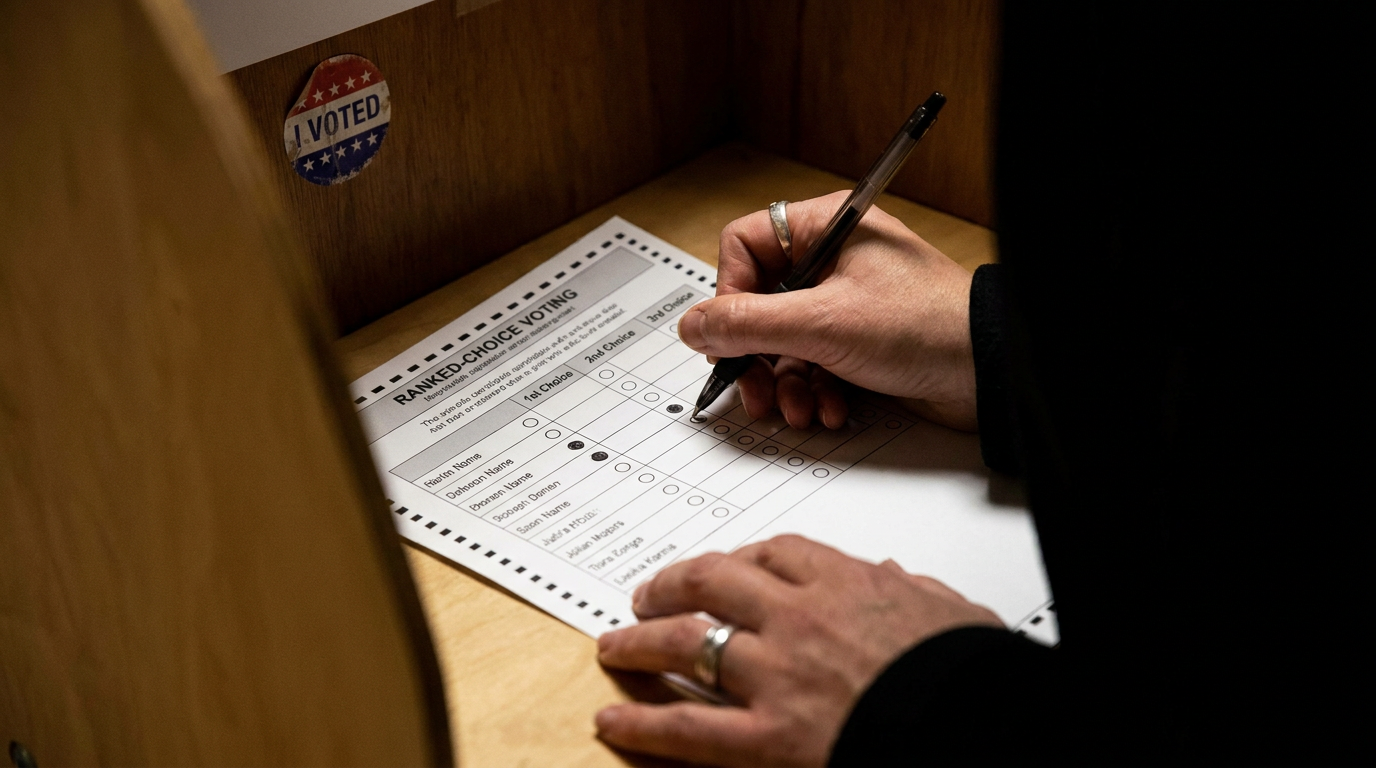
American political polarization has reached generational highs, prompting a desperate search for structural reforms that can lower the temperature. Across the country, the most rapidly expanding proposed solution is Ranked-Choice Voting (RCV), an alternative electoral system designed to replace traditional "winner-take-all" elections. As the reform gains momentum in cities and states, it has attracted both fierce advocacy and intense skepticism. Proponents promise that changing the ballot will fundamentally alter how politicians behave, incentivizing civility and moderating extreme partisanship. Critics, however, argue that the system is a confusing gimmick that fails to deliver on its utopian promises. With years of data now available from jurisdictions that have made the switch, researchers are finally able to fact-check the claims surrounding RCV and determine whether it actually heals democratic dysfunction.[9]
The mechanics of Ranked-Choice Voting are straightforward in theory, though a significant departure from the status quo. Instead of selecting a single candidate, voters rank the field in order of preference: first choice, second choice, third choice, and so on. If a candidate secures an outright majority of first-choice votes, they win immediately. If no one crosses the fifty-percent threshold, an instant runoff is triggered. The candidate with the fewest first-choice votes is eliminated, and the ballots cast for that candidate are redistributed to those voters' second choices. This process repeats until one candidate achieves a majority. The system is designed to eliminate the "spoiler effect," where a third-party candidate siphons votes from a mainstream contender, and to ensure that the ultimate winner possesses broad, majority support.[1][6][8]
The most prominent claim made by electoral reformers is that RCV structurally reduces negative campaigning and toxic political rhetoric. In a traditional plurality election, candidates often win by firing up a narrow, passionate base and aggressively attacking their opponents to suppress rival turnout. Under RCV, that "scorched earth" strategy carries a severe mathematical penalty. Because candidates often need second- or third-choice votes to survive the instant runoff rounds, they have a vested interest in not alienating their opponents' supporters. A candidate who viciously attacks a rival is highly unlikely to be ranked second by that rival's base. Consequently, advocates argue that the system forces politicians to build coalitions and focus on issues rather than personal destruction.[1][6][7]

Empirical evidence largely supports this theory of improved campaign civility, though with some notable caveats. A comprehensive review by the American Bar Association found that voters in cities utilizing RCV consistently perceive their local campaigns as less negative than voters in jurisdictions using traditional plurality rules. Surveys indicate that residents in RCV cities are twice as likely to report that local campaigns were "a lot less negative" and are significantly more satisfied with the conduct of the candidates. In debates and public forums, researchers have observed candidates referring to their opponents using more positive or neutral terms, actively courting cross-endorsements rather than engaging in zero-sum attacks.[1][6]
Furthermore, the reduction in negative campaigning appears to have downstream benefits for candidate diversity. Research highlighted by Ms. Magazine suggests that women and people of color are often deterred from running for public office due to the prevalence of toxic, hyper-negative campaign environments. By structurally discouraging vitriol, RCV has been correlated with more diverse candidate pools and higher success rates for non-traditional candidates who rely on broad coalition-building rather than entrenched partisan machinery. When candidates are incentivized to ask for a voter's second-choice slot rather than simply demanding absolute loyalty, the tone of the entire electoral ecosystem shifts toward persuasion.[7]
However, academic skeptics caution that RCV is not a magical cure for all political animosity. Researchers from the University of Minnesota evaluated the track record of RCV and concluded that its moderating effects are sometimes overstated by enthusiastic advocates. While some studies confirm a reduction in negative campaigning, others have found little to no impact, particularly in highly polarized online environments where partisan echo chambers operate independently of local ballot structures. The Minnesota researchers argue that while candidates might moderate their tone in official campaign materials, the broader political climate often remains highly combative, suggesting that ballot reform alone cannot entirely erase deep-seated ideological divides.[4]
Beyond campaign tone, the second major claim surrounding RCV is that it reduces political extremism and polarization among elected officials. The theory posits that because candidates must appeal to the median voter to secure a majority, extreme partisans who only appeal to the fringes will be systematically disadvantaged. A landmark 2025 study from Harvard University put this claim to the test by analyzing candidate campaign platforms in Maine, the first state to adopt RCV for federal elections. Utilizing text-based analysis of platforms from 2006 through 2024, the researchers quantified the level of political extremism before and after the state's 2018 transition to the new voting system.[2]
Beyond campaign tone, the second major claim surrounding RCV is that it reduces political extremism and polarization among elected officials.
The Harvard findings provided robust evidence for the moderating power of RCV. The study revealed a nearly twenty percent decrease in the rhetorical extremism of candidate platforms following the implementation of ranked-choice voting. The researchers concluded that the inherent incentives of the system—specifically the necessity of securing broader voter appeal to survive runoff rounds—directly contributed to a more moderate political environment. This moderation is not merely rhetorical; it appears to translate into legislative behavior. The Lugar Center for Bipartisanship recently ranked the congressional delegations from Alaska and Maine—the two states utilizing RCV for federal elections—as the most bipartisan in the entire nation.[2][6]

Despite these real-world successes, mathematical models suggest that RCV's ability to elect moderates has structural limits in severely divided electorates. A 2023 study published by New York University modeled the behavior of instant runoff voting under conditions of extreme polarization. The researchers discovered a paradox: when an electorate is deeply divided into two entrenched partisan camps, a true moderate candidate located at the ideological center might fail to capture enough passionate first-choice votes to survive the initial round of elimination. Even if that moderate would theoretically defeat any other candidate in a one-on-one matchup, they can be eliminated early, leaving voters to choose between two extremes in the final rounds.[3]
This dynamic highlights a vulnerability in the instant runoff mechanism. If polarization affects voters so deeply that they refuse to rank a moderate as their first choice, the system can still produce polarized outcomes. The NYU researchers noted that strategic moderates must sometimes adopt slightly more extreme positions just to ensure they survive the first round of counting. While RCV generally favors the less extreme party when polarization is asymmetrical, it is not a foolproof guarantee against extremism if the political center completely collapses in the first-preference vote.[3]

The third major area of contention involves voter comprehension and the legitimacy of the results. Critics frequently argue that RCV is overly complex, leading to voter confusion and "exhausted ballots"—ballots that do not factor into the final round because the voter did not rank the advancing candidates. Following Alaska's 2022 congressional election, where a Democrat won a seat previously held by Republicans, conservative critics labeled the system a "scam" and argued that voters who only ranked one candidate were effectively disenfranchised. They pointed to the thousands of ballots that were exhausted in the final tally as evidence that the system suppresses the true will of the people.[5][8]
Fact-checkers and election experts have largely debunked the claim that exhausted ballots equate to disenfranchisement. PolitiFact rated the assertion that voters were disenfranchised in Alaska as "Mostly False," clarifying that voters have the absolute right to rank only one candidate if they genuinely do not support anyone else on the ballot. An exhausted ballot is the mathematical equivalent of a voter choosing to stay home during a traditional runoff election because their preferred candidate was eliminated. Furthermore, data shows that RCV is actually three times less likely to result in "wasted" votes compared to a typical crowded plurality election, as it allows the vast majority of voters to have their preferences represented in the final count.[1][5]
Studies on voter behavior consistently show that the public grasps the concept of ranking with relative ease. Exit polling and academic reviews indicate that roughly eighty percent of voters across various demographics report understanding the RCV ballot perfectly well. In Santa Fe, eighty-four percent of voters found the ballot easy to use, and in Alaska's inaugural RCV election, over seventy percent of voters successfully ranked multiple candidates. Research also shows that voters of color and lower-income voters utilize the ranking feature at high rates, contradicting claims that the system is too complex for the general public to navigate.[1][6]

To bridge the gap between enthusiastic reformers and skeptical conservatives, some policy analysts suggest pairing RCV with robust election integrity measures. The Cardinal Institute, a conservative think tank, argues that while the benefits of single-elimination RCV are real—including reduced election costs, revealed voter preferences, and increased civility—the system must be implemented with strict transparency. They argue that if jurisdictions ensure results can be tabulated and audited swiftly, conservative legislators who are currently skeptical of the reform could embrace it as a tool that genuinely empowers the individual voter.[8]
Ultimately, the accumulated evidence suggests that Ranked-Choice Voting is neither a flawless democratic utopia nor a confusing partisan scam. It is a structural tool that demonstrably alters the incentive structures of political campaigns. By forcing candidates to compete for second-choice support, it reliably reduces negative campaigning and encourages broader coalition-building. While it cannot single-handedly cure the deepest ideological divides of the American electorate, the data from Maine, Alaska, and dozens of municipalities indicates that changing the rules of the game is one of the most effective ways to change the behavior of the players.[1][2][9]
How we got here
1918
Australia adopts preferential voting (a form of RCV) for its federal elections.
2018
Maine becomes the first US state to use RCV for federal elections.
2021
New York City implements RCV for its mayoral primary, becoming the largest US jurisdiction to use it.
2022
Alaska holds its first federal elections using RCV, drawing national attention to the system.
2025
A Harvard study confirms a nearly 20% drop in rhetorical extremism in Maine following RCV adoption.
Viewpoints in depth
Electoral Reform Advocates
Argue that RCV structurally incentivizes civility and ensures winners have broad majority support.
This camp, which includes organizations like FairVote, emphasizes that the mathematical realities of instant runoff voting force candidates to change their behavior. Because winning often requires securing the second-choice votes of an opponent's base, candidates are heavily disincentivized from engaging in 'scorched earth' negative campaigning. They point to data showing increased voter satisfaction, more diverse candidate pools, and the election of consensus-builders who might otherwise be eliminated in a crowded plurality primary.
Academic Skeptics
Highlight mathematical limits and mixed empirical data regarding RCV's moderating effects.
Researchers in this camp caution against viewing RCV as a panacea for deep-seated political dysfunction. They point to mathematical models demonstrating that in highly polarized electorates, a true moderate candidate can actually be eliminated in the first round if they lack a passionate base of first-choice supporters. Furthermore, they note that while official campaign materials might become more civil, the broader political ecosystem—especially online—often remains highly toxic, suggesting ballot reform alone cannot erase ideological divides.
Election Integrity Advocates
Focus on the administrative complexity of RCV and the potential for voter confusion.
This perspective raises concerns about the administrative burden of tabulating ranked ballots and the phenomenon of 'exhausted ballots,' where voters who choose not to rank multiple candidates do not have their votes counted in the final round. While some in this camp view the system as inherently flawed or disenfranchising, others argue it can be a valuable tool if paired with strict transparency measures, rapid auditing, and extensive voter education to ensure the public trusts the final results.
What we don't know
- Whether the moderating effects of RCV will hold up in highly polarized national presidential elections.
- How long-term candidate recruitment will permanently shift as political parties adapt their strategies to the new rules.
Key terms
- Ranked-Choice Voting (RCV)
- An electoral system where voters rank candidates by preference, rather than selecting just one.
- Instant Runoff
- The process in RCV where the lowest-performing candidate is eliminated and their votes are redistributed to voters' next choices until someone wins a majority.
- Plurality Voting
- The traditional "winner-take-all" system where the candidate with the most votes wins, even if they do not secure a majority.
- Exhausted Ballot
- A ballot that does not count in the final round of an RCV election because the voter chose not to rank any of the advancing candidates.
- Spoiler Effect
- A phenomenon in plurality elections where a third-party candidate draws votes away from a similar major candidate, potentially changing the outcome.
Frequently asked
Does ranked-choice voting favor one political party over the other?
No. Research shows RCV does not inherently favor Democrats or Republicans. It tends to favor candidates of any party who can build broad coalitions and appeal to the median voter.
What happens if I only want to vote for one candidate?
You are completely free to rank only one candidate. If that candidate is eliminated, your ballot simply becomes "exhausted" and does not transfer to anyone else.
Is ranked-choice voting constitutional?
Yes. Federal courts have repeatedly upheld RCV as constitutional, ruling that it complies with the "one person, one vote" principle because every voter gets exactly one active vote in each round of counting.
Does RCV eliminate negative campaigning entirely?
Not entirely. While it heavily disincentivizes "scorched earth" tactics by forcing candidates to compete for second-choice votes, some negative campaigning still occurs, particularly in online spaces.
Sources
Source coverage
9 outlets
4 viewpoints surfaced









[1]American Bar AssociationNeutral Evidence Analysts
Can ranked choice voting (RCV) enhance American democracy?
Read on American Bar Association →[2]Harvard UniversityNeutral Evidence Analysts
More Choices, Less Extremism: The Effect of Ranked-Choice Voting on Political Extremism in Maine
Read on Harvard University →[3]New York UniversityAcademic Skeptics
Ranked Choice Voting and Political Polarization
Read on New York University →[4]University of Minnesota ResearchersAcademic Skeptics
Where's the evidence supporting Ranked Choice Voting Claims?
Read on University of Minnesota Researchers →[5]PolitiFactNeutral Evidence Analysts
Fact-checking Tom Cotton on Alaska's ranked-choice voting
Read on PolitiFact →[6]FairVoteElectoral Reform Advocates
Ranked choice voting lowers polarization in politics
Read on FairVote →[7]Ms. MagazineElectoral Reform Advocates
How Ranked-Choice Voting Helps Women and People of Color
Read on Ms. Magazine →[8]Cardinal InstituteElection Integrity Advocates
Single-elimination ranked-choice voting usually has the best mix
Read on Cardinal Institute →[9]Factlen Editorial TeamNeutral Evidence Analysts
Synthesis by Factlen editorial team
Read on Factlen Editorial Team →
More in news politics
See all 7 stories →Geopolitics
U.S. and Iran Sign 14-Point Agreement at Versailles to End 110-Day War
6 sources

U.S.-Iran Deal
U.S. and Iran Sign Memorandum of Understanding to End 110-Day War
8 sources

UI Fraud Crackdown
Labor Department Threatens to Withhold State Funds in Sweeping Unemployment Fraud Crackdown
7 sources

US-Iran Accord
U.S. and Iran Sign 14-Point Memorandum of Understanding to End War and Reopen Strait of Hormuz
8 sources

Every angle. Every day.
Get news politics stories with full source coverage and perspective breakdowns delivered to your inbox.