
The Great Green Wall: How Africa is Engineering an 8,000-Kilometer Climate Defense
What began as a literal wall of trees across the Sahel has evolved into a massive, multi-sectoral agroforestry project aimed at restoring 100 million hectares of degraded land by 2030.
By Factlen Editorial Team
- International Climate Agencies
- Focuses on the massive potential for landscape restoration and carbon sequestration.
- African Union & Regional Planners
- Views the initiative as a pan-African engine for rural development and economic resilience.
- Independent Ecological Researchers
- Monitors actual progress, highlighting the gap between global funding pledges and ecological results.
What's not represented
- · Nomadic pastoralists whose grazing routes intersect with newly restored agricultural zones.
Why this matters
The Sahel is warming 1.5 times faster than the global average, threatening the livelihoods of over 100 million people. The Great Green Wall demonstrates how integrating traditional agroforestry with modern climate finance can combat desertification, secure food supplies, and prevent mass climate migration.
Key points
- The Great Green Wall has evolved from a literal wall of trees into a mosaic of sustainable agroforestry and rural development.
- The initiative aims to restore 100 million hectares of degraded land and create 10 million jobs across the Sahel by 2030.
- Traditional water-harvesting techniques, like zai pits and stone bunds, are central to improving soil fertility and crop survival.
- While socio-economic gains and job creation are strong, researchers note that ecological restoration is lagging behind targets.
- The African Union has introduced a new 10-year framework with rigorous tracking to ensure global funding reaches local communities.
The Sahel region of Africa, a vast semi-arid belt stretching from the Atlantic Ocean in the west to the Red Sea in the east, finds itself squarely on the frontline of the global climate crisis. Temperatures across this expansive corridor are currently rising 1.5 times faster than the global average, a stark meteorological reality that is triggering increasingly intense droughts, highly erratic rainfall patterns, and rapid soil degradation. For decades, the delicate balance of this ecosystem has been unraveling, leaving the landscape highly vulnerable to the encroaching sands of the Sahara Desert to the north.[3]
For the more than 100 million people who call this transitional corridor home, the creeping desertification represents an immediate and existential threat. As arable land vanishes beneath the sand and topsoil blows away, communities face the devastating loss of food security, reliable water access, and their traditional agricultural livelihoods. This environmental degradation acts as a powerful threat multiplier, exacerbating regional poverty and driving widespread outward migration as families are forced to abandon their ancestral lands in search of survival elsewhere.[3][7]
Recognizing the sheer scale of this impending catastrophe, the African Union launched an audacious, continent-wide counter-offensive in 2007: the Great Green Wall for the Sahara and the Sahel. The initial blueprint for this initiative was highly literal and visually striking—policymakers envisioned planting a continuous, 15-kilometer-wide barrier of trees spanning an astonishing 8,000 kilometers from Dakar, Senegal, all the way to Djibouti City, Djibouti. It was pitched as a monumental green shield designed to physically hold back the advancing desert.[2][4]
However, as the project moved from international conference rooms to the arid soil of the Sahel, scientists and local agrarian communities quickly realized that a monolithic forest planted in a fragile desert margin was ecologically unviable. A single continuous line of trees would struggle immensely to survive the region's punishing dry seasons. Furthermore, a strict conservation barrier failed to address the complex socio-economic needs of the millions of people living there, who required usable land for farming and grazing rather than an untouchable forest reserve.[3][7]

Consequently, the initiative underwent a profound and necessary evolution. Today, the Great Green Wall is no longer conceived as a literal wall of trees, but rather as a comprehensive 'mosaic' of sustainable land use practices, rural development programs, and targeted ecosystem restoration spanning 11 core nations. The overarching goal has shifted from simply planting trees to transforming millions of lives by creating productive, resilient landscapes that can support both human populations and local biodiversity. This paradigm shift acknowledged that true environmental defense requires human integration. By 2030, the revised initiative aims to restore 100 million hectares of degraded land, sequester 250 million tons of carbon dioxide, and create 10 million sustainable rural jobs.[2][3]
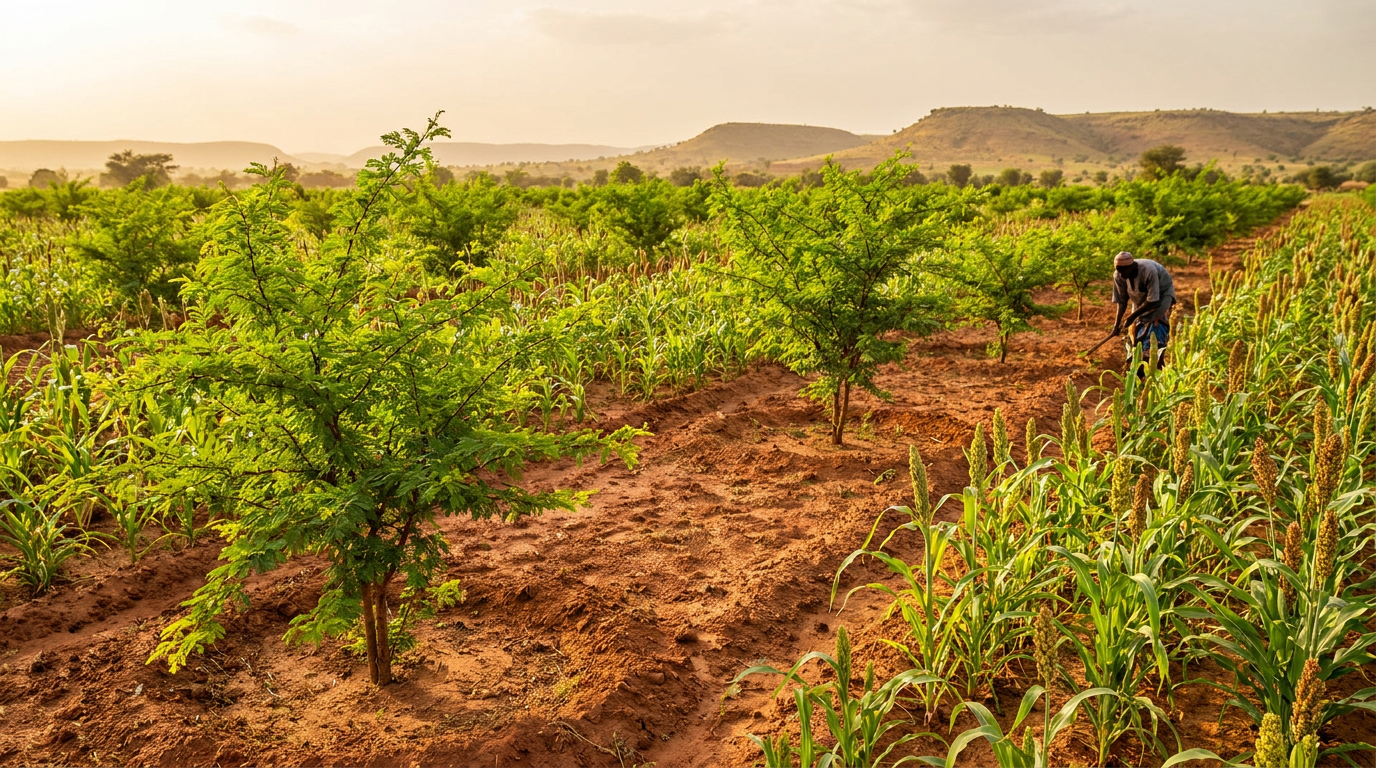
At the absolute heart of this revised strategy is the practice of agroforestry. Instead of attempting to plant isolated, standalone forests that compete with agriculture, farmers are now integrating drought-resistant native tree species directly into their active farming plots. Species such as the resilient acacia, the nutrient-dense baobab, and the fast-growing moringa are carefully cultivated alongside traditional food crops. This symbiotic approach ensures that the trees are actively protected and maintained by the farmers who directly benefit from their presence.[7]
To support these integrated trees and crops in a severely arid environment, communities have successfully revived and scaled up traditional, indigenous water-harvesting techniques. Farmers laboriously dig zai pits—small, precisely measured holes filled with organic compost that catch and retain scarce rainwater directly at the root zone. Additionally, they construct stone bunds, which are low walls built from rocks along the natural contours of the land, designed to slow down sudden rainwater runoff and prevent the nutrient-rich topsoil from washing away during heavy storms.[3][7]
These localized, low-tech interventions work together to create vital microclimates across the harsh landscape. The growing tree canopy provides essential shade that significantly lowers ground temperatures, protecting delicate crop shoots from the scorching sun. Meanwhile, the deep root systems of the native trees, combined with the water-trapping zai pits, dramatically improve the earth's overall ability to absorb and hold moisture. This enhanced soil fertility allows staple crops to survive and even thrive during prolonged dry spells that would have previously resulted in total harvest failure.[2]

These localized, low-tech interventions work together to create vital microclimates across the harsh landscape.
This ecological restoration is intrinsically linked to a powerful economic engine, proving that climate action can drive rural development. According to the African Union, the Great Green Wall initiative has already generated more than 350,000 jobs in sustainable agriculture, forestry, and landscape management across the Sahel. By transforming degraded, unusable dirt back into productive farmland, the project is actively reversing the economic despair that has historically driven young people to migrate away from rural villages toward overcrowded urban centers or across dangerous international borders.[7]
The restored landscapes offer immediate, tangible dividends to local families beyond just improved crop yields. The integrated native trees provide highly valuable secondary byproducts, including gum arabic—a highly sought-after commodity in the global food and cosmetic industries—as well as nutrient-dense moringa leaves that combat local malnutrition. Furthermore, the trees provide essential fuelwood and reliable livestock fodder, which diversifies rural incomes and builds a critical financial safety net, making communities far more resilient against inevitable climate shocks. These alternative revenue streams ensure that even if a primary harvest underperforms due to erratic weather, families still have goods to sell and consume, fundamentally altering the economic trajectory of the region.[2][7]
Senegal is frequently highlighted by international observers as the initiative's flagship success story and a model for neighboring nations. By effectively combining strong state support with enthusiastic local execution, the West African nation has successfully planted over 11 million native trees and restored approximately 27,000 hectares of heavily degraded land. The Senegalese approach proves that when local communities are given ownership of the restoration process and clear economic incentives, landscape-scale transformation is entirely possible. Villages that once struggled with encroaching sand dunes now boast thriving community gardens and stabilized soils, serving as a powerful proof of concept for the broader continental effort.[1][6]
Across the continent, Ethiopia has mobilized massive community planting campaigns that underscore the sheer scale of the initiative. The country has successfully put billions of seedlings into the ground, reclaiming vast tracts of degraded land and demonstrating the immense mobilization possible when national governments fully align with the Great Green Wall's objectives. While survival rates for these seedlings vary, the sheer volume of planting has significantly increased overall vegetation cover and helped stabilize vital watersheds that serve millions of rural citizens.[1][7]
The global community has increasingly rallied behind this pan-African vision, recognizing its dual role in climate mitigation and poverty reduction. International partners, including the World Bank and the European Union, have pledged more than $20 billion in total support. In recent years, the project received a massive $14.3 billion commitment through the Great Green Wall Accelerator, a financial mechanism launched at the One Planet Summit designed specifically to fast-track funding from international donors directly to the 11 participating countries.[1]
Yet, translating these massive global financial pledges into tangible socio-ecological change on the ground remains a formidable challenge. A comprehensive 2025 study published in the journal Land Use Policy examined the project's progress and found a stark dichotomy: while the socio-economic benefits and job creation metrics have been highly encouraging, the actual ecological restoration is lagging far behind the ambitious 2030 targets. The total acreage of fully restored land remains only a fraction of the 100-million-hectare goal. Researchers caution that without a significant acceleration in planting and land rehabilitation, the initiative risks falling short of its core environmental mandate.[1]

Researchers and African officials point to severe, systemic bottlenecks in the international funding pipeline. A significant portion of the billions announced at high-profile global summits has been frustratingly slow to reach the local organizations, municipalities, and farmers doing the actual planting. Furthermore, escalating security concerns and political instability in several Sahelian nations have severely disrupted on-the-ground implementation, making it difficult for agencies to safely operate and monitor progress in some of the region's most vulnerable corridors. These logistical and geopolitical hurdles highlight the immense difficulty of executing a synchronized, multi-national infrastructure project across one of the most complex regions on Earth.[1][2]
Acknowledging the urgent need for a more rigorous, transparent, and efficient approach, the African Union recently unveiled its revised Great Green Wall Strategy and Ten-Year Implementation Framework for the 2024–2034 period. This updated roadmap is specifically designed to address the administrative bottlenecks that have hampered progress, streamlining the flow of capital and ensuring that national action plans are tightly aligned with local realities. The framework emphasizes decentralized execution, putting more resources directly into the hands of the rural communities managing the land.[4]
A cornerstone of this new operational framework is the MELA approach—Monitoring, Evaluation, Learning, and Adaptation. Supported by international agricultural research groups like CGIAR, MELA introduces a standardized, multi-scale scorecard to track real-time changes across the continent. Instead of relying on vague estimates, the system rigorously measures ecosystem health, institutional policy shifts, and community well-being. This data-driven feedback loop ensures that future funds are deployed effectively, allowing project managers to quickly adapt their strategies if certain tree species fail or specific interventions underperform.[5]

The initiative's holistic, community-integrated model is now inspiring other highly vulnerable regions across the continent. Environmental planners in Southern Africa, facing their own alarming trends in land degradation and prolonged droughts, are actively exploring a similar coordination mechanism. By studying the successes and missteps of the Sahel project, Southern African leaders hope to boost international investment and unify their own landscape restoration efforts across their vast dryland belts, proving the exportable value of the Great Green Wall framework. The ability to rally multiple nations around a single, unifying environmental goal is increasingly seen as the gold standard for regional climate adaptation.[6]
Ultimately, the Great Green Wall has transcended its original, somewhat simplistic design. It stands today not as a literal barrier of trees, but as a continent-wide masterclass in adaptive climate strategy. By shifting from a top-down conservation project to a grassroots economic engine, the initiative proves that true environmental resilience must be deeply rooted in the economic survival and traditional knowledge of local communities. As the 2030 deadline approaches, the project remains one of the most hopeful, ambitious, and necessary climate interventions on the planet.[8]
How we got here
2007
The African Union officially launches the Great Green Wall initiative, initially conceived as a continuous line of trees.
2012
The strategy pivots from a literal wall to a holistic 'mosaic' approach emphasizing agroforestry and rural development.
Jan 2021
International partners pledge $14.3 billion at the One Planet Summit to launch the Great Green Wall Accelerator.
2024
The African Union introduces a revised Ten-Year Implementation Framework to improve monitoring and funding distribution.
Oct 2025
A major study in Land Use Policy highlights strong socio-economic gains but warns that ecological restoration is lagging.
Viewpoints in depth
International Climate Agencies
Focuses on the massive potential for landscape restoration and carbon sequestration.
Organizations like the UN Environment Programme and the Green Climate Fund view the Great Green Wall primarily as a vital carbon sink and biodiversity shield. They emphasize that restoring 100 million hectares of land is one of the most cost-effective ways to sequester 250 million tons of carbon while halting the southern expansion of the Sahara. For these agencies, the project is a crucial pillar of the global climate mitigation strategy.
Local Agrarian Communities
Prioritizes immediate food security, water retention, and economic survival.
For the farmers and pastoralists living in the Sahel, the initiative is less about global carbon targets and entirely about livelihood survival. They value the project for its integration of traditional practices like zai pits and stone bunds, which immediately improve crop yields. The ability to harvest secondary products like fodder, fuelwood, and moringa provides a vital economic safety net that prevents forced migration during drought years.
Ecological Researchers
Highlights the gap between global funding pledges and on-the-ground ecological results.
Academic researchers and policy analysts warn that the initiative's ecological progress is lagging behind its socio-economic wins. Studies point out that while billions of dollars are pledged at international summits, bureaucratic bottlenecks prevent much of that capital from reaching the grassroots level. They advocate for rigorous tracking frameworks, like the new MELA scorecard, to ensure accountability and adapt strategies where tree survival rates remain low.
What we don't know
- Whether the $20 billion in global pledges will successfully bypass bureaucratic bottlenecks to reach local implementing farmers.
- How escalating security concerns in several Sahelian nations will impact the long-term maintenance of restored landscapes.
- If the newly implemented MELA tracking framework will be enough to accelerate ecological progress before the 2030 deadline.
Key terms
- Agroforestry
- An agricultural approach that integrates the planting of trees and shrubs directly into crop and animal farming systems to create environmental and economic benefits.
- Desertification
- The process by which fertile land becomes desert, typically as a result of drought, deforestation, or inappropriate agriculture.
- Sahel
- A vast semi-arid region of Africa stretching across the continent just south of the Sahara Desert, serving as a transition zone to the savannas.
- Zai pits
- A traditional soil conservation technique involving digging small, compost-filled holes to catch and concentrate runoff water for plant roots.
- Stone bunds
- Low walls built from stones along the natural contours of a slope to slow down rainwater runoff and prevent topsoil from washing away.
Frequently asked
Is the Great Green Wall an actual wall of trees?
No. While originally conceived in 2007 as a continuous 15-kilometer-wide line of trees, it has evolved into a 'mosaic' of sustainable farming, water harvesting, and targeted reforestation across the Sahel.
Which countries are participating in the initiative?
The core project spans 11 countries across the Sahel region, stretching from Senegal and Mauritania in the west to Ethiopia and Djibouti in the east.
What are zai pits and how do they help?
Zai pits are a traditional farming technique where small holes are dug into arid soil and filled with organic compost. They capture and retain scarce rainwater, drastically improving crop survival during dry spells.
How much of the Great Green Wall is completed?
Progress varies significantly by country. While nations like Senegal and Ethiopia have restored millions of hectares, overall ecological restoration is currently lagging behind the ambitious 2030 targets due to funding bottlenecks and regional insecurity.
Sources
Source coverage
8 outlets
3 viewpoints surfaced








[1]MongabayIndependent Ecological Researchers
A recent study examines the progress to realize Africa's Great Green Wall initiative
Read on Mongabay →[2]Agrifocus AfricaAfrican Union & Regional Planners
The Great Green Wall for the Sahara and the Sahel: Progress and Impact
Read on Agrifocus Africa →[3]UN Environment ProgrammeInternational Climate Agencies
Africa's Great Green Wall shifts from literal wall to mosaic of green landscapes
Read on UN Environment Programme →[4]African UnionAfrican Union & Regional Planners
The Great Green Wall Initiative (GGWI) Strategy and Ten-Year Implementation Framework
Read on African Union →[5]CGIARInternational Climate Agencies
African Union Great Green Wall Initiative Strategy: Monitoring, Evaluation, Learning and Adaptation
Read on CGIAR →[6]World Agroforestry CentreInternational Climate Agencies
Southern Africa could benefit enormously from a coordination mechanism like the Great Green Wall
Read on World Agroforestry Centre →[7]GreenlyIndependent Ecological Researchers
The Great Green Wall: Economic impacts and agroforestry
Read on Greenly →[8]Factlen Editorial TeamIndependent Ecological Researchers
Synthesis by Factlen editorial team
Read on Factlen Editorial Team →

Every angle. Every day.
Get world stories with full source coverage and perspective breakdowns delivered to your inbox.