
The First Working Nuclear Clock Is Here: Why Timekeeping Just Changed Forever
Physicists have successfully built the world's first working nuclear clocks using the thorium-229 isotope. By measuring the 'ticking' of an atomic nucleus rather than its electron shell, the breakthrough promises timekeeping so precise it could revolutionize deep-space navigation and secure communications.
By Factlen Editorial Team
- Quantum Metrologists
- Physicists focused on using the clock to test the fundamental laws of nature.
- Aerospace & Defense Engineers
- Engineers focused on the clock's potential to revolutionize navigation in GPS-denied environments.
- Materials Scientists
- Researchers focused on the physical medium used to host the thorium atoms.
What's not represented
- · Commercial GPS providers who may face disruption from satellite-free navigation tech.
- · Telecommunications infrastructure operators who rely on current atomic clocks for network synchronization.
Why this matters
Our modern world relies entirely on the precise timing of atomic clocks—from GPS navigation to financial transactions and power grid synchronization. A nuclear clock is vastly more stable and immune to environmental interference, meaning it could keep our infrastructure running even if satellite signals are jammed or destroyed.
Key points
- Physicists have successfully demonstrated the world's first fully operational nuclear clocks.
- Unlike atomic clocks that measure electron shells, nuclear clocks measure the tightly bound atomic nucleus, making them immune to most environmental interference.
- The breakthrough relies on thorium-229, the only known isotope with a nuclear isomer low enough in energy to be excited by laboratory lasers.
- Recent advances in electroplating thorium onto steel have dramatically simplified the clock's design, paving the way for eventual miniaturization.
Timekeeping is the invisible heartbeat of modern civilization. From the synchronization of global financial markets to the GPS satellites that guide our phones, the modern world relies entirely on the ultra-precise ticking of atomic clocks.[1]
But atomic clocks, which measure the oscillation of electrons as they jump between energy states, have a fundamental vulnerability. Electrons reside on the outer edge of an atom, making them susceptible to environmental disturbances like stray magnetic fields, temperature fluctuations, and electromagnetic interference.[2]
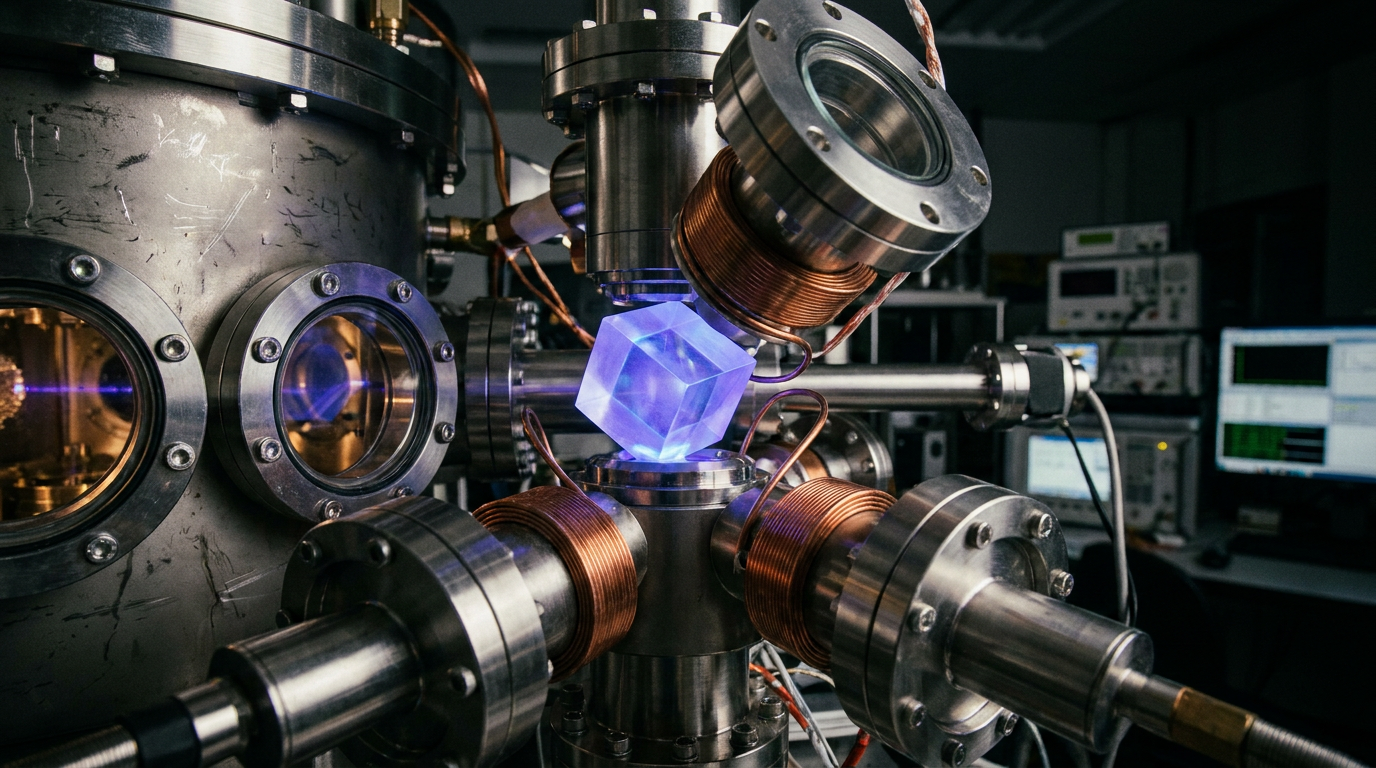
For decades, physicists have dreamed of a more robust alternative: a nuclear clock. Instead of measuring the fragile electron shell, a nuclear clock would measure the "ticking" of the atomic nucleus itself. Because protons and neutrons are bound together by the strong nuclear force, they are heavily shielded from outside noise, promising a timepiece that would neither gain nor lose a second over billions of years.[3][4]
The problem has always been one of energy. Typical nuclear transitions require massive amounts of energy—usually in the form of high-frequency gamma rays—which cannot be produced with the precision lasers required for timekeeping.[5]

There is, however, one known exception in the entire universe of isotopes: thorium-229. Since the 1970s, physicists have known that this specific radioactive isotope possesses a bizarrely low-energy excited state, known as a nuclear isomer.[1]
The energy required to excite the thorium-229 nucleus is just 8.4 electron volts. This corresponds to a wavelength of roughly 145 nanometers, placing it in the vacuum-ultraviolet spectrum—a frequency that can, theoretically, be reached by modern laboratory lasers.[7]
Turning that theory into reality took half a century. The first major breakthrough arrived in mid-2024, when a coalition of researchers from TU Wien and JILA successfully coupled a strontium atomic clock to a calcium fluoride crystal doped with thorium nuclei.[4]
That 2024 prototype proved the concept, but it was only the beginning. Now, the decades-old dream of a fully operational nuclear clock has finally been realized. In June 2026, two independent teams of researchers reported the successful construction of working nuclear clocks.[3][8]
That 2024 prototype proved the concept, but it was only the beginning.
"In some types of measurements, we're already outperforming all of the atomic clocks," noted physicist Thorsten Schumm of TU Wien, whose team published their findings alongside a parallel effort from Tsinghua University.[3]

The physics behind these new clocks is so fundamentally different from their atomic predecessors that they are already breaking new ground. Because the nucleus is governed by the strong force rather than electromagnetism, the clock can be used to test whether the fundamental constants of nature are actually changing over time.[5]
The TU Wien team has already used their nuclear clock to search for ultralight dark matter—the invisible substance thought to make up most of the universe's mass. While they haven't found it yet, the clock's sensitivity to certain dark matter candidates already rivals or beats the best atomic clocks in existence.[3]
As the physics of the clock matures, so too does the engineering required to build it. Until recently, the standard approach involved painstakingly growing specialized calcium fluoride crystals to host the thorium atoms.[5]
But a recent breakthrough by researchers at UCLA has dramatically simplified the process. By slightly modifying a technique used to electroplate jewelry, the team discovered they could simply electroplate a minute amount of thorium onto stainless steel.[6]
This electroplating method not only uses a fraction of the rare isotope but also generates a measurable electric current when the nucleus is excited by a laser. This electrical readout is a crucial step toward miniaturizing the clock, moving it out of the laboratory and into deployable devices.[6]

The implications for aerospace and defense are profound. Currently, deep-space probes cannot self-navigate in real-time; they must wait for Earth to transmit timing signals, a process plagued by latency.[1]
"Thorium nuclear clocks could revolutionize fundamental physics measurements," noted Eric Burt, who leads the High Performance Atomic Clock project at NASA's Jet Propulsion Laboratory. He added that such clocks could establish a solar-system-wide time scale, essential for a permanent human presence on other planets.[6]
Closer to home, miniaturized nuclear clocks could unlock true satellite-free navigation. If a solar storm or a hostile actor were to disable the GPS satellite network, military submarines, power grids, and telecommunications networks equipped with nuclear clocks could continue operating seamlessly.[6]

The race is now on to shrink the complex vacuum-ultraviolet lasers required to drive the clock. With parallel advances in deep-ultraviolet crystal growth, the components necessary for a portable, ultra-stable nuclear clock are rapidly falling into place.[1][7]
Just as the atomic clock defined the technological leaps of the 20th century—enabling everything from the internet to global positioning—the nuclear clock is poised to define the 21st. The ultimate timepiece has arrived, and the race to harness it has only just begun.[2]
How we got here
1976
Physicists first find evidence of a uniquely low-energy nuclear isomer in thorium-229.
2003
The concept of a nuclear clock based on thorium-229 is formally proposed.
April 2024
Researchers successfully switch a thorium nucleus between states using a laser for the first time.
September 2024
The first rudimentary prototype is created by coupling a strontium atomic clock to a thorium crystal.
January 2026
UCLA researchers discover how to electroplate thorium onto steel, drastically simplifying the clock's design.
June 2026
Independent teams publish papers detailing the first fully operational, standalone nuclear clocks.
Viewpoints in depth
Quantum Metrologists
Physicists focused on using the clock to test the fundamental laws of nature.
For quantum metrologists, the nuclear clock is less about keeping time and more about probing the universe's deepest mysteries. Because the nucleus is governed by the strong nuclear force—unlike the electron shell, which is governed by electromagnetism—comparing a nuclear clock to an atomic clock over time can reveal if the fundamental constants of nature are shifting. Furthermore, the clock's extreme precision makes it an unprecedented tool for detecting the subtle gravitational effects of ultralight dark matter.
Aerospace & Defense Engineers
Engineers focused on the clock's potential to revolutionize navigation in GPS-denied environments.
The aerospace and defense sectors view the nuclear clock as the ultimate solution to the vulnerability of satellite navigation. GPS signals are easily jammed, spoofed, or blocked underwater and in deep space. A miniaturized nuclear clock would allow submarines to remain submerged indefinitely without losing their exact positional fix, and would enable deep-space probes to self-navigate without waiting for timing signals to travel millions of miles from Earth.
Materials Scientists
Researchers focused on the physical medium used to host the thorium atoms.
Materials scientists are currently debating the best way to physically build the clock. The traditional approach involves doping thorium into transparent calcium fluoride crystals, which allows for a high density of atoms but requires complex, painstaking crystal growth. Conversely, the recent breakthrough in electroplating thorium directly onto stainless steel offers a cheaper, highly scalable alternative that generates a direct electrical readout, though it presents different challenges for laser excitation.
What we don't know
- Exactly how quickly the bulky vacuum-ultraviolet lasers required to drive the clock can be miniaturized for portable use.
- Whether calcium fluoride crystals or electroplated steel will ultimately become the industry standard for hosting the thorium atoms.
- If the extreme precision of the clock will actually reveal fluctuations in the fundamental constants of nature, as some physicists theorize.
Key terms
- Nuclear Isomer
- A metastable state of an atomic nucleus caused by the excitation of one or more of its protons or neutrons.
- Thorium-229
- A radioactive isotope of thorium that possesses the lowest-energy nuclear isomer known to physics.
- Atomic Clock
- A timekeeping device that uses the microwave or optical transition frequencies of electrons in atoms as a frequency standard.
- Frequency Comb
- A specialized laser source whose spectrum consists of a series of discrete, equally spaced frequency lines, used to precisely measure light.
Frequently asked
Why is a nuclear clock better than an atomic clock?
Because it measures the nucleus rather than the electron shell, it is heavily shielded from environmental disturbances like magnetic fields and temperature changes.
When will nuclear clocks be used in everyday life?
While prototypes exist today, it will likely take several years of engineering to miniaturize the required ultraviolet lasers before they can be deployed in portable devices.
Is the radioactive thorium dangerous?
The amounts of thorium-229 used in these clocks are microscopic—often just a thin film or a few atoms doped into a crystal—posing no radiation hazard.
Sources
Source coverage
8 outlets
3 viewpoints surfaced








[1]Factlen Editorial TeamAerospace & Defense Engineers
Synthesis by Factlen editorial team
Read on Factlen Editorial Team →[2]New ScientistMaterials Scientists
First working nuclear clock heralds a new era in timekeeping
Read on New Scientist →[3]Science NewsQuantum Metrologists
For the first time, scientists used an atomic nucleus as a clock
Read on Science News →[4]NatureQuantum Metrologists
Frequency ratio of the 229mTh nuclear isomeric transition and the 87Sr atomic clock
Read on Nature →[5]TU WienQuantum Metrologists
The first nuclear clock
Read on TU Wien →[6]UCLAAerospace & Defense Engineers
A simpler approach uses far less thorium for nuclear clocks
Read on UCLA →[7]Menlo SystemsMaterials Scientists
Solid-state nuclear clock based on Thorium-229
Read on Menlo Systems →[8]arXiv
First demonstration of a fully operational nuclear clock
Read on arXiv →

More in science
See all 74 stories →Cellular Imaging
The Laser Phase Plate: A Century-Old Physics Trick Just Unlocked the Human Proteome
5 sources
Cancer Vaccines
Personalized mRNA Cancer Vaccine Halves Melanoma Recurrence in 5-Year Milestone
8 sources

Cryo-EM Advance
Laser Phase Plate Breakthrough Illuminates the Smallest Proteins in Human Cells
7 sources
Ocean Tech
How Solar LEDs and Acoustic Pingers Are Solving the Global Bycatch Crisis
6 sources

Every angle. Every day.
Get science stories with full source coverage and perspective breakdowns delivered to your inbox.