
The First Working Nuclear Clock Is Here: How Thorium-229 Is Rewriting Timekeeping
Decades of theoretical physics have culminated in the first functional nuclear clock, a device that measures time using the nucleus of an atom rather than its electron shell. The breakthrough promises to revolutionize GPS-free navigation and our understanding of fundamental physics.
By Factlen Editorial Team
- Quantum Metrologists
- Focused on pushing the absolute limits of precision timekeeping and redefining the SI second.
- Aerospace & Defense Engineers
- Focused on the practical applications of GPS-independent, autonomous navigation.
- Fundamental Physicists
- Focused on using the clock as a sensor to probe dark matter and the constants of nature.
What's not represented
- · Commercial GPS providers who may need to upgrade satellite constellations to support nuclear timekeeping.
- · Regulatory bodies (like the BIPM) responsible for officially redefining global time standards.
Why this matters
Current atomic clocks lose about one second every 30 million years, but they are fragile and sensitive to environmental interference. Nuclear clocks are virtually immune to outside disturbances, paving the way for ultra-precise, portable timekeeping that works underwater, in deep space, and in high-interference environments where GPS fails.
Key points
- Scientists have demonstrated the first working nuclear clock, measuring time via the nucleus rather than the electron shell.
- The device utilizes Thorium-229, the only known isotope with an energy jump small enough to be triggered by a laser.
- Nuclear clocks are highly shielded from environmental noise, theoretically losing less than one second over 300 billion years.
- Recent breakthroughs in continuous-wave ultraviolet lasers and solid-state electroplating have made the clock practical.
- The technology promises to revolutionize GPS-free navigation for submarines and deep-space probes.
- Physicists plan to use the clock to test if the fundamental constants of nature are changing over time.
Timekeeping is about to undergo its biggest technological revolution since the invention of the atomic clock in the 1950s. After decades of theoretical groundwork and incremental laboratory successes, scientists have successfully demonstrated the world's first working nuclear clock. Unlike traditional atomic clocks, which measure time by tracking the movement of electrons, this new device measures time by probing the dense, tightly bound heart of an atom itself. The milestone marks the realization of a long-held physics dream, bringing unprecedented precision to how humanity measures the passage of time and opening entirely new frontiers in quantum mechanics.[1][6]
The breakthrough promises to redefine the limits of precision measurement. While today's best optical atomic clocks are incredibly accurate—losing only a fraction of a second over millions of years—they are fundamentally limited by their reliance on the atomic electron shell. Electrons are highly sensitive to their environment; they can be easily disturbed by stray magnetic fields, temperature fluctuations, and ambient electromagnetic radiation. These vulnerabilities mean that atomic clocks require highly controlled, pristine laboratory conditions to function at their peak, making them difficult to deploy in rugged or unpredictable environments.[2][6]
A nuclear clock bypasses these environmental vulnerabilities entirely. Because the nucleus is roughly 100,000 times smaller than the overall atom, its internal energy states are heavily shielded from outside noise. This inherent structural stability means a nuclear clock could theoretically achieve a fractional uncertainty of 10⁻¹⁹. In practical terms, that equates to losing or gaining less than a single second over 300 billion years—a span of time more than twenty times longer than the current age of the universe. Such stability represents a monumental leap over existing timekeeping standards.[4][5][6]

Building such a device, however, was long considered practically impossible due to the extreme forces involved. To make a quantum clock 'tick,' scientists must fire a highly specific laser at an atom to trigger a jump between energy levels. For almost all known elements in the universe, exciting the tightly bound nucleus requires massive bursts of energy in the form of X-rays or gamma rays. Unfortunately, humanity does not yet possess the technology to produce X-rays with the precise, continuous, and highly controlled wavelengths needed to drive a reliable clock.[2][8]
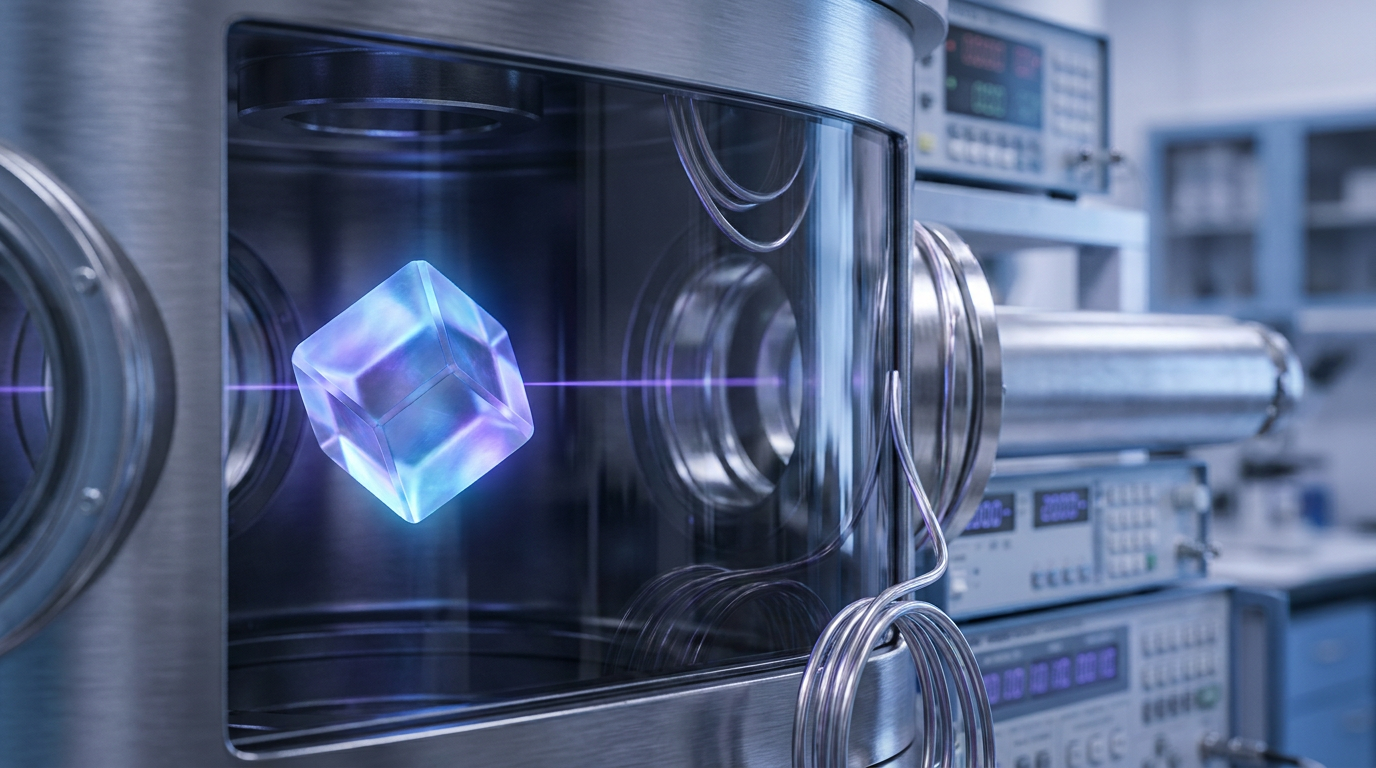
The sole exception in the entire periodic table is Thorium-229. This rare, radioactive isotope possesses a uniquely low-energy 'isomeric state.' Its nucleus requires an energy jump of just 8.4 electron volts to transition—an amount small enough to be triggered by a specialized vacuum ultraviolet laser rather than a high-energy X-ray. For decades, physicists have recognized that if a nuclear clock were ever to be built, Thorium-229 would be the only viable engine to power it, sparking a global race to harness its unique properties.[2][7]
The path to a working prototype accelerated rapidly following a landmark 2024 demonstration. Researchers at JILA, NIST, and TU Wien successfully embedded Thorium-229 ions into a transparent calcium fluoride crystal. By hitting the crystal with a customized vacuum ultraviolet laser and using an optical frequency comb to count the resulting wave cycles, they established the first direct frequency link between a nuclear transition and a traditional strontium atomic clock. That experiment proved the fundamental physics, demonstrating that a nuclear 'tick' could be reliably measured.[2][5]
While that 2024 experiment proved the underlying physics, it was not yet a standalone, continuously running clock. It required massive laboratory infrastructure, complex calibration, and was highly experimental in nature. Over the past two years, however, parallel breakthroughs across the globe have systematically solved the remaining engineering bottlenecks. International research teams have transformed a delicate, proof-of-concept physics experiment into a robust, functional prototype capable of continuous operation, bringing the technology out of the theoretical realm and into practical reality.[1][6]

While that 2024 experiment proved the underlying physics, it was not yet a standalone, continuously running clock.
In early 2026, a major hurdle regarding the laser system was finally cleared. A Chinese research team successfully developed the world's first 148-nanometer continuous-wave ultra-narrow-linewidth laser. By utilizing a complex process known as four-wave mixing in metal vapor, they created a highly stable, continuous vacuum ultraviolet beam. This achievement overcame what was widely considered the 'last core bottleneck' in the field, providing the exact, uninterrupted wavelength of light required to drive the thorium nucleus reliably without degrading the signal.[4]
Simultaneously, materials scientists discovered how to make the clock rugged and portable, moving away from the fragile crystal lattices used in early experiments. Researchers found that electroplating tiny amounts of thorium directly onto steel yielded the exact same precise nuclear transitions. This centuries-old metal-plating technique stabilizes the radioactive atoms while drastically simplifying the clock's physical architecture. By embedding the thorium in a solid, opaque metal, the clock can withstand extreme physical stress, moving it out of the fragile laboratory environment and into field-ready applications.[3][8]
The culmination of these rapid advances is a functional nuclear clock prototype that operates with unprecedented stability and signal strength. Because the solid-state design allows trillions of thorium nuclei to be interrogated simultaneously—far more than the sparse, isolated gas clouds used in traditional atomic clocks—the resulting timing signal is incredibly strong and resilient. This high signal-to-noise ratio ensures that the clock can maintain its extreme accuracy even when subjected to the physical vibrations and temperature shifts of the outside world.[1][5][6]

The immediate practical applications for this technology are vast, particularly for the aerospace and defense sectors. Modern global infrastructure, from high-frequency financial trading markets to the synchronization of the power grid, relies entirely on the precise timing signals beamed down by GPS satellites. However, these satellite signals are relatively weak and highly vulnerable to interference. If those satellites are jammed by hostile actors, spoofed, or destroyed by space debris, critical navigation and synchronization systems on Earth would rapidly fail, plunging modern logistics into chaos.[3][6]
A portable nuclear clock could provide GPS-level accuracy entirely autonomously, without ever needing to connect to a vulnerable satellite network. Military submarines equipped with a solid-state thorium clock could navigate deep underwater for months at a time without surfacing for a satellite fix, maintaining perfect positional awareness through dead reckoning. Similarly, deep-space probes could coordinate complex orbital maneuvers across the solar system autonomously, without waiting hours for timing signals to travel back and forth from Earth, drastically reducing the risk of mission failure during critical planetary encounters.[3][4]
Beyond navigation and defense, the nuclear clock is poised to become one of the most sensitive instruments ever built for fundamental physics research. Because the nucleus is governed by the strong nuclear force—unlike the electron shell, which is governed by electromagnetism—the clock ticks to a fundamentally different rhythm than an atomic clock. By continuously comparing a nuclear clock to an atomic clock over several years, physicists will be able to test whether the fundamental constants of nature, such as the fine-structure constant, are actually shifting over cosmic time.[7]

Theoretical physicists also believe the clock could act as an ultra-sensitive detector for dark matter, the mysterious substance that makes up the majority of the universe's mass. If certain types of ultra-light dark matter interact with normal matter as they pass through the Earth, their presence could cause microscopic fluctuations in the strong nuclear force. These fluctuations would register as a tiny, temporary shift in the nuclear clock's ticking rate, providing the first direct, measurable evidence of dark matter interacting with the visible world.[7][8]
As research teams now work to miniaturize the laser components and refine the solid-state materials, the scientific community is already preparing for a massive paradigm shift. The transition from atomic to nuclear timekeeping represents far more than just a better watch or a more resilient navigation system. It is a fundamentally new lens through which humanity can measure the fabric of the universe, unlocking mysteries of quantum mechanics and gravity that have remained out of reach for nearly a century.[1][6]
How we got here
2003
Theoretical physicists first propose the concept of a nuclear clock using the uniquely low-energy transition of the Thorium-229 isotope.
2024
Researchers at JILA and NIST successfully link a Thorium-229 nuclear transition to a strontium atomic clock, proving the fundamental physics.
Jan 2026
Physicists discover how to build rugged nuclear clocks by electroplating thorium onto steel, bypassing the need for fragile crystals.
Feb 2026
A continuous-wave 148-nanometer laser is developed, overcoming the final hurdle to continuously drive the clock's ticks.
June 2026
The scientific community heralds the arrival of the first fully working nuclear clock prototypes, marking a new era in precision timekeeping.
Viewpoints in depth
Quantum Metrologists
Focused on pushing the absolute limits of precision timekeeping and redefining the SI second.
For metrologists, the nuclear clock is the holy grail of stability. Because the nucleus is roughly 100,000 times smaller than the electron shell, it is virtually immune to the Stark shifts and electromagnetic interference that plague today's best atomic clocks. This camp argues that once the 10⁻¹⁹ fractional uncertainty is fully realized, the international scientific community will need to redefine the fundamental length of a second, basing it on the thorium nucleus rather than the cesium atom.
Aerospace & Defense Engineers
Focused on the practical applications of GPS-independent, autonomous navigation.
Defense and aerospace engineers view the nuclear clock primarily as a resilience tool. Modern military and civilian infrastructure is dangerously reliant on GPS satellites, which can be jammed or destroyed. Because recent breakthroughs allow thorium to be electroplated onto steel, this camp envisions rugged, solid-state nuclear clocks deployed in submarines, stealth aircraft, and deep-space probes, allowing them to navigate flawlessly for months without ever needing an external timing signal.
Fundamental Physicists
Focused on using the clock as a sensor to probe dark matter and the constants of nature.
Theoretical physicists see the nuclear clock as a novel telescope for the invisible universe. Because the thorium transition is governed by the strong nuclear force, comparing its ticking rate against an electromagnetically governed atomic clock over several years could reveal if the fundamental constants of the universe are slowly changing. Furthermore, they hypothesize that waves of ultra-light dark matter passing through Earth would exert a microscopic gravitational drag on the nucleus, making the clock a highly sensitive dark matter detector.
What we don't know
- Exactly how long it will take to miniaturize the complex vacuum ultraviolet laser systems into a truly portable, shoebox-sized device.
- Whether the solid-state steel electroplating method will introduce unforeseen long-term degradation compared to the crystal lattice approach.
- If the clock's sensitivity will actually be sufficient to detect ultra-light dark matter in practice, or if environmental noise will mask the signal.
Key terms
- Isomeric state
- A long-lived excited energy state of an atomic nucleus, which allows it to absorb and release energy at predictable intervals.
- Vacuum ultraviolet (VUV) laser
- A laser that emits light in a specific, high-energy ultraviolet spectrum that typically gets absorbed by air, requiring a vacuum chamber to operate.
- Optical frequency comb
- A specialized laser device that acts like a ruler for light, allowing scientists to precisely count the rapid oscillations of light waves.
- Fine-structure constant
- A fundamental physical constant that characterizes the strength of the electromagnetic interaction between elementary charged particles.
Frequently asked
What makes a nuclear clock better than an atomic clock?
Atomic clocks measure electron transitions, which can be disrupted by stray magnetic or electrical fields. Nuclear clocks measure transitions inside the atomic nucleus, which is tightly bound and shielded from environmental noise.
Why do scientists specifically use Thorium-229?
Most atomic nuclei require massive amounts of energy (like X-rays) to change states. Thorium-229 is unique because it requires a very small energy jump, which can be triggered by a specialized ultraviolet laser.
Will I eventually have a nuclear clock in my smartphone?
Not anytime soon. While they will eventually become portable enough for spacecraft and submarines, the initial applications are strictly for high-end scientific, aerospace, and military navigation.
Sources
Source coverage
8 outlets
3 viewpoints surfaced








[1]New ScientistQuantum Metrologists
First working nuclear clock heralds a new era in timekeeping
Read on New Scientist →[2]NatureQuantum Metrologists
Frequency ratio of the 229mTh nuclear isomeric transition and the 87Sr atomic clock
Read on Nature →[3]ScienceDailyAerospace & Defense Engineers
A centuries-old metal-plating trick may unlock ultra-precise nuclear clocks
Read on ScienceDaily →[4]TV BRICSAerospace & Defense Engineers
China achieves breakthrough in nuclear clock research with world-first 148 nm ultra-stable laser
Read on TV BRICS →[5]Menlo SystemsQuantum Metrologists
Frequency reproducibility of a solid-state nuclear clock based on Thorium-229
Read on Menlo Systems →[6]Factlen Editorial TeamQuantum Metrologists
Synthesis by Factlen editorial team
Read on Factlen Editorial Team →[7]UNSWFundamental Physicists
UNSW researchers underpin nuclear clock breakthrough
Read on UNSW →[8]EurekAlertFundamental Physicists
Researchers open new avenues for nucleus-based quantum technologies
Read on EurekAlert →

More in science
See all 74 stories →Cellular Imaging
The Laser Phase Plate: A Century-Old Physics Trick Just Unlocked the Human Proteome
5 sources
Cancer Vaccines
Personalized mRNA Cancer Vaccine Halves Melanoma Recurrence in 5-Year Milestone
8 sources

Cryo-EM Advance
Laser Phase Plate Breakthrough Illuminates the Smallest Proteins in Human Cells
7 sources
Ocean Tech
How Solar LEDs and Acoustic Pingers Are Solving the Global Bycatch Crisis
6 sources

Every angle. Every day.
Get science stories with full source coverage and perspective breakdowns delivered to your inbox.