
The Evidence Pack: How Targeted Memory Reactivation Uses Sleep to Supercharge Learning
Cognitive neuroscientists have proven that playing specific audio cues during deep sleep can significantly enhance the brain's ability to consolidate memories and motor skills acquired during the day.
By Factlen Editorial Team
- Cognitive Neuroscientists
- Focus on the fundamental mechanisms of memory transfer and how the brain prioritizes information during systems consolidation.
- Clinical Neurologists
- Focus on the therapeutic applications of sleep engineering for stroke recovery, PTSD, and cognitive decline.
- Sleep Ethicists
- Focus on the risks of commercializing sleep manipulation, the zero-sum nature of memory, and the potential for cognitive fatigue.
What's not represented
- · Commercial Wearable Developers
- · Stroke Rehabilitation Patients
Why this matters
We spend a third of our lives asleep. Understanding how to actively engineer the sleep cycle could revolutionize stroke rehabilitation, language acquisition, and the treatment of traumatic memories.
Key points
- Targeted Memory Reactivation (TMR) uses audio or olfactory cues during sleep to strengthen memories acquired during the day.
- The technique works by triggering the hippocampus to replay specific memories, transferring them to the neocortex.
- TMR has been proven to enhance vocabulary retention, spatial memory, and motor skill acquisition.
- Clinical trials are exploring TMR for stroke rehabilitation and the unlearning of implicit biases.
- The brain's consolidation capacity is finite, meaning boosting one memory may come at the expense of others.
The concept of "sleep learning"—or hypnopaedia—has long been dismissed by the scientific community as a science-fiction fantasy. You cannot play a French audiobook to a sleeping person and expect them to wake up fluent, as the sleeping brain actively blocks the encoding of entirely new, complex information from the outside world.[6]
However, over the past decade, cognitive neuroscientists have uncovered a genuine, measurable mechanism for sleep-based cognitive enhancement. It is not about acquiring new information from scratch, but rather selectively amplifying and solidifying what the brain has already encountered during waking hours.[3]
This technique, known as Targeted Memory Reactivation (TMR), involves pairing a learning task with a specific sensory cue—usually a distinct sound or a scent—and then re-playing that exact cue while the subject is in deep sleep.[1]
To understand the evidence behind TMR, we must first examine how the brain naturally consolidates memory. During the day, new declarative memories are temporarily stored in the hippocampus, a seahorse-shaped structure located deep within the brain's temporal lobe.[5]

The hippocampus is a fast learner but has a highly limited storage capacity. During deep, non-REM sleep—specifically the phase known as slow-wave sleep (SWS)—the brain engages in a critical maintenance process called "systems consolidation."[3][5]
In this phase, the hippocampus repeatedly "replays" the day's events at high speed, transferring the information to the neocortex for permanent, long-term storage. This transfer is coordinated by slow electrical oscillations (0.5–2 Hz) and rapid bursts of brain activity known as sleep spindles (11–15 Hz).[3][5]
Targeted Memory Reactivation essentially hacks this natural replay system. By introducing a sound that was associated with a specific daytime memory, researchers can force the hippocampus to prioritize the replay of that exact memory over the thousands of other stimuli encountered that day.[1][6]
The strongest and most highly replicated evidence for TMR lies in declarative memory—the conscious recall of facts, vocabulary, and spatial locations. In standard laboratory setups, participants learn the locations of objects on a screen while a unique sound plays for each specific object.[1][2]
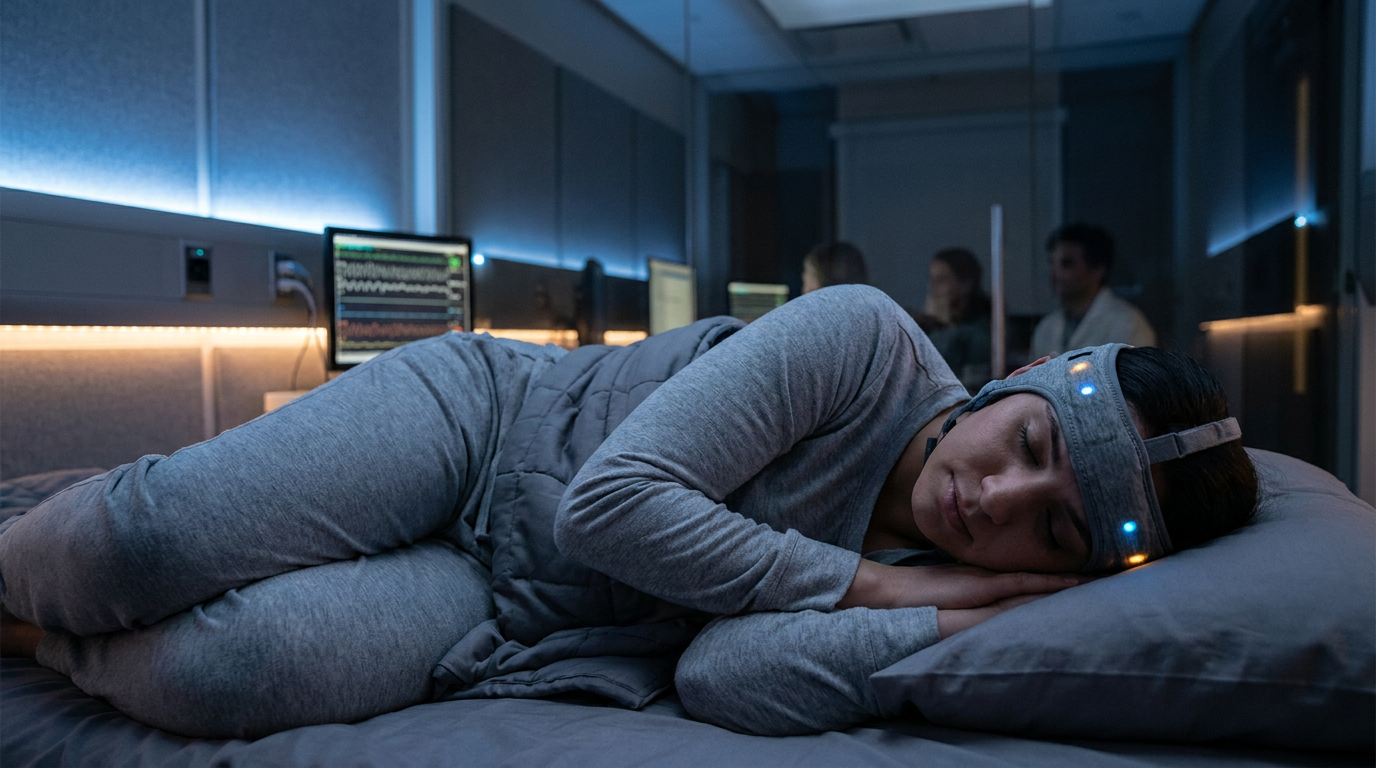
When participants enter slow-wave sleep, researchers quietly play half of those sounds through speakers or headphones. Upon waking, participants consistently demonstrate a 10% to 15% higher retention rate for the spatial locations of the "cued" objects compared to the "uncued" ones.[1][6]

When participants enter slow-wave sleep, researchers quietly play half of those sounds through speakers or headphones.
The benefits of this targeted replay extend well beyond vocabulary and spatial grids into the realm of motor skill acquisition. Studies mapping the acquisition of complex finger-tapping sequences—similar to learning a piano melody—show that TMR can physically accelerate muscle memory.[2]
When the melody associated with a specific finger sequence is played during slow-wave sleep, functional MRI scans show heightened activation in the motor cortex. The brain is literally practicing the physical movement while the body remains paralyzed in sleep.[2][3]

This mechanism has profound implications for clinical neurology. Researchers are currently running trials to determine if TMR can accelerate motor recovery in stroke patients, using auditory cues to strengthen the neural pathways of physical rehabilitation exercises performed during the day.[5][6]
More recently, the evidence pack has expanded into the complex territory of emotional regulation and implicit bias. A landmark study demonstrated that TMR could be used to significantly reduce implicit social biases that are notoriously difficult to unlearn.[3]
Participants underwent a daytime training module designed to counter gender or racial biases, which was paired with a specific sound. Replaying that sound during sleep significantly prolonged the bias-reduction effect compared to control groups who received the training but no sleep cues.[3][6]
Similar protocols are now being tested for exposure therapy in phobias and PTSD. The goal is to decouple traumatic memories from their severe emotional responses by reactivating them in the chemically distinct, low-anxiety state of deep sleep.[5]
Despite these robust findings, significant uncertainties remain regarding the "zero-sum" nature of sleep consolidation. The brain's capacity for memory replay during a single night is finite, and artificially directing it may have hidden costs.[4]

Some evidence suggests that artificially boosting one memory via TMR might come at the expense of uncued memories. If you force the brain to consolidate a Spanish vocabulary list, it might neglect to consolidate the piano sequence or the work presentation you also learned that day.[4][6]
Furthermore, the timing of the cue is absolutely critical. Playing sounds during REM sleep or light sleep does not produce the same consolidation benefits and can sometimes disrupt the delicate architecture of the sleep cycle, leading to cognitive fatigue the next day.[3][4]
This timing constraint poses a major hurdle for commercial TMR devices. While laboratory setups use high-density EEG caps to pinpoint the exact millisecond a slow oscillation peaks, consumer headbands rely on less precise algorithms, potentially playing cues at the wrong moment and disrupting rest.[6]
How we got here
1950s
The concept of "hypnopaedia" (learning entirely new information during sleep) is widely debunked as pseudoscience.
2007
A landmark study proves that exposing participants to specific odor cues during sleep enhances spatial memory.
2012
Researchers successfully use auditory cues to enhance the consolidation of complex motor skills.
2015
The first evidence emerges demonstrating that TMR can be used to unlearn implicit social biases.
2024
Clinical trials begin testing TMR protocols for physical rehabilitation in stroke patients.
Viewpoints in depth
Cognitive Neuroscientists
Focused on the fundamental mechanics of how the brain stores information.
For cognitive neuroscientists, TMR is primarily a tool to decode the black box of systems consolidation. By artificially triggering memory replay, researchers can map the exact neural pathways that transfer data from the hippocampus to the neocortex. Their primary interest lies in understanding the precise role of sleep spindles and slow oscillations, rather than immediate commercial applications.
Clinical Neurologists
Focused on therapeutic applications for brain injury and psychiatric conditions.
Clinical neurologists view TMR as a highly promising, non-invasive therapeutic intervention. Because the brain is highly plastic during sleep, neurologists are investigating how auditory cues can accelerate motor cortex recovery in stroke patients or help extinguish the severe emotional responses attached to traumatic memories in patients with PTSD.
Sleep Ethicists
Focused on the biological limits of the brain and the risks of commercialization.
Researchers focused on sleep health caution against the rush to engineer our rest. They point to evidence suggesting that memory consolidation is a zero-sum game; artificially prioritizing one skill might cause the brain to drop other important daily memories. Furthermore, they warn that poorly timed cues from commercial wearables could disrupt the restorative architecture of slow-wave sleep, leading to long-term cognitive fatigue.
What we don't know
- Whether boosting one specific memory during sleep comes at the direct expense of other memories competing for consolidation.
- The long-term cognitive and neurological effects of artificially manipulating sleep architecture night after night.
- How effectively commercial, non-EEG wearables can replicate the precise timing required for laboratory-grade TMR.
Key terms
- Targeted Memory Reactivation (TMR)
- The technique of re-exposing a sleeping person to sensory cues associated with prior learning to strengthen memory consolidation.
- Slow-Wave Sleep (SWS)
- The deepest phase of non-REM sleep, crucial for physical restoration and declarative memory consolidation.
- Sleep Spindles
- Brief bursts of high-frequency brain activity during sleep that help transfer memories from short-term to long-term storage.
- Hippocampus
- A brain structure essential for learning and the temporary storage of new declarative memories.
- Declarative Memory
- The conscious, intentional recollection of factual information, previous experiences, and concepts.
Frequently asked
Can I learn a new language while I sleep?
No. TMR can only strengthen memories of things you have already studied while awake; it cannot introduce entirely new information to the brain.
Do I need a laboratory to do this?
While consumer sleep headbands exist, laboratory EEG setups are currently required to time the audio cues perfectly with your brain's slow-wave oscillations for maximum effect.
Will playing sounds wake me up?
In TMR protocols, audio cues are played at a very low volume—often masked by "pink noise"—specifically to avoid disrupting the sleep cycle.
Sources
Source coverage
6 outlets
3 viewpoints surfaced





[1]Nature NeuroscienceCognitive Neuroscientists
Targeted Memory Reactivation during Sleep: A Meta-Analysis of Cognitive Benefits
Read on Nature Neuroscience →[2]ScienceCognitive Neuroscientists
Cued memory reactivation during sleep influences skill learning and motor consolidation
Read on Science →[3]Trends in Cognitive SciencesCognitive Neuroscientists
The mechanisms of targeted memory reactivation during slow-wave sleep
Read on Trends in Cognitive Sciences →[4]Journal of NeuroscienceSleep Ethicists
Targeted memory reactivation during sleep degrades related uncued memories
Read on Journal of Neuroscience →[5]National Institute on AgingClinical Neurologists
Sleep's Role in Memory Consolidation and Cognitive Health
Read on National Institute on Aging →[6]Factlen Editorial TeamSleep Ethicists
Synthesis by Factlen editorial team
Read on Factlen Editorial Team →

Every angle. Every day.
Get science stories with full source coverage and perspective breakdowns delivered to your inbox.