
Semi-Automatic vs. Super-Automatic Espresso Machines: The 2026 Trade-Off Analysis
Choosing between a semi-automatic and super-automatic espresso machine comes down to a fundamental trade-off between absolute cup quality and morning convenience. Here is how the two technologies compare on extraction science, maintenance, and long-term cost.
By Factlen Editorial Team
- Hobbyist Home Baristas
- Prioritize absolute cup quality, extraction control, and the tactile ritual of dialing in coffee beans.
- Convenience-Focused Consumers
- Value speed, consistency, and zero-mess workflows above the subtle nuances of specialty coffee extraction.
- Appliance Technicians
- Focus on the long-term repairability, modularity, and total cost of ownership of the internal mechanics.
What's not represented
- · Commercial Cafe Owners
- · Pod-Machine Users
Why this matters
Home espresso machines represent a significant investment, often ranging from $500 to over $3,000. Understanding the mechanical and lifestyle trade-offs between manual control and automated convenience prevents costly buyer's remorse and ensures your morning routine actually matches your equipment.
Key points
- Semi-automatic machines offer a higher flavor ceiling but require manual skill, tamping, and a separate burr grinder.
- Super-automatic machines provide push-button convenience and consistency but rely on pressurized brewing that limits espresso nuance.
- True microfoam for latte art requires the manual steam wand found on semi-automatic machines.
- Semi-automatics are modular and easier to repair, often lasting over a decade with basic maintenance.
- Super-automatics feature complex internal robotics that are prone to failure and require meticulous weekly cleaning to prevent mold.
The home espresso market has matured significantly by 2026, moving past the era of pod-based machines into a landscape dominated by high-quality whole-bean brewing. But for buyers ready to invest anywhere from $500 to $3,000 in their morning routine, the market presents a stark fork in the road: the semi-automatic machine, which demands manual skill, or the super-automatic machine, which promises cafe-quality coffee at the push of a single button.[1][6]
Understanding this choice requires looking past the marketing claims of perfect espresso and examining the internal mechanics of how each machine extracts flavor from a roasted coffee bean. The fundamental trade-off is not just about price; it is a tug-of-war between absolute cup quality, daily convenience, and long-term mechanical reliability.[6]
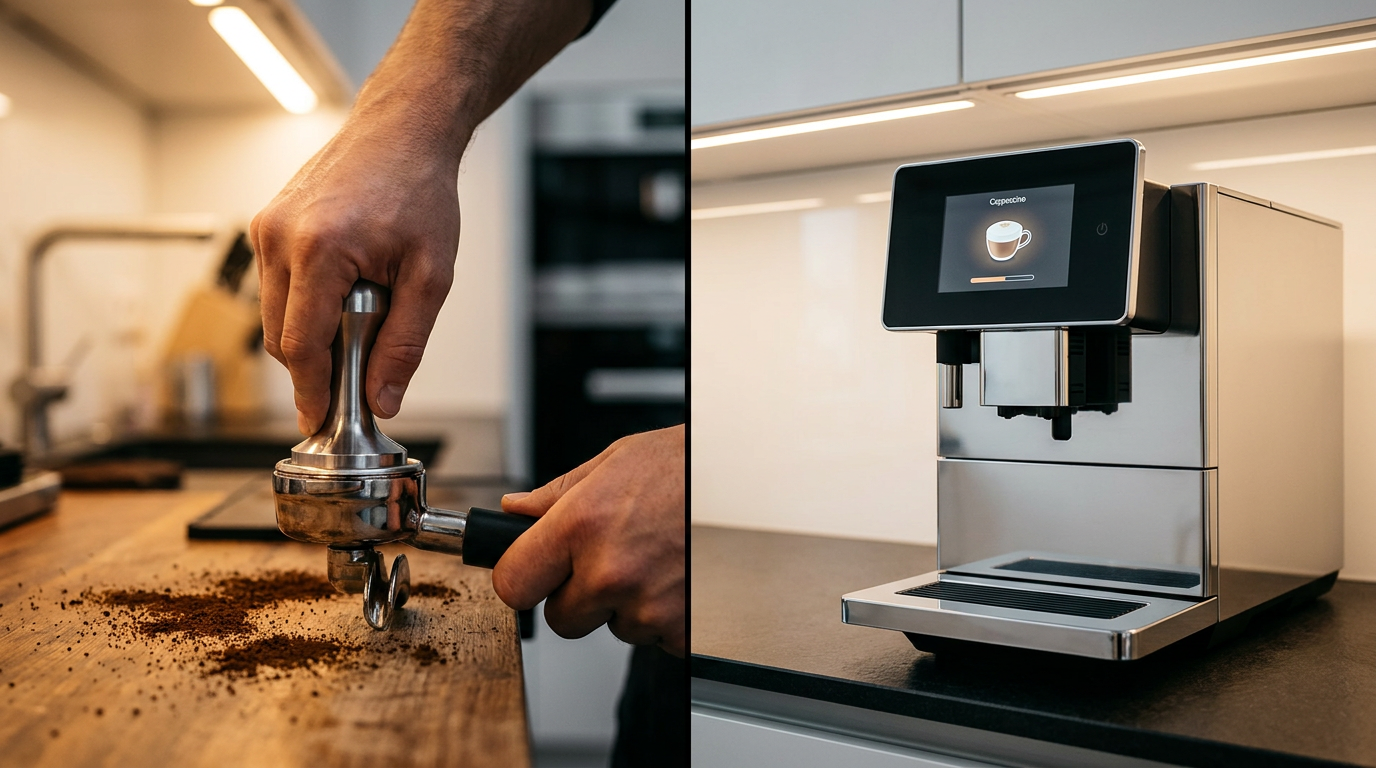
Semi-automatic machines represent the traditional cafe workflow scaled down for the kitchen. The user is responsible for grinding the beans in a separate standalone grinder, dosing the exact weight of grounds into a metal portafilter, tamping the bed of coffee to create a level puck, and manually starting and stopping the water flow.[3]
The argument for the semi-automatic route is entirely about the flavor ceiling. Because the user controls the grind size and the tamp pressure, they can dial in the extraction to hit the industry-standard nine bars of pressure perfectly. Evidence from specialty coffee associations consistently shows that this manual control is the only way to extract the nuanced origin flavors—the bright acidity of an Ethiopian bean or the deep chocolate notes of a Brazilian roast—without over-extracting bitter compounds.[2][3]

However, the argument against semi-automatics centers on the steep learning curve and the daily workflow. A semi-automatic setup requires a dedicated, high-quality burr grinder, which often adds $200 to $500 to the initial budget. Furthermore, the morning routine demands active participation: dialing in the grind, dealing with stray coffee grounds on the counter, and manually knocking out the wet puck after brewing.[1][4]
Super-automatic machines, by contrast, internalize the entire process. Inside their plastic or metal housings, a complex robotic brew group handles the workflow. When the user presses a button, the machine grinds a pre-set volume of beans, drops them into an internal chamber, mechanically compresses the grounds, and forces hot water through the puck before automatically dumping the spent grounds into an internal bin.[2][5]
The primary argument for super-automatics is frictionless consistency. For households with multiple coffee drinkers, or for those whose primary goal is caffeine delivery before a morning commute, the super-automatic delivers a highly repeatable cup in under 60 seconds with zero countertop mess. There is no tamping, no dialing in, and no need for a separate grinder.[5]
The primary argument for super-automatics is frictionless consistency.
The evidence against super-automatics, however, lies in their extraction limitations. Because the internal brew groups cannot tamp the coffee as firmly as a human using a heavy metal tamper, super-automatics rely on pressurized brewing systems to artificially create crema. This results in a lower flavor ceiling; the espresso is generally thinner, less viscous, and lacks the complex flavor separation found in a well-pulled semi-automatic shot.[2][3]
Milk texturing presents another stark divergence in the trade-off analysis. Semi-automatic machines feature traditional steam wands, requiring the user to manually introduce air into a pitcher of cold milk to create a vortex. While this takes practice, it is the only way to achieve the glossy, wet-paint texture of true microfoam required for latte art and cafe-quality mouthfeel.[1][3]

Super-automatics typically utilize automated milk carafes or siphon systems that draw milk from a container, heat it, and dispense it directly into the cup. While undeniably convenient, these automated systems tend to produce a stiffer, drier foam that separates quickly from the liquid milk, resembling a traditional cappuccino rather than a modern flat white.[5]
Long-term maintenance and repairability heavily favor the semi-automatic architecture. Semi-automatics are essentially modular plumbing systems: a boiler, a pump, and a group head. When a gasket fails or a pump dies, the parts are standard, relatively inexpensive, and often replaceable by the user with basic tools. Daily maintenance involves a simple backflush and wiping down the steam wand.[4]
Super-automatics are intricate electromechanical devices packed with gears, sensors, and moving plastic parts operating in a hot, damp environment. If the internal brew group is not meticulously cleaned weekly, coffee oils build up and mold can form inside the machine. When a super-automatic fails, it almost always requires a professional technician, and out-of-warranty repairs can easily exceed $300.[2][4]
Cost of ownership over a five-year horizon reveals a hidden parity. A quality entry-level semi-automatic machine and a capable grinder might cost $1,000 upfront. A mid-tier super-automatic costs roughly the same. However, the semi-automatic setup is likely to last a decade with minor maintenance, while the super-automatic's complex internals give it an average lifespan of five to seven years before requiring major service or replacement.[4][5]

Ultimately, the semi-automatic approach fits well when the buyer views coffee as a hobby, values peak flavor over speed, enjoys the tactile ritual of preparation, and is willing to invest time in learning the science of extraction. It is the only choice for those who want to explore light-roast specialty coffees or pour latte art.[1][6]
Conversely, the semi-automatic does not fit when mornings are rushed, when multiple family members want coffee without learning a workflow, or when countertop space is strictly limited and cannot accommodate a separate grinder and knock box.[3]
The super-automatic machine fits well when the primary goal is replacing a daily cafe habit with maximum convenience. It excels in busy households, office environments, or for users who prefer medium-to-dark roasts and milk-heavy drinks where the subtle nuances of the espresso shot are less critical.[5][6]
The super-automatic does not fit when the buyer expects absolute cafe-quality microfoam, when they want a machine that will last a lifetime with minimal repair costs, or when they enjoy the hands-on craft of brewing and dialing in new coffee beans.[2][6]

How we got here
Early 2000s
Pod-based machines popularize the concept of push-button home espresso, prioritizing convenience over quality.
2010s
The 'Third Wave' coffee movement drives consumer interest in manual semi-automatic machines and standalone grinders.
2020
Pandemic lockdowns spark a massive surge in premium home espresso equipment sales as consumers seek to replicate cafe routines.
2026
Super-automatic machines reach near-parity in price with mid-tier semi-automatic setups, forcing buyers to choose strictly based on workflow preferences.
Viewpoints in depth
The Hobbyist's View
Focuses on the science of extraction, flavor clarity, and the ritual of preparation.
For the hobbyist, coffee is a culinary pursuit rather than just a caffeine delivery system. This camp argues that the entire point of spending over $500 on an espresso machine is to unlock the origin characteristics of specialty coffee beans. They view the manual steps of a semi-automatic machine—weighing the dose, distributing the grounds, and tamping—not as chores, but as necessary variables to control in pursuit of the perfect nine-bar extraction. To this group, super-automatics are fundamentally compromised because they remove the user's ability to adjust to the daily aging of the coffee beans.
The Convenience Seeker's View
Prioritizes speed, consistency, and a frictionless morning routine.
This perspective treats the espresso machine as a high-end home appliance designed to solve a problem: getting a good cup of coffee before work with zero hassle. Convenience seekers argue that while a semi-automatic might produce a 10/10 cup in the hands of a skilled barista, it often produces a sour or bitter 4/10 cup when the user is rushed or inexperienced. A super-automatic, by contrast, delivers a consistent 7/10 cup every single morning in under 60 seconds. For households where multiple people need coffee but only one person knows how to 'dial in' a grinder, the super-automatic is viewed as the only practical choice.
The Technician's View
Evaluates machines based on internal build quality, repairability, and total cost of ownership.
Appliance repair technicians look past the touchscreen interfaces to the internal plumbing. From this viewpoint, semi-automatic machines are praised for their modularity; they are essentially hot water boilers connected to simple vibration pumps. If a part breaks, it can be swapped out cheaply. Super-automatics, however, are viewed with caution. Technicians note that packing a grinder, a robotic brew group, and a heating element into a small, damp plastic box creates a high failure rate. They emphasize that buyers of super-automatics must factor in the cost of professional servicing every few years, whereas semi-automatic owners can often perform their own maintenance.
What we don't know
- Whether upcoming hybrid machines will successfully bridge the gap by automating the tamp while leaving the portafilter manual.
- How long the current generation of touchscreen interfaces on super-automatics will remain supported by manufacturers.
Key terms
- Portafilter
- The handled metal basket that holds the ground coffee and locks into the group head of a semi-automatic machine.
- Brew Group
- The mechanical assembly inside a super-automatic machine that tamps the coffee, brews the espresso, and ejects the spent grounds.
- Microfoam
- Finely textured milk created with a steam wand, characterized by tiny, uniform bubbles that create a glossy, velvet-like texture.
- Dialing In
- The process of adjusting the grind size and coffee dose on a semi-automatic setup to achieve a perfectly timed and balanced espresso extraction.
Frequently asked
Do I need a separate grinder for a semi-automatic machine?
Yes. A high-quality burr grinder is essential for a semi-automatic machine, as precise grind size is required to build the correct pressure for extraction. This often adds $200 to $500 to your setup cost.
Can super-automatic machines make latte art?
Generally, no. The automated milk frothers on super-automatic machines produce a stiff, airy foam rather than the dense, glossy microfoam required to pour latte art.
How long do these machines typically last?
A well-maintained semi-automatic machine can last 10 to 15 years due to its modular, repairable parts. Super-automatics typically last 5 to 7 years before their complex internal moving parts require expensive servicing.
Are super-automatic machines harder to clean?
While daily use is cleaner, weekly maintenance is more intensive. The internal brew group of a super-automatic must be removed and rinsed regularly to prevent mold and coffee oil buildup.
Sources
Source coverage
6 outlets
3 viewpoints surfaced






[1]WirecutterHobbyist Home Baristas
The Best Espresso Machines for Home
Read on Wirecutter →[2]Perfect Daily GrindHobbyist Home Baristas
Understanding the Mechanics of Super-Automatic Espresso
Read on Perfect Daily Grind →[3]Seattle Coffee GearAppliance Technicians
Semi-Auto vs. Super-Auto: Which is Right for You?
Read on Seattle Coffee Gear →[4]HomegroundsAppliance Technicians
The True Cost of Home Espresso in 2026
Read on Homegrounds →[5]CNETConvenience-Focused Consumers
Are Super-Automatic Espresso Machines Worth the Price?
Read on CNET →[6]Factlen Editorial Team
Synthesis by Factlen editorial team
Read on Factlen Editorial Team →
Every angle. Every day.
Get shopping stories with full source coverage and perspective breakdowns delivered to your inbox.