
The Evidence Behind the Pentagon's 'Total Halt' on US Wind Power
More than 100 planned wind farms across 21 states are stalled indefinitely as the Pentagon halts military reviews over radar interference concerns, prompting a major industry lawsuit.
By Factlen Editorial Team
- Military & Defense Officials
- Argues that national security must take precedence, and that current radar mitigation technologies are not secure or scalable enough to handle the rapid expansion of wind farms.
- Renewable Energy Industry
- Maintains that the radar interference problem is solvable with existing technology, and views the blanket halt as an arbitrary, economically destructive policy shift.
- Scientific & Engineering Community
- Focuses on the physical reality of the interference and the technical viability of hardware and software workarounds, viewing the issue as an engineering challenge rather than a zero-sum conflict.
What's not represented
- · Local municipalities losing projected tax revenue
- · Aviation authorities managing civilian air traffic
Why this matters
This standoff freezes billions of dollars in renewable energy investments and threatens US climate targets, pitting national security infrastructure directly against the clean energy transition.
Key points
- The Pentagon has indefinitely halted routine reviews of new wind farms over concerns that turbine blades interfere with military radar.
- Renewable energy developers have sued the Department of Defense, arguing the freeze is arbitrary and violates federal procedure.
- While radar interference is a genuine physical issue, the industry argues that proven software and hardware mitigations already exist.
- The military claims that integrating private mitigation tech into defense networks introduces unacceptable cybersecurity risks.
- The standoff freezes billions in investment and threatens the timeline for US grid decarbonization.
The United States' renewable energy transition has hit a formidable, non-market obstacle: the military. Across 21 states, more than 100 planned wind farms have been indefinitely stalled following a Department of Defense directive that halts routine military reviews of new turbine installations.[1][2]
The freeze has prompted a coalition of renewable energy developers to file a sweeping lawsuit in federal court, arguing that the Pentagon's "total halt" is arbitrary, economically devastating, and potentially politically motivated.[1][3]
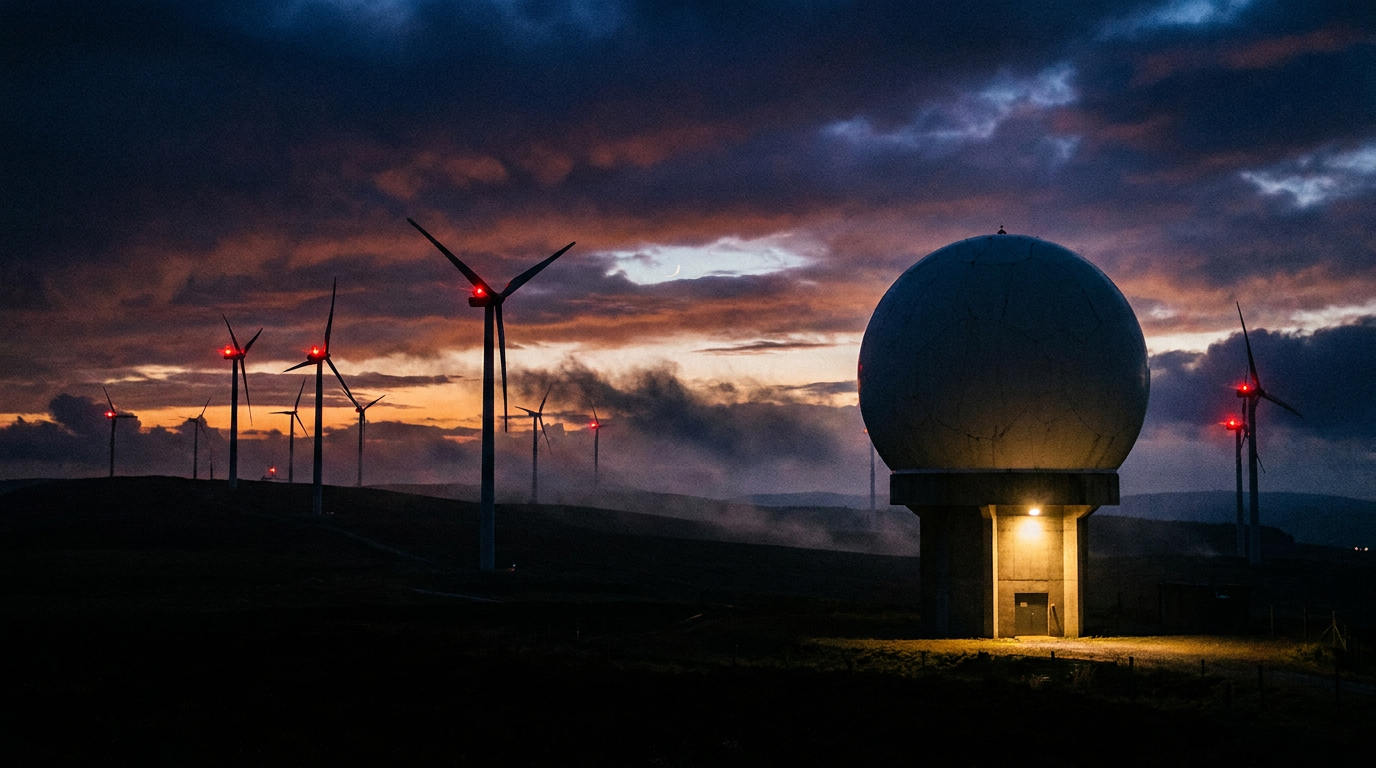
At the heart of this legal and scientific standoff is a genuine physical phenomenon known as wind turbine radar interference (WTRI). The Pentagon argues that the sheer size and rotational speed of modern turbines create unacceptable blind spots for early-warning and air-traffic control radars.[4][6]
To understand the evidence, Factlen reviewed the core claims from the military, the counter-claims from the wind industry, and the underlying physics of radar mitigation. The outcome of this dispute will likely determine whether the US can meet its end-of-decade grid decarbonization targets.[7]

The Department of Defense Siting Clearinghouse, which traditionally reviews energy projects to ensure they do not compromise military readiness, issued a memo earlier this year pausing all approvals. This shift moved the agency from a case-by-case review model to a blanket moratorium.[4]
The DoD asserts that turbines, which now frequently exceed 600 feet in height with massive composite blades, reflect radar waves in ways that mimic aircraft. Because the blades are moving, they trigger Doppler shifts that confuse radar software designed to filter out stationary objects like buildings or mountains.[4][6]
According to the DoD's technical filings, a dense cluster of turbines can create a "clutter zone" that degrades the military's ability to track low-flying aircraft, drones, or incoming threats within a 50-mile radius of the installation. The military argues that as turbine density increases nationwide, these blind spots are merging into unacceptable security gaps.[4][6]
The American Clean Power Association and other plaintiffs do not deny the physics of radar interference, but they argue the Pentagon's blanket halt ignores a decade of proven mitigation strategies. They assert the pause is a blunt instrument applied to a highly localized engineering problem.[2][3]
In their court filings, the renewable groups cite Department of Energy data showing that software upgrades to existing radar systems can successfully filter out turbine signatures in over 85% of cases, allowing wind farms and military bases to coexist safely.[3][5]
Furthermore, the industry argues that the sudden shift to a nationwide moratorium is a procedural violation of the Administrative Procedure Act. The lawsuit claims this freezes roughly 30 gigawatts of potential clean energy capacity without a formal rulemaking process or public comment period.[1][3]

Furthermore, the industry argues that the sudden shift to a nationwide moratorium is a procedural violation of the Administrative Procedure Act.
Academic research into WTRI confirms that while the interference is real, it is increasingly solvable through a combination of hardware and software interventions. However, the solutions require significant capital and coordination between private developers and federal agencies.[6][7]
One approach involves applying radar-absorbent materials—similar to the coatings used on stealth aircraft—to the turbine blades. While effective in laboratory settings, the Department of Energy notes that scaling this to thousands of commercial turbines remains cost-prohibitive for developers and adds significant weight to the blades.[5][6]
The more viable solution relies on "in-fill" radar. This involves placing smaller, supplementary radar systems around the perimeter of a wind farm to look under or around the turbines, feeding clean data back into the primary military network to patch the blind spots.[5][6]
However, the Pentagon maintains that integrating these disparate, privately-funded data feeds into legacy defense networks introduces unacceptable latency and cybersecurity vulnerabilities. The DoD memo justifies the pause by stating a unified, secure software architecture must be developed before further approvals are granted.[4]
The timing of the halt has drawn intense scrutiny. Reports indicate that the delays align with broader administrative shifts under the current executive branch, which has frequently expressed skepticism toward wind energy and prioritized traditional infrastructure.[1]
Renewable advocates argue that the DoD is being used as a regulatory weapon to slow the energy transition, noting that similar radar concerns were routinely resolved through mitigation agreements and developer-funded radar upgrades during previous administrations.[1][2]

The federal court must now decide whether to grant an injunction forcing the DoD to resume its project-by-project reviews. A ruling is expected later this summer, which will set a major precedent for how federal agencies balance competing national priorities.[3][7]
In the meantime, the supply chain for US wind energy remains in a state of suspended animation. Turbine manufacturers, construction firms, and local municipalities relying on projected tax revenues are all bearing the financial cost of the delay.[2][7]
If the halt is upheld long-term, developers will be forced to abandon prime wind corridors in the Midwest and Great Plains. This would push projects into less efficient, lower-wind areas that avoid military airspace entirely, driving up the cost of clean electricity.[5][7]
Ultimately, the standoff highlights a critical vulnerability in the climate transition: the physical infrastructure required to decarbonize the grid must share the same geography and airspace as the infrastructure required for national defense, and currently, the two are on a collision course.[7]
How we got here
Pre-2026
The DoD Siting Clearinghouse routinely reviews wind projects on a case-by-case basis, often requiring developers to fund radar upgrades.
Early 2026
The Pentagon issues a memorandum halting all routine reviews, citing the cumulative impact of turbine density on national security.
June 2026
A coalition of renewable energy developers files a federal lawsuit seeking an injunction to end the 'total halt'.
Viewpoints in depth
The Military's View
National security cannot be compromised by infrastructure that blinds early-warning systems.
Defense officials argue that the rapid proliferation of massive wind turbines is creating a cumulative 'clutter zone' across the United States. They maintain that while individual workarounds exist, patching together thousands of private, in-fill radar feeds into secure military networks introduces unacceptable latency and cybersecurity vulnerabilities. Until a unified, secure architecture is developed, they argue the pause is a necessary measure to protect airspace integrity.
The Industry's View
The halt is an arbitrary regulatory overreach that ignores proven engineering solutions.
Renewable energy developers acknowledge the physics of radar interference but point out that they have successfully funded and implemented mitigation strategies for over a decade. They view the sudden shift to a nationwide moratorium as a blunt, potentially politically motivated instrument that bypasses standard administrative procedures. By freezing 30 gigawatts of capacity, they argue the DoD is inflicting catastrophic economic damage on the clean energy supply chain.
The Scientific View
The interference is real, but solvable through coordinated hardware and software upgrades.
Researchers and engineers view the conflict as a solvable technical challenge rather than an intractable policy dispute. Studies confirm that spinning blades create Doppler shifts that confuse legacy radar, but modern software filters and supplementary radar arrays can effectively clean the data. The scientific consensus suggests that the barrier is no longer the physics of radar, but rather the cost allocation and bureaucratic coordination required to implement the upgrades at scale.
What we don't know
- Whether the federal court will grant an injunction forcing the DoD to resume project reviews.
- How long it would take the Pentagon to develop the 'unified software architecture' it claims is necessary.
- Whether developers will abandon the stalled projects entirely if the delay stretches into 2027.
Key terms
- Wind Turbine Radar Interference (WTRI)
- The phenomenon where the physical structure and spinning blades of a wind turbine disrupt or confuse radar signals used for aviation and defense.
- Doppler Shift
- A change in the frequency of a wave in relation to an observer who is moving relative to the wave source; in this context, spinning blades create shifts that radar interprets as moving aircraft.
- In-fill Radar
- Smaller, supplementary radar systems placed around a wind farm to cover the blind spots created by the turbines, feeding clean data back to the main radar network.
- DoD Siting Clearinghouse
- The Pentagon office responsible for reviewing civilian energy and infrastructure projects to ensure they do not interfere with military training, readiness, or operations.
Frequently asked
Why do wind turbines interfere with radar?
Turbines are massive structures with spinning blades. The movement of the blades creates a 'Doppler shift' that mimics the radar signature of moving aircraft, confusing the software designed to track actual threats.
Can the radar systems be upgraded to fix this?
Yes. Software upgrades and supplementary 'in-fill' radars can filter out the turbines. However, the military argues that integrating these private fixes into secure defense networks introduces cybersecurity risks.
How much wind energy is currently delayed?
Industry groups estimate that the halt has frozen roughly 30 gigawatts of planned capacity across more than 100 projects in 21 states.
Sources
Source coverage
7 outlets
3 viewpoints surfaced





[1]The New York TimesRenewable Energy Industry
Renewable Groups Ask Courts to End Pentagon’s ‘Total Halt’ of Wind Power
Read on The New York Times →[2]E&E NewsRenewable Energy Industry
Wind industry sues Pentagon over review freeze
Read on E&E News →[3]U.S. District CourtRenewable Energy Industry
Complaint: American Clean Power Association v. Department of Defense
Read on U.S. District Court →[4]Department of Defense Siting ClearinghouseMilitary & Defense Officials
2026 Memorandum on Radar Interference and Mitigation Readiness
Read on Department of Defense Siting Clearinghouse →[5]Department of EnergyScientific & Engineering Community
Wind Energy and Radar Interference Mitigation Report
Read on Department of Energy →[6]IEEE Transactions on AerospaceScientific & Engineering Community
Analysis of Wind Turbine Clutter on Air Defense Radar Systems
Read on IEEE Transactions on Aerospace →[7]Factlen Editorial TeamScientific & Engineering Community
Synthesis by Factlen editorial team
Read on Factlen Editorial Team →

More in science
See all 74 stories →Cellular Imaging
The Laser Phase Plate: A Century-Old Physics Trick Just Unlocked the Human Proteome
5 sources

Cancer Vaccines
Personalized mRNA Cancer Vaccine Halves Melanoma Recurrence in 5-Year Milestone
8 sources

Cryo-EM Advance
Laser Phase Plate Breakthrough Illuminates the Smallest Proteins in Human Cells
7 sources

Ocean Tech
How Solar LEDs and Acoustic Pingers Are Solving the Global Bycatch Crisis
6 sources
Every angle. Every day.
Get science stories with full source coverage and perspective breakdowns delivered to your inbox.