
The Biomechanics of the 'High Elbow Catch': Why the Early Vertical Forearm is Swimming's Holy Grail
Mastering the Early Vertical Forearm (EVF) transforms a swimmer's stroke by converting the entire lower arm into a paddle. By shifting the workload from fragile shoulder muscles to the powerful lats, EVF maximizes propulsion and minimizes drag.
By Factlen Editorial Team
- Biomechanists & Coaches
- Focus on fluid dynamics, drag reduction, and shifting the muscular load to the lats for maximum efficiency.
- Distance & Fitness Swimmers
- Value EVF for its ability to conserve energy over long distances and protect the rotator cuff from overuse injuries.
- Sprint Specialists
- Acknowledge EVF's efficiency but often prioritize a straight-arm, high-tempo pull for maximum raw power in short races.
What's not represented
- · Physical Therapists treating swimmer's shoulder
- · Beginner swimmers struggling with water feel
Why this matters
For anyone swimming for fitness, triathlon, or competition, fixing a 'dropped elbow' is the single fastest way to increase speed, reduce fatigue, and prevent rotator cuff injuries.
Key points
- A 'dropped elbow' pushes water downward, lifting the body and creating massive drag.
- The Early Vertical Forearm (EVF) turns the hand and forearm into a rigid, backward-facing paddle.
- EVF shortens the moment arm, protecting the fragile rotator cuff from overuse injuries.
- The technique shifts the workload from the shoulders to the powerful latissimus dorsi muscles.
- While sprinters sometimes use a straight-arm pull, EVF is essential for distance and fitness swimming.
- Dryland training with resistance bands is one of the most effective ways to build EVF muscle memory.
Swimming is fundamentally an exercise in problem-solving against physics. Unlike running, where the ground provides a fixed anchor, water flows, rushes, and slips through a swimmer's fingers. To move forward, a swimmer must create their own anchor in a fluid medium and pull their entire body mass past it.[5]
The most critical phase of the freestyle stroke is the "catch"—the moment immediately after the hand enters the water and begins to pull. Yet, this is where the vast majority of amateur and fitness swimmers make a critical biomechanical error: the dropped elbow.[1][7]
When a swimmer drops their elbow, their arm forms a diagonal line in the water. Instead of pressing water backward toward their feet, the hand and forearm push the water downward toward the bottom of the pool. This is akin to trying to climb a ladder with greased rungs; it requires immense effort but yields very little forward progress.[5][8]
Pushing water downward also creates a cascade of biomechanical inefficiencies. The downward force lifts the swimmer's head and chest, which in turn causes their hips and legs to sink. This sinking lower body drastically increases frontal drag, forcing the swimmer to work even harder just to maintain their position in the water.[4][7]

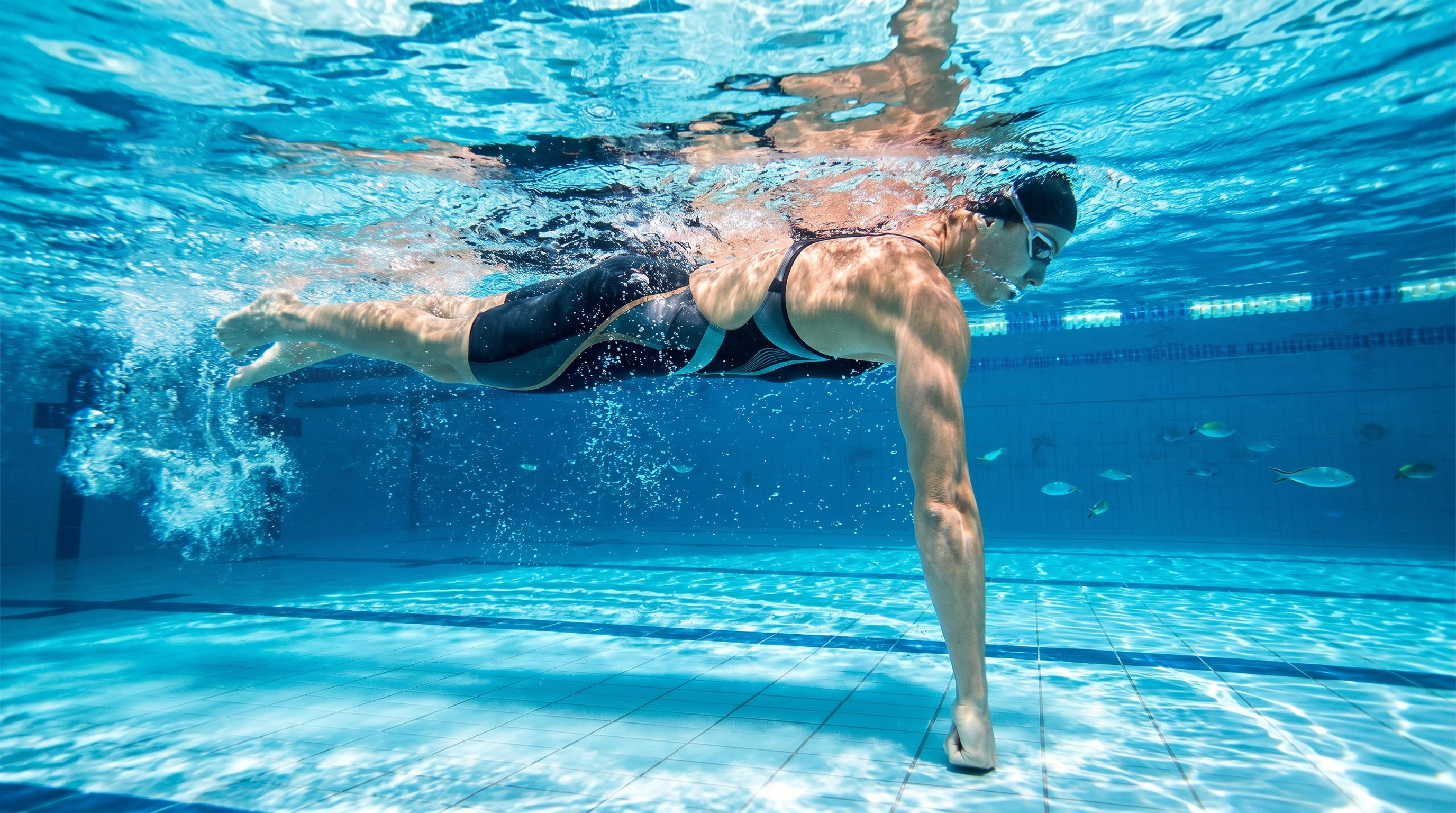
The antidote to the dropped elbow is a technique known as the Early Vertical Forearm (EVF), or the "high elbow catch." In an EVF stroke, the swimmer keeps their elbow near the surface of the water while rapidly bending the joint to point their fingertips toward the bottom of the pool.[1][2]
The goal is to achieve an elbow angle of approximately 90 to 120 degrees as early in the stroke as possible. By doing so, the swimmer aligns their hand and forearm into a vertical plane, effectively turning the entire lower arm into a massive, rigid paddle blade.[4][7]
The physics behind EVF are profound. By keeping the elbow high, the swimmer maximizes the propulsive surface area pressing backward against the water. Interestingly, a 2021 biomechanical review noted that while the hand contributes 90 to 97 percent of the propulsive force, the forearm itself only adds 3 to 10 percent.[3][5]

Therefore, the true genius of the Early Vertical Forearm is not just that the forearm pushes water, but that the high-elbow position rapidly angles the hand into its most powerful, backward-facing orientation. It anchors the water early, converting muscular effort directly into forward velocity rather than wasted downward force.[3][6]
It anchors the water early, converting muscular effort directly into forward velocity rather than wasted downward force.
Beyond fluid dynamics, EVF fundamentally changes how the human body generates power in the water. A straight-arm pull or a dropped elbow creates a long "moment arm"—the distance from the shoulder joint to the center of pressure on the hand.[5]
In physics, torque is the product of force and the moment arm. A long moment arm places massive, unsustainable stress on the small, fragile muscles of the rotator cuff and the deltoids. This is why novice swimmers frequently experience "shoulder burn" or overuse injuries after just a few laps.[5][7]
By bending the elbow and keeping it high, EVF shortens the lever arm. This biomechanical shift places the shoulder into a position of slight internal rotation, mechanically linking the arm to the torso.[5]

Once linked, the swimmer stops relying on their shoulders and begins drawing power from the latissimus dorsi and the pectoralis major—the largest and strongest muscle groups in the upper body. The arms simply become rigid levers that transfer the rotational torque of the core directly into forward speed.[4][5][7]
Despite its clear advantages, adopting the Early Vertical Forearm requires what veteran coaches call a "leap of faith." Because the dropped elbow utilizes a longer lever, it often feels more powerful to the swimmer, even though that power is being misdirected downward.[2]
Transitioning to EVF can initially feel awkward and weak, as the swimmer must develop new neural pathways and strengthen their "EVF muscles," specifically the scapular stabilizers and the lats. It requires trading the illusion of effort for the reality of efficiency.[2][6]
It is worth noting that EVF is not the only way to swim freestyle. In elite 50-meter sprint events, some athletes utilize a straight-arm recovery and a deeper, straighter pull. This technique relies on a rapid stroke rate and raw shoulder power to generate extreme speed over very short durations.[6]
However, the straight-arm technique is highly fatiguing and biomechanically unsustainable for distances beyond 100 meters. For distance swimmers, triathletes, and anyone swimming for fitness, the high elbow catch is universally recognized as the superior, smarter choice for long-term shoulder health and endurance.[6]

Because the catch happens underwater, it is notoriously difficult for swimmers to self-correct. Coaches often recommend dryland training to build the necessary muscle memory. Exercises using resistance bands, stability balls, or swim ergometers allow athletes to practice the high-elbow position slowly and deliberately without the distraction of breathing or staying afloat.[3][7]
In the pool, drills like "front sculling" help swimmers develop a feel for the water, teaching them to maintain pressure on their palms and forearms without letting their wrists collapse. Fist drills—where the swimmer closes their hands to remove the palm's surface area—force the athlete to rely entirely on their forearm for propulsion, instantly exposing a dropped elbow.[1]
Ultimately, mastering the Early Vertical Forearm is a journey of patience and precision. It transforms swimming from a frantic battle against the water into a smooth, leveraged glide, unlocking a level of speed and efficiency that raw effort alone can never achieve.[8]
How we got here
1970s–1980s
The 'S-curve' pull dominates swimming instruction, emphasizing sweeping the hand under the body to find 'still' water.
1990s
Biomechanists begin analyzing elite swimmers using computational fluid dynamics, revealing that a straighter, high-elbow pull generates more propulsion.
2000s
The Early Vertical Forearm (EVF) becomes the gold standard in Olympic distance swimming, championed by coaches for its efficiency.
2021
Studies quantify the exact propulsive forces of the arm, proving the hand generates over 90% of the force, with EVF serving primarily to position the hand earlier.
Viewpoints in depth
Biomechanists & Coaches
Focus on fluid dynamics, drag reduction, and shifting the muscular load to the lats for maximum efficiency.
For sports scientists and elite coaches, the Early Vertical Forearm is a solution to a physics problem. Water is roughly 800 times denser than air, meaning drag is the ultimate enemy of speed. Biomechanists emphasize that a dropped elbow not only fails to generate forward propulsion but actively pushes the swimmer's upper body up and their lower body down, drastically increasing frontal drag. By teaching EVF, coaches aim to shorten the moment arm at the shoulder, allowing the swimmer to tap into the massive torque generated by the latissimus dorsi and core rotation.
Distance & Fitness Swimmers
Value EVF for its ability to conserve energy over long distances and protect the rotator cuff from overuse injuries.
For triathletes, marathon swimmers, and recreational lap swimmers, efficiency and injury prevention are paramount. This camp views the high elbow catch as a protective mechanism for the shoulder joint. A straight-arm pull places unsustainable strain on the deltoids and rotator cuff, leading to the infamous 'swimmer's shoulder.' By adopting EVF, distance swimmers can maintain a steady, powerful pace for miles without burning out their smaller muscle groups, trading the illusion of high-effort pulling for smooth, sustainable leverage.
Sprint Specialists
Acknowledge EVF's efficiency but often prioritize a straight-arm, high-tempo pull for maximum raw power in short races.
While EVF is the undisputed king of distance swimming, the 50-meter sprint is a different biomechanical beast. Sprint specialists and their coaches often utilize a straighter arm pull and a windmill-like recovery. In a race that lasts barely 20 seconds, the goal is maximum stroke tempo and raw power output, regardless of the energetic cost or drag penalty. This camp recognizes that while the straight-arm technique is highly inefficient and fatiguing, it can produce explosive, short-burst speed that EVF's more deliberate setup phase cannot always match.
What we don't know
- Whether new swimsuit materials will eventually alter the optimal drag-to-propulsion ratio of the stroke.
- Exactly how much individual shoulder anatomy dictates a swimmer's maximum achievable EVF angle.
Key terms
- Early Vertical Forearm (EVF)
- A freestyle swimming technique where the elbow remains high near the surface while the forearm and hand point downward to catch the water.
- Catch
- The initial phase of the swimming stroke where the hand and arm anchor into the water to begin generating propulsion.
- Moment Arm
- In physics, the distance from a joint (like the shoulder) to the point where force is applied; a shorter moment arm reduces joint strain.
- Latissimus Dorsi
- The large, flat muscles covering the middle and lower back, which provide the primary pulling power in an efficient freestyle stroke.
- Frontal Drag
- The water resistance a swimmer faces as they move forward, which increases significantly if the hips and legs sink.
- Sculling
- A drill involving small, sweeping hand movements to develop a better feel for water pressure and pitch.
Frequently asked
How long does it take to master the high elbow catch?
Because it requires building new neural pathways and strengthening specific back muscles, mastering EVF can take several months of consistent drill work and dryland practice.
Can I practice EVF out of the water?
Yes. Coaches highly recommend using resistance bands, stability balls, or swim ergometers to practice the high-elbow position slowly without the distraction of breathing.
Why do my shoulders hurt when I swim freestyle?
Shoulder pain is often caused by a 'dropped elbow' or straight-arm pull, which places immense torque on the small rotator cuff muscles instead of utilizing the stronger back muscles.
Do sprinters use the Early Vertical Forearm?
While many do, some elite 50-meter sprinters use a straight-arm pull to maximize stroke tempo and raw power, though this technique is too fatiguing for longer distances.
Sources
Source coverage
8 outlets
3 viewpoints surfaced








[1]MySwimProDistance & Fitness Swimmers
What is EVF (Early Vertical Forearm)?
Read on MySwimPro →[2]The Race ClubDistance & Fitness Swimmers
Freestyle Stroke: Early Vertical Forearm
Read on The Race Club →[3]YourSwimLogSprint Specialists
Early Vertical Forearm: It's Not Really About the Forearm
Read on YourSwimLog →[4]SpeediSwimBiomechanists & Coaches
Swimming Arm Stroke Mechanics
Read on SpeediSwim →[5]HobbyTierBiomechanists & Coaches
Analyze the physics of the Early Vertical Forearm
Read on HobbyTier →[6]Swim Like A FishSprint Specialists
High Elbow Catch vs Straight Arm
Read on Swim Like A Fish →[7]Vasa TrainerDistance & Fitness Swimmers
Faster Freestyle Swimming
Read on Vasa Trainer →[8]Factlen Editorial TeamBiomechanists & Coaches
Synthesis by Factlen editorial team
Read on Factlen Editorial Team →

More in fitness
See all 24 stories →Longevity Training
The Science of Rucking: Why Walking with Weight is the Ultimate Longevity Tool
9 sources

Cardio Science
Why the Slowest Form of Cardio Became the Gold Standard for Longevity
7 sources

Fascia Science
The New Science of Fascia: Why Fitness is Shifting from Muscles to Connective Tissue
6 sources

Biomechanics
The Science of Rucking: Why Weighted Walking is Replacing the Jogging Habit
8 sources

Every angle. Every day.
Get fitness stories with full source coverage and perspective breakdowns delivered to your inbox.