
The 2026 Guide to Running AI Locally: Why Millions Are Taking Their Prompts Offline
Advances in open-weight models and user-friendly tools like LM Studio and Ollama have made running powerful AI directly on consumer laptops a mainstream reality.
By Factlen Editorial Team
- Open-Source Developers
- Value the freedom to customize models, integrate local APIs, and build offline workflows without recurring costs.
- Privacy & Compliance Advocates
- Argue that local AI is essential for protecting sensitive corporate and personal data from cloud surveillance.
- Hardware Enthusiasts
- Focus on the performance metrics, VRAM requirements, and the silicon arms race enabling local inference.
What's not represented
- · Cloud AI Providers
- · Enterprise IT Administrators
Why this matters
Running AI locally guarantees complete data privacy and eliminates monthly subscription costs. As models become more efficient, mastering local AI tools allows professionals to own their intelligence stack rather than renting it from cloud providers.
Key points
- Local AI allows users to run Large Language Models offline, ensuring complete data privacy.
- Tools like LM Studio and Ollama have replaced complex setups with one-click installations.
- Mixture-of-Experts (MoE) architectures allow massive models to run efficiently on consumer laptops.
- Apple's unified memory makes M-series Macs highly capable for local AI without dedicated GPUs.
- Quantization compresses model sizes by up to 60% with minimal loss in intelligence.
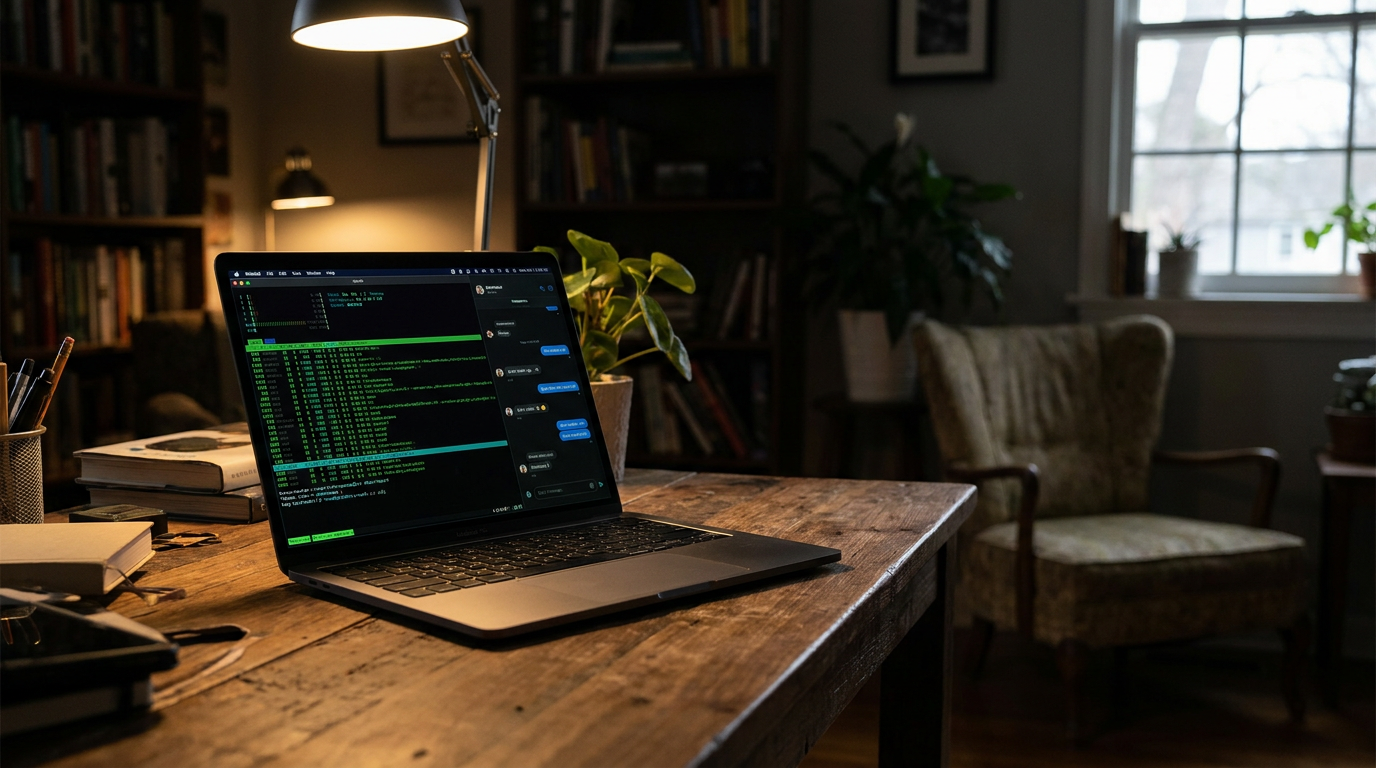
For the past three years, interacting with artificial intelligence meant paying a toll to the cloud. Every prompt typed into ChatGPT, Claude, or Gemini traveled to a remote server, processed by massive data centers, and returned with a per-token price tag. But in 2026, a quiet revolution is happening on the desks of developers, writers, and privacy-conscious professionals. Millions of users are pulling their AI workflows offline, choosing to run powerful Large Language Models (LLMs) directly on their own laptops and desktop computers.[1][3]
This shift from renting intelligence to owning it is driven by a convergence of accessible software, hyper-efficient model architectures, and increasingly capable consumer hardware. Just two years ago, running a local model felt like a science experiment requiring complex terminal commands and a tolerance for jet-engine fan noises. Today, the barrier to entry has vanished. With a few clicks, a standard MacBook or a gaming PC can host an AI assistant that rivals the frontier cloud models of 2024, all without an internet connection.[1][3][4][7]
The primary catalyst for this migration is data privacy. When users rely on cloud-based AI, their proprietary code, sensitive financial documents, and personal queries are transmitted to servers they do not control. For enterprise workers and professionals bound by strict compliance regulations, this is often a dealbreaker. Running a local LLM guarantees absolute data sovereignty; the prompts never leave the physical machine, eliminating the risk of data leaks or unauthorized model training.[5][7]
Beyond privacy, the economics of heavy AI usage have pushed power users toward local solutions. Cloud APIs charge by the token, meaning that complex tasks like autonomous agent workflows or processing massive documents can quickly rack up hundreds of dollars in monthly fees. Local AI flips this model. Once the hardware is purchased, the marginal cost of generating a token drops to zero. Users only pay for the electricity required to power their machines, freeing them to experiment without watching a meter.[3][4]

The software ecosystem enabling this shift is dominated by two breakout tools: Ollama and LM Studio. Before these applications existed, users had to manually manage Python environments, CUDA drivers, and complex repository clones just to get a model to say hello. Now, these tools act as streamlined package managers and graphical interfaces, abstracting away the technical friction and making local AI as easy to install as a standard web browser.[1][6]
Ollama has become the undisputed champion for developers and power users. Operating primarily through a command-line interface, it allows users to download and run models with a single line of text. More importantly, Ollama runs a local server in the background that perfectly mimics the OpenAI API structure. This means developers can point their existing AI applications, coding assistants, and automation scripts to their local machine instead of the cloud, requiring zero changes to their underlying code.[5][6]
For those who prefer a visual approach, LM Studio has emerged as the iTunes of local AI. The desktop application features a built-in browser that lets users search for models, read their specifications, and download them with a single click. It provides a familiar, ChatGPT-style chat interface right out of the box, complete with options to tweak system prompts and adjust hardware settings. For non-technical users, LM Studio is the fastest bridge to private AI.[1][5]

For those who prefer a visual approach, LM Studio has emerged as the iTunes of local AI.
The models themselves have undergone a radical transformation in 2026. The open-weight ecosystem is no longer playing catch-up; it is setting benchmarks. Meta's Llama 4, Google's Gemma 4, and Alibaba's Qwen 3 families offer varying sizes tailored for consumer hardware. These models are highly capable of coding, creative writing, and complex reasoning, often matching or exceeding the performance of paid cloud tiers for specific, specialized tasks.[2][3][7]
A major breakthrough enabling this local performance is the widespread adoption of Mixture-of-Experts (MoE) architectures. Instead of activating every single parameter for every word generated, MoE models route queries to specialized sub-networks. For example, a massive 122-billion parameter model might only use 15 billion parameters during active inference. This dramatically reduces the computational load, allowing laptops to run models that would have required server racks just a year ago.[1][4]
Despite these software and architectural leaps, hardware remains the ultimate gatekeeper of local AI. The critical metric is no longer raw processing speed, but Video RAM (VRAM). Because LLMs must be loaded entirely into memory to function efficiently, a computer's VRAM dictates the size and intelligence of the model it can run. In 2026, 8 to 12 gigabytes of VRAM is considered the baseline for running capable 7-billion to 14-billion parameter models.[1][3][5]
To fit these massive models into consumer-grade memory, developers rely on a technique called quantization. Quantization compresses the mathematical precision of the model's weights, often shrinking a model's file size by 60 percent or more, with only a negligible drop in actual intelligence. A model that requires 30 gigabytes of RAM in its raw state can be quantized to run smoothly on a standard 16-gigabyte laptop, democratizing access to high-tier reasoning.[3][7]

In the hardware arms race, Apple Silicon has carved out a unique and dominant position. Unlike traditional PCs that separate system RAM from GPU VRAM, Apple's M-series chips use a unified memory architecture. This allows a MacBook with 64 gigabytes of unified memory to dedicate almost all of it to running massive AI models. The recently released M5 Max chip has become a favorite among local AI enthusiasts, offering desktop-class inference speeds while drawing a fraction of the power of a dedicated NVIDIA graphics card.[4][6]
For PC users, NVIDIA's RTX 40-series and 50-series cards remain the gold standard for raw speed. An RTX 4090 with 24 gigabytes of VRAM can generate text from a 32-billion parameter model faster than a human can read it. However, this speed comes at the cost of massive power consumption and heat generation, drawing up to 575 watts under heavy load compared to the 90 watts sipped by an Apple laptop.[3][4]
The practical applications for local AI have expanded far beyond simple chatbots. Developers are using local models as offline coding assistants that integrate directly into their editors, analyzing proprietary codebases without risking corporate leaks. Researchers are utilizing Retrieval-Augmented Generation (RAG) to instantly search and summarize thousands of offline PDFs. And frequent travelers are discovering the magic of having a fully functional AI brainstorming partner at 30,000 feet with no Wi-Fi required.[1][2][3][7]

Despite the rapid advancements, local AI is not a complete replacement for the cloud. Frontier models like GPT-5 and Claude Opus still hold a distinct advantage in highly complex, multi-step reasoning tasks and massive context windows. A 7-billion parameter model running on a laptop will occasionally hallucinate or lose the thread of a long conversation in ways that a trillion-parameter data center model will not.[1][3]
Yet, for the vast majority of daily tasks, drafting emails, explaining concepts, formatting data, and basic coding, the local models of 2026 are more than sufficient. The ecosystem has reached a tipping point where the friction of setup is lower than the friction of paying a monthly subscription. As open-weight models continue to shrink in size and grow in capability, the default computing paradigm is shifting: the cloud is for the heavy lifting, but the daily intelligence lives on the desk.[1][3][7]
How we got here
Early 2024
Running local models requires complex terminal commands and massive hardware.
Late 2024
Ollama and LM Studio launch, providing user-friendly interfaces for local AI.
Mid 2025
Open-weight models like Llama 3 and Qwen 2 close the quality gap with cloud APIs.
Early 2026
Apple releases the M5 Max, setting a new benchmark for low-power local inference.
June 2026
Local AI becomes a mainstream workflow for developers and privacy-conscious professionals.
Viewpoints in depth
Privacy & Compliance Advocates
Local AI is the only way to guarantee absolute data sovereignty.
For enterprise workers, lawyers, and healthcare professionals, sending sensitive documents to cloud providers like OpenAI or Anthropic violates strict compliance frameworks. This camp views local AI not as a cost-saving measure, but as a mandatory security protocol. By keeping all prompts and context windows confined to the physical device, they eliminate the risk of data leaks, unauthorized model training, and third-party surveillance.
Open-Source Developers
Owning the AI stack enables limitless customization and autonomous workflows.
Developers and tinkerers champion local AI for the freedom it provides. Without the constraints of API rate limits or recurring token costs, they can build autonomous agents that run 24/7. This camp relies heavily on tools like Ollama to spin up local endpoints, allowing them to seamlessly integrate uncensored, fine-tuned models into their existing codebases and development environments.
Hardware Enthusiasts
The shift to local AI is driving a new era of consumer silicon.
For hardware reviewers and PC builders, local AI is the ultimate benchmark. This group closely tracks the VRAM capacities of NVIDIA's latest RTX cards and the unified memory bandwidth of Apple's M-series chips. They argue that the bottleneck for AI is no longer software, but the physical limitations of consumer hardware, pushing for larger memory pools and more efficient power consumption in next-generation laptops.
What we don't know
- Whether future frontier models will become too large to ever be quantized for consumer hardware.
- How cloud providers will adjust their pricing models to compete with the rise of free local inference.
Key terms
- Local LLM
- A Large Language Model that runs entirely on a user's physical device rather than a remote cloud server.
- VRAM (Video RAM)
- The dedicated memory on a graphics card, which dictates the size of the AI model a computer can run.
- Quantization
- A compression technique that reduces the mathematical precision of an AI model, allowing it to run on consumer hardware.
- Mixture-of-Experts (MoE)
- An AI architecture that only activates a small portion of its neural network for any given prompt, saving massive amounts of computing power.
- Inference
- The process of an AI model actively generating text or analyzing data based on a user's prompt.
Frequently asked
Do I need an internet connection to use a local LLM?
No. Once the model and software are downloaded to your device, the AI runs entirely offline without needing any internet access.
Is it free to run AI locally?
Yes. After the initial purchase of your computer hardware, there are no subscription fees or per-token costs to generate responses.
Can a local model match ChatGPT's intelligence?
For most daily tasks like drafting, summarizing, and basic coding, top local models perform similarly to cloud models. However, frontier cloud models still win on highly complex reasoning.
What is the difference between Ollama and LM Studio?
Ollama is a command-line tool favored by developers for its background API server, while LM Studio is a visual desktop app that makes downloading and chatting with models as easy as using an app store.
Sources
Source coverage
7 outlets
3 viewpoints surfaced






[1]XDA DevelopersHardware Enthusiasts
Local LLMs are finally good enough for daily use
Read on XDA Developers →[2]Hugging FaceOpen-Source Developers
The Best Open Source LLM Models to Run Locally in 2026
Read on Hugging Face →[3]MediumOpen-Source Developers
Why I went all-in on local AI in 2026
Read on Medium →[4]GOpenAIHardware Enthusiasts
The Hardware Guide to Local AI: M5 Max vs RTX 5090
Read on GOpenAI →[5]Canadian Compliance InstitutePrivacy & Compliance Advocates
Running LLMs Locally: A Privacy and Compliance Guide
Read on Canadian Compliance Institute →[6]MindStudioOpen-Source Developers
The Complete Guide to Ollama in 2026
Read on MindStudio →[7]Factlen Editorial TeamPrivacy & Compliance Advocates
Synthesis by Factlen editorial team
Read on Factlen Editorial Team →


Every angle. Every day.
Get ai stories with full source coverage and perspective breakdowns delivered to your inbox.