
South Korea Conducts First Flight Test of Domestically Developed Hypersonic Glide Vehicle
The weapon separated from its booster and performed irregular low-altitude maneuvers before striking its target. The successful trial marks a major milestone in Seoul's effort to field advanced conventional strike capabilities.
By Hunter Cole

South Korea successfully conducted the first flight test of its domestically developed hypersonic glide vehicle on October 8, 2026. The weapon separated from its booster at high altitude, descended, and executed irregular horizontal and vertical maneuvers before striking a designated target.[1][3]
The launch took place from a barge at the Agency for Defense Development’s Anheung Test Center in Taean, roughly 130 kilometers south of Seoul. President Lee Jae-myung and Defense Minister Kang Shin-chul observed the milestone, marking a rare presidential appearance for a new weapon system's initial trial.[1][3]
The test validates South Korea’s entry into a small group of nations capable of fielding maneuverable hypersonic systems. These weapons travel at speeds exceeding Mach 5 while flying at lower altitudes than traditional ballistic missiles, making them exceptionally difficult for conventional air defense networks to track and intercept.[2][5]
Presidential spokesperson Kang Yu-jung stated the test was designed to verify three critical technological thresholds. Engineers evaluated the performance of ultra-high-temperature thermal protection materials, the precision of the vehicle's guidance and control systems, and its ability to perform non-linear maneuvers under extreme aerodynamic stress.[3][5]
Validating indigenous defense technology
The Agency for Defense Development has been quietly advancing the program for years, relying entirely on domestic engineering. The successful separation and controlled glide phase demonstrate that South Korean materials science can withstand the intense friction generated by hypersonic atmospheric reentry.[1][3]
“The HGV successfully separated from its booster and seamlessly executed its planned flight path under hypersonic conditions,” Kang said in a written statement. She described the launch as a major milestone in securing a new deterrent capable of striking critical targets across the Korean Peninsula.[3][5]
After the vehicle detached from its rocket booster, it intentionally lowered its flight altitude to begin the unpowered glide phase. By altering its trajectory both vertically and horizontally, the weapon proved it could dynamically adjust its course to evade simulated interceptors before reaching its terminal phase.[1][3]
President Lee praised the research team immediately following the successful impact. “Our security must be secured through our own strength,” Lee said, adding that the government will fully support the rapid development and operational deployment of advanced weaponry so the public can live without concern.[3][5]
A shifting regional balance
The demonstration occurs against a backdrop of accelerating military modernization across the Korean Peninsula. North Korea has conducted multiple tests of its own hypersonic systems this year, including an intermediate-range launch in early October that Pyongyang claimed utilized artificial intelligence for terminal guidance.[4][5]
While the presidential office did not explicitly link the hypersonic glide vehicle test to recent North Korean activities, the strategic messaging is clear. South Korea is systematically building a conventional strike portfolio that can hold heavily fortified or time-sensitive targets at risk without relying on nuclear payloads.[3][4]
During the same visit to the Taean facility, Lee inspected the military’s Hyunmoo-5 surface-to-surface ballistic missile. Often referred to in domestic media as a “monster missile” due to its massive payload capacity, the Hyunmoo-5 is designed to penetrate deeply buried underground bunkers.[1][3][5]
The combination of the heavy-payload Hyunmoo-5 and the highly maneuverable hypersonic glide vehicle gives South Korean commanders complementary tools. One provides sheer destructive mass against static subterranean facilities, while the other offers an evasive, rapid-response capability against mobile launchers or command nodes.[2][4]
The engineering challenges ahead
Despite the initial success, transitioning a hypersonic prototype into a reliable, mass-produced operational asset requires years of additional testing. The extreme thermal and structural loads placed on the vehicle during maneuvers often reveal hidden flaws in heat-shielding materials that only emerge over repeated flights.[2]
The government has not disclosed the weapon's maximum speed, operational range, or intended deployment timeline. Analysts note that while the first flight validated the basic aerodynamic design and control software, subsequent tests will need to push the vehicle to its maximum thermal and structural limits.[1][2]
Launching from a barge rather than a land-based silo or mobile erector launcher was likely a safety precaution for the inaugural flight. Future trials will need to integrate the weapon with the military's existing ground or naval launch platforms to prove its tactical viability in a combat environment.[1][3]
South Korea's defense industry is also working to ensure the new system integrates seamlessly with the military's broader command and control network. As Seoul prepares to assume wartime operational control from the United States, independent intelligence, surveillance, and reconnaissance assets must be capable of feeding real-time targeting data to the hypersonic platform.[3][4]
Strategic implications for the alliance
The successful test aligns with Seoul's broader strategy of assuming a larger share of the regional deterrence burden. By fielding advanced conventional strike capabilities, South Korea reduces its absolute reliance on the United States for immediate retaliatory options during a crisis.[3][4]
Washington and Seoul have previously stated that existing allied defense assets can detect and intercept North Korean hypersonic threats. However, South Korea's own offensive hypersonic capability forces adversaries to dedicate significant resources to air defense, complicating their strategic calculus.[4][5]
The development of indigenous hypersonic technology also opens potential future avenues for defense exports, a sector where South Korea has recently excelled. While strategic weapons like hypersonic glide vehicles are heavily restricted by international export control regimes, the underlying materials science and guidance technologies have broad aerospace applications.[2]
Ultimately, the October 8 launch represents a critical node in South Korea's evolving defense posture. The military is moving beyond traditional artillery and ballistic missiles, embracing next-generation aerospace engineering to maintain a qualitative edge in an increasingly contested regional environment.[3][4]
Key points
- South Korea successfully tested its first domestically developed hypersonic glide vehicle on October 8, 2026.
- The weapon separated from its booster and performed irregular vertical and horizontal maneuvers before hitting its target.
- The test validated ultra-high-temperature thermal protection materials and advanced guidance systems.
- The launch demonstrates Seoul's growing capability to field advanced conventional strike weapons independently.
What we don’t know
- The maximum speed, operational range, and payload capacity of the hypersonic glide vehicle remain classified.
- The government has not disclosed a timeline for when the weapon will enter mass production or operational service.
- It is unclear how the vehicle will be integrated with existing ground or naval launch platforms, as the initial test was conducted from a barge.
How we got here
September 2026
North Korea conducts a suspected hypersonic missile provocation, escalating regional tensions.
Early October 2026
North Korean leader Kim Jong-un oversees the launch of an intermediate-range missile utilizing hypersonic technology.
October 8, 2026
South Korea conducts the first successful flight test of its indigenous hypersonic glide vehicle from a barge in Taean.
- South Korean Defense Establishment
- Views the hypersonic glide vehicle as a necessary conventional deterrent against regional threats.
- Regional Security Analysts
- Warns that the reciprocal development of hypersonic weapons accelerates an arms race on the peninsula.
Perspectives this story doesn't cover
- North Korean state media's official response to the South Korean test.
- Perspectives from regional neighbors, such as Japan or China, on the shifting balance of conventional strike capabilities.
Sources
Source coverage
5 outlets
2 viewpoints surfaced





- [1]JanesSouth Korean Defense Establishment
South Korea conducts first test launch of indigenous HGV
Read on Janes → - [2]The War ZoneRegional Security Analysts
First Look At Hypersonic Boost-Glide Vehicle Just Tested By South Korea
Read on The War Zone → - [3]The Korea HeraldSouth Korean Defense Establishment
Lee observes S. Korea's first homegrown hypersonic missile test
Read on The Korea Herald → - [4]Asia TimesRegional Security Analysts
South Korea's hypersonic leap runs into North Korea's nuclear wall
Read on Asia Times → - [5]The IndependentRegional Security Analysts
South Korea conducts first test launch of hypersonic glide missile
Read on The Independent →

More in Defense & Security
See all →Autonomous Warfare
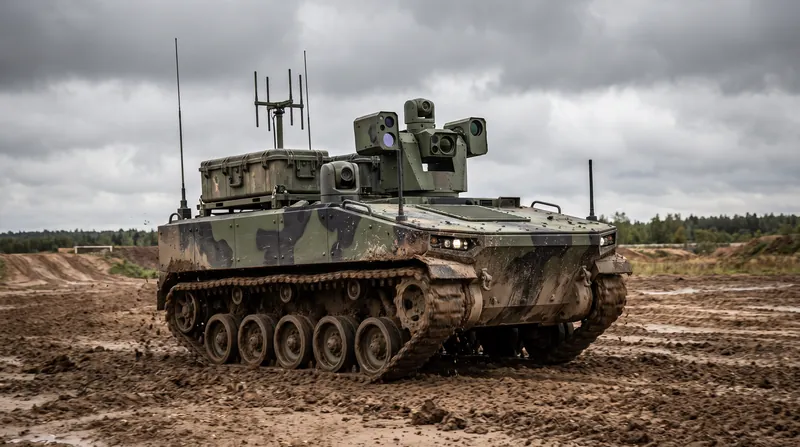
Ukraine Launches 'Army of Robots' Initiative to Replace Human Infantry with Autonomous Ground Systems
5 sources
GNSS Architecture
The Four Components of GPS Error: Ephemeris, Clock, Ionosphere, and Troposphere
6 sources

Hypersonic Propulsion
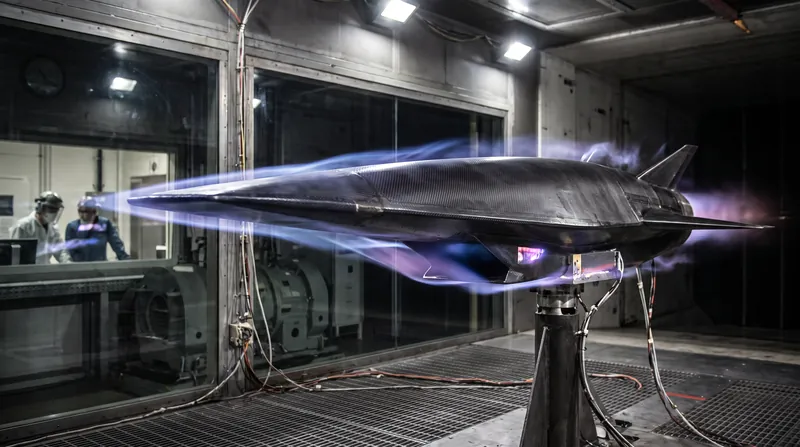
The Three Stages of a Scramjet: How Compression, Combustion, and Expansion Enable Hypersonic Flight
9 sources
Naval Aviation
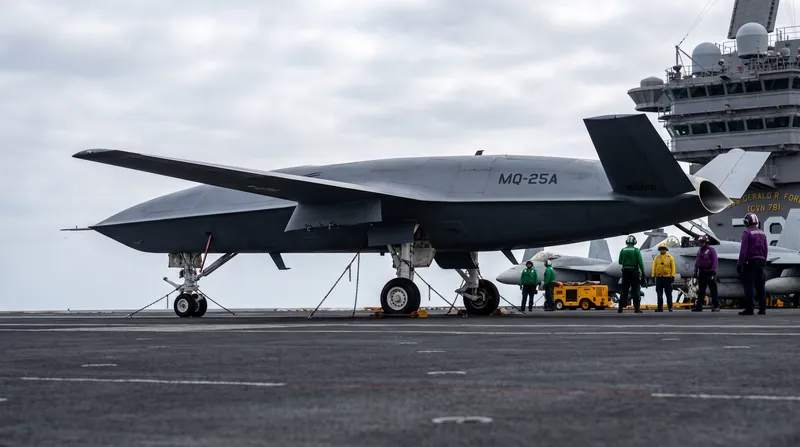
U.S. Navy Awards Boeing $562 Million Production Contract for MQ-25A Stingray Carrier Drones
8 sources
Comments
Every angle. Every day.
Get Defense & Security stories with full source coverage and perspective breakdowns, free every day.