
U.S. Military Schedules Directed Energy 'Shoot-Off' to Select Operational Counter-Drone Lasers
The Pentagon will host a live-fire competition in December to rapidly acquire and field laser and microwave weapons for domestic base defense.

Share this story
The cost of defending military infrastructure has become mathematically unsustainable. When a $4 million kinetic interceptor is required to neutralize a $20,000 one-way attack drone, the defender eventually exhausts its budget before the attacker exhausts its swarm. This asymmetric economic reality is driving a fundamental shift in how the U.S. military protects its installations and personnel.
For years, directed energy weapons—lasers and microwaves—were relegated to experimental laboratories and controlled test ranges. Now, driven by the proliferation of cheap unmanned aerial systems, the Pentagon is forcing these technologies into operational service to invert the cost curve of modern air defense.[4]
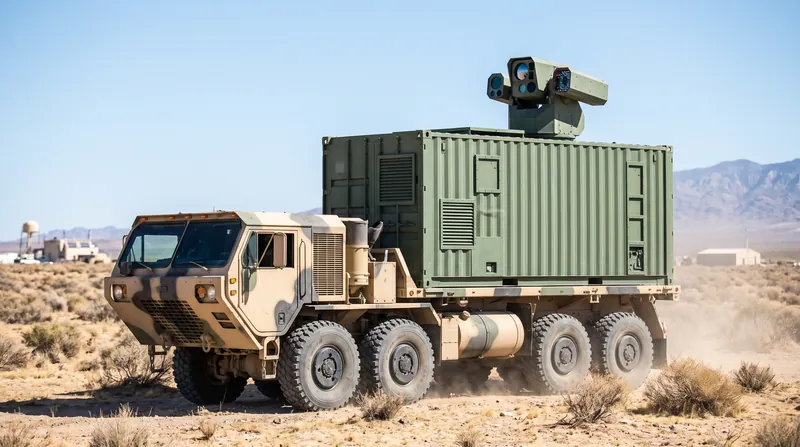
To accelerate this transition, the Pentagon’s Joint Interagency Task Force 401 (JIATF-401) has scheduled a comprehensive "directed energy shoot-off" for December 2026 at the Army's Dugway Proving Ground in Utah. The event will pit select commercial high-energy lasers and high-power microwaves against target drones in realistic operational scenarios.
Brig. Gen. Matt Ross, commander of JIATF-401, stated that the competition is designed to bypass the traditional, years-long defense procurement cycle. Systems that demonstrate successful performance during the live-fire event will immediately receive purchase orders, allowing manufacturers to establish production lines and push the technology directly to the field.[1][2]
The primary claim driving this rapid acquisition strategy is the marginal cost per engagement. Defense contractor AeroVironment estimates that a laser shot from its LOCUST X3 system costs under $5 in total, with the electricity itself accounting for roughly 18 cents. This represents a paradigm shift from traditional air defense systems like the Patriot PAC-3 MSE. By trading a multimillion-dollar missile for a beam of light that fires for pennies, military planners believe they can finally achieve a sustainable defense against sustained drone campaigns.[4]
The initiative extends beyond the December testing event. JIATF-401 has already initiated a directed energy pilot program across five domestic military installations: Fort Huachuca in Arizona, Fort Bliss in Texas, Naval Base Kitsap in Washington, Grand Forks Air Force Base in North Dakota, and Whiteman Air Force Base in Missouri. These sites will operate the beam weapons for a 365-day period. Crucially, the systems will be run and maintained by actual service members rather than civilian field support representatives, testing the technology's reliability and usability in a true operational context.[2][3]
The urgency of this deployment stems from a documented increase in drone incursions over critical U.S. military infrastructure. The Naval Criminal Investigative Service (NCIS) recently issued warnings regarding drone surveillance over warships, flight lines, and nuclear storage facilities. Bases such as Camp Pendleton reported multiple drone incursions throughout 2024, while overseas installations like Diego Garcia have faced similar threats. Military leaders have repeatedly warned that domestic bases remain ill-prepared for the kind of mass drone attacks currently defining conflicts in Eastern Europe and the Middle East.[3]
While the cost-per-shot economics are highly favorable, the operational evidence for directed energy remains mixed. High-energy lasers require extraordinary precision—maintaining a focused beam on a small, maneuvering target for the entire dwell time required to melt its components. This places immense demands on tracking range, angular stability, and end-to-end latency. Furthermore, environmental factors such as dust, rain, and humidity can scatter the laser beam, significantly reducing its effective range and lethality in adverse weather conditions.[4]
To mitigate the limitations of lasers, the shoot-off heavily emphasizes high-power microwave (HPM) systems. Unlike lasers, which must track and melt individual targets sequentially, HPMs use concentrated bursts of electromagnetic energy to overload and disable drone electronics. This approach allows a single pulse to neutralize an entire swarm simultaneously, offering a distinct tactical advantage. The Pentagon's strategy relies on layering these two technologies—using microwaves for broad swarm defense and lasers for precise, localized interception—to create a comprehensive shield around critical bases.[1][2]
This push for directed energy aligns with broader directives from the Department of Defense to field lighter, more efficient counter-drone technologies. Top Pentagon officials have recently called on the defense industry to move beyond "slideware" and deliver hardware that can be stressed on a range.
By forcing commercial vendors into a live shoot-off with immediate procurement contracts on the line, the military is attempting to match the rapid innovation cycles of the commercial drone industry, signaling that the era of relying solely on expensive kinetic interceptors is coming to an end.[1][5]
Key points
- The Pentagon's JIATF-401 will host a directed energy shoot-off in December 2026 at Dugway Proving Ground.
- Successful laser and microwave systems will receive immediate purchase orders to bypass traditional procurement delays.
- The shift is driven by unsustainable economics, replacing $4 million interceptors with laser shots costing under $5.
- A 365-day pilot program is deploying these weapons to five domestic military bases for testing by actual service members.
What we don’t know
- How effectively the directed energy systems will perform in adverse weather conditions like heavy rain or dust storms during the December shoot-off.
- Whether the commercial defense base can scale production lines quickly enough to meet the Pentagon's demand if multiple systems are selected.
- The specific rules of engagement for deploying high-power microwaves in domestic airspace near civilian infrastructure.
How we got here
August 2025
The Pentagon launches Joint Interagency Task Force 401 to synchronize counter-drone activities.
May 2026
JIATF-401 announces a pilot program to test directed energy systems at five domestic military facilities.
August 2026
Military officials confirm plans for a live-fire shoot-off with immediate procurement contracts for successful systems.
December 2026
Scheduled directed energy shoot-off at Dugway Proving Ground in Utah.
- Defense Procurement Officials
- Advocating for rapid acquisition models that prioritize cost-per-shot economics over traditional kinetic systems.
- Base Security Commanders
- Focused on the immediate tactical need to defend domestic installations from escalating drone surveillance.
- Directed Energy Skeptics
- Highlighting the physical and environmental limitations that complicate the operational deployment of lasers.
Perspectives this story doesn't cover
- Civilian aviation authorities concerned about airspace safety.
- Local communities surrounding the five pilot program bases.
Sources
Source coverage
7 outlets
3 viewpoints surfaced







- [1]Breaking DefenseDefense Procurement Officials
Pentagon counter-drone task force preps 'shoot-off' for directed energy prototypes
Read on Breaking Defense → - [2]DefenseScoopDefense Procurement Officials
US military to host directed energy shoot-off event in 2026
Read on DefenseScoop → - [3]The Washington TimesBase Security Commanders
A specialized counter-drone unit has begun a directed energy pilot program
Read on The Washington Times → - [4]Business InsiderDirected Energy Skeptics
Cheap Lasers Just Made Aiming Priceless
Read on Business Insider → - [5]Air & Space Forces MagazineBase Security Commanders
Pentagon Tech Official Calls for Lighter, More Efficient Directed Energy Weapons
Read on Air & Space Forces Magazine → - [6]Fast CompanyDirected Energy Skeptics
Defense Secretary Pete Hegseth observes live directed energy weapon firing
Read on Fast Company → - [7]AxiosDefense Procurement Officials
Defense Secretary Pete Hegseth attends demonstration of laser and microwave weapons
Read on Axios →
More in Defense & Security
See all →GNSS Architecture
The Four Components of GPS Error: Ephemeris, Clock, Ionosphere, and Troposphere
6 sources

Hypersonic Propulsion
The Three Stages of a Scramjet: How Compression, Combustion, and Expansion Enable Hypersonic Flight
9 sources
Naval Aviation
U.S. Navy Awards Boeing $562 Million Production Contract for MQ-25A Stingray Carrier Drones
8 sources

Stealth Engineering
The Four Mechanisms of Radar Cross-Section Reduction: Shaping, Materials, Cancellation, and Emission Control
7 sources
Comments
Every angle. Every day.
Get Defense & Security stories with full source coverage and perspective breakdowns, free every day.