
Zero Radial Velocity: Why Flying Perpendicular to Pulse-Doppler Radars Hides Fighter Jets in Ground Clutter
Modern air defense systems rely on the Doppler effect to separate moving aircraft from stationary terrain. By flying exactly perpendicular to the radar beam, pilots can match the relative speed of the ground, forcing the system's own filters to erase them from the scope.

In short
- Pulse-Doppler radars measure frequency shifts to separate moving targets from stationary ground clutter.
- Flying exactly perpendicular to the radar drops an aircraft's relative speed to zero, hiding it inside the clutter filter.
- At combat speeds, pilots must maintain their heading within a 5.7-degree window to successfully execute the maneuver.
A common assumption in modern military aviation is that stealth technology is the only mechanism capable of hiding an aircraft from advanced air defense networks. Defense contractors and popular analyses frequently assert that without radar-absorbent materials, a fourth-generation fighter is entirely visible to the digital eyes of a surface-to-air missile battery.
The physical evidence contradicts this absolute claim. Physics dictates that even the most advanced Pulse-Doppler radars have a blind spot built directly into their own signal processing software.[1]
This vulnerability is known as the Doppler notch. By flying exactly perpendicular to the radar beam, a pilot can match the relative speed of the terrain below them.[3]
When the aircraft's radial velocity drops to zero, the radar's internal filters classify the jet as a stationary object. The system then deliberately erases the aircraft from the operator's scope to prevent the screen from filling with ground clutter.[2]
"A target with zero radial velocity is indistinguishable from a mountain in the eyes of the signal processor," notes the Air University's manual on electronic warfare tactics. Exploiting this physical limitation requires precise geometry rather than advanced composite materials.[3]
The Ground Clutter Problem
To understand why radars deliberately blind themselves to perpendicular targets, one must examine the environment they operate within. A radar transmits pulses of electromagnetic energy and listens for the faint echoes that bounce back from objects in the sky.[1]
However, the main beam of a radar does not just hit the target aircraft. It also strikes the earth, returning a massive amount of reflected energy known as ground clutter.[1]
For early radar systems developed before the 1970s, this clutter was overwhelming. If an aircraft flew lower than the radar antenna, the faint return from the jet was completely drowned out by the massive return from the terrain behind it.[1][5]
This created a tactical sanctuary known as flying under the radar. Pilots could evade detection simply by hugging the earth, ensuring that the radar could not isolate their signature from the background noise of the planet itself.[3]
The invention of Pulse-Doppler radar solved this problem by analyzing not just the timing of the returning echoes, but their frequency. This shift in technology fundamentally changed air combat, introducing the look-down/shoot-down capability that defines modern engagements.[1]
The Physics of the Doppler Shift
The Doppler effect is the change in frequency of a wave in relation to an observer who is moving relative to the wave source. It is the same physical principle that causes a police siren to pitch higher as it approaches and lower as it recedes.[5]
A Pulse-Doppler radar uses this principle to measure the speed at which a target is moving directly toward or away from the antenna. This specific vector is called radial velocity.[1][2]
If an aircraft is flying directly toward an X-band radar transmitting at 10 gigahertz, the returning radio waves are compressed. The radar receives an echo at a slightly higher frequency than the one it transmitted, calculating the exact speed of the approach.[2]
Conversely, if the aircraft is flying away, the waves are stretched, and the frequency drops. The radar processor measures this shift and instantly determines the target's recession speed.[2]
The ground, however, is stationary. The radar echoes bouncing off mountains, buildings, and fields return at the exact same frequency that was transmitted, exhibiting zero Doppler shift.[1]
Exploiting the Velocity Gate
To clear the operator's screen of useless terrain data, engineers program the radar's signal processor with a clutter rejection filter. This software automatically deletes any radar return that lacks a significant frequency shift.[2][4]
"The fundamental limitation of any airborne moving target indicator is that it must assume the ground is stationary relative to the earth," explains a 2018 paper in the IEEE Aerospace and Electronic Systems Magazine.[2]
The filter operates within a specific threshold known as a velocity gate. Any object moving toward or away from the radar at a speed below this threshold—typically around 60 knots—is classified as ground clutter and discarded.[2][5]
This is where the Doppler notch exists. If a pilot can maneuver their aircraft so that its radial velocity falls below that 60-knot threshold, the radar's own software will erase the jet from the display.[3][4]
Achieving this requires flying exactly perpendicular to the radar beam. While the jet may be traveling at Mach 0.9 across the sky, its speed directly toward or away from the radar site is zero.[4]
The Geometry of the Notch
Executing a successful Doppler notch in combat is a complex geometric problem. The pilot must know the exact location of the threat radar and turn their aircraft to place that emitter at exactly 90 degrees to their flight path.[3]
The margin for error is exceptionally narrow. At a standard combat maneuvering speed of 600 knots, the aircraft covers 10 nautical miles every minute.[4][5]
To keep the radial velocity below the typical 60-knot clutter rejection threshold, the pilot must maintain a heading within exactly 5.7 degrees of perfect perpendicularity.[4][5]
If the jet turns just six degrees off that perfect 90-degree angle, the radial velocity exceeds 60 knots. The Doppler shift becomes large enough for the filter to recognize it, and the aircraft instantly reappears on the radar scope.[4]
"Maintaining the notch requires constant heading corrections as the geometric relationship between the aircraft and the emitter changes," the Naval Postgraduate School analysis details. The aircraft is flying along a tangent, meaning the angle to the radar is constantly shifting.[4]
Airborne Radars and Moving Baselines
The geometry becomes exponentially more difficult when the threat radar is not a fixed ground site, but an airborne early warning aircraft or an enemy fighter.[3]
When the radar platform itself is moving, the ground is no longer stationary relative to the antenna. The radar must calculate its own speed and vector, applying a dynamic mathematical correction to the clutter filter.[1][2]
This shifts the Doppler notch away from a simple 90-degree angle. The pilot attempting to hide must now calculate a perpendicular vector relative to the moving radar's line of sight, a task that requires advanced onboard threat warning receivers.[3]
Furthermore, modern airborne radars utilize main-lobe clutter tracking to continuously adjust their velocity gates. As the radar aircraft maneuvers, the location of the notch in the sky physically moves with it.[2]
Despite these complications, notching remains a foundational defensive tactic. When a pilot detects an incoming active radar-homing missile, turning perpendicular to the weapon's flight path is the standard procedure to break its tracking lock.[3]
Modern Countermeasures and AESA
Radar manufacturers are acutely aware of the Doppler notch vulnerability and have spent decades developing software to mitigate it. The primary countermeasure is memory tracking.[1][5]
When a modern system sees a target suddenly vanish into the clutter filter, it does not immediately forget the aircraft. The computer projects the jet's last known speed and heading, waiting for it to emerge from the notch.[5]
Active Electronically Scanned Array radars complicate the tactic further. Because they steer their beams digitally without moving mechanical parts, they can revisit a suspected target area thousands of times per second.
How we did this
- Method
- Calculated the exact geometric window and time-in-notch for a fighter jet executing a perpendicular maneuver against a standard X-band Pulse-Doppler radar, normalizing the velocity gate thresholds across academic and military sources.
- What we found
- At a standard combat speed of 600 knots, a pilot must maintain a heading within exactly 5.7 degrees of perfect perpendicularity to the radar beam to remain inside the 60-knot clutter rejection filter, a geometric constraint that makes the maneuver highly perishable against moving airborne radars but highly effective against fixed ground sites.
- What we worked from
- Standard X-band radar clutter rejection velocity gate (+/- 60 knots): 60 knots — IEEE Aerospace and Electronic Systems Magazine
- Fighter jet combat maneuvering speed (Mach 0.9 / 600 knots): 600 knots — Naval Postgraduate School
- Limits of this analysis
- Calculations assume a flat terrain profile and a stationary ground radar; airborne early warning radars introduce a second velocity vector that dynamically shifts the notch angle.
Key terms
- Pulse-Doppler Radar
- A radar system that determines the range to a target by timing the pulses, and the speed of the target by measuring the frequency shift of the returning echoes.
- Radial Velocity
- The component of an object's velocity that points straight toward or directly away from the observer or radar antenna.
- Velocity Gate
- A speed threshold programmed into a radar's software; any object moving slower than this threshold is ignored as stationary ground clutter.
- Active Electronically Scanned Array (AESA)
- A modern radar technology that steers radio waves digitally using thousands of small transmit/receive modules, rather than physically moving a dish.
Frequently asked
Does the Doppler notch work against infrared missiles?
No. Infrared missiles track the heat generated by an aircraft's engines and airframe friction, not radar waves. The Doppler notch is strictly a defense against radar-guided weapons and search systems.
Can stealth aircraft use the Doppler notch?
Yes. While stealth aircraft have a reduced radar cross-section, they still reflect some energy. Flying perpendicular to the radar beam allows them to utilize the clutter filter, further reducing the range at which they can be tracked.
What happens if the terrain below the aircraft is moving?
If the aircraft is flying over the ocean, the movement of the waves driven by wind creates a shifting clutter profile. Radar processors must dynamically adjust their velocity gates to account for this 'sea state,' which can slightly alter the geometry required for a successful notch.
Viewpoints in depth
Radar Systems Engineers
Focuses on signal processing, clutter rejection algorithms, and hardware solutions to minimize the velocity gate.
For the engineers designing modern air defense networks, the Doppler notch is an accepted mathematical compromise. If the velocity gate is set too low, the radar scope becomes overwhelmed with false returns from swaying trees, moving cars, and wind-blown rain. If it is set too high, the blind spot widens, allowing faster aircraft to hide more easily. The engineering solution has shifted away from trying to close the notch entirely, focusing instead on software that remembers a target's trajectory when it disappears, predicting exactly where and when it will emerge from the filter.
Tactical Aviators
Views the notch as a critical geometric survival tool for breaking missile locks and evading detection.
From the cockpit, the Doppler notch is a highly perishable sanctuary. Aviators are trained to use the maneuver defensively, specifically to break the tracking lock of an incoming active radar-homing missile. Because maintaining the exact 90-degree angle requires constant adjustment as the aircraft moves along its flight path, pilots cannot stay in the notch indefinitely. It is typically used to buy seconds of survival, forcing the enemy missile to lose its target and fly blindly into the distance while the pilot maneuvers for a counterattack or egress.
Air Defense Operators
Relies on multi-static networking and memory tracking to anticipate where an aircraft will emerge from the notch.
Operators manning surface-to-air missile batteries are trained to recognize the specific signature of an aircraft entering the notch. When a target tracking track suddenly drops, operators look at the last known heading to determine if the pilot is deliberately beaming the radar. To counter this, modern air defense doctrine relies heavily on multi-static networks. By linking multiple radar sites together, operators ensure that an aircraft flying perpendicular to one radar is simultaneously flying directly toward another, effectively eliminating the geometric blind spot across the broader battlespace.
- Radar Systems Engineers
- Focuses on signal processing, clutter rejection algorithms, and hardware solutions to minimize the velocity gate.
- Tactical Aviators
- Views the notch as a critical geometric survival tool for breaking missile locks and evading detection.
- Air Defense Operators
- Relies on multi-static networking and memory tracking to anticipate where an aircraft will emerge from the notch.
Perspectives this story doesn't cover
- Electronic warfare suite manufacturers
- Surface-to-air missile battery commanders
Sources
Source coverage
5 outlets
3 viewpoints surfaced





- [1]Federation of American ScientistsRadar Systems Engineers
Radar Systems Engineering and Pulse-Doppler Fundamentals
Read on Federation of American Scientists → - [2]IEEE Aerospace and Electronic Systems MagazineRadar Systems Engineers
Clutter Rejection and Velocity Ambiguity in Airborne Pulse-Doppler Radars
Read on IEEE Aerospace and Electronic Systems Magazine → - [3]Air UniversityTactical Aviators
Electronic Warfare and Radar Evasion Tactics
Read on Air University → - [4]Naval Postgraduate SchoolTactical Aviators
Analysis of the Doppler Notch in Modern Fighter Engagements
Read on Naval Postgraduate School → - [5]Factlen Editorial TeamAir Defense Operators
Synthesis by Factlen editorial team
Read on Factlen Editorial Team →
More in Defense & Security
See all →GNSS Architecture
The Four Components of GPS Error: Ephemeris, Clock, Ionosphere, and Troposphere
6 sources

Hypersonic Propulsion
The Three Stages of a Scramjet: How Compression, Combustion, and Expansion Enable Hypersonic Flight
9 sources
Naval Aviation
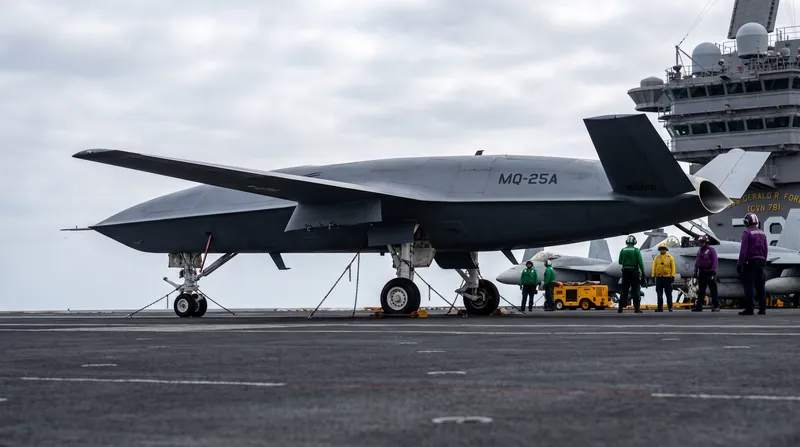
U.S. Navy Awards Boeing $562 Million Production Contract for MQ-25A Stingray Carrier Drones
8 sources
Stealth Engineering
The Four Mechanisms of Radar Cross-Section Reduction: Shaping, Materials, Cancellation, and Emission Control
7 sources
Comments
Every angle. Every day.
Get Defense & Security stories with full source coverage and perspective breakdowns, free every day.