
Softwood Lumber Prices Decouple From Soft Housing Demand Due to Structural Supply and Multi-Family Shift
Despite a slowdown in single-family housing starts, North American softwood lumber prices have remained resilient in 2026 due to structural mill closures and a shift toward multi-family construction.

In short
- Softwood lumber prices have remained elevated in 2026 despite a drop in single-family housing demand.
- Domestic mills in the U.S. and Canada have reduced production capacity, keeping the market tight.
- A shift toward multi-family construction means builders are using less wood per housing unit.
The short version is this: softwood lumber prices are staying stubbornly high even though fewer single-family homes are being built. For anyone planning a major renovation, an addition, or a new custom build in 2026, the old real estate rule—that a slow housing market automatically means cheap wood—is currently broken.
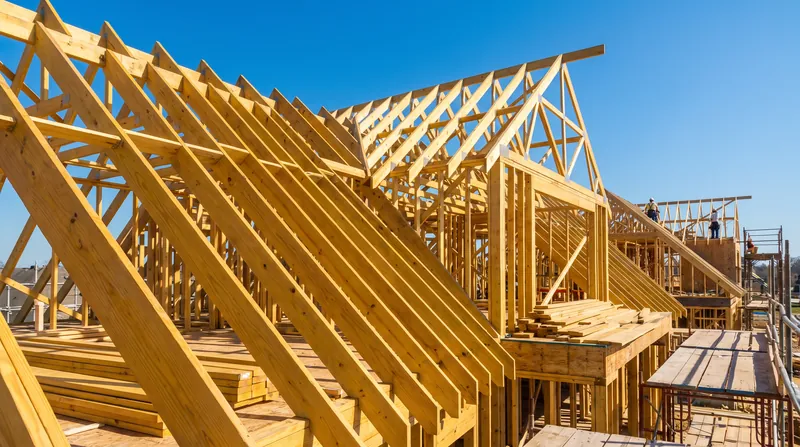
Buyers waiting on the sidelines for material costs to crash alongside softening consumer demand are finding themselves caught in a fundamentally rewired market. The cost of framing a house remains elevated, and the reasons have less to do with how many people want to buy homes and more to do with how much wood is actually available to build them.[1][5]
Historically, the relationship between lumber prices and housing starts was one of the most reliable indicators in the construction industry. When mortgage rates rose and builder confidence fell, lumber got cheaper as demand evaporated. Conversely, a booming housing market sent prices soaring. But throughout 2026, that traditional link has visibly decoupled. North American softwood lumber consumption has fallen year-over-year, yet prices have remained surprisingly resilient, refusing to drop in tandem with the slowing demand for single-family homes.[1][2]
This divergence reflects a profound structural shift on the supply side of the forest products industry. The primary reason prices have not fallen is that domestic lumber production has shrunk simultaneously. Sawmills across both the United States and Canada have significantly reduced their output in response to long-term operational challenges, including timber availability, high operating costs, and previous market volatility.[1][2]
This structural contraction means that even a smaller pool of buyers is now competing for a much smaller pile of available wood. When supply falls at the exact same time that consumption falls, the market remains artificially tight. Market pricing does not respond to demand in a vacuum; it responds to the balance between what is needed and what is available. Right now, that balance is keeping prices firm, proving that supply constraints can dictate market terms just as forcefully as consumer appetite.[1][2]
The second major factor driving this decoupling is a shift in how developers are actually building. While overall housing starts have seen some growth in certain quarters, the increase has been heavily concentrated in multi-family projects—such as apartment complexes and condominiums—rather than traditional single-family homes. This distinction is critical for understanding the lumber market's current behavior.[1][2]
Multi-family units put more families under one roof using significantly less framing lumber per family than a sprawling single-family house. Because apartments share walls, floors, and foundational structures, their lumber footprint is highly efficient. As a result, top-line housing activity can look robust on paper, driven by multi-family starts, while the actual volume of softwood lumber consumed across the continent softens.[1]
For a prospective homeowner or a local contractor, this macroeconomic dynamic translates directly to the bottom line. Elevated material costs are adding tens of thousands of dollars to the price of a typical new single-family home. The National Association of Home Builders notes that the rising cost of building materials, particularly softwood lumber, is actively harming housing affordability and exacerbating price volatility for buyers trying to enter the market.[4]
Builders are attempting to adapt to these economic realities by shrinking lot sizes, optimizing floor plans, and focusing on lower-priced home tiers to keep properties within reach of buyers facing high mortgage rates. However, they cannot entirely absorb the inflated cost of framing materials. The expense inevitably flows down the supply chain, meaning that the buyer ultimately pays the premium for the industry's structural supply deficit.[2][4]
The decoupling of demand and price is also playing out differently across various regions, adding another layer of complexity for buyers and distributors. Southern Yellow Pine (SYP), a staple framing material in the Southeastern United States, has recently broken away from the broader North American softwood complex, developing an increasingly independent price trajectory that defies national trends.[3]
Unlike the broader market, the SYP sector expanded its milling capacity aggressively during and after the pandemic. This rapid capacity growth in the U.S. South created a localized level of supply pressure not seen in Western or Canadian regions. Consequently, SYP prices have occasionally faced sustained downward pressure, creating massive price spreads between Southern pine and Western Spruce-Pine-Fir (SPF).[3]
This regional divergence highlights how localized the lumber market has become. Because Southern Yellow Pine is heavily dependent on the real estate market within the Southeast, any localized economic downturn in that specific region amplifies volatility. It proves that while national supply is tight, regional overcapacity can still create pockets of distinct pricing behavior, complicating the purchasing strategies of national homebuilding firms.[3]
This regional divergence highlights how localized the lumber market has become.
Looking ahead, the timeline for resolving this structural supply deficit remains highly uncertain. Rebuilding domestic mill capacity to a level that could comfortably oversupply the market requires significant time, capital investment, and a skilled workforce. With high interest rates and ongoing affordability pressures weighing on the broader economy, mill operators have little incentive to rapidly scale up production.[2][5]
Until production capacity expands or import dynamics shift dramatically to flood the market with foreign wood, buyers and renovators should not expect a return to the cheap lumber pricing of previous housing slumps. The North American lumber market has fundamentally rewired itself. For the foreseeable future, anyone breaking ground on a new project will have to navigate a landscape where tight supply keeps a firm floor under material costs, regardless of how many other people are building.[1][2][5]
Definitions
- Softwood Lumber
- Wood from conifer trees (like pine, spruce, and fir) primarily used for structural framing in residential construction.
- Housing Starts
- An economic indicator reflecting the number of new residential construction projects that have begun during a specific period.
- Multi-Family Housing
- Residential buildings designed to house several different families in separate units, such as apartment complexes or condos.
- Southern Yellow Pine (SYP)
- A group of pine species grown in the Southeastern U.S., heavily used in construction and currently experiencing unique regional pricing dynamics.
- Spruce-Pine-Fir (SPF)
- A mix of conifer woods commonly harvested in Canada and the Western U.S., serving as a benchmark for framing lumber prices.
Questions & answers
Why are lumber prices high if housing demand is down?
Domestic sawmills have significantly reduced their production capacity. Because supply has fallen at the same time as demand, the market remains tight, keeping prices firm.
Will waiting to build or renovate save me money on lumber?
It is unlikely in the near term. Until mill production capacity expands or import levels rise dramatically, structural supply constraints are expected to keep a floor under material costs.
How does multi-family construction affect lumber demand?
Multi-family units, such as apartments, use significantly less framing lumber per family than single-family homes. This allows housing starts to increase on paper while actual wood consumption drops.
Are all types of wood staying equally expensive?
No. Regional variations exist, such as Southern Yellow Pine in the Southeast, which has seen localized overcapacity and price behavior that differs from Western wood species.
Analysis by camp
The Market Observer's View
Highlights the broken historical link between housing demand and lumber pricing.
For decades, the housing market operated on a simple premise: when demand for homes dropped, the cost of the materials to build them dropped too. Market observers note that 2026 has shattered this assumption. Even as high mortgage rates sideline potential buyers and single-family housing starts soften, lumber prices have refused to crater. This decoupling forces a reevaluation of how construction costs are forecasted, proving that demand-side economics only tell half the story when supply chains fundamentally contract.
The Forest Products Analyst's View
Emphasizes structural supply deficits and regional capacity shifts as the primary drivers of price resilience.
Analysts tracking mill output point out that North American lumber production has structurally shrunk. Sawmills in Canada and the Western U.S. have curtailed operations due to timber shortages and high costs, effectively matching the drop in consumer demand with a drop in available wood. Furthermore, analysts highlight regional anomalies, such as Southern Yellow Pine, where localized overcapacity has created an independent pricing ecosystem entirely disconnected from the broader national trends.
The Homebuilder's View
Focuses on the immediate impact of sustained material costs on housing affordability and construction margins.
For contractors and developers, the macroeconomic puzzle of lumber pricing translates directly into margin compression and affordability crises. Homebuilders argue that they cannot simply absorb the tens of thousands of dollars in elevated framing costs. Instead, these expenses are passed down to the consumer, exacerbating the housing affordability crisis. To survive, builders are forced to pivot toward smaller lot sizes, denser multi-family projects, and value-engineered floor plans that maximize every board foot of lumber.
- Forest Products Analysts
- Focuses on structural supply constraints, mill capacity reductions, and regional price divergences.
- Market Observers
- Focuses on the macroeconomic puzzle of prices staying firm despite softening consumer demand.
- Homebuilders & Contractors
- Focuses on how elevated material costs squeeze margins and harm housing affordability for buyers.
Perspectives this story doesn't cover
- First-Time Homebuyers
- Canadian Sawmill Operators
Sources
Source coverage
5 outlets
3 viewpoints surfaced





- [1]BriefsMarket Observers
Softwood Lumber Prices Stay Strong Even as Housing Demand Softens
Read on Briefs → - [2]ResourceWiseForest Products Analysts
Why Haven't Lumber Prices Fallen?
Read on ResourceWise → - [3]Global Wood Markets InfoForest Products Analysts
SYP price behaviour breaks away from other softwood species
Read on Global Wood Markets Info → - [4]National Association of Home BuildersHomebuilders & Contractors
Understanding the Impact of Rising Building Material Costs
Read on National Association of Home Builders → - [5]Factlen Editorial TeamMarket Observers
Synthesis by Factlen editorial team
Read on Factlen Editorial Team →

More in Home
See all →Building Science
The Physics of Radiant Floor Heating: How Thermal Mass and Fluid Dynamics Actually Dictate Comfort and Cost
6 sources

Roofing Standards
Weight vs. Fire Resistance: How Class A Roofing Upgrades Dictate Structural Load Limits
8 sources
Self-Healing Concrete
How Self-Healing Concrete Uses Bacteria and Roman Chemistry to Seal Its Own Cracks
6 sources
Material Science
The 28-Day Mark: How Hydration and Water-Cement Ratio Actually Dictate Concrete Compressive Strength
6 sources
Comments
Every angle. Every day.
Get Home stories with full source coverage and perspective breakdowns, free every day.