
The 28-Day Mark: How Hydration and Water-Cement Ratio Actually Dictate Concrete Compressive Strength
While water is essential to activate the chemical binding of cement, any moisture beyond the strict stoichiometric requirement permanently weakens the final structure. Understanding the delicate balance of the water-cement ratio reveals why concrete takes 28 days to reach its rated capacity.
By Noor Saidi

Share this story
When a homeowner watches a contractor spray extra water into a concrete mixer to make the pour flow easier, they are watching the driveway's future lifespan evaporate. The addition of that extra moisture might save an hour of labor with a trowel, but it fundamentally alters the chemical structure of the slab.
Concrete does not dry; it cures through an exothermic chemical reaction called hydration. The precise ratio of water to cement dictates whether that reaction builds a dense, impenetrable synthetic rock or a porous sponge that will crack under the first winter freeze.
The mechanism at the heart of this transformation is entirely stoichiometric. Portland cement requires a specific amount of water to activate the silicate compounds that form its binding matrix. "The strength of concrete is dependent on the net quantity of water used per sack of cement," as stated by researcher Duff A. Abrams in 1918. That foundational rule, known as Abrams' Law, remains the governing physics of every construction site today.
To fully hydrate the cement particles, the chemical reaction requires a water-cement mass ratio of approximately 0.35. At this exact ratio, every molecule of water is consumed by the cement to form calcium silicate hydrate, the microscopic crystalline glue that gives concrete its strength. There is no excess moisture left behind, and the resulting structure is incredibly dense.[4]
However, a concrete mix at a 0.35 ratio is exceptionally stiff and nearly impossible to pour or finish by hand. The friction between the dry aggregates prevents the material from flowing into forms or around steel reinforcement. To achieve the necessary workability, contractors routinely increase the water-cement ratio to between 0.40 and 0.60.[4]
This practical compromise introduces a permanent structural penalty. Because the cement can only chemically consume water up to the 0.35 threshold, any additional water added for flowability serves no chemical purpose. It acts purely as a mechanical lubricant during the pour. Once the concrete sets and the hydration process consumes its share, that excess water remains trapped inside the hardening matrix.[4]
Over the following weeks and months, that trapped, unreacted water slowly evaporates out of the slab. As it leaves, it creates a microscopic network of capillary voids and pores throughout the concrete. The volume of these voids is directly proportional to the amount of excess water added on the day of the pour. More water means more voids, and more voids mean a weaker, more permeable final structure.[2]
The mathematical consequence of this dilution is severe. A standard cubic meter of concrete typically contains between 400 and 450 kilograms of cement. If a contractor mixes that cement at a 0.45 water-cement ratio, they are adding roughly 191 kilograms of water. At that ratio, the concrete will reliably reach a compressive strength of 4,500 pounds per square inch (psi) after a standard curing period.[5]
But if a frustrated operator grabs a hose and adds just 60 to 180 liters of extra water to a standard six-cubic-meter mixer truck to make the concrete flow faster, the ratio spikes to 0.52 or higher. That single, uncontrolled addition can destroy nearly a quarter of the concrete's designed compressive strength, dropping it closer to 3,000 psi while simultaneously increasing its susceptibility to shrinkage cracks.[5]
The 1997 Uniform Building Code recognized this vulnerability by strictly capping the allowable water-cement ratio for structures exposed to harsh environments. For concrete subjected to freezing and thawing cycles in moist conditions, the code specifies a maximum ratio of 0.50. For concrete exposed to severe sulfate conditions, the limit drops even further to 0.45.[4]
These strict limits exist because porous concrete is defenseless against the elements. When winter arrives, water from rain or melting snow seeps into the capillary voids left behind by the evaporated mix water. When the temperature drops below freezing, that trapped water expands by nine percent, exerting massive internal pressure that spalls and fractures the concrete surface.[2]
The timeline of the hydration reaction also explains the industry's universal reliance on the 28-day benchmark. The chemical bonding of cement and water is not instantaneous. It is a prolonged, exothermic process that generates significant heat and takes weeks to reach structural maturity.[4]
During the first 24 to 48 hours, the concrete undergoes its most rapid strength development, solidifying enough to support light foot traffic. By the end of the first week, the continuous growth of calcium silicate hydrate crystals allows the slab to reach approximately 70 percent of its ultimate compressive strength.[2]
However, the reaction slows down exponentially as the easily accessible cement particles are consumed. The remaining unhydrated cement cores take much longer to react with the available moisture. It takes a full 28 days for the concrete to achieve 99 percent of its designed structural capacity, which is why engineering specifications and building codes universally mandate compressive strength tests at the 28-day mark.[2]
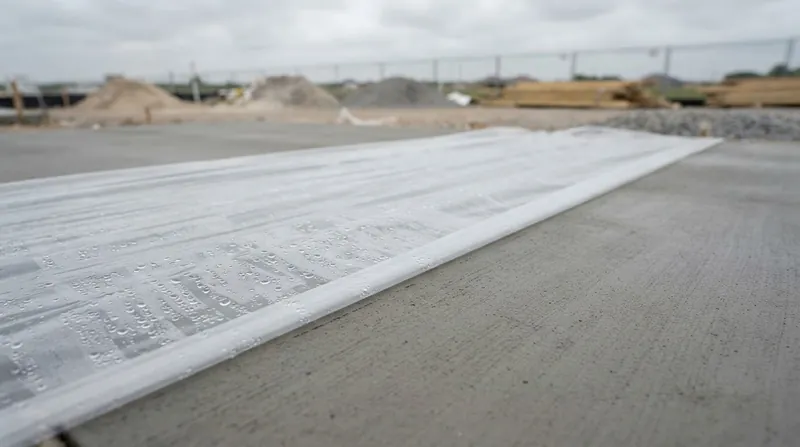
Maintaining the hydration reaction for those 28 days requires strict moisture management, a process known as curing. If the surface of the concrete is allowed to dry out too quickly in the sun or wind, the water necessary for the chemical reaction evaporates before the cement can consume it.[2]
When premature evaporation occurs, the hydration process halts abruptly. The surface of the concrete, which bears the brunt of the drying, fails to reach its designed strength, resulting in a weak, dusty top layer that is prone to flaking and abrasion. To prevent this, contractors must actively cure the concrete by covering it with wet burlap, applying liquid curing compounds, or continuously misting the surface to lock the moisture inside the slab.[2]
Modern concrete technology has provided a chemical solution to the workability dilemma, allowing builders to achieve high flow rates without sacrificing strength. Superplasticizers, a class of high-range water-reducing admixtures, can be added to the concrete during the mixing phase.[4]
These chemical additives impart a negative electrical charge to the cement particles, causing them to repel each other. This dispersion dramatically increases the fluidity of the wet concrete, allowing contractors to pour complex forms and heavily reinforced structures using a water-cement ratio as low as 0.30.[4]
By utilizing superplasticizers, builders can achieve the dense, void-free matrix of a mathematically perfect hydration reaction while still maintaining the practical workability required on a modern job site. The resulting high-strength concrete is nearly impermeable, easily exceeding 6,000 psi and offering decades of resistance against freeze-thaw cycles and chemical attacks.
The durability of any concrete structure is decided in the mixer, not just in the forms. The water-cement ratio is not merely a recipe suggestion; it is the fundamental physics equation that dictates the material's final density. Every drop of water added beyond the strict chemical requirement of the cement is a permanent structural compromise, trading decades of lifespan for a few minutes of easier labor.
Competing readings
Structural Engineers
Prioritize strict adherence to low water-cement ratios to guarantee long-term durability and load-bearing capacity.
For structural engineers, the water-cement ratio is a non-negotiable mathematical limit. They view job-site water additions as a direct threat to the integrity of the building, as the resulting capillary voids compromise the concrete's ability to withstand freeze-thaw cycles and chemical attacks. Their specifications often mandate the use of superplasticizers to achieve flowability without altering the chemical balance of the mix.
Concrete Contractors
Balance the theoretical strength requirements with the practical physical realities of placing and finishing the material.
Contractors on the ground face the physical challenge of moving heavy, stiff material into complex forms before it sets. While they understand the strength penalties of excess water, they argue that a mix that is too dry cannot be properly consolidated around steel reinforcement, leading to honeycombing and structural voids that are just as damaging as a high water-cement ratio. They advocate for practical workability limits that allow for efficient placement.
Ready-Mix Suppliers
Focus on delivering consistent, verifiable batches that meet code requirements while surviving transit times.
Ready-mix plant operators sit between the engineers and the contractors. They design batches that account for the moisture already present in the sand and aggregate, ensuring the final water-cement ratio leaving the plant is exact. They frequently battle the issue of transit time, as concrete that begins to set in the truck loses workability, prompting contractors to request unauthorized water additions upon delivery.
- Structural Engineers
- Prioritize strict adherence to low water-cement ratios to guarantee long-term durability and load-bearing capacity.
- Concrete Contractors
- Balance theoretical strength requirements with the practical physical realities of placing and finishing the material.
- Ready-Mix Suppliers
- Focus on delivering consistent, verifiable batches that meet code requirements while surviving transit times.
Sources
Source coverage
6 outlets
3 viewpoints surfaced






- [1]Pavement InteractiveStructural Engineers
ACI Mix Design
Read on Pavement Interactive → - [2]Aparna RMCReady-Mix Suppliers
Water Cement Ratio in Concrete: Formula, Ideal Values & Strength
Read on Aparna RMC → - [3]The University of MemphisStructural Engineers
CIVL 1101 - Part 13 - Strength
Read on The University of Memphis → - [4]Wikipedia
Water–cement ratio
Read on Wikipedia → - [5]Best Support UndergroundConcrete Contractors
W/C ratio 101: a backgrounder
Read on Best Support Underground → - [6]Factlen Editorial Team
Synthesis by Factlen editorial team
Read on Factlen Editorial Team →
More in Home
See all →Supply Chain Security
US and Argentina Launch $7 Billion Andes-Atlantic Corridor to Secure Critical Mineral and Energy Supply Chains
4 sources

Building Science
The 1/300 Rule: How Attic Square Footage Dictates Minimum Net Free Vent Area
10 sources

Building Standards
The 2:12 Minimum Slope: How Double Underlayment Allows Asphalt Shingles on Low-Pitch Roofs
4 sources

Concrete Moisture
The ASTM F1869 and F2170 Standards: How Relative Humidity and Moisture Vapor Emission Rate Actually Dictate When a Concrete Slab is Ready for Flooring
7 sources

Comments
Every angle. Every day.
Get Home stories with full source coverage and perspective breakdowns, free every day.