
How Mass Timber is Turning Skyscrapers into Massive Carbon Sinks
Engineered wood products like cross-laminated timber are replacing concrete and steel in high-rise construction, offering a sustainable way to build faster while locking away atmospheric carbon.
By Dev Anand

In short
- Mass timber relies on engineered wood products like cross-laminated timber (CLT) to build high-rise structures.
- Unlike concrete and steel, which emit heavy greenhouse gases during production, mass timber acts as a carbon sink.
- CLT panels are engineered to char on the outside during a fire, protecting their structural core and meeting strict safety codes.
For over a century, the recipe for a modern city skyline has remained stubbornly unchanged: pour concrete, forge steel, and repeat. It is a formula that has allowed humanity to build higher and denser than ever before, but it comes with a staggering environmental cost. The building and construction sector is responsible for a massive portion of global carbon emissions, with the manufacturing of concrete and steel serving as primary culprits.[4]
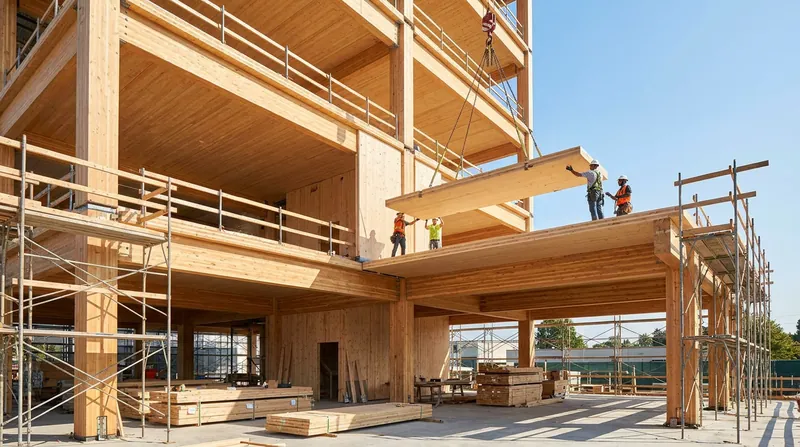
But a quiet revolution is taking root in architectural firms and construction sites around the world. Buildings are no longer just being constructed; in a sense, they are being grown. Welcome to the era of mass timber, a structural engineering movement that replaces traditional heavy materials with advanced, engineered wood.[2][4]
This is not the standard two-by-four lumber used in suburban home framing. Mass timber refers to a category of massive, industrially processed wood products designed to bear the immense loads of high-rise buildings. By binding together layers of solid wood, engineers have created a material that rivals the strength of steel while weighing significantly less.[2][3]
The crown jewel of this movement is Cross-Laminated Timber, or CLT. To create a CLT panel, manufacturers take layers of solid sawn lumber and stack them, gluing each layer at a strict 90-degree perpendicular angle to the one below it. This cross-hatching of the wood grain gives the resulting panel extraordinary rigidity and two-way structural strength, earning it the nickname "super plywood."[3]
While CLT is typically used for massive floor slabs and load-bearing walls, it is often paired with another engineered product called Glulam (glue-laminated timber). In Glulam, the wood grains are aligned parallel to one another, creating thick, ultra-strong beams and columns that form the skeleton of the building.[3]
The primary driver behind the mass timber renaissance is the urgent need to decarbonize the built environment. As trees grow, they absorb carbon dioxide from the atmosphere through photosynthesis, using it to build their cellular structure. When a tree is harvested and turned into a mass timber panel, that carbon does not return to the atmosphere—it remains locked inside the wood for the lifetime of the building.
This process, known as biogenic carbon sequestration, effectively turns skyscrapers into massive urban carbon sinks. According to researchers at the Yale School of the Environment, a widespread global shift toward mass timber could have a profound impact. Their modeling suggests that if 30% to 60% of new urban buildings utilized CLT, it could reduce global greenhouse gas emissions by up to 39 gigatons by the end of the century.
To put the math into perspective, every cubic meter of mass timber stores roughly 0.9 tons of carbon dioxide. Conversely, manufacturing a single ton of cement emits nearly half a ton of CO₂. By swapping concrete for CLT, developers are not just reducing their carbon footprint; they are actively pulling carbon out of the sky.
Despite the environmental benefits, the concept of a wooden skyscraper inevitably raises a primal fear: fire. For decades, building codes heavily restricted wood construction due to the catastrophic urban fires of the 19th and early 20th centuries. But mass timber behaves entirely differently than light-frame wood in a blaze.[4]
When exposed to intense heat, the outer layer of a massive CLT panel or Glulam beam chars. This blackened layer of char acts as a natural insulator, protecting the unburned structural core of the wood from the flames. In rigorous fire testing, mass timber has consistently met or exceeded strict safety codes, maintaining its structural integrity longer than steel, which can rapidly warp and buckle under extreme temperatures.
Beyond safety and sustainability, mass timber is fundamentally changing how buildings are assembled. Because CLT panels are manufactured off-site in highly controlled factories, they are cut to millimeter precision using digital blueprints. Openings for doors, windows, and plumbing are pre-routed before the wood ever leaves the facility.[2]
When the panels arrive at the construction site, they are slotted together like a massive piece of flat-pack furniture. This prefabricated approach requires smaller construction crews, generates significantly less on-site waste, and can reduce overall construction time by up to 50% compared to traditional concrete pouring.[2]
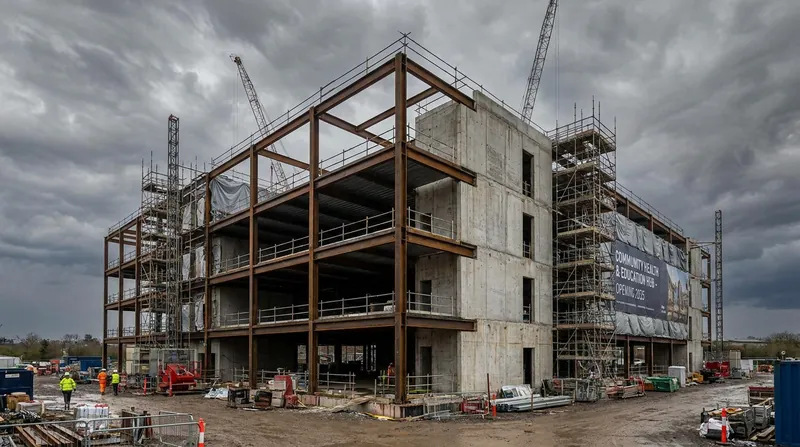
Armed with these advantages, architects are pushing timber structures higher into the sky. In 2022, the Ascent MKE tower in Milwaukee claimed the title of the world's tallest mass timber building, rising 25 stories and 284 feet. But records in this emerging field are fleeting.[1]
Just blocks away from Ascent, construction is already underway on The Edison, a 31-story mass timber tower slated for completion in 2026. Expected to reach 362 feet, The Edison relies on a hybrid structural system, pairing a concrete core with CLT floors and Glulam framing. Meanwhile, in Sydney, the 42-story Atlassian Central tower is pushing the boundaries of hybrid timber-and-steel design on an even grander scale.[1]
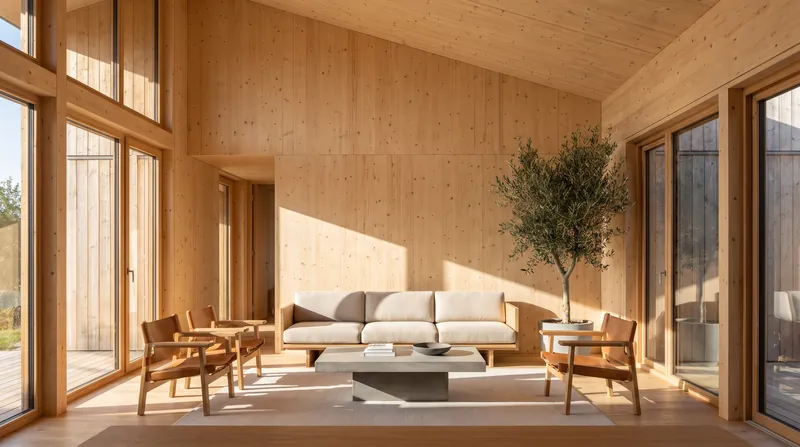
For the people who live and work in these buildings, the appeal goes beyond engineering metrics. Mass timber architecture heavily leans into biophilic design—the concept of connecting indoor environments to nature. By leaving the structural wood exposed on ceilings and columns, these buildings offer a warmth and texture that sterile drywall and concrete cannot match. Studies have shown that environments featuring exposed natural wood can lower heart rates, reduce stress, and improve overall occupant wellbeing.[4]
The widespread adoption of mass timber is not without its complexities. The environmental math relies entirely on sustainable forestry practices. If the timber is not sourced from certified, responsibly managed forests where harvested trees are continually replanted, the carbon benefits evaporate.
Furthermore, the industry is still grappling with the end-of-life phase of these buildings. For mass timber to remain a true carbon sink, the wood must be salvaged, repurposed, or safely preserved when a building is eventually decommissioned, rather than being left to rot in a landfill where it would release its stored carbon back into the atmosphere.[4]
Furthermore, the industry is still grappling with the end-of-life phase of these buildings.
Yet, as the technology matures and supply chains expand, mass timber offers a rare architectural win-win. It provides a blueprint for cities to grow denser and taller, not by extracting a heavy toll from the earth, but by partnering with the natural world to build a more resilient future.[4]
Jargon, explained
- Mass Timber
- A category of engineered wood products made by binding together layers of lumber to create structural panels and beams.
- Cross-Laminated Timber (CLT)
- A mass timber panel made by gluing layers of wood perpendicularly to one another, giving it immense strength in two directions.
- Glulam
- Glue-laminated timber, where wood grains are aligned parallel to each other, typically used for load-bearing columns and beams.
- Biogenic Carbon Sequestration
- The process by which trees absorb carbon dioxide from the atmosphere and store it in their wood, keeping it out of the air.
- Embodied Carbon
- The total greenhouse gas emissions generated by the manufacturing, transportation, and installation of building materials.
Common questions
Isn't a wooden skyscraper a massive fire hazard?
No. Mass timber is engineered to char on the outside during a fire, creating an insulating layer that protects the structural integrity of the inner wood, often outperforming steel.
Does mass timber construction cause deforestation?
When sourced responsibly, it encourages sustainable forestry. Trees are harvested at maturity when their carbon uptake slows, and new trees are planted to continue the cycle.
Is mass timber cheaper than concrete?
The material itself can be more expensive, but developers often save money overall because prefabricated timber buildings require less labor and can be assembled up to 50% faster.
Competing readings
Sustainable Architects
View mass timber as the most viable path to decarbonizing the heavily polluting construction industry.
For sustainable designers, the appeal of mass timber lies in its embodied carbon. Traditional concrete and steel require massive amounts of fossil fuels to manufacture and transport. By contrast, trees naturally sequester carbon as they grow. Architects argue that by utilizing cross-laminated timber, the construction industry can transform from a leading source of global emissions into a mechanism for climate mitigation, all while delivering aesthetically superior, biophilic spaces that improve occupant wellbeing.
Forestry & Timber Industry
Argue that increased demand for engineered wood incentivizes sustainable forest management and rural economic growth.
The forestry sector views the mass timber boom as an economic catalyst that directly supports environmental stewardship. Industry advocates point out that increased demand for lumber gives landowners a financial incentive to maintain and expand forested lands rather than selling them for agricultural or commercial development. By harvesting trees at maturity—when their carbon absorption rate naturally slows—and immediately replanting, the industry argues it is optimizing the forest's ability to act as a continuous carbon sink.
Urban Developers
Focus on the economic benefits of faster construction times, lighter building weights, and premium rents.
While the raw materials for mass timber can sometimes carry a premium over concrete, developers are increasingly drawn to the holistic cost savings. Because CLT panels are prefabricated off-site with millimeter precision, buildings can be assembled with smaller crews in a fraction of the time. Additionally, timber is significantly lighter than concrete, which reduces the need for massive, expensive foundation work. Developers also note that the warm, exposed-wood interiors command premium rents from commercial and residential tenants.
- Sustainable Architects
- View mass timber as the most viable path to decarbonizing the heavily polluting construction industry.
- Forestry & Timber Industry
- Argue that increased demand for engineered wood incentivizes sustainable forest management and rural economic growth.
- Urban Developers
- Focus on the economic benefits of faster construction times, lighter building weights, and premium rents for biophilic spaces.
Perspectives this story doesn't cover
- Fire safety regulators adapting local building codes to new materials
- Environmental groups concerned about the ecological impact of increased commercial logging
Sources
Source coverage
4 outlets
3 viewpoints surfaced




- [1]Construction BriefingUrban Developers
Construction of 'world's tallest' mass timber high-rise underway
Read on Construction Briefing → - [2]ArchDailySustainable Architects
What Is Mass Timber?
Read on ArchDaily → - [3]WoodWorksUrban Developers
What are the common mass timber products and systems?
Read on WoodWorks → - [4]Factlen Editorial Team
Synthesis by Factlen editorial team
Read on Factlen Editorial Team →
More in Home
See all →Mass Timber
Charring vs. Melting: Why Cross-Laminated Timber Outlasts Steel in a 1,800-Degree House Fire
3 sources
Transit-Oriented Development
California's 'Abundant Homes Near Transit' Law Overrides Local Height and Density Limits in Eight Major Counties
2 sources
Building Codes
The 2021 IECC Explainer: The Math Behind the Federal Energy Code Mandate for New Homes
4 sources
Tornado Resilience
The First-Ever Tornado Code: How the New IBC Mandate is Rewriting Structural Engineering
2 sources
Comments
Every angle. Every day.
Get Home stories with full source coverage and perspective breakdowns, free every day.