
Smart Rings vs. Smartwatches: The 2026 Health Tracking Trade-Off
As wearables diverge into passive rings and active watches, choosing the right form factor comes down to a fundamental choice between sleep comfort and real-time workout coaching.
By Factlen Editorial Team
- Passive Tracking Advocates
- Argue that wearables should disappear into the background, prioritizing sleep comfort, long battery life, and digital minimalism.
- Active Performance Seekers
- Prioritize real-time workout feedback, built-in GPS, and active coaching displays for athletic training.
- Clinical Feature Proponents
- Value wearables primarily for their advanced health screening capabilities, such as FDA-cleared ECGs and irregular heart rhythm alerts.
What's not represented
- · Traditional Watch Enthusiasts
- · Medical Professionals
Why this matters
Choosing the right wearable dictates whether you actually collect useful health data or abandon the device in a drawer. Understanding the fundamental trade-off between passive sleep comfort and active workout coaching ensures you invest in a tool that matches your daily habits.
Key points
- Smart rings prioritize passive tracking, offering 4-8 day battery life and unmatched comfort for overnight sleep monitoring.
- Smartwatches act as active coaches, providing real-time workout metrics, built-in GPS, and FDA-cleared heart health alerts.
- Finger-based optical sensors capture cleaner resting data due to capillary density, achieving up to 79% accuracy in sleep staging.
- Wrist-worn devices excel at tracking elevated heart rates during intense exercise but often overestimate total sleep time.
- Consumers increasingly adopt a hybrid approach, wearing a watch during the day for connectivity and a ring at night for recovery.
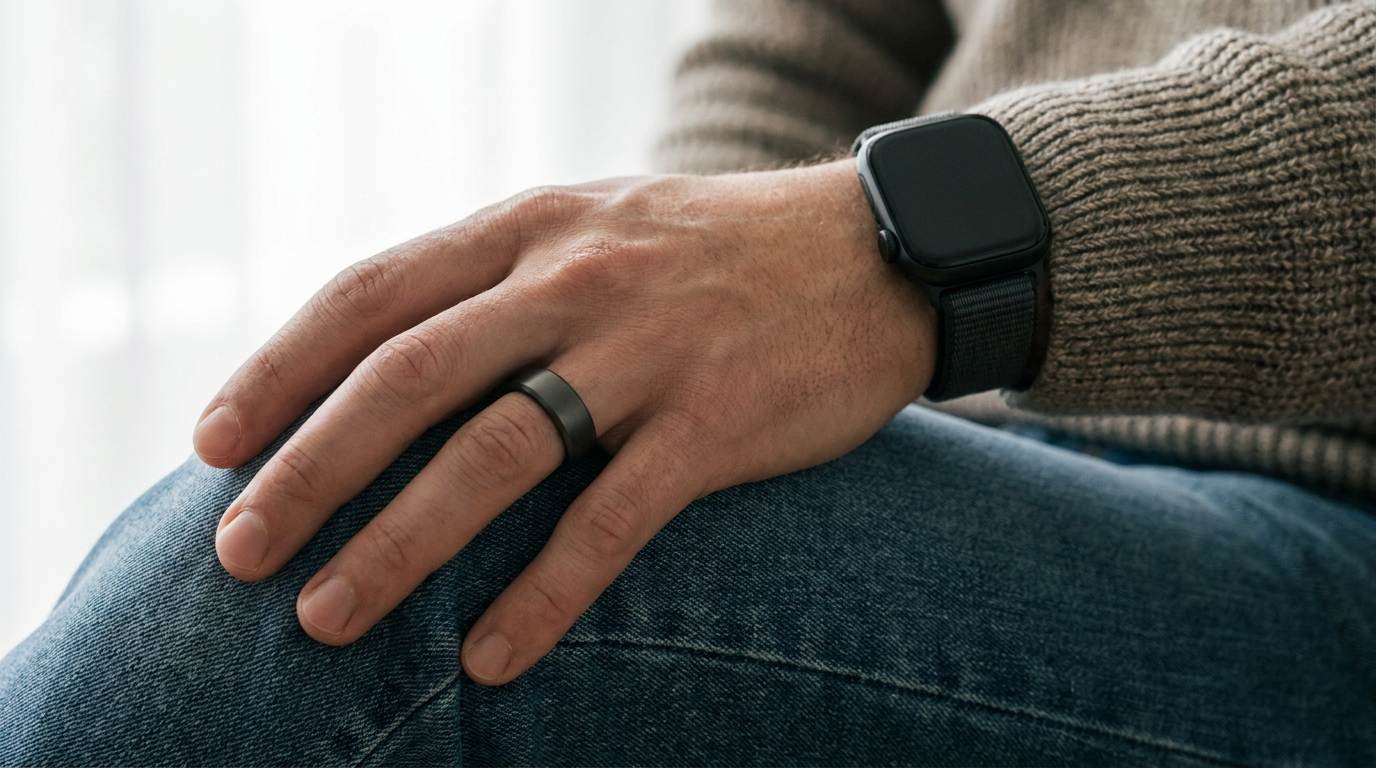
The wearable health technology market in 2026 has fractured into two distinct philosophies: the active coaching of the smartwatch and the passive observation of the smart ring. Consumers looking to optimize their fitness and sleep are increasingly forced to choose between these competing form factors. On one side, devices like the Apple Watch Series 11 and Samsung Galaxy Watch 7 offer vibrant screens, real-time data, and deep smartphone integration. On the other, the Oura Ring 4 and Samsung Galaxy Ring provide screenless, discreet monitoring that disappears into the background. Deciding between the two is no longer just about budget; it is a fundamental choice about how individuals want to interact with their health data and how much digital noise they are willing to tolerate in their daily lives.[1][2]
When evaluating the case for smart rings, the primary argument centers on nighttime comfort and uninterrupted data collection. Weighing between three and eight grams, smart rings are designed to be forgotten. This form factor solves the biggest hurdle in sleep tracking: user compliance. Because rings are unobtrusive, users are significantly more likely to wear them to bed compared to a bulky 50-gram smartwatch. Furthermore, the battery life of a smart ring typically spans four to eight days, meaning it rarely needs to be removed for overnight charging. For users seeking digital minimalism, the lack of a screen is a feature, not a bug, allowing them to collect biometric data without the constant ping of notifications or the temptation to check another display.[3][7]
The argument against smart rings becomes apparent the moment a user steps into a gym or starts a run. Without a display, smart rings cannot provide real-time feedback on heart rate zones, pacing, or distance. They also lack built-in GPS, meaning runners and cyclists must still carry their smartphones to track route data. Furthermore, while rings are excellent at measuring resting heart rates, their optical sensors can struggle to maintain accuracy during high-intensity workouts where gripping motions—such as lifting weights or holding handlebars—restrict blood flow to the fingers.[2][4]

The clinical evidence strongly supports smart rings for sleep and recovery metrics, largely due to human anatomy. The arteries in the finger are closer to the skin surface and feature a denser capillary network than the wrist, providing photoplethysmography sensors with a remarkably clean signal. A 2024 validation study published in the Journal of Medical Internet Research demonstrated that finger-based sensors achieved up to 79 percent agreement with medical-grade polysomnography for sleep stage classification, outperforming wrist-worn alternatives. Because the finger moves less than the wrist during sleep, the data suffers from fewer motion artifacts, making metrics like heart rate variability and overnight skin temperature highly reliable.[5][7]
Conversely, the case for smartwatches is built on comprehensive, real-time utility and advanced medical screening. Devices like the Apple Watch and Garmin Venu serve as active fitness coaches, displaying live metrics that athletes need to adjust their effort mid-workout. Beyond basic fitness, modern smartwatches are equipped with FDA-cleared electrocardiogram capabilities, irregular heart rhythm notifications, and sleep apnea detection. They offer a self-contained ecosystem where users can stream music, pay for groceries, and answer calls without needing a smartphone nearby. For the data-hungry athlete or the user monitoring a specific cardiovascular condition, the smartwatch remains the undisputed powerhouse.[2][4]
Conversely, the case for smartwatches is built on comprehensive, real-time utility and advanced medical screening.
The primary argument against the smartwatch is the persistent anxiety of battery life and the physical bulk of the device. Most flagship smartwatches require daily charging, typically lasting between 18 and 36 hours. This creates a logistical headache for sleep tracking; if the watch is worn all night, it must be charged during the day, often resulting in gaps in activity data. Additionally, the constant influx of haptic taps and glowing notifications can contribute to screen fatigue, counteracting the stress-reduction goals that many health trackers aim to support.[3][6]
The evidence regarding smartwatch accuracy highlights their superiority in active scenarios but reveals compromises during rest. Independent testing confirms that wrist-worn optical sensors are highly accurate for tracking elevated heart rates during moderate to vigorous exercise, easily outperforming rings in these conditions. However, research indicates that smartwatches consistently overestimate total sleep time by an average of 20 to 25 minutes. The wrist is a highly mobile joint, and the resulting motion noise makes it harder for the watch algorithms to distinguish between light sleep and quiet wakefulness.[5][7]

Ultimately, a smart ring fits well when a user's primary goals are sleep optimization, recovery tracking, and long-term health awareness. It is the ideal choice for individuals who want to wear traditional mechanical watches during the day but still desire 24/7 biometric monitoring. The ring form factor also perfectly suits those who suffer from digital fatigue and want to collect health data passively, without introducing another screen into their daily routine. If the goal is to wake up, check a readiness score, and adjust the day's exertion accordingly, the smart ring is unmatched in its seamless integration into daily life.[1][7]
However, a smart ring does not fit well when the user is actively training for an endurance event, requires real-time pacing guidance, or wants to leave their smartphone at home during a workout. It is also a poor fit for individuals whose fitness routines heavily involve gripping heavy barbells, as the pressure can scratch the ring and disrupt the sensor readings. In these active, data-driven scenarios, the passive nature of the ring becomes a frustrating limitation rather than a minimalist benefit.[2][4]
A smartwatch fits well when the user needs an all-in-one device that bridges the gap between a fitness tracker and a smartphone. It is the optimal choice for runners, cyclists, and swimmers who rely on built-in GPS and live heart-rate zones to structure their training. Furthermore, it is highly recommended for users who specifically want medical-grade features like on-demand ECGs or fall detection, which currently require the larger sensor arrays and processing power found in wrist-worn devices.[4][6]

Conversely, a smartwatch does not fit well when daily charging is considered a dealbreaker or when the user finds wearing a bulky device to bed uncomfortable. For those who already feel overwhelmed by digital notifications, strapping a connected screen to the wrist often exacerbates stress rather than alleviating it. As the wearable market matures in 2026, an increasing number of consumers are actually opting for a hybrid approach—wearing a smartwatch during the day for workouts and connectivity, and switching to a smart ring at night for unencumbered sleep tracking.[3][7]
Viewpoints in depth
Passive Tracking Advocates
Argue that wearables should disappear into the background.
This camp, heavily populated by sleep researchers and digital minimalists, argues that the best wearable is the one you forget you are wearing. They emphasize that the psychological burden of closing daily activity rings and managing wrist-based notifications actively harms the stress-reduction goals of health tracking. By removing the screen, smart rings allow users to collect vital biometric data without being tethered to an attention-demanding interface.
Active Performance Seekers
Prioritize real-time workout feedback and active coaching displays.
Athletes, runners, and fitness coaches argue that health data is only useful if it can be acted upon in the moment. This perspective values the smartwatch's ability to display live heart rate zones, pace metrics, and GPS routing during a workout. For this camp, the passive nature of a smart ring is a critical flaw; reviewing a heart rate graph hours after a run is far less valuable than receiving a haptic tap mid-stride indicating it is time to push harder.
Clinical Feature Proponents
Value wearables primarily for their advanced health screening capabilities.
Medical technologists and users managing specific health conditions focus on the diagnostic potential of wearables. They champion smartwatches for their larger sensor arrays, which enable FDA-cleared electrocardiograms, irregular rhythm notifications, and sleep apnea detection. From this viewpoint, the bulk and battery limitations of a watch are acceptable trade-offs for access to clinical-grade alerts that can potentially identify life-threatening cardiovascular events before they escalate.
What we don't know
- Whether upcoming non-invasive blood glucose monitoring technology will be successfully miniaturized for smart rings or remain exclusive to larger smartwatches.
- How the long-term durability of smart rings holds up against years of gripping forces during heavy weightlifting.
Key terms
- Photoplethysmography (PPG)
- An optical sensor technology that uses light to measure changes in blood volume at the skin's surface, commonly used to track heart rate.
- Heart Rate Variability (HRV)
- The fluctuation in the time intervals between adjacent heartbeats, used as a key indicator of physical recovery and nervous system stress.
- Polysomnography
- A comprehensive, medical-grade sleep study used as the gold standard to evaluate the accuracy of consumer sleep trackers.
- Electrocardiogram (ECG)
- A medical test that measures the electrical activity of the heart, available on high-end smartwatches to detect irregular rhythms.
- SpO2
- An estimate of the amount of oxygen in the blood, tracked by wearables to monitor respiratory health during sleep.
Frequently asked
Can I wear a smart ring while lifting weights?
While possible, most manufacturers advise against wearing smart rings during heavy barbell or dumbbell exercises to prevent scratching the titanium finish and to avoid pinching the finger.
Do smart rings require a monthly subscription?
It depends on the brand. The Oura Ring requires a monthly subscription to access detailed health insights, while the Samsung Galaxy Ring and most smartwatches provide their data without recurring fees.
Can a smart ring detect irregular heart rhythms like AFib?
Currently, smart rings track resting heart rate and variability, but they lack the FDA-cleared electrocardiogram (ECG) sensors required to officially detect and alert users to Atrial Fibrillation.
Sources
Source coverage
7 outlets
3 viewpoints surfaced







[1]Factlen Editorial TeamPassive Tracking Advocates
Synthesis by Factlen editorial team
Read on Factlen Editorial Team →[2]ForbesActive Performance Seekers
Oura Ring Vs. Apple Watch: Which Health Tracker Is Best For You?
Read on Forbes →[3]PreventionPassive Tracking Advocates
Oura Ring vs. Apple Watch: Which Fitness Tracker Is Right for You?
Read on Prevention →[4]WareableActive Performance Seekers
Oura Ring vs Apple Watch: Which is the ultimate health tracker?
Read on Wareable →[5]Journal of Medical Internet ResearchClinical Feature Proponents
Validation of Finger-Based Photoplethysmography for Sleep Staging
Read on Journal of Medical Internet Research →[6]Good HousekeepingClinical Feature Proponents
Oura Ring vs. Apple Watch: Which Tracker Is Best for You?
Read on Good Housekeeping →[7]Smart Ring HQPassive Tracking Advocates
Smart Ring vs Smartwatch: The Honest 2026 Comparison
Read on Smart Ring HQ →

Every angle. Every day.
Get shopping stories with full source coverage and perspective breakdowns delivered to your inbox.