
Why Neurologists Are Prescribing Table Tennis to Fight Cognitive Decline
Recent clinical meta-analyses reveal that the high-speed, dual-task nature of table tennis makes it one of the most effective non-pharmacological therapies for preserving brain health and combating neurodegenerative diseases.
By Factlen Editorial Team
- Neuroscientists & Researchers
- Focuses on the biological mechanisms of neuroplasticity, BDNF release, and structural brain changes.
- Clinical Therapists
- Focuses on the practical, low-cost application of the sport in rehabilitation and memory care.
- Table Tennis Advocates
- Focuses on the social, emotional, and community-building aspects of the sport for older adults.
What's not represented
- · Pharmaceutical Industry Researchers
- · Caregivers of Dementia Patients
Why this matters
As global populations age and the prevalence of neurodegenerative diseases rises, finding accessible, non-pharmacological therapies is critical. Table tennis offers a low-cost, highly effective way for older adults to actively protect their cognitive health, maintain physical balance, and combat social isolation.
Key points
- Table tennis is increasingly prescribed as a non-pharmacological therapy for Alzheimer's, Parkinson's, and general cognitive decline.
- Recent meta-analyses show large, statistically significant improvements in both cognitive and motor functions for patients who play regularly.
- The sport acts as a 'dual-task' activity, combining aerobic exercise with high-speed strategic decision-making.
- Playing stimulates the release of BDNF, a protein crucial for neuroplasticity and the growth of new neural connections.
- The social interaction inherent in the game helps reduce stress and combats the isolation often associated with dementia.
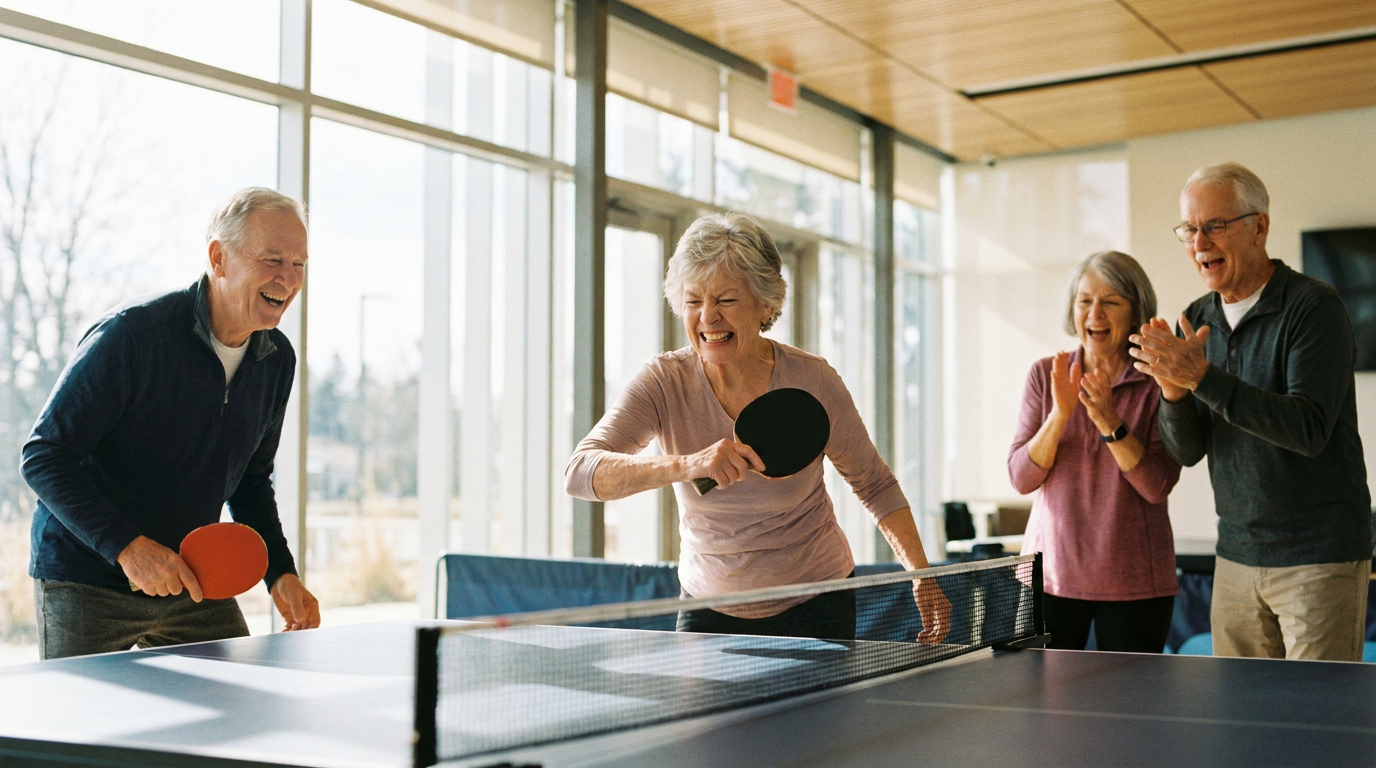
Table tennis is widely recognized as a fast-paced Olympic spectacle or a casual basement pastime, but in recent years, it has quietly infiltrated a very different arena: neurology clinics and memory care centers. Across the globe, medical professionals are increasingly prescribing ping pong not just for physical fitness, but as a targeted, non-pharmacological intervention for cognitive decline. For individuals facing Alzheimer’s disease, Parkinson’s disease, and general age-related dementia, the sport is proving to be a uniquely powerful therapeutic tool.[7]
The concept of using a paddle and a lightweight plastic ball to fight neurodegeneration might sound overly simplistic, but the clinical data supporting it is robust and growing. Researchers have dubbed table tennis the "world's number one brain sport" due to its unparalleled ability to activate multiple neural networks simultaneously. Unlike solitary brain-training applications or repetitive physical exercises, table tennis forces the brain and body to work in high-speed, synchronized harmony.[3][4]
The foundation of this therapeutic approach lies in recent comprehensive reviews of clinical data. A 2025 systematic review and meta-analysis published in Authorea aggregated data from multiple randomized controlled trials involving older adults with neurodegenerative diseases. The findings revealed large, statistically significant effect sizes for cognitive outcomes, including marked improvements in standard clinical assessments like the Mini-Mental State Examination (MMSE) and the Montreal Cognitive Assessment (MoCA).[1]

These cognitive gains are mirrored by substantial improvements in motor function and dual-task gait—the ability to walk while simultaneously performing a cognitive task. A separate meta-analysis published in MDPI synthesized data from over 1,500 participants, confirming that table tennis interventions consistently enhanced both balance and cognitive function across various age groups and health statuses. The researchers noted that the sport serves as a highly feasible, low-cost intervention with broad applicability in rehabilitation settings.[2]
To understand why table tennis is so effective, neuroscientists point to the concept of an "enriched environment." The sport is a motor-cognitive dual-task activity that requires continuous aerobic exertion, visual-motor coordination, and reactive decision-making. When a player tracks an incoming ball, their brain must calculate its speed, spin, and trajectory in a fraction of a second, formulate a strategic response, and execute a precise motor command to return the shot.[1][5]
This rapid sequence of events heavily engages the brain's executive functions, which act as the neurological management system. Executive functions encompass working memory, cognitive flexibility, and inhibitory control. Players must hold their strategy in mind, adapt instantly when the opponent changes the pace, and suppress the impulse to swing wildly. By constantly challenging these high-level cognitive skills, table tennis acts as a rigorous workout for the prefrontal cortex.[6]
The physical nature of the sport provides a crucial second layer of neurological benefit. Table tennis is an aerobic-dominant activity that elevates the heart rate and significantly increases blood flow to the brain without subjecting the joints to the high-impact stress associated with sports like tennis or running. This increased cerebral blood flow delivers oxygen and vital nutrients to brain tissues that are vulnerable to age-related atrophy.[2][5]

The physical nature of the sport provides a crucial second layer of neurological benefit.
More importantly, this aerobic exertion stimulates the release of Brain-Derived Neurotrophic Factor (BDNF). Often described by neuroscientists as "Miracle-Gro for the brain," BDNF is a protein that plays a critical role in neuroplasticity—the brain's ability to reorganize itself by forming new neural connections. Elevated levels of BDNF promote the survival of existing neurons and encourage the growth of new ones, particularly in the hippocampus.[5]
The hippocampus is the brain's primary center for learning and memory formation, and it is typically one of the first regions to suffer severe damage in the early stages of Alzheimer's disease. Clinical studies, including foundational research conducted in Japan, have utilized functional MRI scans to observe the brains of Alzheimer's patients while they play table tennis. These scans revealed increased blood flow and activation in up to five distinct regions of the brain simultaneously, stimulating the hippocampus and potentially helping to preserve its volume.[3]
The therapeutic benefits extend beyond the mechanics of neurobiology into the realm of emotional and psychological well-being. Cognitive decline is frequently accompanied by social isolation, depression, and anxiety, which can in turn accelerate the progression of dementia. Table tennis is inherently social, requiring a partner and fostering direct, face-to-face interaction.[4][6]
This social engagement triggers the release of oxytocin and other endorphins, which help to therapeutically reduce stress and elevate mood. For older adults, participating in a local table tennis club or a clinical rehabilitation program provides a sense of community, purpose, and playful competition. The psychological resilience built through these regular social interactions is considered just as vital to long-term brain health as the physical and cognitive exertion.[4][5]

Despite the overwhelming positivity surrounding these findings, researchers are careful to maintain scientific objectivity regarding the sport's limitations. Table tennis is not a cure for Alzheimer's or Parkinson's disease, and it cannot entirely halt the progression of severe neurodegeneration. Medical reviews consistently note that while the effect sizes are large, the existing body of evidence features considerable heterogeneity in study designs, intervention durations, and participant demographics.[1][2]
To solidify table tennis as a standardized medical prescription, the scientific community is calling for more rigorous, large-scale randomized controlled trials with standardized protocols and long-term follow-ups. Organizations like the BAT Foundation are currently partnering with institutions such as King's College London to conduct deeper medical research, utilizing advanced neuroimaging to precisely map the structural brain changes induced by regular play.[1][3]
Even with these clinical caveats, the risk-to-reward ratio of table tennis makes it an exceptionally attractive intervention. It requires minimal equipment, can be played indoors year-round, and is adaptable to almost any physical ability level—including modifications for players in wheelchairs. As global healthcare systems brace for the demographic shift of an aging population, low-cost, accessible therapies that simultaneously target physical, cognitive, and emotional health are becoming increasingly vital.[2][7]

Ultimately, the transformation of table tennis from a recreational pastime into a recognized neurological therapy highlights a broader shift in how medical science approaches aging. By blending aerobic exercise with intense cognitive demands and social connection, the sport offers a holistic defense against cognitive decline. For millions of older adults, picking up a paddle may be one of the most effective—and enjoyable—ways to keep their minds sharp and resilient.[4][7]
How we got here
1998
Early Japanese clinical trials utilize MRI scans to observe brain activation in Alzheimer's patients playing table tennis.
2014
A study involving 164 women demonstrates that ping pong has a stronger positive effect on cognitive function than walking or resistance training.
2022
A comprehensive meta-analysis in MDPI confirms table tennis interventions significantly improve balance and cognitive functions across diverse age groups.
2025
A systematic review of 10 studies in Authorea reports large, robust effect sizes for cognitive and motor outcomes in patients with neurodegenerative diseases.
Viewpoints in depth
Neuroscientists & Researchers
Focuses on the biological mechanisms of neuroplasticity and structural brain changes.
For the scientific community, the value of table tennis lies in its ability to reliably trigger neurogenesis. Researchers emphasize the measurable increases in Brain-Derived Neurotrophic Factor (BDNF) and the simultaneous activation of the prefrontal and motor cortices. They advocate for rigorous, MRI-backed clinical trials to map exactly how dual-task aerobic activities can physically preserve hippocampus volume against neurodegenerative atrophy.
Clinical Therapists
Focuses on the practical, low-cost application of the sport in rehabilitation and memory care.
Therapists and rehabilitation specialists view table tennis as a highly accessible, non-pharmacological tool. Unlike expensive medical treatments or high-impact sports that risk joint injury, ping pong can be safely integrated into senior centers and memory care units. They highlight its dual benefit of improving physical balance—reducing fall risks—while simultaneously providing a structured cognitive workout that patients actually enjoy doing.
Table Tennis Advocates
Focuses on the social, emotional, and community-building aspects of the sport for older adults.
Organizations like the ITTF Foundation and the BAT Foundation champion the sport as a way to break the stigma and isolation associated with aging and dementia. They argue that the social interaction, playful competition, and sense of belonging fostered by local ping pong clubs are just as vital to a patient's well-being as the physiological benefits. For them, it is about restoring joy and agency to vulnerable populations.
What we don't know
- The exact optimal dosage (frequency and duration of play) required to maximize cognitive benefits.
- How the neurological benefits of table tennis compare head-to-head against other racket sports like pickleball or badminton in long-term clinical trials.
- Whether the structural brain changes observed in early-stage dementia patients can be sustained over a decade or more of continuous play.
Key terms
- Brain-Derived Neurotrophic Factor (BDNF)
- A protein that acts like fertilizer for the brain, promoting the survival and growth of neurons.
- Executive Functions
- High-level cognitive skills used to plan, focus attention, remember instructions, and juggle multiple tasks successfully.
- Neuroplasticity
- The brain's ability to reorganize itself by forming new neural connections throughout life.
- Hippocampus
- A complex brain structure embedded deep into the temporal lobe that plays a major role in learning and memory.
- Dual-Task Activity
- An exercise that requires a person to simultaneously perform a physical movement and a demanding cognitive task.
Frequently asked
Can table tennis cure Alzheimer's disease?
No, table tennis is not a cure for Alzheimer's. However, clinical studies show it can significantly delay cognitive decline, improve memory recall, and enhance the overall quality of life for patients.
Why is table tennis better for the brain than running?
While running provides excellent aerobic benefits, table tennis is a 'motor-cognitive dual-task.' It combines aerobic exercise with high-speed strategic decision-making and hand-eye coordination, which activates more regions of the brain simultaneously.
Do I need to be a skilled player to get the benefits?
Not at all. The cognitive benefits come from the process of tracking the ball, moving, and reacting. Even casual, slow-paced rallies provide substantial neurological and social benefits.
How does ping pong affect the hippocampus?
The aerobic exertion of playing increases blood flow and stimulates the release of Brain-Derived Neurotrophic Factor (BDNF), which promotes the growth of new neural connections in the hippocampus, the brain's memory center.
Sources
Source coverage
7 outlets
3 viewpoints surfaced





[1]AuthoreaNeuroscientists & Researchers
Table tennis for cognitive and motor functions in neurodegenerative diseases: A systematic review and meta-analysis
Read on Authorea →[2]MDPINeuroscientists & Researchers
Effects of Table Tennis on Balance and Cognitive Functions: A Meta-Analysis
Read on MDPI →[3]BAT FoundationTable Tennis Advocates
BAT's Original Medical Research on Table Tennis and Alzheimer's
Read on BAT Foundation →[4]ITTF FoundationTable Tennis Advocates
World Alzheimer's Day: The Benefits of Table Tennis
Read on ITTF Foundation →[5]Brain Health MattersClinical Therapists
Why Ping Pong Is a Brain Workout in Disguise
Read on Brain Health Matters →[6]Sydney CBD Table Tennis ClubClinical Therapists
The Surprising Brain Benefits of Playing Table Tennis
Read on Sydney CBD Table Tennis Club →[7]Factlen Editorial TeamTable Tennis Advocates
Synthesis by Factlen editorial team
Read on Factlen Editorial Team →


Every angle. Every day.
Get sports stories with full source coverage and perspective breakdowns delivered to your inbox.