
Smart Bassinets vs. Traditional Sleepers: Which Nursery Upgrade Is Actually Worth It?
A comprehensive breakdown of the trade-offs between algorithm-driven smart bassinets and traditional bedside sleepers to help expecting parents navigate newborn sleep.
By Factlen Editorial Team
- Tech-Assisted Sleep Advocates
- Believe automated bassinets are a crucial tool for preserving parental sleep and mental health.
- Pediatric & Lactation Specialists
- Prioritize natural movement, organic feeding cues, and tech-free sleep environments.
- Practicality & Budget Focus
- Emphasize cost-effectiveness, physical accessibility, and multi-use baby gear.
What's not represented
- · Families with multiples (twins/triplets)
- · Second-hand market buyers
Why this matters
Choosing the right bassinet is one of the most financially and emotionally significant decisions for expecting parents. The choice between a traditional sleeper and a smart bassinet directly impacts a family's budget, the mother's physical recovery, and the amount of sleep the entire household will get during the grueling newborn phase.
Key points
- Smart bassinets use microphones and motors to automatically soothe waking infants, acting as a technological night nurse.
- Traditional bassinets offer a static, tech-free sleep surface that prioritizes physical closeness and parental soothing.
- Premium smart models can cost upwards of $1,700, though month-to-month rental programs have made them more accessible.
- Traditional bedside sleepers are highly recommended for mothers recovering from C-sections due to their swivel and drop-down features.
- Pediatric specialists warn that over-reliance on automated motion can mask early hunger cues and create difficult sleep associations.
- Convertible smart cribs are extending the lifespan of the investment by accommodating children up to 24 months of age.
Standing in the baby gear aisle or scrolling through endless registry guides, modern parents face a sleep dilemma that previous generations never had to consider. The choice of where a newborn will sleep has evolved from a simple woven basket into a high-stakes decision between traditional bedside sleepers and algorithm-driven robotic bassinets. With sleep deprivation looming as one of the most daunting challenges of early parenthood, the promise of purchasing extra rest is incredibly alluring. However, the decision involves navigating a massive price gap, differing pediatric philosophies, and the fundamental question of how much technology belongs in a newborn's sleep environment.[1]
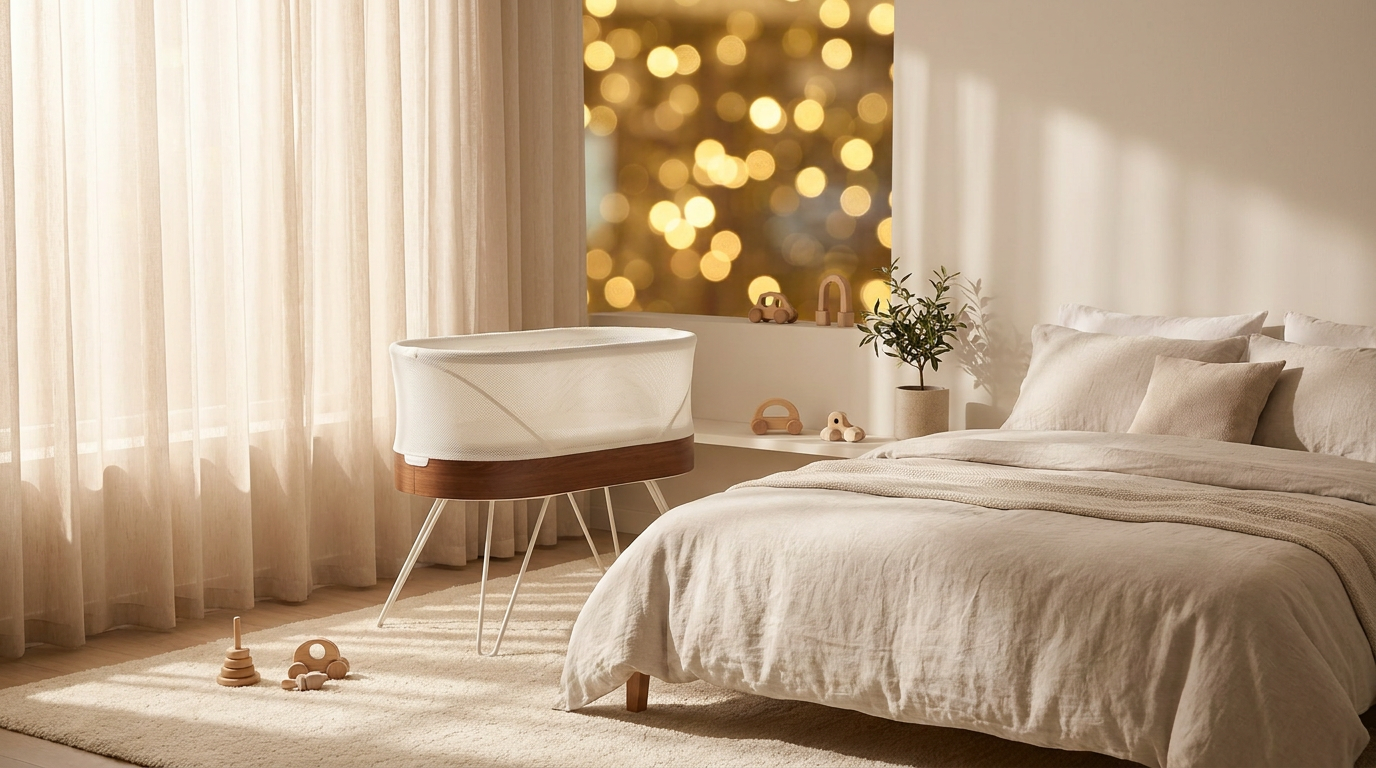
To understand the landscape, one must define the two primary categories dominating the market. Traditional bassinets, such as the Halo Bassinest or the Newton Baby Bassinet, provide a safe, flat, and static sleep surface that sits adjacent to the parents' bed. They rely entirely on the parent to provide soothing, feeding, and rocking. In stark contrast, smart bassinets like the Happiest Baby SNOO, the Cradlewise, and the Maxi-Cosi Starling act as robotic assistants. As detailed by Babylist and Upside Dad, these devices actively listen for a baby's cries and automatically respond with escalating levels of motion and white noise.[1][4]
The case for smart bassinets centers entirely on the promise of sleep preservation and automated soothing. Proponents argue that the technology effectively acts as an extra set of hands during the most exhausting hours of the night. Reviewers at The Postpartum Party note that when a baby experiences a minor sleep cycle disruption or begins to fuss, the smart bassinet detects the noise and initiates a gentle rocking or swaying motion. This immediate, automated response is designed to mimic the sensory environment of the womb, calming the baby before they escalate into a full, wakeful cry that would require the parent to get out of bed.[4][8]

The evidence supporting smart bassinets is largely found in the extra hours of sleep parents report gaining. High-end models have evolved significantly; while the SNOO relies on a reactive, side-to-side swaying motion, Mommyhood101 highlights that newer competitors like Cradlewise utilize a predictive, up-and-down bouncing motion that activates at the first sign of stirring. Furthermore, baby enRoute reports that models like the Maxi-Cosi Starling now incorporate artificial intelligence to translate cry frequencies, alerting parents whether the baby is hungry, gassy, or simply agitated. For families without overnight help, this technological intervention can be a profound tool for maternal mental health.[3][7]
The case against smart bassinets is rooted in their steep financial cost and the potential for long-term sleep dependency. The upfront investment is substantial, with premium models ranging from $1,000 to $1,700—a staggering figure for a piece of furniture that a baby will typically outgrow in four to six months. Beyond the price tag, pediatric nurses writing for Harbor Monitor frequently warn about the risks of creating deep-seated sleep associations. If an infant becomes entirely dependent on constant motion and algorithmic white noise to connect their sleep cycles, the inevitable transition to a stationary, traditional crib at the four-month mark can trigger severe sleep regressions.[1][5]
The case against smart bassinets is rooted in their steep financial cost and the potential for long-term sleep dependency.
Additional evidence against the heavy reliance on smart bassinets comes from lactation consultants and physical therapists. Specialists at Integrative Lactation Care caution that artificially extending sleep through automated rocking can sometimes mask early hunger cues, potentially delaying necessary nighttime feedings and impacting a mother's milk supply. There are also concerns regarding the restrictive, clip-in swaddles required by some smart models to keep the baby safely on their back while the bed moves. Pediatric physical therapists note that these designs limit natural hip and arm movements, prompting some parents to seek out newer smart models that allow for unrestrictive sleep.[3][6]

The case for traditional bassinets champions simplicity, immediate physical access, and budget-friendly practicality. Models in this category typically cost between $150 and $350, leaving ample room in the family budget for other essential newborn gear. Rather than relying on algorithms, traditional bedside sleepers prioritize the physical connection between parent and child. Kido Bebe points out that designs like the Halo Bassinest feature a 360-degree swivel and a drop-down side wall, allowing the bassinet to hover directly over the parents' mattress. This setup provides the safety of an independent sleep space while maintaining the intimacy and immediate reach of co-sleeping.[1][2]
The evidence favoring traditional bassinets highlights their immense value for maternal physical recovery, particularly following a Cesarean section. The ability to simply reach over, lower the bassinet wall, and bring the baby into bed for nursing without engaging the abdominal core is a genuinely pain-reducing feature that robotic bassinets cannot replicate. Furthermore, pediatricians often prefer the tech-free environment of a standard bassinet, as it encourages parents to learn and respond to their baby's natural cues organically, fostering intuitive bonding without the interference of a machine attempting to soothe a hungry infant.[2][8]

The case against traditional bassinets is simply that the parent remains the sole engine of soothing. If a baby wakes up every hour needing to be rocked, bounced, or shushed back to sleep, the burden falls entirely on the exhausted caregivers. Upside Dad notes that there is no automated safety net to handle the minor grunts, startles, and active sleep phases that newborns frequently exhibit. Parents using traditional bassinets must manually intervene for every disruption, which can lead to profound sleep deprivation if the infant is a particularly fussy or high-needs sleeper who struggles to settle on a static mattress.[2][4]
When evaluating the trade-offs, longevity and physical footprint also play a crucial role in the decision. A standard bassinet, whether smart or traditional, has a strict lifespan; once a baby begins to roll over or push up on their hands and knees—usually around four to six months—they must be moved to a full-sized crib for safety. However, the market is shifting to address this limitation. Mommyhood101 notes that convertible smart cribs, such as the Cradlewise, function as a bassinet initially but lower into a mini-crib that can accommodate a child up to 24 months, significantly altering the long-term value calculation for parents willing to make the initial investment.[1][7]
Ultimately, a smart bassinet fits well when a family lacks overnight support, has the budget to prioritize early-months sleep, or is dealing with a highly sensitive infant who startles easily. The automated intervention serves as a vital tool for parents who need to maximize their rest to function during the day. For those hesitant about the high purchase price, Babylist highlights that the growing availability of month-to-month rental programs offers a lower-risk pathway to test whether the baby actually responds to the robotic soothing before fully committing financially.[1][2]

Conversely, a smart bassinet does not fit when parents are committed to immediate, organic responsiveness to every infant cue, or when families are on a strict budget. It is also less suitable for parents who are highly anxious about tech dependency and the eventual transition to a stationary crib. A traditional bassinet fits perfectly for mothers recovering from abdominal surgery who require close physical access, families who prefer a minimalist, tech-free nursery, and parents who want a reliable, safe sleep surface without the premium price tag.[2][5][6]
Viewpoints in depth
Tech-Forward Parents
Parents who view smart baby gear as a necessary investment in sleep and mental health.
For this camp, the steep price tag of a smart bassinet is justified by the return on investment in parental sleep. They value the data tracking provided by companion apps, which help predict nap times and monitor sleep patterns. To these parents, the automated rocking is not a crutch, but a vital 'night nurse' that allows them to function during the day and be more present caregivers.
Pediatric & Lactation Specialists
Healthcare professionals focused on natural development, feeding cues, and safe sleep habits.
Many pediatric nurses and lactation consultants express caution regarding the over-reliance on automated soothing. They argue that immediate parental response to a baby's stirring is crucial for establishing milk supply and recognizing early hunger cues before the baby becomes distressed. This camp also warns against restrictive swaddles that limit natural hip movement and the potential for creating deep-seated sleep associations that make the eventual transition to a stationary crib highly disruptive.
Budget & Practicality Advocates
Families and reviewers who prioritize cost-effectiveness and multi-functional baby gear.
This perspective emphasizes the fleeting nature of the newborn phase. Because a baby will outgrow a standard bassinet in just a few months, these advocates argue that spending over $1,000 is an inefficient use of family funds. They champion traditional bedside sleepers for their physical accessibility and often recommend multi-use playards that include a bassinet attachment, providing a sleep and play space that grows with the child into toddlerhood.
What we don't know
- Whether the long-term use of predictive AI in smart bassinets definitively improves independent sleep habits in toddlerhood.
- How upcoming pediatric guidelines might formally address the use of AI cry-translation technology in the nursery.
Key terms
- Bassinet
- A small bed specifically designed for infants from birth to about four to six months, providing a firm, flat sleep surface.
- Sleep Regression
- A period, often around four months of age, when a baby who previously slept well suddenly begins waking frequently during the night.
- White Noise
- A consistent, ambient sound used to mask household noises and mimic the auditory environment of the womb to help babies sleep.
- Plagiocephaly
- A condition characterized by a flat spot on the back or side of a baby's head, sometimes associated with restricted movement during sleep.
Frequently asked
Are smart bassinets safe for newborns?
Yes, when used according to manufacturer instructions. They must provide a firm, flat surface and meet federal safety standards, though pediatricians advise transitioning away from constant motion by three to four months.
Can I rent a smart bassinet instead of buying one?
Yes, several companies offer month-to-month rental programs, allowing parents to test the technology without committing to the full purchase price.
How long can a baby sleep in a bassinet?
Most babies outgrow a standard bassinet between four and six months, or as soon as they begin to roll over or push up on their hands and knees.
Why do traditional bassinets help with C-section recovery?
Many traditional bedside sleepers feature a 360-degree swivel and a drop-down side wall, allowing mothers to reach and feed the baby without engaging their healing abdominal muscles.
Sources
Source coverage
8 outlets
3 viewpoints surfaced






[1]BabylistTech-Assisted Sleep Advocates
Best Bassinets for Newborns 2026 | Traditional vs Smart vs Pack & Play
Read on Babylist →[2]Kido BebePracticality & Budget Focus
Halo BassiNest vs SNOO vs Alternatives | Best Bassinets
Read on Kido Bebe →[3]baby enRouteTech-Assisted Sleep Advocates
Is a Smart Bassinet Worth It? A Sleep-Deprived Parent's Guide
Read on baby enRoute →[4]Upside DadPracticality & Budget Focus
SNOO vs Halo Luxe - All You Need to Know
Read on Upside Dad →[5]Harbor MonitorPediatric & Lactation Specialists
Smart Bassinets: What Parents Need to Know (From a Pediatric Nurse)
Read on Harbor Monitor →[6]Integrative Lactation CarePediatric & Lactation Specialists
The Truth About Smart Bassinets
Read on Integrative Lactation Care →[7]Mommyhood101Tech-Assisted Sleep Advocates
Cradlewise Review: Better than the SNOO?
Read on Mommyhood101 →[8]The Postpartum PartyPracticality & Budget Focus
SNOO vs Halo: Battle of the Bassinets
Read on The Postpartum Party →

Every angle. Every day.
Get shopping stories with full source coverage and perspective breakdowns delivered to your inbox.