
SEC Proposes 'E-Delivery' Rule, Making Electronic Disclosure the Default for Investors
The Securities and Exchange Commission has proposed a sweeping rule change that would flip the default for investor disclosures from paper to digital, aiming to modernize communications and save the industry billions in printing costs.


- Financial Institutions
- Broker-dealers and issuers view the rule as a long-overdue modernization that eliminates unnecessary costs.
- Retail Investor Advocates
- Consumer protection groups focus on ensuring that vulnerable populations are not left behind by the digital shift.
- Regulatory & Accessibility Voices
- Regulators and accessibility experts highlight the inherent advantages of digital-first documents for disabled investors.
Common questions
Will I still be able to get paper copies of my financial documents?
Yes. Under the proposed rule, any investor can opt out of electronic delivery at any time and request paper copies of all or specific documents, completely free of charge.
Do I need to take any action right now?
No. The rule is currently in the proposal stage. If adopted, there will be a two-year transition period before the new default takes full effect.
What happens if my email address changes?
Financial institutions are required to allow you to update your electronic address easily and free of charge to ensure you continue receiving your disclosures.
How will I know if my account is being switched to digital delivery?
If you currently receive paper, your brokerage must send you two separate paper notices explaining the upcoming transition and providing instructions on how to opt out before any change occurs.
The short answer
- The SEC has proposed Regulation E-Delivery, shifting the default for investor disclosures from paper to digital.
- Financial institutions can use electronic delivery by default if they have an investor's digital address and provide upfront notice.
- Investors retain the absolute right to opt out and request paper copies of any document free of charge.
- The rule aims to save the industry hundreds of millions in printing and postage costs while modernizing the investor experience.
- Existing paper recipients will receive two physical notices before being transitioned to the new digital default.
- The proposal includes a two-year transition period following its final adoption to allow firms to update their compliance systems.
For the average retail investor, opening a new brokerage account or buying a mutual fund has long guaranteed one immediate consequence: a mailbox stuffed with thick, densely printed booklets. These mandatory mailings—prospectuses, annual reports, and proxy statements—cost the financial industry billions of dollars to print and ship, while often ending up unread in household recycling bins.[1]
That physical default is now poised to flip. On July 16, 2026, the Securities and Exchange Commission proposed Regulation E-Delivery, a sweeping regulatory overhaul that establishes electronic disclosure as the default standard for investors.[1][2]
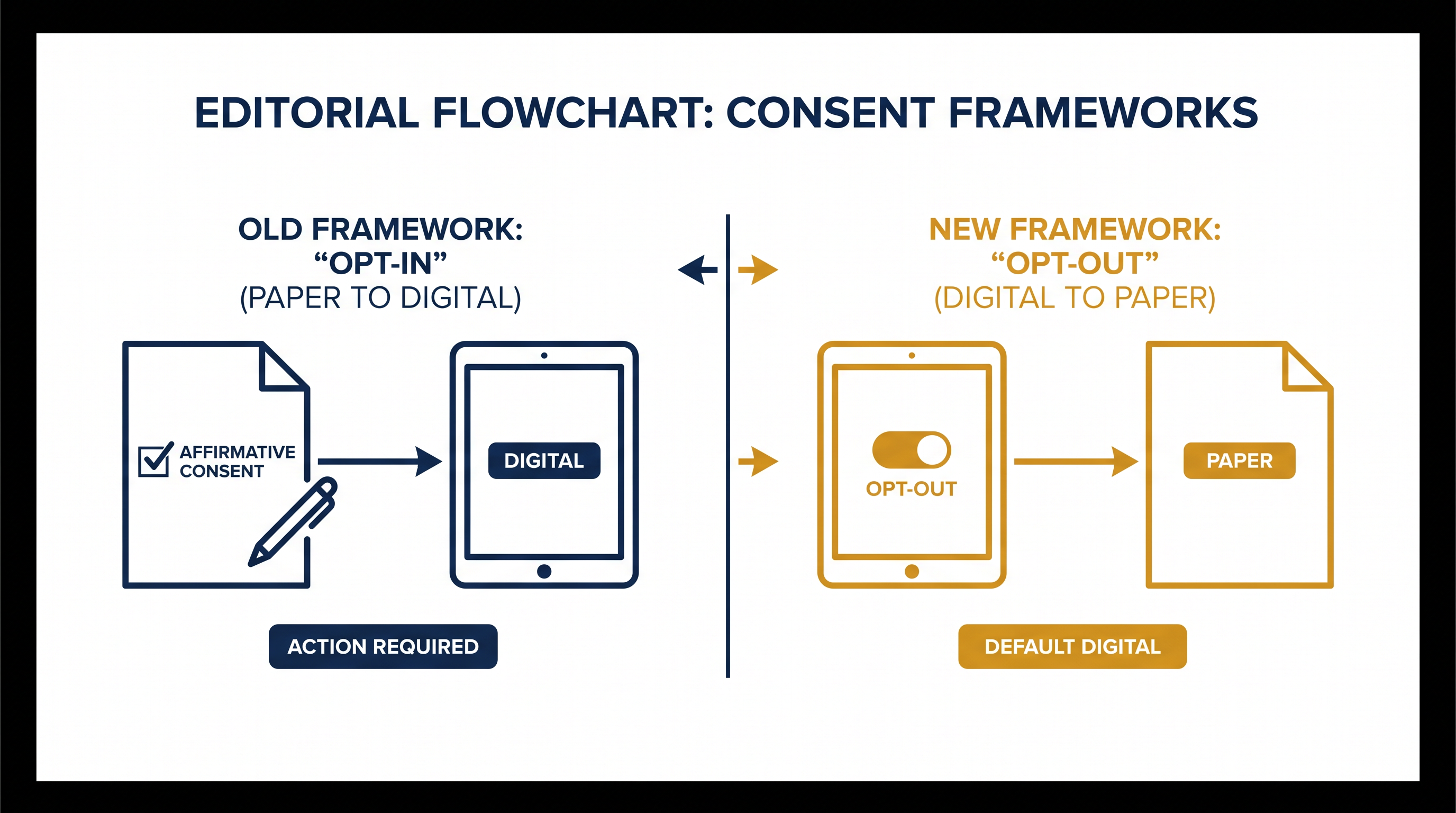
To understand the magnitude of this shift, one must look at the decades-old framework it replaces. Currently, the SEC relies on a patchwork of interpretive guidance dating back to the early days of the internet. Under this legacy system, paper is the absolute default.[3][4]
To send a document digitally under the old rules, financial institutions had to navigate the cumbersome requirements of the E-SIGN Act, forcing investors to affirmatively "opt in" to electronic delivery, often through a multi-step verification process. This friction kept digital adoption artificially low.[5]
Regulation E-Delivery completely inverts this model. Instead of requiring an affirmative opt-in, the new rule permits "covered entities"—which includes public companies, broker-dealers, and investment advisers—to default to digital delivery, provided the investor does not explicitly opt out.[2][6]
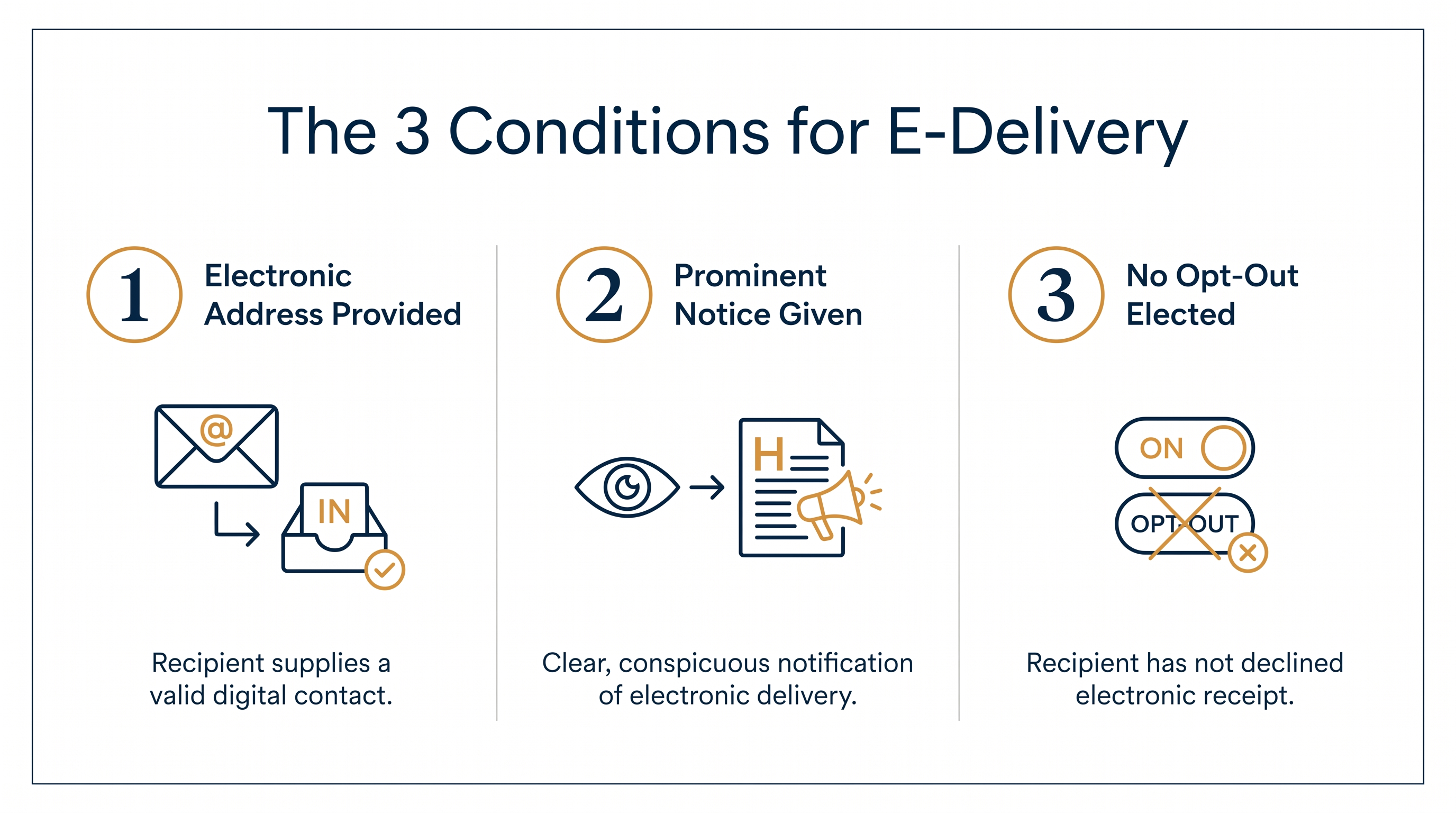
The SEC has structured this new freedom around three strict conditions to ensure investors are not caught off guard. First, the investor must have provided an "electronic address," such as an email or a mobile phone number, during their relationship with the firm.[1][5]
Second, the financial institution must provide prominent, upfront disclosure notifying the investor that regulatory documents will be sent to that specific digital address.[6]
Finally, the investor must not have exercised their right to opt out. This opt-out provision is the bedrock of the rule's consumer protection framework: any investor can demand paper delivery for all or a subset of their documents at any time, and the firm must comply completely free of charge.[2][4]
Finally, the investor must not have exercised their right to opt out.
The scope of "covered information" under the proposal is vast. It encompasses virtually every major disclosure required under federal securities laws. This includes trade confirmations, mutual fund annual and semi-annual shareholder reports, and the critical Form CRS (Client Relationship Summary).[1][3]
The rule also modernizes the mechanics of corporate governance. For public companies, the biggest impact will be on the annual proxy delivery process. The proposal amends rules surrounding tender offers and proxy solicitations, requiring companies to include electronic addresses on shareholder lists provided to third parties, thereby digitizing contested corporate actions.[3][4]
Recognizing that millions of investors currently rely on paper, the SEC has designed a deliberate transition process. Firms cannot simply flip a switch and stop mailing documents to existing paper-preference clients.[1][7]
Instead, if a firm wishes to transition an existing paper recipient to the new digital default, it must send two separate paper notices. The first notice must arrive at least 30 days before the transition, clearly explaining the upcoming change and providing simple instructions on how the investor can opt out to maintain their paper mailings.[6]

For the financial industry, the economic stakes are enormous. The shift will eliminate billions of pages of paper annually, translating to massive reductions in printing, handling, and postage costs—savings that proponents argue will ultimately be passed down to investors in the form of lower fees.[5][7]
For investors, the SEC argues that digital delivery is not just cheaper, but objectively superior. Electronic documents can be hyperlinked, making it easier to jump between a summary and the underlying data. They are instantly searchable, easily archived, and can be read by screen-reading software for visually impaired investors.[1]
Despite the clear momentum toward digitization, the rule is not yet final. The SEC has opened a public comment period running through late September 2026, inviting feedback from industry groups and investor advocates alike.[2][4]
If adopted in its current form, the market will not see an overnight transformation. The SEC has proposed a 60-day effective date following final approval, coupled with a generous two-year transition period. This window will give brokerages and issuers the necessary time to overhaul their compliance systems, track electronic addresses, and manage the complex logistics of the paper-to-digital migration.[2][5]
Why it matters
For the average retail investor, this rule will clear the clutter of unread financial mailings from their physical mailbox, replacing dense paper booklets with instantly searchable, hyperlinked digital documents. For the financial industry, it represents a massive modernization effort that will eliminate billions of pages of paper and hundreds of millions of dollars in annual printing and postage costs.
Competing readings
Financial Institutions
Broker-dealers and issuers view the rule as a long-overdue modernization that eliminates unnecessary costs.
For decades, the financial industry has argued that the SEC's paper-first presumption forced them to spend hundreds of millions of dollars annually printing and mailing documents that most investors immediately discarded. By shifting to an opt-out model, institutions can drastically reduce their overhead while modernizing their compliance infrastructure. Industry advocates emphasize that the savings generated from reduced postage and printing can ultimately be passed down to retail investors in the form of lower expense ratios and administrative fees.
Retail Investor Advocates
Consumer protection groups focus on ensuring that vulnerable populations are not left behind by the digital shift.
While acknowledging the efficiency of digital delivery, investor advocates stress the importance of the SEC's strict opt-out provisions. Their primary concern is that elderly investors, or those without reliable broadband access, might miss critical proxy votes or fee disclosures if documents are quietly routed to an unmonitored email address. These groups strongly support the rule's requirement that firms must allow investors to request paper copies at any time, completely free of charge, ensuring that the digital transition does not create an information gap for less tech-savvy individuals.
Digital Accessibility Advocates
Accessibility experts highlight the inherent advantages of digital-first documents for disabled investors.
Beyond mere convenience, digital delivery represents a massive leap forward for accessibility. Physical paper prospectuses are entirely inaccessible to visually impaired investors. In contrast, electronic documents can be seamlessly processed by screen-reading software, instantly translated into multiple languages, and dynamically resized for readability. For these advocates, Regulation E-Delivery is not just about saving money; it is about ensuring that the financial markets are structurally accessible to all participants, regardless of their physical capabilities.
The sequence
1995
The SEC issues its initial guidance on the use of electronic media for information delivery.
2000
Congress passes the E-SIGN Act, establishing legal standards for electronic signatures and records.
2008
The SEC updates its guidance to clarify the use of company websites for disclosures.
July 16, 2026
The SEC formally proposes Regulation E-Delivery to make digital disclosure the default.
September 21, 2026
The public comment period for the proposed rule closes.
Jargon, explained
- Regulation E-Delivery
- A proposed SEC rule that would make electronic delivery the default method for sending required regulatory disclosures to investors.
- Covered Entity
- Any financial institution, such as a broker-dealer, investment adviser, or public company, that is required to deliver information under federal securities laws.
- Opt-Out Framework
- A system where a service is provided automatically by default, but the user has the right to explicitly decline or choose an alternative.
- Form CRS
- A brief relationship summary document that broker-dealers and investment advisers must provide to retail investors, detailing fees, services, and conflicts of interest.
- Proxy Statement
- A document containing the information the SEC requires companies to provide to shareholders so they can make informed decisions about matters that will be brought up at an annual stockholder meeting.
What’s still unclear
- How quickly retail investors will adapt to the new digital default, or how many will actively choose to opt out and retain their paper mailings.
- The exact final language of the rule, which remains subject to revision based on public feedback gathered during the open comment period.
Sources
Source coverage
7 outlets
3 viewpoints surfaced






[1]U.S. Securities and Exchange CommissionRegulatory & Accessibility Voices
SEC Proposes Regulation E-Delivery
Read on U.S. Securities and Exchange Commission →[2]SkaddenFinancial Institutions
SEC Proposes Regulation E-Delivery to Modernize Disclosure Framework
Read on Skadden →[3]Ropes & GrayFinancial Institutions
SEC Proposes Comprehensive New Framework for Electronic Delivery
Read on Ropes & Gray →[4]WilmerHaleRetail Investor Advocates
SEC Proposes Default Electronic Delivery for Required Information
Read on WilmerHale →[5]StinsonFinancial Institutions
SEC Proposes Sweeping Overhaul of Electronic Delivery Rules
Read on Stinson →[6]King & SpaldingRetail Investor Advocates
SEC Proposes New Default Rule for Electronic Delivery
Read on King & Spalding →[7]Factlen Editorial TeamRegulatory & Accessibility Voices
Synthesis by Factlen editorial team
Read on Factlen Editorial Team →
Comments
Every angle. Every day.
Get finance stories with full source coverage and perspective breakdowns delivered to your inbox.