
The New Global Quality Reality: A Guide to ISO 9001:2026, Quality Culture, and the Climate Change Mandate
The upcoming ISO 9001:2026 revision introduces strict new mandates requiring organizations to formally integrate climate change risks and demonstrate an active quality culture. Certified businesses have until September 2029 to update their management systems or risk losing compliance.


- Certification Bodies & Auditors
- Focus on strict compliance, structural alignment, and verifiable evidence of the new mandates.
- Quality Management Practitioners
- Focus on practical implementation, minimizing administrative burden, and leveraging the transition for process improvement.
- Sustainability & Risk Advocates
- Focus on the integration of climate risk into core business strategy and supply chain resilience.
Summary
- ISO 9001:2026 is an evolutionary update that retains the core structure of the 2015 version while introducing targeted new mandates.
- The standard formally integrates climate change considerations, requiring organizations to assess environmental impacts on their quality management.
- Leadership is now explicitly required to demonstrate an active quality culture and ethical behavior, moving beyond simple policy signatures.
- Risks and opportunities have been separated into distinct requirements to encourage proactive process improvements.
- The revised standard aligns with the Harmonized Structure, making it easier to integrate with other ISO management systems.
- Certified organizations will have a three-year transition period, concluding in September 2029, to update their systems.
The most common mistake organizations make about the upcoming ISO 9001:2026 revision is assuming it is either a radical rewrite of the 2015 standard or a purely administrative update. Neither is true. The core architecture remains intact, but the 2026 revision introduces targeted, high-stakes mandates that fundamentally change how auditors will evaluate compliance.[4]
Instead of tearing down the existing framework, the International Organization for Standardization (ISO) has surgically inserted new requirements that reflect the modern business environment. The two most significant additions are the formal integration of climate change considerations and a strict new mandate for leadership to demonstrate an active quality culture.[2][3]
For the over one million organizations globally holding an ISO 9001 certification, the directive is direct and utility-first: update your Quality Management System (QMS) to reflect these new realities or risk non-conformity during your next recertification cycle. The revised standard is scheduled for publication in September 2026, triggering a three-year transition period that ends in September 2029.[1][2]
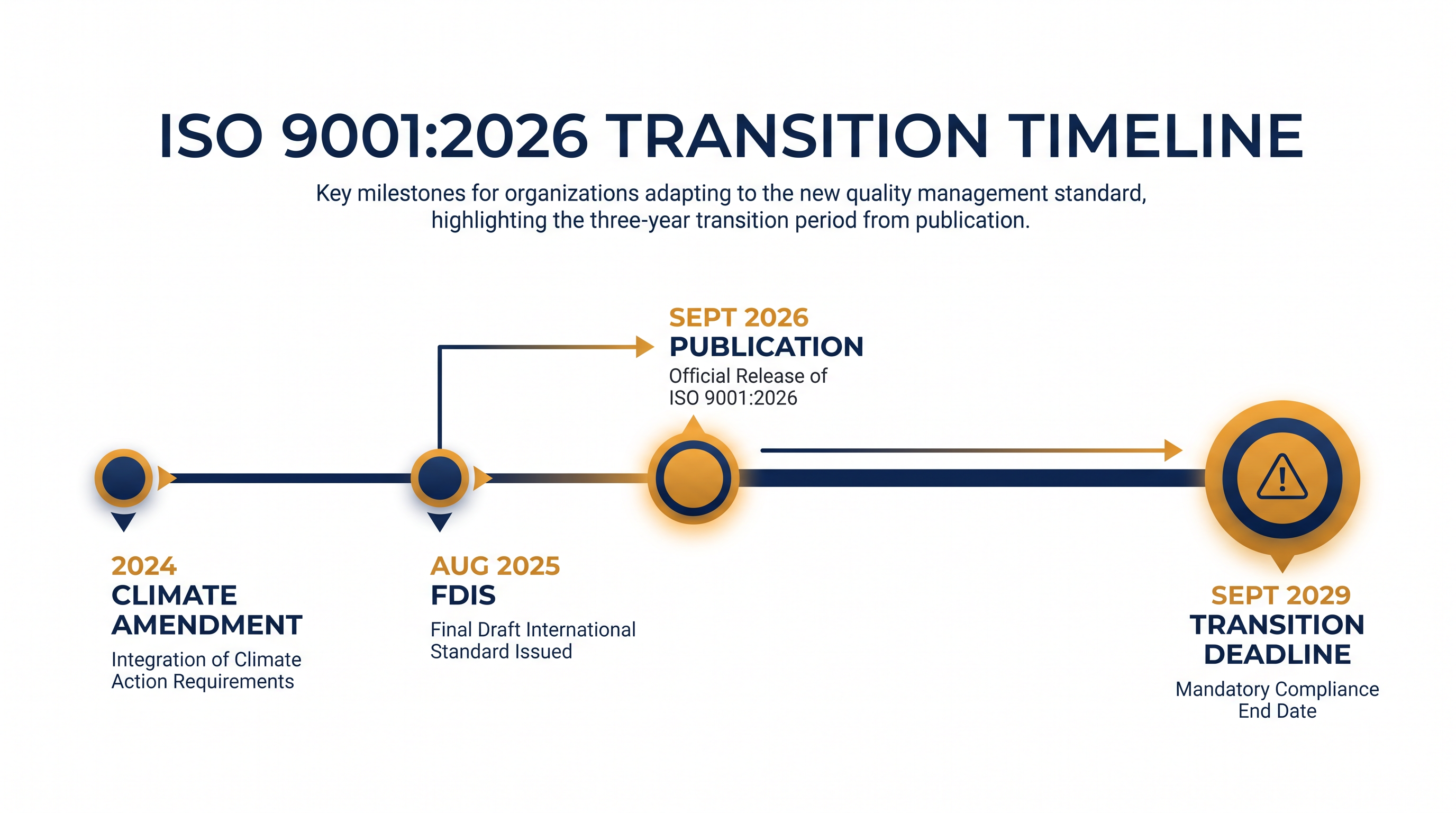
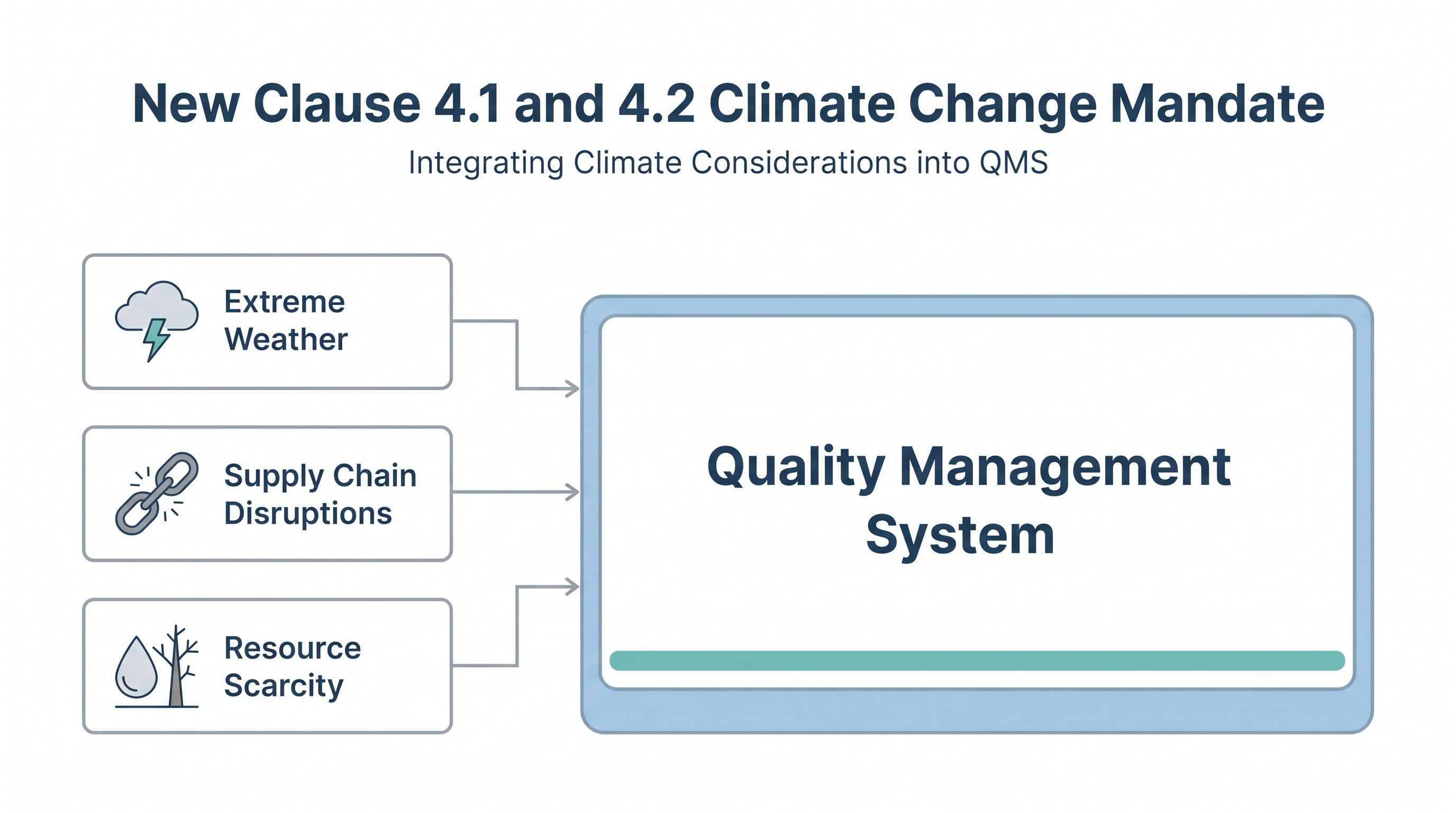
The most heavily debated addition is the Climate Change Mandate. In early 2024, ISO released an amendment requiring organizations to evaluate climate change as a potential factor in their QMS. The 2026 revision permanently bakes this requirement into Clauses 4.1 and 4.2, which govern the context of the organization.[1][3]
This means quality management can no longer exist in a vacuum of product specifications. Organizations must explicitly document whether climate change affects their ability to deliver consistent quality. If a company claims climate change is irrelevant to its operations, it must provide a defensible, documented justification to auditors.
In practice, climate risks cast a wide net over quality control. Extreme weather events disrupt global supply chains, rising temperatures affect raw material stability, and resource scarcity drives up production costs. Auditors will now look for evidence that these environmental factors are mapped into the organization's risk registers and supplier evaluations.
The second major shift targets the boardroom. Clause 5.1 of the revised standard expands leadership responsibilities by introducing the concept of quality culture and ethical behavior. Previously, top management could satisfy auditor requirements by simply signing a quality policy and allocating resources.[1][2]
Clause 5.1 of the revised standard expands leadership responsibilities by introducing the concept of quality culture and ethical behavior.
Under ISO 9001:2026, a signature is no longer enough. Executives are explicitly on the hook for demonstrating—not just stating—a culture of quality and ethical conduct. Auditors will increasingly rely on employee interviews and behavioral observations to verify that shared values, beliefs, and ethical practices are actively promoted from the top down.[2][3]
This requires a tangible shift in how leadership engages with the QMS. Companies should prepare by integrating quality metrics into executive performance reviews, establishing clear ethical guidelines for supply chain management, and maintaining documented evidence of leadership's direct involvement in quality initiatives.[3][4]
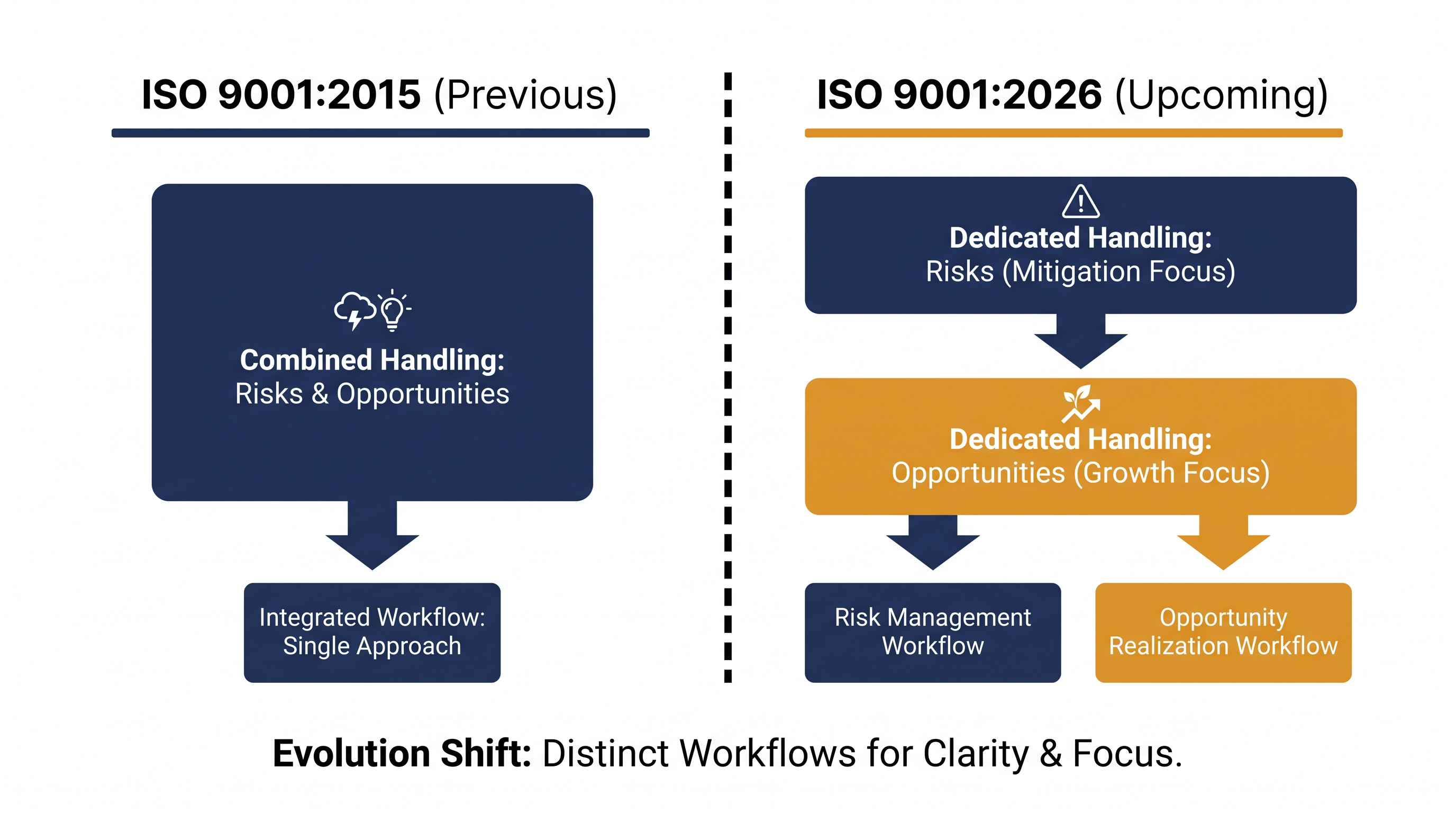
Beyond climate and culture, the 2026 revision fundamentally changes how organizations handle uncertainty. The 2015 version grouped risks and opportunities together, which often led companies to focus exclusively on mitigating negative risks while ignoring potential process improvements.[1]
ISO 9001:2026 separates these two concepts into distinct requirements. Auditors will now expect to see separate registers and clear evidence of how the organization identifies and capitalizes on opportunities—such as adopting new technologies or entering new markets—independently of how it mitigates risks.[1][2]
Structurally, the new revision aligns with the Harmonized Structure (HS), previously known as the High-Level Structure. This ensures that ISO 9001 shares identical core text, terms, and definitions with other major management standards like ISO 14001 for environmental management and ISO/IEC 27001 for information security.[1][3]
For organizations operating integrated management systems, this alignment significantly reduces administrative overhead. A single, unified context analysis or internal audit program can now more easily satisfy the requirements of multiple ISO standards simultaneously, lowering compliance costs and streamlining operations.[1][4]
The standard also modernizes its approach to documented information. With the rapid acceleration of remote work, cloud computing, and artificial intelligence since the 2015 revision, the 2026 update places stronger emphasis on the control of digital records, cybersecurity considerations, and the validation of automated decision-making processes.[4]
The transition window gives organizations ample time, but early preparation is the most cost-effective strategy. Companies should immediately begin conducting gap analyses against the Final Draft International Standard (FDIS), updating their context of the organization to include climate risks, and training leadership on the new cultural expectations. Waiting until 2028 to address these changes will only guarantee rushed implementations and higher consulting fees.[2][3][4]
Definitions
- Quality Management System (QMS)
- A formalized system that documents processes, procedures, and responsibilities for achieving quality policies and objectives.
- Harmonized Structure (HS)
- A standardized framework created by ISO to ensure all management system standards share the same core text and terminology.
- Clause 4.1 & 4.2
- The sections of the ISO 9001 standard that require organizations to understand their internal and external context, including the needs of interested parties.
- Final Draft International Standard (FDIS)
- The last stage of review before an ISO standard is officially published.
- Non-conformity
- A failure to meet one or more requirements of the ISO standard, which can jeopardize an organization's certification status.
Chronology
1987
ISO 9001 is first published as a global quality assurance standard.
2015
The standard undergoes a major revision, introducing the High-Level Structure and risk-based thinking.
February 2024
ISO publishes Amendment 1, immediately requiring organizations to consider climate change in their management systems.
August 2025
The Draft International Standard (DIS) for the 2026 revision is published and approved by member bodies.
September 2026
Expected official publication of the finalized ISO 9001:2026 standard.
September 2029
The three-year transition period concludes for all certified organizations.
Analysis by camp
Certification Bodies & Auditors
Focus on strict compliance, structural alignment, and verifiable evidence of the new mandates.
For certification bodies, the 2026 revision provides much-needed clarity on ambiguous topics. Auditors have historically struggled to evaluate leadership commitment objectively. By explicitly requiring evidence of a quality culture and separating risks from opportunities, the new standard gives auditors concrete criteria to assess. They emphasize that organizations can no longer rely on generic policy statements; every claim about climate resilience or ethical behavior must be backed by documented, verifiable actions.
Quality Management Practitioners
Focus on practical implementation, minimizing administrative burden, and leveraging the transition for process improvement.
Quality managers on the ground view the update as an evolutionary step rather than a revolution. Their primary goal is to integrate the new climate and culture requirements without creating redundant paperwork. Practitioners advocate for leveraging the Harmonized Structure to unify ISO 9001 with environmental and security standards, turning a compliance exercise into an opportunity to streamline operations and reduce overall audit fatigue.
Sustainability & Risk Advocates
Focus on the integration of climate risk into core business strategy and supply chain resilience.
Sustainability experts see the ISO 9001:2026 climate mandate as a massive victory for corporate accountability. By tying climate change directly to quality management, the standard forces companies to acknowledge that extreme weather, resource scarcity, and carbon regulations are material business risks. This perspective argues that treating climate change as a quality issue will drive more meaningful environmental action than voluntary sustainability pledges, as failure to comply now threatens a company's core commercial certifications.
Questions & answers
Do I need to rewrite my entire Quality Management System for 2026?
No. The 2026 revision is an update, not a complete overhaul. The core requirements of the 2015 version remain intact, but you will need to add specific documentation for climate change, quality culture, and separated risk/opportunity registers.
What happens if climate change does not affect my business?
If you determine that climate change is not relevant to your operations, you must explicitly state this in your context documentation and provide a defensible justification that an auditor can verify.
When is the deadline to transition to ISO 9001:2026?
The standard is scheduled for publication in September 2026. Certified organizations will have a three-year transition period, meaning all systems must be updated by September 2029.
Limits of the evidence
- How strictly individual auditors will interpret 'demonstrating' a quality culture during the first wave of recertifications.
- Whether the climate change mandate will lead to a significant increase in non-conformity reports for companies in high-emission industries.
Significance
The ISO 9001:2026 update forces over a million certified businesses to formally integrate climate risk and executive ethics into their quality management systems. Failing to adapt to these new mandates could result in lost certifications, disrupting supply chain contracts and market access.
Sources
Source coverage
4 outlets
3 viewpoints surfaced




[1]TÜV SÜDCertification Bodies & Auditors
Key updates in ISO 9001:2026 you should know
Read on TÜV SÜD →[2]9001 SimplifiedCertification Bodies & Auditors
ISO 9001:2026 Revision – Latest Updates
Read on 9001 Simplified →[3]ISO 9001 ChecklistQuality Management Practitioners
ISO 9001:2026 Revision Guide
Read on ISO 9001 Checklist →[4]Factlen Editorial Team
Synthesis by Factlen editorial team
Read on Factlen Editorial Team →
Comments


Every angle. Every day.
Get guides stories with full source coverage and perspective breakdowns delivered to your inbox.