
US Battery Storage Capacity Hits 52 GW After Three Years of 70% Annual Growth
Utility-scale battery storage has quietly become a massive shock absorber for the US electrical grid, surpassing 52 gigawatts of capacity amid surging demand from AI data centers.
By Hunter Cole

- Grid Operators & Utilities
- Focused on maintaining system reliability and managing the complexities of peak demand.
- Energy Developers & Investors
- Focused on rapid deployment, tax incentives, and capturing arbitrage profits.
- Tech & Data Center Operators
- Focused on securing firm, 24/7 clean power to meet AI load growth without waiting years for grid upgrades.
- Eastern Grid Critics
- Focused on the regulatory and market design failures preventing storage deployment in PJM and MISO.
Perspectives this story doesn't cover
- Natural gas peaker plant operators facing reduced run-times and lower profitability.
- Local communities living near massive lithium-ion installations concerned about fire risks and land use.
The United States electrical grid is currently navigating an era of unprecedented strain. Between the escalating frequency of extreme weather events and the sudden, explosive electricity demands of artificial intelligence data centers, the prevailing narrative has often centered on the risk of rolling blackouts and a forced return to fossil fuels. Grid operators have repeatedly warned that the rapid retirement of legacy coal plants, combined with the slow pace of new transmission line construction, leaves the system vulnerable during peak demand hours. Yet, beneath the alarmism, a silent shock absorber has been rapidly woven into the national power network. Utility-scale battery storage has quietly scaled up to meet the moment, fundamentally altering how electricity is managed and dispatched across the country.
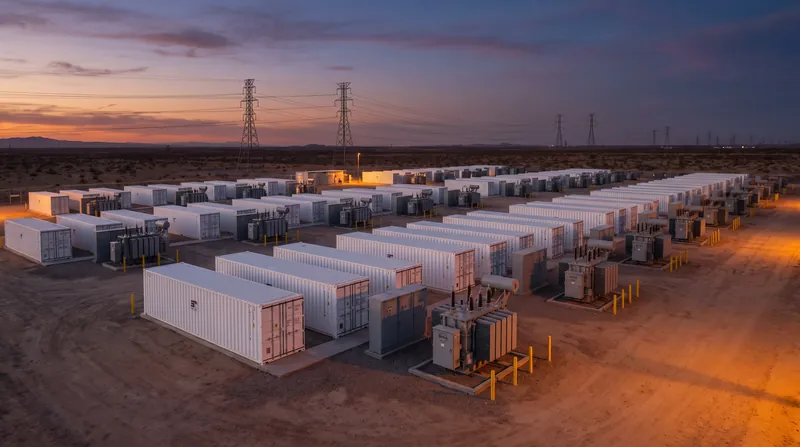
The scale of this deployment has now crossed a historic threshold. According to the U.S. Energy Information Administration, the United States officially surpassed 52 gigawatts of operational utility-scale battery storage capacity in the first half of 2026. This milestone is the result of an extraordinary trajectory, with the sector maintaining an annual average growth rate of 70% over the past three years. To put 52 gigawatts into perspective, it is roughly equivalent to the maximum output of 50 standard nuclear reactors, capable of instantly injecting massive volumes of power into the grid at a moment's notice.[1][2]
The momentum shows no signs of slowing. The American Clean Power Association reported that the industry installed a record 3.3 gigawatts of new capacity in just the first quarter of 2026 alone, a 54% increase over the previous first-quarter record. Driven by a combination of federal tax incentives, falling lithium-ion component costs, and desperate utility procurement, the total pipeline of battery energy storage systems is projected to reach an astonishing 200 gigawatts by 2031. This rapid buildout is not merely an addition to the grid; it represents a structural transition in how the grid functions.
To understand why batteries are deploying at this velocity, it is necessary to look at the mechanism of modern power delivery. Batteries do not generate electricity; they shift it across time. Their core function relies on a concept known as energy arbitrage and peak shaving. During the middle of the day, when vast arrays of solar panels overproduce and wholesale power prices frequently plummet below zero, battery facilities absorb and store the excess, otherwise-wasted energy. They act as massive sponges, soaking up the midday solar glut that would otherwise overwhelm transmission lines.
The critical moment arrives when the sun sets. As solar generation drops to zero, evening residential demand typically spikes as people return home, turn on appliances, and plug in electric vehicles. Historically, grid operators managed this steep ramp-up by firing up expensive, highly polluting natural gas "peaker" plants. Today, massive lithium-ion banks discharge their stored midday power precisely during these vulnerable evening hours. This temporal shift smooths out the generation curve, stabilizing grid frequency and drastically reducing the reliance on rapid-start fossil fuel facilities.
As solar generation drops to zero, evening residential demand typically spikes as people return home, turn on appliances, and plug in electric vehicles.
The real-world impact of this mechanism is already highly visible in the nation's two largest and most volatile energy markets: California and Texas. Both states have aggressively deployed storage to manage their massive renewable energy portfolios. In California, the grid operator CAISO now manages a system where batteries are routinely the largest source of supply during the evening transition. In early July 2026, California's battery fleet discharged a record 12.99 gigawatts during the evening peak, seamlessly covering 36% of the state's total electricity demand at that exact moment.[4]
Texas demonstrated a distinctly different, yet equally vital, use case for battery storage during a severe weather event in February 2026. When a sudden winter cold snap caused early morning heating demand to spike alongside a steep drop in wind generation, the ERCOT battery fleet proved its worth. The state's batteries simultaneously discharged 4,100 megawatts of power onto the grid, setting a new operational record. This rapid injection stabilized the grid's frequency and actively dampened extreme real-time wholesale price spikes, saving commercial electricity buyers an estimated $150 million in avoided scarcity costs across a single four-hour event.
Beyond weather resilience, the next massive catalyst for battery growth is the technology sector. The proliferation of artificial intelligence is driving a historic surge in electricity demand, with data centers projected to outpace planned utility capacity additions by more than 100 gigawatts through 2030. Because AI workloads require firm, uninterrupted power to operate continuously, tech companies and utilities are scrambling to find solutions. The traditional approach of building high-voltage transmission lines and new gas plants often takes five to ten years—a timeline that is incompatible with the rapid deployment schedules of hyperscale data centers.
Battery storage offers a critical workaround to this infrastructure bottleneck. Because modular battery systems can be manufactured, permitted, and installed in as little as 6 to 12 months, they are increasingly being co-located with new data centers or deployed at congested grid substations. By acting as a local buffer, batteries allow data centers to draw steady power without triggering the need for massive, decade-long transmission upgrades. This speed-to-deployment advantage has made storage an essential, rather than optional, component of modern digital infrastructure planning.
Despite the staggering top-line growth, the battery boom remains highly uneven geographically. While Texas and California dominate the landscape, Eastern grid operators such as PJM and MISO are lagging severely behind. Research indicates that this deployment gap is not due to a lack of developer interest or capital, but rather archaic interconnection queues and regulatory friction. In these Eastern markets, systemic market design failures and prolonged permitting processes frequently neutralize the inherent speed advantage of battery technology, leaving those grids more exposed to peak demand shortfalls.[3]
Furthermore, the industry faces looming supply chain and regulatory hurdles. As the United States enforces stricter domestic sourcing requirements and foreign entity of concern restrictions tied to federal tax credits, securing compliant battery cells and high-voltage transformers has become increasingly difficult. Developers are racing to secure long-term supply agreements with domestic manufacturers, and analysts warn that equipment bottlenecks could constrain the pace of installations over the next two to four years.
Ultimately, the milestone of 52 gigawatts signals a profound paradigm shift in energy infrastructure. The electrical grid is evolving from a rigid, "just-in-time" delivery mechanism—where supply must perfectly match demand every second of the day—into a flexible, "store-and-forward" network. By decoupling the moment electricity is generated from the moment it is consumed, battery storage is quietly absorbing the shocks of both a changing climate and a rapidly digitizing economy, proving that the grid can adapt faster than many predicted.
What to know
- The US has surpassed 52 gigawatts of utility-scale battery storage, maintaining a 70% annual growth rate over three years.
- The industry installed a record 3.3 gigawatts in the first quarter of 2026, with total capacity projected to hit 200 GW by 2031.
- Batteries act as a grid shock absorber, storing cheap midday solar power and discharging it during vulnerable evening demand peaks.
- In July 2026, California's battery fleet covered 36% of the state's evening peak demand, while Texas batteries saved $150 million during a February cold snap.
- Tech companies are increasingly relying on battery storage to power AI data centers, bypassing decade-long transmission upgrade delays.
Key terms
- Energy Arbitrage
- The practice of storing electricity when wholesale prices are low (often midday) and discharging it onto the grid when prices are high (often evening).
- Peak Shaving
- Reducing the amount of electricity drawn from the main grid during times of maximum demand, often by relying on stored battery power.
- Interconnection Queue
- The waiting list and study process that new power projects must complete before they are allowed to physically connect to the electrical grid.
- Firm Power
- Electricity supply that is guaranteed to be available 24 hours a day, 7 days a week, regardless of weather conditions.
- Peaker Plant
- A power plant, typically fueled by natural gas, that only runs during times of high electricity demand to prevent grid shortages.
Reader questions
What is utility-scale battery storage?
It refers to massive installations of batteries—typically lithium-ion—connected directly to the electrical grid. Instead of generating power, they store excess electricity when demand is low and discharge it when demand peaks.
Why is battery storage growing so fast?
The growth is driven by the need to balance intermittent renewable energy sources like solar and wind, combined with falling battery costs, federal tax incentives, and surging electricity demand from new data centers.
How do batteries help prevent blackouts?
Batteries can discharge their stored power onto the grid almost instantly. During extreme weather or sudden power plant failures, this rapid injection of electricity stabilizes the grid's frequency and fills supply gaps before blackouts occur.
Why are Texas and California leading in battery deployment?
Both states have high amounts of renewable energy generation and experience significant peak demand challenges. Their market structures also financially reward battery operators for providing power during critical, high-priced shortage events.
Sources
Source coverage
4 outlets
4 viewpoints surfaced




- [1]U.S. Energy Information AdministrationGrid Operators & Utilities
Battery storage capacity averaged 70% growth over the last three years
Read on U.S. Energy Information Administration → - [2]CleanTechnicaEnergy Developers & Investors
U.S. Battery Storage Capacity Averaged 70% Growth Over The Last Three Years
Read on CleanTechnica → - [3]GridLabEastern Grid Critics
The BESS Deployment Gap: Structural Barriers in Eastern U.S. Markets
Read on GridLab → - [4]Winss SolutionsGrid Operators & Utilities
Solar and battery storage set records in California, Texas, the EU and Germany in mid-2026
Read on Winss Solutions →
Comments
More in Energy
See all →Nuclear Safety
The 0-to-7 Scale That Classifies the Severity of Nuclear Accidents and Incidents
6 sources
Grid Economics
The Merit Order Effect That Determines Which Power Plants Run First
6 sources

Waste Classification
The Low-Level, Intermediate-Level, and High-Level Categories That Define Nuclear Waste Disposal and Isolation
8 sources
Storage Economics
The Capital Cost, Round-Trip Efficiency, and Cycle Life That Determine the Levelized Cost of Storage
8 sources
Every angle. Every day.
Get Energy stories with full source coverage and perspective breakdowns delivered to your inbox.