
China Mandates Sweeping Higher Education Overhaul, Forcing Universities to Specialize Amid Demographic Decline
In a major policy shift, China is restructuring its higher education system to classify universities into research, application, and skills tracks. The reform aims to align degree programs with industrial needs and address graduate unemployment as the country faces a shrinking college-age population.
By Tiago Sousa

- Ministry of Education
- Argues that specialized tracks are necessary to align educational output with national strategic needs and industrial upgrading.
- Higher Education Analysts
- Emphasize that the reform is a pragmatic response to demographic decline and a saturated job market for generic degrees.
Perspectives this story doesn't cover
- Current university students
- Private sector employers
Fast facts
- China's Ministry of Education has mandated that all universities classify into research, application, or skills-oriented tracks.
- The reform aims to address graduate unemployment and align degree programs with industrial needs amid a declining birthrate.
- Elite "Double First-Class" universities will add 76,000 undergraduate places between 2027 and 2030, specifically in AI, biomedicine, and new energy.
- China's higher-educated population has reached 270 million, with a gross enrollment rate of 61.3 percent in 2025.
- The government will use ultra-long special treasury bonds to fund laboratory and campus upgrades for specialized institutions.
Why this matters
As the world's largest higher education system pivots from mass enrollment to targeted specialization, the shift will reshape the global talent pipeline in critical sectors like AI and green energy. For international researchers and multinational employers, China's move signals a highly coordinated effort to match its workforce directly to its industrial ambitions.
On September 21, 2026, China's Ministry of Education unveiled a sweeping new guideline that fundamentally restructures the nation's higher education system. Moving away from a decades-long model of mass enrollment and generic degree programs, the policy mandates that the country's more than 3,000 colleges and universities classify themselves into one of three distinct tracks: research-oriented, application-oriented, or skills-oriented.[1][4]
The overhaul arrives as China confronts a dual structural challenge: a rapidly declining birthrate that is shrinking the pool of future high school graduates, and an increasingly tight job market for current degree holders. With the country's higher-educated population now reaching 270 million, Vice Minister of Education Wang Guangyan confirmed that total enrollment stands at 48.73 million, pushing the gross enrollment rate in higher education to 61.3 percent in 2025 and producing a surplus of generalists.[2][4]
Under the new classification framework, research-oriented universities will be tasked exclusively with driving breakthroughs in foundational science and technology. Application-oriented institutions must pivot to industry-education integration and research commercialization, while skills-oriented schools will focus on employment-driven training to cultivate highly skilled professionals for the modern industrial sector.[1][3]
As part of the broader reform, the government announced that universities under the elite "Double First-Class Initiative" will expand undergraduate enrollment by 76,000 places between 2027 and 2030. However, Guo Peng, head of the ministry's development planning department, stated that this expansion is strictly targeted. Institutions are required to adjust their academic programs to support emerging strategic fields, specifically artificial intelligence, integrated circuits, biomedicine, and new energy.
However, Guo Peng, head of the ministry's development planning department, stated that this expansion is strictly targeted.
To support the transition, the central government is tapping ultra-long special treasury bonds to fund new campuses and upgrade basic facilities, including laboratories and dormitories. The Ministry of Education stressed that the goal is no longer simply increasing capacity, but improving the structural quality of the education delivered to better align with national priorities.[3]
The demographic reality underpins the urgency of the mandate. As the legacy of population decline takes hold, universities are facing a future with fewer applicants. By forcing specialization, the government aims to prevent institutions from competing for a shrinking student base with identical, theoretical degree programs that fail to meet the demands of an innovation-driven economy.[1][4]
Educational experts note that the structural adjustment will require a corresponding shift in cultural attitudes. "This is not simply about labeling universities, but about creating a rational division of functions among higher education institutions and their respective missions," said Liu Zhentian, a professor of education at Xiamen University. Officials are urging a break from traditional stereotypes to ensure that graduates from vocational and skills-oriented tracks receive equal professional respect.[1]
The third phase of the Double First-Class initiative officially launches in 2026, setting the tone for the 2026–2030 period. As universities begin submitting their classification plans, the immediate focus will be on how quickly application- and skills-oriented institutions can forge partnerships with the private sector to absorb the record 11.58 million students graduating annually into the workforce.[3][4]
Viewpoints in depth
State Planners' View
The government views university specialization as a critical lever for national economic security.
Ministry of Education officials argue that the era of universities trying to be everything to everyone has ended. By forcing institutions into distinct lanes, the state aims to eliminate redundant degree programs and concentrate resources where they are needed most. For research universities, this means a singular focus on foundational science to reduce reliance on foreign technology, while vocational tracks are expected to supply the specialized labor required to maintain China's manufacturing dominance.
Labor Market Analysts' View
Analysts see the reform as a pragmatic, necessary response to a looming demographic and employment crisis.
With a record 11.58 million students graduating annually into a slowing economy, analysts point out that a generic bachelor's degree has rapidly lost its premium. They argue that the demographic decline—which will soon shrink the pool of incoming freshmen—makes the current university model financially and socially unsustainable. By pivoting to skills-based and application-oriented tracks, the reform attempts to bridge the severe mismatch between the theoretical knowledge graduates possess and the practical skills employers actually demand.
Sources
Source coverage
4 outlets
2 viewpoints surfaced




- [1]XinhuaMinistry of Education
China Focus: China seeks to foster distinctive strengths among universities
Read on Xinhua → - [2]InKunmingMinistry of Education
China's higher-educated population reaches 270 mln as universities expand enrollment, adjust programs
Read on InKunming → - [3]AcademicJobs.comHigher Education Analysts
China Classified University Reform 2026
Read on AcademicJobs.com → - [4]The EdvocateHigher Education Analysts
Dramatic Shift: China's Higher Ed Overhaul Redefines Degree Value for Millions
Read on The Edvocate →
Comments
More in Education
See all →Educational Standards
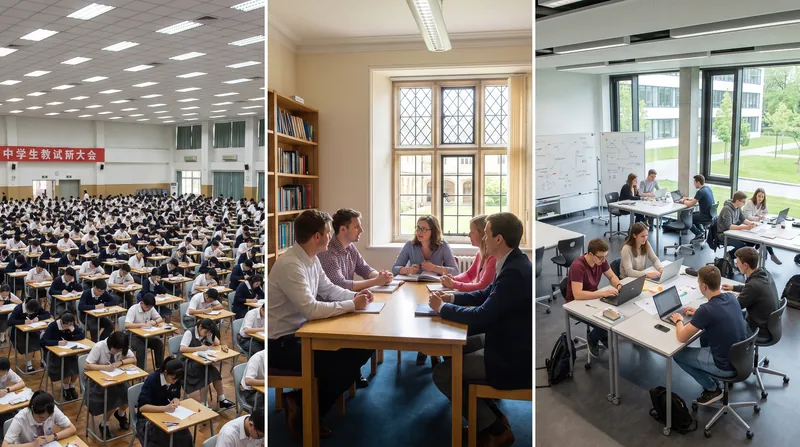
The 9 Levels of ISCED: How UNESCO Standardizes Global Educational Attainment
6 sources
Quality Assurance
The Three Pillars of Higher Education Quality Assurance: How Universities Prove Their Worth
8 sources
Open Access
The Financial Mechanics of Open Access: Comparing the Gold, Green, and Diamond Publishing Routes
8 sources

AI Literacy
House Committee Advances Bill to Unlock Federal Funds for K-12 AI Literacy
7 sources
Every angle. Every day.
Get Education stories with full source coverage and perspective breakdowns delivered to your inbox.