
SEC and CFTC Propose Raising Private Fund Reporting Threshold to $1 Billion, Halving Filers
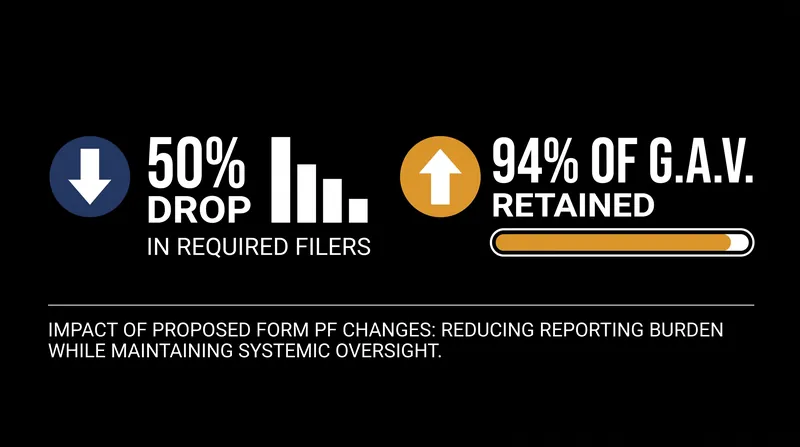
A proposed regulatory overhaul would exempt approximately 50% of current private fund advisers from filing Form PF, eliminating a major compliance burden for mid-sized firms while retaining visibility over 94% of the industry's gross assets.


- Deregulation Advocates
- Argue that the $150 million threshold was outdated and trapped mid-sized advisers in a costly compliance net meant for Wall Street giants.
- Systemic Risk Analysts
- Emphasize that while 94% of gross assets remain covered, the sheer volume of mid-sized funds dropping off the radar could obscure localized risks.
- Compliance Practitioners
- Welcome the relief but warn that complex fund structures still face rigorous reporting, and the timing of the rollback creates uncertainty.
At a glance
- The SEC and CFTC proposed raising the Form PF filing threshold from $150 million to $1 billion.
- The 'large hedge fund adviser' threshold would jump from $1.5 billion to $10 billion.
- The changes would eliminate reporting obligations for approximately 50% of current filers.
- Regulators estimate that 94% of the industry's gross asset value will still be reported.
Why it matters now
For private fund advisers, this proposal represents a massive reduction in compliance costs and red tape. For the broader market, it signals a regulatory shift that focuses systemic risk monitoring exclusively on the largest financial players, leaving mid-sized funds free to operate with less federal friction.
A proposed regulatory overhaul will exempt approximately 50% of current private fund advisers from filing Form PF, eliminating a major compliance burden for mid-sized firms while retaining visibility over 94% of the industry's gross assets. For over a decade, the SEC and CFTC have used Form PF as a massive dragnet to monitor systemic risk, but that dragnet caught thousands of smaller advisers, imposing heavy costs for data that regulators arguably didn't need.[6]
Now, the regulatory pendulum is swinging back. On April 20, 2026, the SEC and CFTC jointly proposed sweeping amendments to Form PF that would drastically raise the reporting thresholds, resolving the tension between systemic risk monitoring and operational friction.[1][2]
The proposal marks a sharp reversal from the regulatory expansion seen between 2021 and 2024, reflecting a new mandate under the Atkins-led SEC to reduce compliance burdens and streamline capital formation.[4]
To understand the stakes, one must look at the mechanics of Form PF. Created in 2011 in the wake of the 2008 financial crisis, the confidential form was designed to give the Financial Stability Oversight Council (FSOC) a clear view into the opaque world of private equity, hedge funds, and liquidity funds.[1][6]
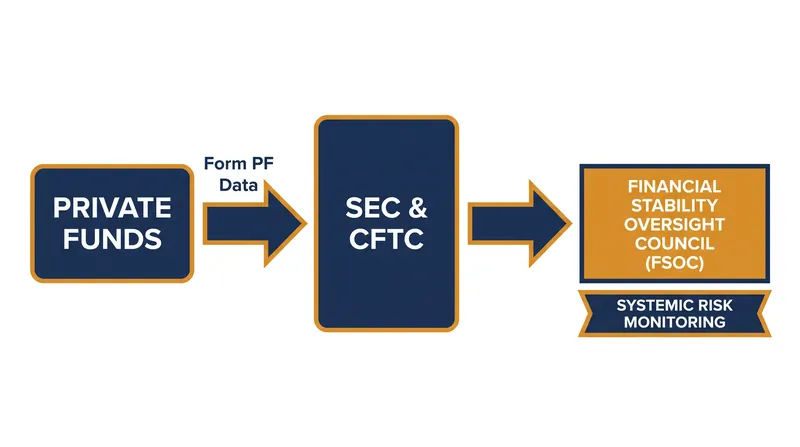
Advisers report granular data on portfolio exposures, leverage, counterparty risk, and liquidity. This data allows regulators to spot dangerous concentrations of risk before they threaten the broader financial system.[3]
However, the definition of who needed to report had remained relatively low. Under the current rules, any SEC-registered adviser with at least $150 million in private fund assets under management (AUM) is required to file.[4][5]
The new proposal would increase that baseline threshold by nearly seven times, pushing it to $1 billion in private fund AUM.[1][2]
The agencies project that this single change will eliminate the Form PF filing obligation for roughly half of all current filers, providing immediate operational relief to smaller and mid-sized advisory firms.[3][5]
Crucially, the SEC and CFTC argue that this massive cut in the filer population will not blind the FSOC. Because private market wealth is heavily concentrated at the top, removing 50% of the filers will only reduce the aggregate private fund gross asset value reported by about 6%—leaving 94% of the industry's assets still under the regulatory microscope.[1][3]
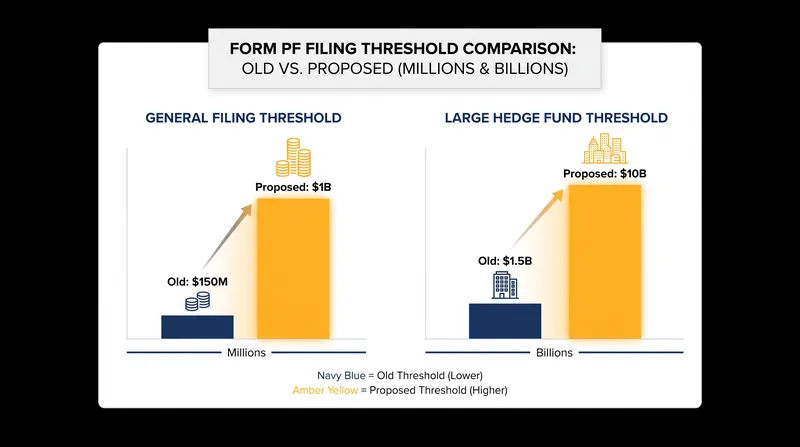
Crucially, the SEC and CFTC argue that this massive cut in the filer population will not blind the FSOC.
The relief extends further up the chain to hedge funds. The proposal raises the threshold for "large hedge fund advisers"—a designation that triggers rigorous quarterly filing requirements—from $1.5 billion to $10 billion in hedge fund AUM.[2][4]
This adjustment is expected to reduce the number of large hedge fund adviser filers by roughly 65%. Those falling between $1.5 billion and $10 billion will shift to a much lighter annual reporting schedule.[3][5]
The proposal also takes an axe to specific reporting requirements that the industry has long criticized as overly prescriptive. For private equity funds, the agencies proposed eliminating Section 6 quarterly event reporting entirely, which currently mandates disclosures on adviser-led secondary transactions and general partner removals.[4][5]
Additionally, granular questions regarding monthly asset turnover, reference asset exposure, and complex look-through mechanics for indirect exposures would be streamlined or replaced with a "reasonable estimates" standard.[5]
The rollback is not happening in a vacuum. It follows a January 2025 Presidential Memorandum that directed federal agencies to review, delay, or postpone the effective dates of rules that had not yet taken effect.[1]
The SEC had previously adopted expansive Form PF amendments in early 2024, but the compliance dates for those rules had been repeatedly delayed, most recently to October 1, 2026. This new proposal effectively unwinds much of that 2024 framework before it ever goes live.[1][5]
Despite the sweeping cuts, the proposal is not a total retreat from private fund oversight. The thresholds for large private equity fund advisers ($2 billion) and large liquidity fund advisers ($1 billion) remain completely unchanged.[3][5]
Furthermore, advisers that still qualify as large hedge funds under the new $10 billion threshold will continue to face strict 72-hour current reporting deadlines for major stress events, alongside revised counterparty exposure reporting.[5]
The transition timeline remains a critical variable. The proposal suggests a minimum 12-month transition period after a final rule is published. With the public comment period closing in late June 2026, compliance teams are left navigating a complex interim period.[2][5]
If the agencies cannot finalize the new, lighter framework before the October 2026 compliance date of the old, heavier rules, mid-sized advisers may be forced to build compliance systems for regulations that are slated for demolition.[2]
Ultimately, the $1 billion threshold proposal represents a calculated bet by the SEC and CFTC: that systemic risk in the 2020s is driven by the titans of private capital, and that freeing mid-sized funds from the FSOC's dragnet will spur market efficiency without sacrificing financial stability.[6]
Terms to know
- Form PF
- A confidential regulatory filing required of certain private fund advisers, designed to help federal agencies monitor systemic risk.
- Assets Under Management (AUM)
- The total market value of the investments that a financial institution manages on behalf of its clients.
- Financial Stability Oversight Council (FSOC)
- A federal panel established after the 2008 financial crisis to identify and respond to emerging risks in the U.S. financial system.
- Adviser-Led Secondary Transaction
- A transaction initiated by a fund manager that offers existing investors the option to sell their interests or roll them into a new vehicle.
The backstory
2011
The SEC and CFTC adopt Form PF following the Dodd-Frank Act to monitor systemic risk.
May 2023
The SEC adopts amendments expanding Form PF to include current event reporting for large hedge funds.
February 2024
The SEC and CFTC adopt further amendments requiring granular reporting on master-feeder structures and trading vehicles.
January 2025
A Presidential Memorandum directs federal agencies to review and delay rules that have not yet taken effect.
April 2026
The SEC and CFTC jointly propose sweeping amendments to raise reporting thresholds and roll back the 2024 expansions.
Different angles
Deregulation Advocates
Argue that the $150 million threshold was outdated and trapped mid-sized advisers in a costly compliance net meant for Wall Street giants.
Proponents of the rollback argue that the original $150 million threshold, set in 2011, failed to account for inflation and the massive growth of the private fund industry. By keeping the threshold low, regulators forced mid-sized advisers to spend millions on compliance infrastructure to report data that ultimately had little bearing on systemic risk. They view the $1 billion threshold as a necessary modernization that frees up capital for investment rather than administrative overhead.
Systemic Risk Analysts
Emphasize that while 94% of gross assets remain covered, the sheer volume of mid-sized funds dropping off the radar could obscure localized risks.
While acknowledging the efficiency gains, risk analysts point out that systemic crises often begin in the overlooked corners of the market. By exempting 50% of filers, the FSOC loses visibility into the interconnected leverage and counterparty exposures of thousands of mid-sized funds. Even if these funds only represent 6% of total assets, a synchronized failure among them could still trigger liquidity crunches in specific sectors, such as regional banking or commercial real estate.
Compliance Practitioners
Welcome the relief but warn that complex fund structures still face rigorous reporting, and the timing of the rollback creates uncertainty.
For compliance officers, the proposal is a double-edged sword. While the higher thresholds offer a clear exit ramp for many, the transition timeline is fraught with peril. The compliance date for the heavier 2024 rules is currently set for October 2026. If the new, lighter rules are not finalized before then, firms may be forced to build expensive reporting systems for regulations that are destined to be scrapped. Furthermore, practitioners note that large liquidity funds and complex master-feeder structures will still face significant reporting hurdles under the new regime.
Still unresolved
- Whether the October 2026 compliance date for the 2024 rules will be delayed again before this new proposal is finalized.
- How the SEC and CFTC will ultimately handle reporting requirements for the rapidly growing private credit sector.
- If the final rule will adjust the thresholds for large private equity and liquidity funds, which currently remain unchanged.
Questions readers ask
What is Form PF?
A confidential reporting form used by the SEC and CFTC to monitor systemic risk in the private fund industry.
What is the new proposed filing threshold?
The baseline threshold would rise from $150 million to $1 billion in private fund assets under management.
Will this blind regulators to market risks?
Regulators estimate that while half of the filers will be exempt, 94% of the industry's gross asset value will still be reported.
When do these changes take effect?
The proposal is currently in the comment period, with a minimum 12-month transition expected once a final rule is published.
Sources
Source coverage
6 outlets
3 viewpoints surfaced






[1]Mayer BrownDeregulation Advocates
SEC and CFTC Propose Sweeping Form PF Amendments
Read on Mayer Brown →[2]DechertSystemic Risk Analysts
SEC and CFTC Propose Form PF Burden-Reduction Amendments
Read on Dechert →[3]KattenSystemic Risk Analysts
Form PF Overhaul: SEC and CFTC Propose Raising Filing Thresholds
Read on Katten →[4]Simpson ThacherDeregulation Advocates
SEC and CFTC Propose Form PF Changes to Reduce Reporting Burdens
Read on Simpson Thacher →[5]Pine Advisor SolutionsCompliance Practitioners
Form PF Overhaul: What Private Fund Advisers Need to Know
Read on Pine Advisor Solutions →[6]Factlen Editorial TeamDeregulation Advocates
Synthesis by Factlen editorial team
Read on Factlen Editorial Team →
Comments

Every angle. Every day.
Get finance stories with full source coverage and perspective breakdowns delivered to your inbox.