
Supreme Court Rules DHS Decisions on Temporary Protected Status Are Not Subject to Judicial Review
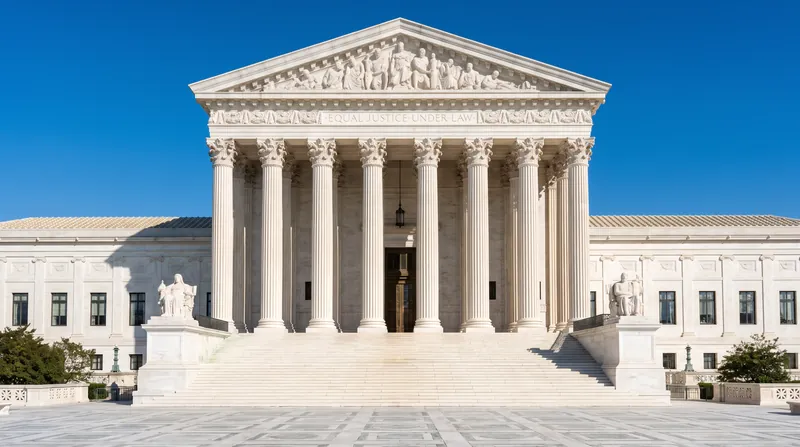
In a 6-3 decision, the Supreme Court held that federal courts cannot review the executive branch's decisions to terminate Temporary Protected Status, clearing the way for the deportation of hundreds of thousands of foreign nationals.

- Executive Branch Officials
- Argue that TPS was designed to be temporary and that the executive branch must have unhindered authority to end it.
- Immigration Advocates
- Warn that removing judicial oversight allows the government to ignore the law and endangers hundreds of thousands of long-term residents.
- U.S. Employers & Industry Groups
- Focus on the severe economic and operational disruptions caused by the sudden loss of authorized workers.
How we got here
1990
Congress establishes Temporary Protected Status to provide short-term relief for foreign nationals fleeing disaster or conflict.
2010 & 2012
Haiti and Syria receive TPS designations following a devastating earthquake and the outbreak of civil war, respectively.
Nov 2025
Former DHS Secretary Kristi Noem announces the termination of Haiti's TPS designation, prompting lawsuits.
Feb 2026
A federal district court issues an injunction blocking the termination of Haiti's TPS pending judicial review.
June 25, 2026
The Supreme Court rules in Mullin v. Doe that federal courts lack jurisdiction to review TPS terminations, lifting the injunctions.
Why it matters
By removing the federal judiciary's ability to review how the government terminates Temporary Protected Status, this ruling grants the executive branch near-total control over the fate of 1.3 million foreign nationals. The decision immediately exposes hundreds of thousands of long-term U.S. residents to deportation and strips them of their right to work, threatening severe disruptions in sectors like healthcare and construction that rely heavily on their labor.
For decades, the executive branch has granted Temporary Protected Status (TPS) to foreign nationals fleeing disaster or war, allowing them to live and work legally in the United States. But when the Department of Homeland Security (DHS) moves to revoke that status, a fundamental structural question emerges: can the federal judiciary intervene to stop the termination if the agency allegedly violates its own procedural rules?
In a 6-3 decision issued in late June 2026, the Supreme Court answered definitively in the negative. In the consolidated cases of Mullin v. Doe and Trump v. Miot, the Court ruled that federal law strips lower courts of the jurisdiction to review the DHS Secretary's decisions to designate, extend, or terminate TPS.[1][7]
The ruling clears the way for the administration to proceed with terminating TPS designations for Haiti and Syria, affecting roughly 350,000 Haitians and 6,000 Syrians. By lifting lower-court injunctions that had frozen the terminations, the decision exposes these populations to deportation and strips them of their employment authorization, fundamentally altering the legal landscape for immigrants who have lived in the U.S. for years.[3][8]
Congress established TPS in 1990 as a humanitarian mechanism, granting the DHS Secretary the authority to designate countries experiencing armed conflict, environmental disasters, or other extraordinary conditions. While designed as a short-term relief valve, designations are frequently renewed, allowing beneficiaries to build lives, purchase homes, and establish careers in the United States over decades.[1][8]
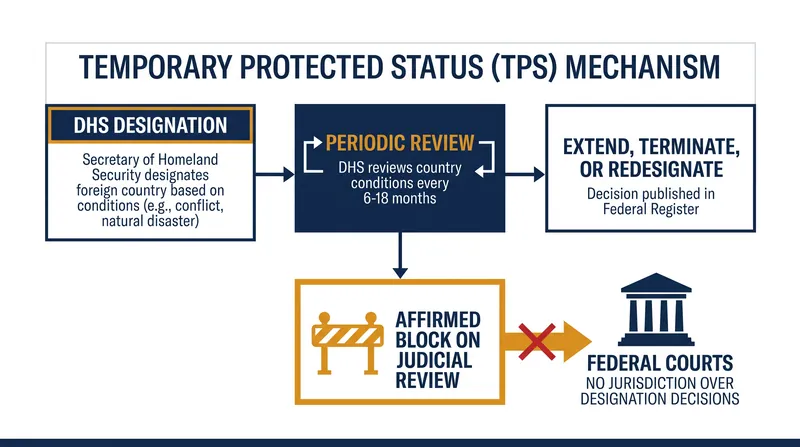
The legal dispute began when former DHS Secretary Kristi Noem announced the termination of TPS for Haiti and Syria. Plaintiffs sued under the Administrative Procedure Act (APA), arguing the agency failed to conduct the required interagency reviews and ignored ongoing dangers in those countries. Lower courts initially agreed, issuing injunctions that paused the terminations while the litigation proceeded.[3][6]
The legal dispute began when former DHS Secretary Kristi Noem announced the termination of TPS for Haiti and Syria.
Writing for the majority, Justice Samuel Alito grounded the decision in the strict text of the Immigration and Nationality Act. The statute explicitly bars "judicial review of any determination of the [Secretary of Homeland Security] with respect to the designation, or termination or extension of a designation, of a foreign state." The Court interpreted this provision as a near-absolute shield against APA challenges, concluding that Congress intended to leave TPS determinations entirely to the executive branch's discretion.[1][7]
The Court did leave a narrow window open for constitutional claims, such as the plaintiffs' argument that the termination of Haiti's TPS was motivated by racial animus in violation of the Equal Protection Clause. However, the majority opinion noted that such claims are unlikely to succeed on the merits, effectively closing the door on the primary legal strategy used by immigration advocates to protect TPS holders.[1][7]
The Department of Homeland Security welcomed the ruling as a restoration of the program's original intent. DHS General Counsel James Percival stated that the decision reaffirms that TPS "was always supposed to be temporary and can be cancelled at the appropriate time," providing the agency with the necessary tools to enforce immigration law without judicial interference.[2]
The sudden vulnerability of hundreds of thousands of legally authorized workers has triggered alarm among employers. U.S. Citizenship and Immigration Services (USCIS) has instructed employers to treat July 10, 2026, as the revised expiration date for certain TPS-related Employment Authorization Documents. Corporate immigration attorneys are advising companies to immediately audit their Form I-9 records and prepare for the loss of affected staff.[4][6]

The workforce implications are particularly acute in the aging services and healthcare sectors. Industry groups note that TPS holders represent a critical segment of the caregiving workforce. The sudden revocation of work authorization for these employees threatens to exacerbate chronic staffing shortages, potentially forcing nursing homes and home health agencies to limit admissions or reduce services.[5]
Beyond Haiti and Syria, the Mullin v. Doe decision fundamentally alters the balance of power over immigration policy. By removing the judiciary as a backstop against procedural violations, the ruling grants the executive branch nearly unchecked authority over the fate of the 1.3 million individuals who currently hold TPS.[3][8]
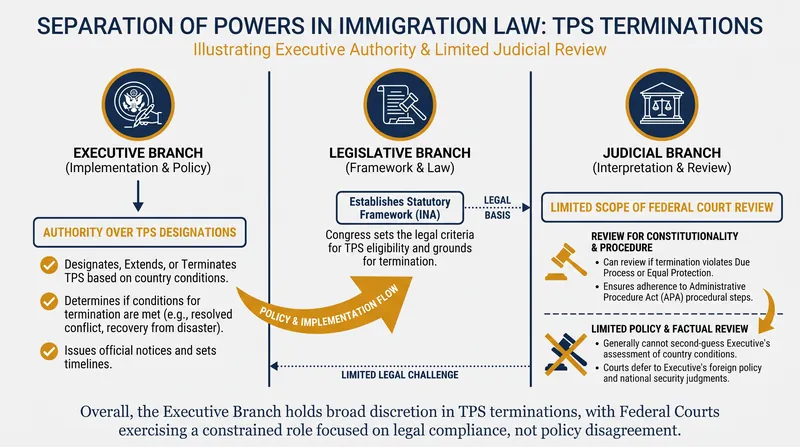
With the courts largely sidelined, the battle over TPS shifts entirely to the political arena. Immigration advocates are now directing their efforts toward Congress, urging lawmakers to create a permanent legislative pathway to legal residency for long-term TPS holders before their protections expire and mass deportations begin.[8]
What to know
- The Supreme Court ruled 6-3 that federal courts cannot review DHS decisions to terminate Temporary Protected Status.
- The decision allows the administration to proceed with ending TPS for roughly 350,000 Haitians and 6,000 Syrians.
- The Court held that the Immigration and Nationality Act explicitly bars judicial review of TPS determinations.
- A narrow exception remains for constitutional claims, though the Court indicated those are unlikely to succeed.
- Employers are auditing records as affected workers face the imminent loss of employment authorization.
- Advocates are now pressuring Congress to create a permanent legislative pathway for TPS holders.
Where opinion splits
The Executive Branch
DHS argues the ruling restores the original intent of the TPS program.
The Department of Homeland Security views the Supreme Court's decision as a necessary correction to years of judicial overreach. Officials argue that Congress explicitly designed TPS as a temporary humanitarian measure, not a permanent immigration pathway, and intentionally shielded the Secretary's designation decisions from court review to allow for nimble foreign policy responses. By lifting the injunctions, DHS maintains it can now faithfully execute the law and end protections when country conditions no longer warrant them.
Immigration Advocates
Advocates warn the decision removes a vital check on executive power and endangers hundreds of thousands.
Immigrant rights organizations argue the ruling effectively gives the executive branch a blank check to ignore statutorily mandated procedures when terminating TPS. Advocates point out that many TPS holders have lived in the U.S. for over a decade, establishing deep community ties and having U.S.-citizen children. They warn that stripping these individuals of their legal status and work authorization will devastate families and force long-term residents into the shadows or back to dangerous conditions.
U.S. Employers
Businesses are bracing for sudden workforce disruptions and compliance challenges.
Corporate immigration attorneys and industry groups are sounding the alarm over the immediate operational impacts of the ruling. Sectors that rely heavily on TPS labor—such as healthcare, construction, and hospitality—face the prospect of losing thousands of authorized workers overnight. Employers are now scrambling to audit their Form I-9 records, track shifting USCIS deadlines for Employment Authorization Documents, and prepare contingency plans for sudden staffing shortages.
Key terms
- Temporary Protected Status (TPS)
- A temporary immigration status granted to eligible nationals of designated countries experiencing armed conflict, environmental disaster, or other extraordinary conditions.
- Administrative Procedure Act (APA)
- The federal law that governs the process by which federal agencies develop and issue regulations, and which allows courts to review agency actions for procedural fairness.
- Judicial Review
- The power of courts to examine the actions of the legislative and executive branches and determine whether such actions are consistent with the law.
- Employment Authorization Document (EAD)
- A card issued by U.S. Citizenship and Immigration Services that proves the holder is authorized to work in the United States.
Unanswered questions
- It remains unclear exactly how quickly DHS will move to deport individuals whose TPS protections have expired.
- The fate of TPS designations for other countries currently protected by lower-court stays is now highly uncertain.
- It is unknown whether Congress will act to provide a permanent legislative solution for long-term TPS holders before mass deportations begin.
Reader questions
What did the Supreme Court decide about TPS?
The Court ruled 6-3 that federal law prevents lower courts from reviewing the Department of Homeland Security's decisions to designate, extend, or terminate Temporary Protected Status.
Who is immediately affected by this ruling?
The ruling directly impacts roughly 350,000 Haitians and 6,000 Syrians whose TPS terminations had been paused by lower-court injunctions.
Can TPS holders still sue to stop terminations?
The Court left a narrow opening for lawsuits based on constitutional claims, such as racial discrimination, but barred lawsuits based on procedural violations by the agency.
How does this affect employers?
Employers must track revised expiration dates for their employees' work permits and prepare to terminate employment if those permits expire without renewal.
Sources
Source coverage
8 outlets
3 viewpoints surfaced








[1]Supreme Court of the United States
MULLIN, SECRETARY, DEPARTMENT OF HOMELAND SECURITY, ET AL. v. DOE ET AL.
Read on Supreme Court of the United States →[2]Department of Homeland SecurityExecutive Branch Officials
Supreme Court Rulings are Victories for the Rule of Law and Common Sense
Read on Department of Homeland Security →[3]American Immigration CouncilImmigration Advocates
Supreme Court Allows Trump to Strip TPS, Turn Away Asylum Seekers Arriving at the Border in Pair of New Immigration Rulings
Read on American Immigration Council →[4]Nilan Johnson LewisU.S. Employers & Industry Groups
U.S. Supreme Court Allows the Department of Homeland Security to Terminate Temporary Protected Status: Next Steps for Employers
Read on Nilan Johnson Lewis →[5]LeadingAgeU.S. Employers & Industry Groups
Supreme Court Ruling on TPS Threatens Aging Services Workforce
Read on LeadingAge →[6]Morgan LewisU.S. Employers & Industry Groups
Supreme Court Limits Judicial Review of TPS Terminations
Read on Morgan Lewis →[7]The Regulatory Review
A sweeping ruling on temporary protected status tests judicial review, directly impacting thousands
Read on The Regulatory Review →[8]Vera Institute of JusticeImmigration Advocates
Supreme Court Ruling Exposes Hundreds of Thousands of TPS Holders to Deportation
Read on Vera Institute of Justice →
Comments
Every angle. Every day.
Get law justice stories with full source coverage and perspective breakdowns delivered to your inbox.