
Pentagon Commits $847M to Operational Laser Weapons to Counter Drone and Missile Threats
The U.S. Defense Department has awarded initial contracts to Lockheed Martin and nLIGHT to develop containerized high-energy laser weapons, aiming to replace costly interceptor missiles with low-cost directed energy.

- Defense Planners
- Focuses on the unsustainable economics of current air defense and the necessity of deep magazines.
- Defense Industry Primes
- Emphasizes the shift from bespoke laboratory prototypes to modular, mass-produced systems.
- Technology Skeptics
- Highlights the severe physical and engineering constraints that have historically plagued laser weapons.
Why this matters
As cheap autonomous drones increasingly threaten global shipping and critical infrastructure, traditional air defenses are becoming economically unsustainable. Transitioning to laser weapons promises to drastically lower the cost of interception, securing vital supply chains and protecting personnel without depleting finite missile stockpiles.
Key points
- The Pentagon awarded $86 million to Lockheed Martin and nLIGHT to develop containerized laser weapons, with a program ceiling of $847 million.
- The Joint Laser Weapon System (JLWS) aims to replace expensive kinetic interceptors with low-cost directed energy to counter drone swarms.
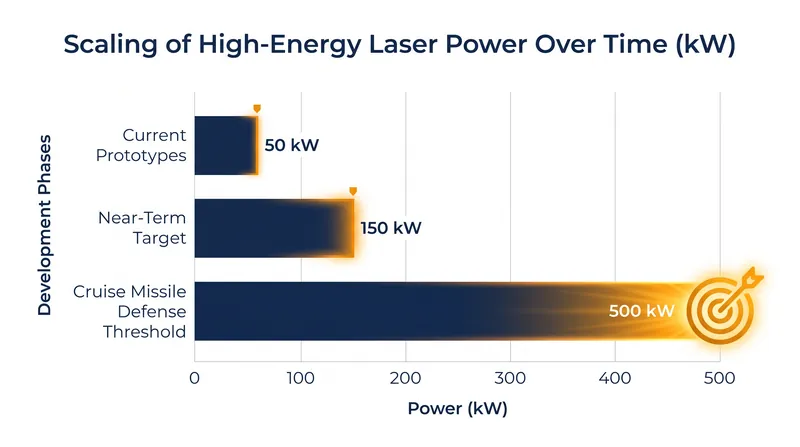
- Initial prototypes will operate at 150 kilowatts, with future iterations scaling to 500 kilowatts to intercept cruise missiles.
- The shift addresses the 'magazine math' problem, where traditional air defenses are rapidly depleted by cheap, mass-produced drones.
- Significant engineering hurdles remain, particularly regarding thermal management and atmospheric interference.
- $847M
- JLWS total program ceiling
- $86M
- Initial OTA award value
- 150 kW
- Initial prototype power rating
- 300–500 kW
- Target threshold for cruise missile defense
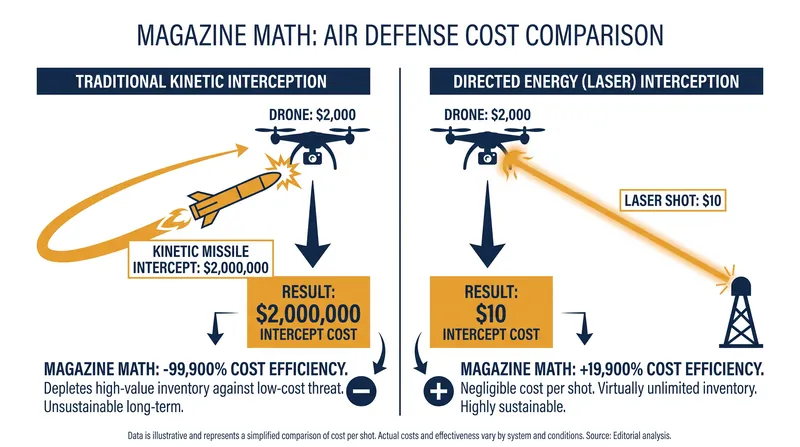
For the modern citizen, the security of global trade routes, the stability of energy grids, and the safety of forward-deployed personnel increasingly depend on a lopsided economic equation. When adversaries can launch a $2,000 off-the-shelf drone to cripple critical infrastructure, and defending that infrastructure requires firing a $2 million interceptor missile, the arithmetic of security breaks down. This unsustainable "magazine math" ultimately translates into higher costs for global shipping, strained defense budgets, and vulnerable supply chains. Now, the defense apparatus is moving to rewrite that equation entirely, investing heavily in technologies that promise to flip the cost curve back in favor of the defender.
The Pentagon has committed to a massive shift in its air defense architecture, awarding initial contracts to Lockheed Martin Aculight and nLIGHT Defense to build operational, containerized high-energy laser weapons. The Joint Laser Weapon System (JLWS) program begins with an $86 million initial award but carries a total program ceiling of $847 million, marking one of the most significant transitions of directed energy from the laboratory to the battlefield. The goal is to provide combatant commanders with a scalable, cost-effective intercept solution that fires at the speed of light, fundamentally altering how the military protects its assets.[1][2][3][5]
The primary claim driving this investment is that directed energy can solve the magazine depth crisis currently straining U.S. and allied forces. Traditional kinetic systems rely on physical missiles, which are expensive, difficult to manufacture at scale, and finite in number. A laser weapon, provided it has a steady power supply, offers an exceptionally deep magazine and a cost-per-intercept measured in dollars rather than millions. This capability is essential for countering high-volume drone swarms that are specifically designed to exhaust a defender's limited supply of kinetic interceptors before the primary attack begins.[1][3][6]
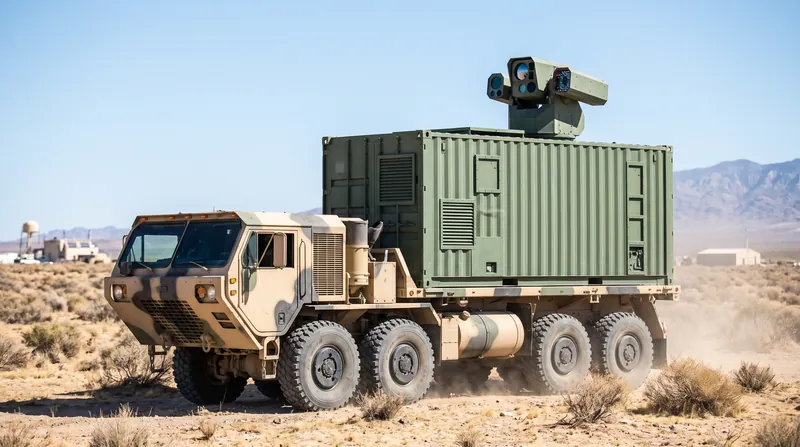
Under the JLWS agreements, executed by the Office of the Under Secretary of Defense for Research and Engineering, the initial prototypes will be rated at approximately 150 kilowatts. This power level is specifically targeted at addressing urgent operational demands, primarily the proliferation of small-to-medium unmanned aerial systems that have become ubiquitous in modern conflicts. By packaging these systems into modular, containerized form factors, the military intends to seamlessly bolt them onto existing ground vehicles and naval vessels, enabling rapid fielding across various geographic combatant commands without requiring bespoke vehicle designs.[2][3][5]
However, the evidence suggests that 150 kilowatts is merely a stepping stone. Defense officials have explicitly stated that subsequent iterations of the JLWS will be scaled to reach the 300- to 500-kilowatt threshold. At 500 kilowatts, the physics of interception change dramatically, providing enough thermal energy to burn through the reinforced nose cones of incoming cruise missiles. To achieve this, a separate laser source developed under the High Energy Laser Scaling Initiative (HELSI) will concurrently build a 500-kilowatt integrated system, pushing the boundaries of what solid-state lasers can achieve.[1][2][3][5]
However, the evidence suggests that 150 kilowatts is merely a stepping stone.
This $847 million ceiling is part of a wider, synchronized push across the defense industrial base. Concurrently, the U.S. Army is nearing a separate production contract, potentially worth hundreds of millions, for the Enduring High Energy Laser (E-HEL) with AeroVironment. That system, which builds on earlier tests of 50-kilowatt lasers mounted on Stryker armored vehicles, represents the Army's first directed-energy program of record. Together, these parallel efforts indicate that the Pentagon is finally moving beyond decades of isolated prototypes and committing to sustained operational fielding of directed energy weapons.[3][4][7]
Despite the immense capital flowing into directed energy, transparent uncertainty remains regarding real-world performance. The evidence for laser lethality is robust in controlled environments, such as the successful March 2026 tests of the LOCUST laser at White Sands Missile Range. Yet, physics dictates that a laser beam's power degrades over distance when passing through atmospheric disturbances. Rain, fog, sea spray, and dust scatter the photons, significantly reducing the thermal energy delivered to the target and shrinking the weapon's effective engagement range during adverse weather conditions.[3][5]
Furthermore, the data on countering high-volume swarms reveals a critical limitation known as dwell time. Unlike a kinetic explosive that destroys a target instantly upon proximity, a laser must remain focused on a specific point of a moving drone for several seconds to melt through its critical components. In a saturation attack, where dozens of drones arrive simultaneously, the system's ability to sequentially track, lock, and burn targets before they reach their objective remains an unproven variable in chaotic combat conditions, requiring highly advanced artificial intelligence and beam-control software.[3]
The industrial evidence also points to severe thermal management challenges. Generating hundreds of kilowatts of optical power inside a shipping container produces massive amounts of waste heat that must be rapidly dissipated to prevent the system from melting itself. The supply chain for the advanced cooling systems and power conditioning modules required to keep these lasers operational in austere environments is still maturing. The $847 million ceiling is structured as an option stack, meaning the full funding will only be unlocked if the prototypes successfully clear these brutal engineering hurdles.[1][3]
If successful, the deployment of the JLWS will fundamentally alter the economics of defensive warfare. By shifting the burden of countering cheap drones to directed energy, the military can preserve its expensive, hard-to-replace kinetic interceptors for high-end threats like ballistic missiles and advanced aircraft. This layered defense architecture ensures that a $2 million Patriot missile is not wasted on a commercially available quadcopter, restoring balance to the magazine math and providing a more sustainable model for long-term security in contested regions.[4][6]

The U.S. is not alone in this technological pivot. The global defense market is witnessing a brisk adoption of solid-state laser architectures. Germany recently selected MBDA and Rheinmetall to develop a maritime laser weapon system for its navy, while South Korea fielded its 30-kilowatt Block-I laser in 2024, linking it to national air-and-missile defense sensors. The race to operationalize directed energy is accelerating globally as nations recognize that the proliferation of cheap autonomous weapons has permanently altered the battlefield, necessitating entirely new defensive paradigms.[1][4]
The Pentagon's $847 million commitment represents a calculated bet that the remaining technical barriers are now engineering problems rather than physics problems. By bypassing traditional acquisition pathways through Other Transaction Authority agreements, the defense apparatus is prioritizing rapid, iterative development over prolonged procurement cycles. While the fog of war—and literal atmospheric fog—will test the limits of these systems, the transition from laboratory curiosities to containerized, field-ready weapons is now definitively underway, promising a future where critical infrastructure can be protected with unprecedented efficiency.[1][2][3]
How we got here
2024
South Korea fields its 30-kilowatt Block-I laser, demonstrating early directed energy integration.
March 2026
The FAA and Defense Department successfully test the LOCUST laser system at White Sands Missile Range without harming civilian aircraft.
July 2026
The Pentagon announces the JLWS Other Transaction Authority agreements with Lockheed Martin and nLIGHT.
August 2026
The U.S. Army nears a separate production contract for the Enduring High Energy Laser (E-HEL) to counter drones.
Viewpoints in depth
Defense Planners' View
Focuses on the unsustainable economics of current air defense and the necessity of deep magazines.
For military strategists, the push toward directed energy is driven entirely by 'magazine math.' When adversaries can launch swarms of cheap, commercially available drones, defending against them with multi-million-dollar interceptor missiles rapidly depletes both budgets and stockpiles. Planners argue that lasers, which cost mere dollars per shot and only run out of ammunition when they run out of power, are the only mathematically viable long-term solution to saturation attacks.
Technology Skeptics' View
Highlights the severe physical and engineering constraints that have historically plagued laser weapons.
Skeptics point out that battlefield lasers have been 'five years away' for four decades. They emphasize that while lasers perform flawlessly in the controlled environment of a desert test range, real-world combat introduces rain, fog, dust, and sea spray—all of which scatter photons and degrade the beam's thermal energy. Furthermore, the immense waste heat generated by a 300-kilowatt laser requires massive, complex cooling systems that are difficult to maintain in austere environments.
Defense Industry's View
Emphasizes the shift from bespoke laboratory prototypes to modular, mass-produced systems.
Industry leaders view the $847 million Joint Laser Weapon System program as the critical bridge between research and mass production. By focusing on containerized, modular architectures, primes like Lockheed Martin and nLIGHT can build standardized systems that bolt onto any ship or truck. This modularity not only lowers manufacturing costs but also allows the military to rapidly swap out degraded components in the field, turning a science project into a ruggedized product.
What we don’t know
- How well the systems will maintain beam coherence through heavy rain, fog, or dust in real-world combat environments.
- Whether the industrial base can manufacture the necessary cooling and power-generation components at scale.
- The exact timeline for when the 500-kilowatt variants will be fully integrated into naval and ground architectures.
Key terms
- Directed Energy Weapon (DEW)
- A system that uses highly focused energy, such as lasers or microwaves, to damage or destroy targets.
- Magazine Depth
- The number of shots a weapon system can fire before needing to be reloaded; laser weapons theoretically offer an 'infinite' magazine as long as power is supplied.
- Kilowatt (kW)
- A unit of power; in laser weapons, higher kilowatt ratings correlate with the ability to destroy larger, faster, or more heavily armored targets.
- Other Transaction Authority (OTA)
- A streamlined contracting mechanism used by the U.S. military to bypass traditional acquisition processes and rapidly prototype new technologies.
- Containerized System
- A weapon designed to fit within standard shipping containers, allowing it to be easily transported and bolted onto various ground vehicles or ships.
Sources
Source coverage
7 outlets
3 viewpoints surfaced







[1]Breaking DefenseDefense Industry Primes
Pentagon picks Lockheed, nLIGHT for laser defense project
Read on Breaking Defense →[2]Tectonic DefenseDefense Industry Primes
Pentagon Awards $86M in OTAs for Laser Weapons
Read on Tectonic Defense →[3]19FortyFiveDefense Planners
The Pentagon’s New Laser Weapon Program Is Bigger Than the Headlines Say
Read on 19FortyFive →[4]RBC UkraineTechnology Skeptics
Pentagon to spend nearly $500 million on anti-drone laser weapons
Read on RBC Ukraine →[5]Defense ScoopTechnology Skeptics
Pentagon awards deals for laser weapons that could shoot down drone swarms
Read on Defense Scoop →[6]Business InsiderDefense Planners
The US military is investing millions in new laser weapons that can shoot down enemy drones and cruise missiles
Read on Business Insider →[7]Army RecognitionTechnology Skeptics
U.S. Army Moves to Make High-Energy Lasers a Permanent Counter-Drone Weapon
Read on Army Recognition →
Comments

Every angle. Every day.
Get defense security stories with full source coverage and perspective breakdowns delivered to your inbox.