
USCIS Finalizes Rule Allowing Asylum Referrals to Court Without Interview, Drawing Fire From Advocates
A new Department of Homeland Security rule permits asylum officers to bypass mandatory interviews and send affirmative asylum cases directly to immigration court. While the administration argues the measure will reduce severe backlogs, immigration advocates warn it strips vulnerable applicants of a crucial opportunity to explain their claims.
By Anaya Sharma

The cornerstone of the affirmative asylum process—a non-adversarial interview where applicants can explain their fear of persecution in their own words—is no longer guaranteed. Effective immediately, a new Department of Homeland Security (DHS) rule allows U.S. Citizenship and Immigration Services (USCIS) officers to refer certain asylum seekers directly to immigration court without an interview. The interim final rule, published on July 28, marks a fundamental shift in how the government processes humanitarian claims, drawing immediate fire from legal advocates who warn it will accelerate deportations.[1]
For decades, nearly all affirmative asylum seekers—those who apply proactively with USCIS rather than as a defense against deportation—received an in-person interview. This step allowed specially trained officers to assess credibility, clarify translation errors, and hear complex trauma narratives before making a decision. Under the new regulation, titled "Affirmative Asylum Referrals Without Interview," officers can now evaluate the written record alone. If they determine an applicant is statutorily barred or otherwise ineligible, they can bypass the interview and send the case straight to the Executive Office for Immigration Review (EOIR).[1][6]
The Trump administration frames the measure as a necessary tool to clear a massive and growing backlog. According to DHS estimates, the affirmative asylum backlog exceeded 1.4 million pending cases by the end of Fiscal Year 2025, with average processing times stretching to over seven years. USCIS Director Joseph Edlow stated that the system has been "exploited for purposes of delay and work authorization," arguing the rule will redirect resources to legitimate claims.[1]
The agency estimates that up to 444,000 pending cases—roughly 31 percent of the backlog—could potentially be affected by the new procedural bypass. The rule primarily targets applications that appear legally barred on their face. The most common trigger is the one-year filing deadline, which requires asylum seekers to submit their applications within a year of arriving in the United States unless they can prove exceptional circumstances. Under the new framework, an officer can skip the interview if the paperwork suggests the applicant missed this deadline without a clearly documented exception.[1][5]
Beyond missed deadlines, officers can also issue paper-based referrals if an applicant is subject to mandatory bars, such as certain criminal convictions or national security concerns. More controversially, the rule allows officers to refer cases if they determine the applicant does not merit a favorable exercise of discretion, or if the claim lacks merit entirely. By removing regulatory language that previously suggested applicants had a "right" to an interview, DHS has granted its officers broad authority to act on the written file alone.[1][7]
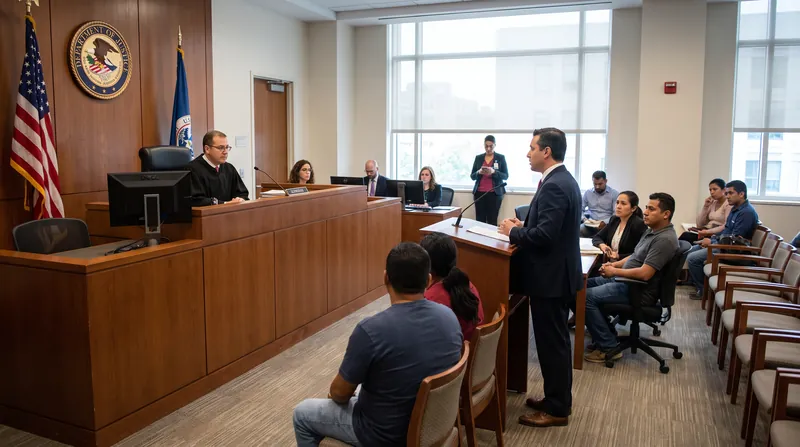
A referral under this rule is not an outright denial of asylum; the applicant still receives a de novo hearing before an immigration judge. However, it places them directly into adversarial removal proceedings. Instead of sitting across a desk from an asylum officer in a private office, the applicant must present their case in a formal courtroom setting, defending against deportation while a government attorney actively opposes their claim.[2][6]
Immigration advocates and legal organizations have strongly condemned the bypass, arguing it undermines fundamental due process. The American Immigration Council warned that the rule strips away a vital opportunity for applicants to clarify inconsistencies that might not translate well on paper. Asylum seekers often face severe language barriers, trauma, and a lack of legal representation when filing their initial paperwork. Advocates argue that the non-adversarial interview was designed precisely to let them explain their story and correct innocent mistakes before facing a judge.[2][3]
Critics also contend that the rule does not actually solve the immigration backlog, but merely shifts it from one agency to another. RAICES Texas noted that transferring hundreds of thousands of cases from USCIS to the courts will only further overwhelm the EOIR system, which is already managing its own unprecedented docket of removal cases. Furthermore, advocates warn that direct referral to immigration court gives DHS additional justification to detain applicants while their cases are pending.[3][4]
Because DHS issued the regulation as an interim final rule, it bypassed the standard advance notice-and-comment period, taking effect the day it was published. A retroactive public comment window remains open until September 28, but the policy is already actively shaping adjudications. The American Immigration Lawyers Association and other practitioner groups are scrambling to update their guidance for pending and future cases.[1]
Legal practitioners emphasize that the strength and completeness of the initial written Form I-589 application now carries unprecedented weight. With the interview safety net removed, applicants can no longer rely on an in-person meeting to fill in the gaps of a thin or incomplete filing. Every piece of evidence, from country condition reports to detailed personal declarations, must be airtight from the moment it is submitted, fundamentally raising the stakes for anyone seeking refuge in the United States.[5][6][7]
Viewpoints in depth
DHS and the Administration
The administration views the rule as an essential efficiency measure to combat systemic exploitation.
Officials argue that the affirmative asylum process has been bogged down by meritless claims filed primarily to secure work authorization and delay deportation. By allowing officers to quickly refer cases that appear legally barred—such as those missing the one-year filing deadline—the administration contends it can clear the backlog and focus resources on genuine refugees. From their perspective, the interview was a redundant step for cases that were destined for immigration court anyway.
Immigration Advocates
Legal advocates argue the rule undermines due process and increases the risk of wrongful deportations.
Organizations like the American Immigration Council emphasize that asylum seekers often face language barriers, trauma, and a lack of legal representation when filing their initial paperwork. The non-adversarial interview was designed to let them explain their story and correct innocent mistakes. Advocates warn that referring cases based solely on paper records will push valid claims into adversarial removal proceedings, where unrepresented applicants face steep odds of success and an increased risk of detention.
Key points
- DHS published an interim final rule allowing USCIS to refer certain affirmative asylum cases to immigration court without an interview.
- The rule targets applications that appear legally barred, such as those missing the one-year filing deadline.
- The administration argues the measure is necessary to clear a 1.4 million-case backlog and stop systemic delays.
- Advocates warn the policy strips vulnerable applicants of due process and pushes them into adversarial removal proceedings.
How we got here
July 27, 2026
DHS announces the upcoming publication of the interim final rule.
July 28, 2026
The rule is published in the Federal Register and takes effect immediately.
September 28, 2026
The retroactive public comment period for the interim final rule closes.
- Immigration Advocates
- Warns the rule strips due process and pushes vulnerable applicants into rapid deportation proceedings.
- DHS and Administration Officials
- Argues the rule is necessary to clear backlogs and prevent exploitation of the asylum system.
- Immigration Attorneys
- Focuses on the heightened legal stakes, advising applicants that their initial written filings must now be flawless.
Perspectives this story doesn't cover
- Immigration Judges (EOIR)
- Asylum Seekers
Sources
Source coverage
7 outlets
3 viewpoints surfaced







- [1]Federal RegisterDHS and Administration Officials
Affirmative Asylum Referrals Without Interview
Read on Federal Register → - [2]American Immigration CouncilImmigration Advocates
New USCIS Asylum Interview Rule Could Speed Up Deportations of Asylum Seekers
Read on American Immigration Council → - [3]National Immigration ForumImmigration Advocates
Interim Final Rule Allows USCIS to Refer Affirmative Asylum Cases Without an Interview
Read on National Immigration Forum → - [4]RAICES TexasImmigration Advocates
TL;DR A new Department of Homeland Security (DHS) interim final rule allows U.S. Citizenship and Immigration Services (USCIS) to bypass non-adversarial interviews
Read on RAICES Texas → - [5]Asylum Seeker Advocacy ProjectImmigration Attorneys
How are laws changing for asylum seekers?
Read on Asylum Seeker Advocacy Project → - [6]Alonge LawImmigration Attorneys
New Asylum Rule Allows USCIS to Refer Some Cases to Immigration Court Without an Interview: What Applicants Should Know
Read on Alonge Law → - [7]Fayad LawImmigration Attorneys
Overview of the Interim Final Rule (91 FR 47101)
Read on Fayad Law →
More in News & Politics
See all →Immigration Policy
DHS Reinstates Stricter 'Public Charge' Rule for Green Card Applicants
4 sources

Asylum Policy
Supreme Court Rules Government Can Turn Back Migrants at Ports of Entry Without Allowing Asylum Claim
8 sources

Public Charge Rule
DHS Expands 'Public Charge' Rule, Allowing Non-Cash Benefits to Trigger Green Card Denials
7 sources
Diversity Visa
State Department Resumes Diversity Visa Issuance Following Federal Court Order
8 sources
Comments
Every angle. Every day.
Get News & Politics stories with full source coverage and perspective breakdowns, free every day.