
Trump Administration Rule Change Fast-Tracks 444,000 Asylum Cases to Immigration Court
A new Department of Homeland Security rule allows immigration officers to bypass mandatory interviews for asylum seekers, sending hundreds of thousands of cases directly to an adversarial court system.

The Trump administration has enacted a sweeping rule change that will allow federal immigration officials to bypass mandatory interviews for hundreds of thousands of asylum seekers, fast-tracking their cases directly to immigration court.[1][2]
The interim final rule, announced Monday by the Department of Homeland Security (DHS), targets the "affirmative" asylum process—used by migrants who proactively request protection upon or after entering the United States. Under the new policy, U.S. Citizenship and Immigration Services (USCIS) officers can skip the traditional non-adversarial interview and immediately place applicants into deportation proceedings.[3][4]
DHS estimates the policy shift could affect roughly 444,000 of the 1.4 million pending affirmative asylum cases currently backlogged at USCIS. The rule takes effect immediately upon its scheduled publication in the Federal Register on Tuesday, though the agency will accept public comments for 60 days.[4][5]
Administration officials framed the overhaul as a necessary step to clear crippling administrative backlogs and prevent migrants from using the asylum system to secure long-term residency and work permits while awaiting a decision.[2][5]
"For far too long the asylum system has been exploited for purposes of delay and work authorization, not legitimate claims of protection," USCIS Director Joseph Edlow said in a statement, adding that the rule ensures resources are directed toward timely adjudications rather than "those seeking to use the system as a loophole."[2]
DHS General Counsel James Percival echoed the sentiment, stating that the rule fulfills the president's mandate to improve efficiency and overcome "intentional delay by illegal aliens and the open borders attorneys who represent them."[2]
However, immigration attorneys and advocacy groups warn the measure is designed to accelerate deportations by funneling vulnerable migrants into a highly adversarial court system that is currently denying the vast majority of claims.[1][3]
By removing the regulatory language that guaranteed an applicant's "right" to an asylum officer interview, the government is effectively eliminating a crucial first step where migrants—including victims of trauma and torture—can present their cases in a less hostile environment.[3][5]
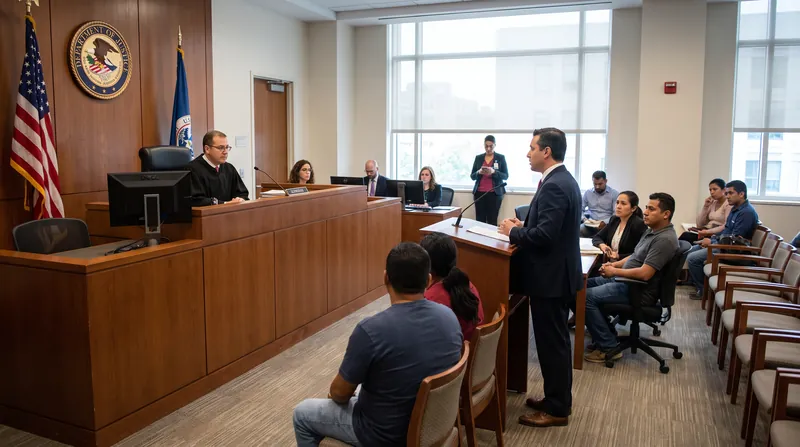
Once referred to immigration court, asylum seekers must plead their cases before judges employed by the Department of Justice (DOJ). Under the second Trump administration, the DOJ has aggressively reshaped these courts, hiring hundreds of former Immigration and Customs Enforcement (ICE) prosecutors while dismissing judges with higher-than-average asylum grant rates.[3][6]
The statistical impact of this judicial overhaul has been stark. During the first half of fiscal year 2026, immigration judges approved just 8.8% of asylum requests—the lowest rate in over a decade. By June 2026, the denial rate in immigration courts had reportedly surged to 94%, according to data from the Transactional Records Access Clearinghouse (TRAC).[4]
"They just want to get as many people into that deportation process as quickly as possible so they can be denied," Reuben Kerben, a New York-based immigration attorney, told reporters, characterizing the rule as "another tool to keep the deportation machine humming."[3]
The rule change also carries significant economic implications for the migrants involved. Because work authorizations are often tied to the duration of a pending affirmative asylum application, fast-tracking cases to rapid denials in immigration court could strip thousands of asylum seekers of their ability to work legally in the United States.[3]
The policy marks the latest in a series of aggressive executive actions by the Trump administration to restrict both legal and illegal immigration. It follows recent moves to terminate temporary legal protections for hundreds of thousands of migrants and a broader push to achieve the president's stated goal of mass deportations.[1][6]
Where opinion splits
Trump Administration
The rule is a necessary efficiency measure to clear backlogs and stop migrants from exploiting the asylum system for work permits.
DHS and USCIS officials argue that the affirmative asylum process has become a loophole. By skipping the mandatory interview for certain applicants, the government can quickly identify those without legitimate claims and move them into removal proceedings, saving resources for genuine cases of persecution.
Immigration Advocates & Attorneys
The policy is a deliberate mechanism to fast-track deportations by denying migrants a fair, non-adversarial hearing.
Legal experts argue that the initial USCIS interview is critical for trauma victims who may struggle to articulate their claims in a hostile courtroom. They point out that funneling applicants directly to DOJ immigration judges—who are currently denying over 90% of claims—effectively strips asylum seekers of due process and their ability to secure work authorization.
Key points
- A new DHS rule allows USCIS to skip mandatory interviews for affirmative asylum seekers.
- The policy could immediately affect up to 444,000 of the 1.4 million pending cases in the agency's backlog.
- Administration officials say the rule will clear administrative delays and stop migrants from exploiting the system for work permits.
- Immigration advocates warn the change will fast-track deportations by sending applicants to courts that currently deny over 90% of asylum claims.
Unanswered questions
- It is unclear how quickly USCIS will begin transferring the estimated 444,000 cases to the Department of Justice.
- It remains to be seen if federal courts will intervene to block the interim final rule following anticipated legal challenges from immigration advocacy groups.
How we got here
2024 - 2025
The affirmative asylum backlog at USCIS swells to approximately 1.4 million pending cases.
Early 2026
Immigration judges approve just 8.8% of asylum requests in the first half of the fiscal year, a decade low.
June 2026
The asylum denial rate in immigration courts surges to 94% amid a broader reshaping of the judiciary by the DOJ.
July 27, 2026
DHS announces an interim final rule allowing USCIS to bypass mandatory interviews and fast-track cases to immigration court.
- Homeland Security Officials
- Argues the rule is a necessary efficiency measure to clear backlogs and stop migrants from exploiting the asylum system for work permits.
- Immigration Defense Bar
- Argues the policy is a deliberate mechanism to fast-track deportations by denying migrants a fair, non-adversarial hearing.
- Immigration Policy Analysts
- Focuses on the broader statistical trends, noting the unprecedented drop in asylum approval rates and the structural reshaping of the immigration courts.
Perspectives this story doesn't cover
- Asylum seekers currently in the USCIS backlog
- Immigration court judges managing the increased caseload
Sources
Source coverage
6 outlets
3 viewpoints surfaced






- [1]Los Angeles TimesImmigration Defense Bar
Trump administration rule change could fast-track deportations for thousands of asylum seekers
Read on Los Angeles Times → - [2]NewsweekHomeland Security Officials
Trump Admin Overhauls Asylum Process With No-Interview Rule
Read on Newsweek → - [3]Courthouse NewsImmigration Defense Bar
DHS fast-tracking asylum process, bypassing interviews
Read on Courthouse News → - [4]NOTUSImmigration Policy Analysts
New Rule Could Send Hundreds of Thousands Seeking Asylum to Immigration Courts
Read on NOTUS → - [5]LivemintHomeland Security Officials
Trump Moves to Shift Asylum Cases to DOJ Immigration Judges
Read on Livemint → - [6]Migration Policy InstituteImmigration Policy Analysts
The Future of Immigration Enforcement Under the Trump Administration
Read on Migration Policy Institute →
More in News & Politics
See all →Immigration Policy
DHS Reinstates Stricter 'Public Charge' Rule for Green Card Applicants
4 sources

Asylum Policy
Supreme Court Rules Government Can Turn Back Migrants at Ports of Entry Without Allowing Asylum Claim
8 sources
Immigration Policy
Higher Court Allows USCIS to Continue Reviewing and Potentially Revoking Past Immigration Approvals for 40 Nationalities
7 sources
International Law
Refugees Owe No Duty Under International Law to Seek Asylum in the First Safe Country They Reach
7 sources

Comments
Every angle. Every day.
Get News & Politics stories with full source coverage and perspective breakdowns, free every day.