
DOJ Offers $300M in Police Grants Conditioned on Abandoning 'Progressive' Policing Ideologies
The Justice Department has launched the Model Cities Initiative, a $300 million grant program that requires applying municipalities to adopt conservative law enforcement, homelessness, and immigration policies.

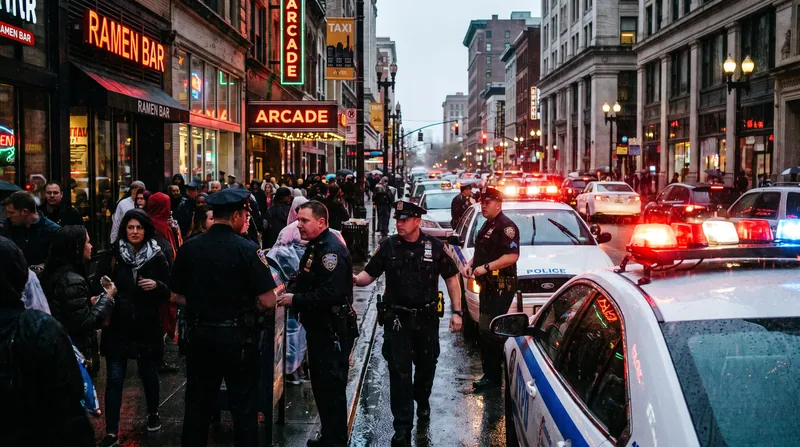
- The Justice Department
- Argues the initiative is necessary to restore order and support law enforcement.
- Municipal Critics
- Argues the grant undermines local autonomy and forces ideological compliance.
- Civil Rights Advocates
- Warns the initiative will criminalize poverty and increase police violence.
At a glance
- The DOJ's Model Cities Initiative offers $300 million to two to four cities for public safety programs.
- Funding is conditioned on cities adopting conservative policies on policing, homelessness, and immigration.
- Cities must assist ICE and enforce bans on urban camping and loitering.
- The grant encourages targeted enforcement surges and heavy investment in surveillance technology.
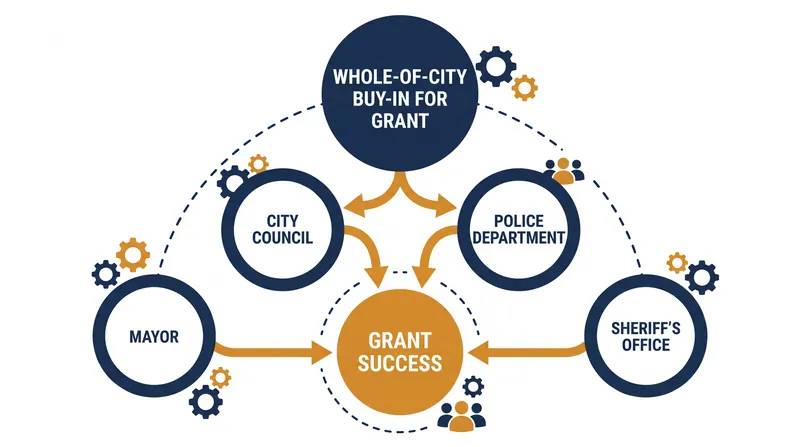
- Applications require unanimous support from local leadership, including mayors, sheriffs, and city councils.
- Critics argue the program uses federal funds to force ideological compliance and undermine local autonomy.
Why it matters now
This initiative represents a significant shift in federal public safety funding, explicitly tying hundreds of millions of dollars to local compliance with conservative law enforcement, immigration, and homelessness policies. For municipal leaders, it forces a stark choice between securing massive federal investment and maintaining local autonomy over policing and social services.
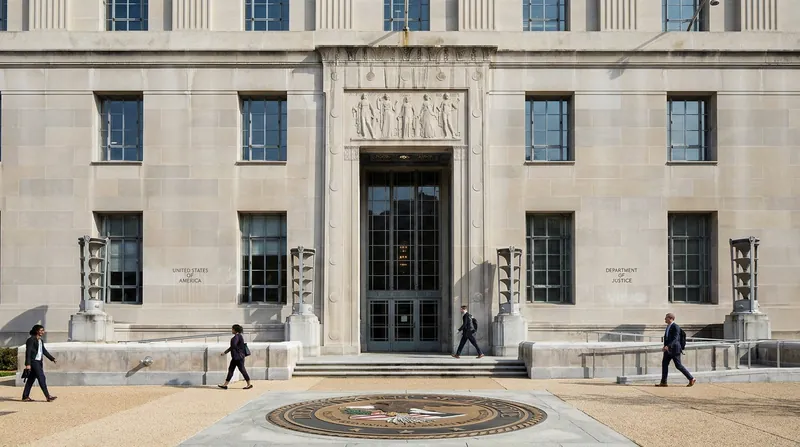
The Justice Department has launched a $300 million grant program that offers massive federal funding to a handful of American cities, provided they agree to abandon "progressive" policing models and adopt a strict law-and-order agenda. Dubbed the Model Cities Initiative (MCI), the program will select two to four mid-sized municipalities to split the funding over three years.[1][2]
Acting Attorney General Todd Blanche announced the initiative, framing it as a "whole-of-city" approach to reducing violent crime and restoring order to American streets. "The Model Cities Initiative will supercharge our law enforcement partners and restore the rule of law to America's neighborhoods, towns, and cities," Blanche stated, adding that the administration will "help those who help us Make America Safe Again."[3]
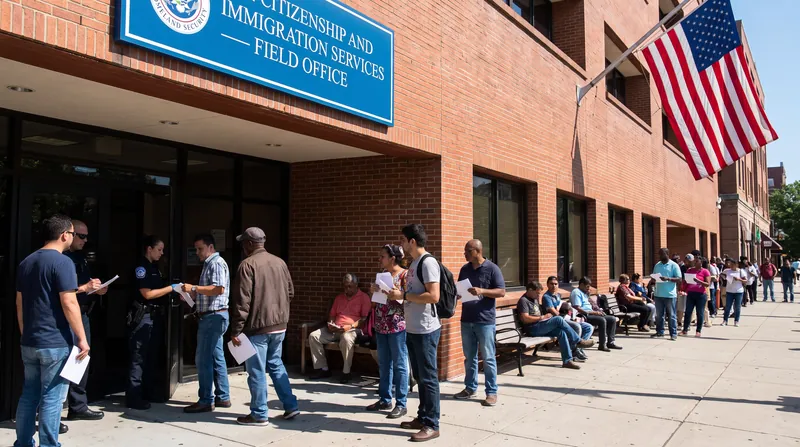
The conditions attached to the funding are unusually explicit. To qualify, cities must agree to directly support federal immigration law enforcement operations, including assisting Immigration and Customs Enforcement (ICE) with extraditions and detentions.[1][4]
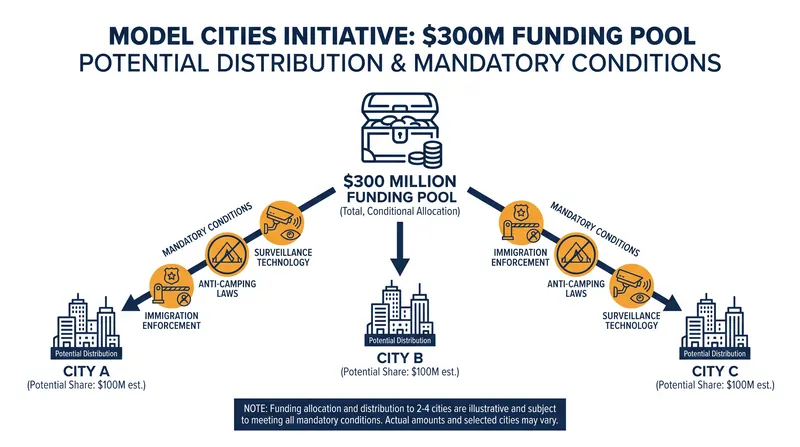
The grant also mandates strict new approaches to homelessness and public disorder. Participating cities are required to enforce prohibitions on urban camping, loitering, and squatting. Furthermore, the initiative repudiates the "housing-first" model of homelessness relief, instead requiring that individuals comply with assisted outpatient treatment for mental health or substance abuse issues in order to retain housing.[1][4]
Funding from the MCI can be deployed toward hiring both sworn and non-sworn personnel, expanding prisoner re-entry efforts, and funding substance abuse recovery programs. A significant portion of the grant is earmarked for advanced surveillance and crime-fighting technology, including real-time crime centers, forensic tools, body-worn cameras, license plate readers, artificial intelligence systems, and drones.[2][3]
Funding from the MCI can be deployed toward hiring both sworn and non-sworn personnel, expanding prisoner re-entry efforts, and funding substance abuse recovery programs.
The initiative actively encourages what the grant documents describe as "Memphis-style enforcement surges," citing Washington D.C. and Memphis, Tennessee, as models to emulate. This approach relies on heavy, targeted police presence in high-crime areas, a tactic that has drawn intense scrutiny following high-profile incidents of police violence.[1]
Unlike traditional DOJ grants, such as those managed by the Office of Community Oriented Policing Services (COPS) which have disbursed more than $20 billion since 1994 through politically neutral peer-review evaluations, MCI applications will be evaluated directly by senior political appointees in the Justice Department.[5]
To qualify for the funds, local governments must demonstrate unanimous "buy-in and support" across key regional leadership. This requires alignment among mayors, city councils, police departments, county commissions, and sheriff's offices, ensuring that the entire municipal apparatus is committed to the administration's policy goals.[1][5]
The initiative also includes a clawback provision. According to grant documents, cities could potentially be forced to repay millions of dollars in the event of a subsequent surge in violent crime or "civil unrest," placing a significant financial risk on the participating municipalities.[1]
The program has drawn sharp criticism from municipal leaders and civil rights advocates, who view the grant as a $300 million enticement to accept a package of ideological interests. Critics argue that it attempts to buy the reshaping of local government from Washington, forcing applicants to preemptively foot the bill for future federal interventions in their own jurisdictions.[1][4]
Several leaders of large municipalities with Democratic majorities have already signaled they will not apply for the grant. Montgomery, Alabama Mayor Steven Reed stated he had reviewed the grant and passed, noting, "Everybody wants a quick fix, and no one wants to invest in the root cause of the issue."[1]
Despite the pushback, the Justice Department claims that jurisdictions have expressed "intense interest" in the initiative. Proposals from qualifying cities—defined as local government entities serving populations of at least 100,000—are due by September 1, 2026, with the department expecting to make initial award decisions late in the year.[1][2][3]
Terms to know
- Model Cities Initiative (MCI)
- A $300 million federal grant program launched by the DOJ in 2026 to fund local public safety efforts, conditioned on the adoption of specific law-and-order policies.
- Housing-First Model
- An approach to homelessness that prioritizes providing permanent housing to people experiencing homelessness without preconditions like sobriety or psychiatric treatment.
- Assisted Outpatient Treatment
- Court-ordered mental health treatment for individuals who have a history of medication noncompliance, often used as a condition for remaining in the community.
- Real-Time Crime Center
- A centralized technology hub used by law enforcement to monitor surveillance cameras, license plate readers, and other data streams to direct police responses.
- Clawback Provision
- A contractual clause that allows the grant issuer to demand the return of funds if the recipient fails to meet specific conditions or outcomes.
Different angles
The Justice Department's view
The DOJ argues the initiative is necessary to restore order and support law enforcement.
Administration officials frame the Model Cities Initiative as a necessary intervention to rescue cities that have lost control of their streets to violent crime and public disorder. By tying funding to specific enforcement strategies, the DOJ aims to incentivize a return to traditional law-and-order policing, arguing that progressive policies have undermined public safety. Acting Attorney General Todd Blanche emphasized that the administration is leveraging its authority to 'supercharge' law enforcement partners who are willing to align with federal safety priorities.
Municipal Critics' view
Local leaders and critics argue the grant undermines local autonomy and forces ideological compliance.
Many municipal leaders view the grant's conditions as an unprecedented federal overreach into local governance. Critics argue that the initiative uses the lure of massive funding to force cities into adopting conservative policies on homelessness and immigration, regardless of local needs or voter preferences. Furthermore, the requirement for unanimous local government buy-in and the threat of financial clawbacks in the event of 'civil unrest' are seen as mechanisms to suppress local dissent and shift the financial burden of federal interventions onto city taxpayers.
Civil Rights Advocates' view
Advocates warn the initiative will criminalize poverty and increase police violence.
Civil rights organizations express deep concern over the grant's explicit repudiation of progressive policing and housing-first homelessness models. They argue that mandating 'Memphis-style enforcement surges' and the enforcement of anti-camping laws will inevitably lead to the criminalization of poverty and an increase in police brutality against marginalized communities. The heavy emphasis on surveillance technology and mandatory cooperation with ICE also raises alarms about privacy violations and the erosion of trust between immigrant communities and local police.
Still unresolved
- Which specific cities will apply for and ultimately receive the funding.
- Whether the grant's ideological conditions will face legal challenges from municipalities or civil rights groups.
- How the DOJ will define and measure 'civil unrest' to trigger the grant's financial clawback provisions.
Questions readers ask
How much money is the DOJ offering through this grant?
The Justice Department is offering a total of $300 million, which will be split among two to four selected cities.
What conditions must cities meet to receive the funding?
Cities must agree to assist federal immigration enforcement, enact strict anti-homelessness rules, abandon progressive policing models, and implement targeted enforcement surges.
Can any city apply for the Model Cities Initiative?
Eligible applicants must be local government entities serving a population of at least 100,000, and the application must have unanimous support from local leadership.
What can the grant money be used for?
Funds can be used to hire personnel, purchase surveillance technology, expand prisoner re-entry efforts, and fund substance abuse recovery programs.
Sources
Source coverage
5 outlets
3 viewpoints surfaced





[1]The GuardianCivil Rights Advocates
Trump officials offer cities tens of millions for Memphis-style police surges – with conditions
Read on The Guardian →[2]Police1The Justice Department
Justice Department to award $300M to 'Model Cities' through new public safety initiative
Read on Police1 →[3]Department of JusticeThe Justice Department
Making America Safe Again: DOJ to Award $300 Million to Model Cities Dedicated to Restoring Law and Order
Read on Department of Justice →[4]InklCivil Rights Advocates
DOJ Unveils $300M 'Model Cities' Grant: Ban Progressive Policing, Round up Homeless, Assist ICE Extraditions
Read on Inkl →[5]SubstackMunicipal Critics
Trump Administration Launches $300M 'Model Cities' Initiative, Offering Public Safety Grants to Cities with Conservative Policy Conditions
Read on Substack →
Comments
Every angle. Every day.
Get news politics stories with full source coverage and perspective breakdowns delivered to your inbox.