
Houston Amends ICE Cooperation Policy, Securing $114 Million in State Public Safety Grants
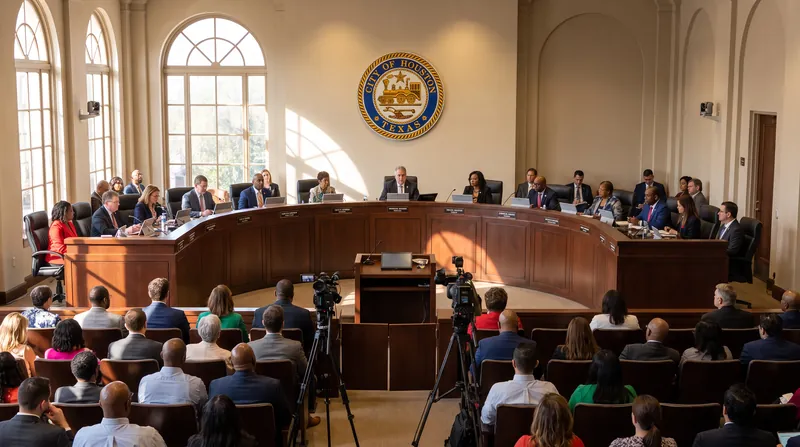
The Houston City Council voted to revise its law enforcement guidelines regarding federal immigration authorities, resolving a standoff with the state government. The amendment ensures the city retains over $100 million in public safety funding ahead of the 2026 FIFA World Cup.

Houston faced a $114 million ultimatum: reverse a newly passed ordinance limiting police cooperation with federal immigration authorities, or lose the state grants funding the city's police, fire, and 2026 World Cup security operations. The tension broke when the Houston City Council voted 13-4 to amend the policy, reaching a compromise with Governor Greg Abbott's office. The resolution secures the critical public safety funds while maintaining the core operational change that sparked the dispute.[2][3][6]
The conflict centered on an April 8 ordinance that eliminated a longstanding Houston Police Department (HPD) practice. Previously, officers were required to wait up to 30 minutes for U.S. Immigration and Customs Enforcement (ICE) agents to arrive when encountering individuals with civil administrative warrants. The original measure explicitly stated that these warrants—which are not signed by a judge—did not constitute probable cause for a criminal arrest and could not solely justify extending a detention.[1][2][6]
State leadership immediately pushed back. Governor Abbott warned that the city was violating the terms of its state grant agreements, which mandate full cooperation with the Department of Homeland Security. Texas Attorney General Ken Paxton escalated the pressure by filing a lawsuit against Mayor John Whitmire and the city council, arguing the policy violated Senate Bill 4, a 2017 state law prohibiting local governments from restricting cooperation with federal immigration enforcement.[2][4]
Facing a June budget deficit and the potential loss of vital funding, Mayor Whitmire's administration negotiated directly with the governor's Public Safety Office. The resulting amendment, passed as an emergency measure, removes the explicit language stating that administrative warrants do not justify a stop.
It also adjusts the rules around detention length. While officers are still instructed to detain individuals only as long as reasonably necessary to complete the initial purpose of a stop, the new text adds that they may extend the detention 'for other legitimate purposes discovered during the detention.'[1][3][6]
The practical impact on the ground remains nuanced. City Attorney Arturo Michel assured council members that the amendment does not fundamentally alter the core intent of the original measure, noting that the prohibition on the 30-minute wait time for ICE agents remains intact. Mayor Whitmire emphasized the pragmatic necessity of the vote, stating that the city had 'no alternative for Houston to survive' and prepare for upcoming international events without the restoration of the state funds.[1][4][6]
Despite the council's approval, the administrative steps are not fully complete. Following the vote, Governor Abbott indicated that while the city's legislative action brought it into compliance on paper, the funds would remain frozen until HPD formally issues internal directives aligning with the new agreement. The mayor's office subsequently confirmed that HPD has released an updated order requiring a sergeant to respond to scenes involving administrative warrants, ensuring detentions adhere to the newly established legal standard.[1][5]
The amendment has drawn mixed reactions across the political spectrum. A spokesperson for the governor praised the revision as a necessary step toward protecting Texans and upholding law enforcement standards. Conversely, civil rights advocates and the four dissenting council members criticized the move, arguing that the added language introduces ambiguity that could lead to prolonged detentions and unconstitutional practices during routine traffic stops.[1][3][4]
The resolution in Houston highlights a broader enforcement push by the state government. Similar warning letters regarding public safety funding and ICE cooperation have been dispatched to officials in Austin and Dallas, signaling that Texas intends to strictly enforce compliance with Senate Bill 4 across its major metropolitan areas as preparations for the 2026 World Cup continue.[2][4]
Perspectives explored
State Leadership's View
State officials maintain that local policies must align with state laws requiring cooperation with federal immigration enforcement.
Governor Greg Abbott and Attorney General Ken Paxton have consistently argued that local ordinances limiting cooperation with ICE violate Senate Bill 4, a 2017 state law designed to prevent 'sanctuary city' policies. By tying $114 million in public safety grants to full compliance with Department of Homeland Security procedures, state leaders aim to ensure uniform enforcement across Texas. They view the original Houston ordinance as a reckless measure that undermined law enforcement and public safety, and consider the amendment a necessary correction to restore legal order.
City Administration's View
The mayor's office emphasizes the necessity of compromise to protect the city's financial stability and operational readiness.
For Mayor John Whitmire and the majority of the city council, the primary objective was safeguarding the municipal budget. Facing a significant deficit and the monumental task of preparing for the 2026 FIFA World Cup, the administration determined that engaging in a protracted legal battle over the grant funding was a risk the city could not afford. City Attorney Arturo Michel defended the amendment by noting that it preserves the core operational change—ending the mandatory 30-minute wait for ICE agents—while satisfying the state's contractual requirements for the grants.
Civil Rights Advocates' View
Advocacy groups warn that the revised ordinance dilutes protections against unwarranted detentions.
Organizations such as the ACLU of Texas and dissenting council members argue that the amendment effectively guts the protections established just two weeks prior. By removing explicit language that classified ICE administrative warrants as insufficient grounds for a stop, and by allowing detentions to be extended for vaguely defined 'other legitimate purposes,' advocates fear the new policy provides officers with too much leeway. They contend this ambiguity could lead to prolonged detentions and erode trust between law enforcement and immigrant communities.
Key points
- Houston City Council voted 13-4 to amend a policy limiting police cooperation with ICE.
- The amendment was negotiated to prevent the loss of $114 million in state public safety grants.
- The funds are critical for municipal services and security for the 2026 FIFA World Cup.
- The revised ordinance removes language stating that administrative warrants do not justify a stop.
- State Leadership
- Argues that local municipalities must fully cooperate with federal immigration authorities as mandated by state law to qualify for public safety grants.
- City Administration
- Prioritizes securing essential municipal funding and maintaining public safety operations through pragmatic compromise with state officials.
- Civil Rights Advocates
- Expresses concern that the amended language creates legal loopholes that could lead to unconstitutional detentions during routine police stops.
Perspectives this story doesn't cover
- Federal ICE Officials
- Local Taxpayers
Sources
Source coverage
6 outlets
3 viewpoints surfaced






- [1]The Texas TribuneCivil Rights Advocates
Houston City Council approves gutting policy limiting ICE cooperation, civil rights groups say
Read on The Texas Tribune → - [2]AP NewsState Leadership
Houston changes ordinance limiting cooperation with ICE after pressure from governor
Read on AP News → - [3]Click2HoustonCity Administration
Houston City Council passes Whitmire's amended immigration ordinance in 13-4 vote to preserve state funding
Read on Click2Houston → - [4]Texas ScorecardState Leadership
Houston Walks Back ICE Ordinance, Votes To Amend Policy Under State Pressure
Read on Texas Scorecard → - [5]Defender NetworkCivil Rights Advocates
Houston amends ICE ordinance after Abbott threatens $114M in funding
Read on Defender Network → - [6]Houston ChronicleCity Administration
Mayor Whitmire, Houston council pass amendments to ICE policy as Greg Abbott threatens funding
Read on Houston Chronicle →

More in Community
See all →Tenant Protections
Asheville Bars Landlords From Collecting Rent on Unsafe Housing
4 sources
Labor Organizing
New York City Launches First-in-Nation Office of Worker Power to Aid Private-Sector Organizing
6 sources
Municipal Finance
Houston and The Woodlands Finalize $50 Million Agreement to Permanently Block Annexation
2 sources
Municipal Labor
St. John's City Council Ratifies Four-Year CUPE Contract Despite Taxpayer Concerns
3 sources

Comments
Every angle. Every day.
Get Community stories with full source coverage and perspective breakdowns, free every day.