
Arctic Cloud Formation Driven by Newly Discovered Iodine-Organic Molecules, Study Finds
Researchers have discovered a new class of iodine-containing molecules that rapidly grow cloud-seeding particles over the Arctic Ocean. The findings reveal a previously unrecognized climate feedback loop where melting sea ice accelerates cloud formation.
By Ishani Patel

- Atmospheric Chemists
- Focus on the molecular mechanisms and the novelty of the chemical pathways.
- Climate Modelers
- Focus on integrating the new data to improve global climate projections.
Perspectives this story doesn't cover
- Indigenous Arctic communities affected by changing ice patterns
The Arctic Ocean is generating its own cloud cover through a newly discovered chemical reaction at the edge of the melting sea ice. A study published in Nature Geoscience reveals that a previously unknown class of molecules—iodine-containing oxygenated organic molecules, or I-OOMs—is driving the rapid formation of cloud-seeding particles.[1][3]
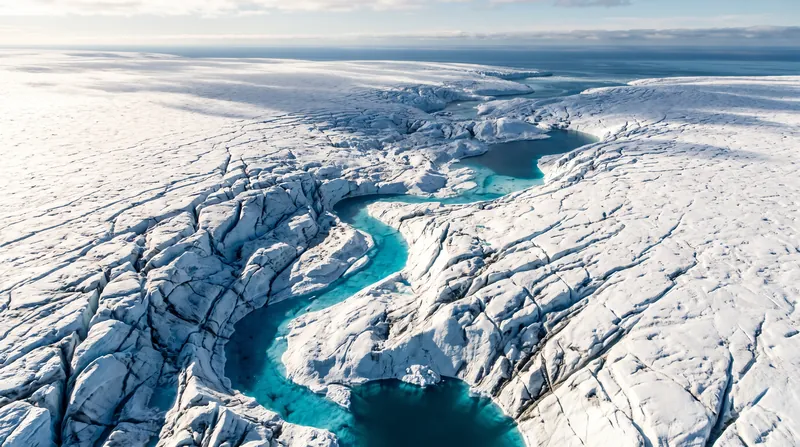
The process begins in the marginal ice zone, the narrow, highly dynamic band where open ocean meets retreating sea ice. As the warming atmosphere melts the ice, it exposes more of the ocean surface to direct sunlight. This boundary region is highly biologically active, hosting marine algae and microorganisms that release dimethyl sulfide into the air, while the seawater and the ice itself release natural iodine compounds.[1][2]
When these invisible gases mix in the atmosphere under strong sunlight, they undergo a rapid chemical transformation. The solar radiation triggers the formation of iodine oxoacids and sulfuric acid. While researchers had previously observed these two acids forming particles together in controlled laboratory settings—specifically at CERN's CLOUD chamber—the new study provides the first real-world evidence of the mechanism operating in the open Arctic atmosphere.[1][2]
However, the acids alone are not sufficient to build particles large enough to actually influence cloud formation. A fresh atmospheric particle is far too small to seed anything; it must reach roughly 50 nanometers across before water vapor will condense onto it to form a cloud droplet.[3][4]
This is where the newly discovered I-OOMs play their critical role. The research team, led by the University of Birmingham alongside partners from China and Spain, found that these iodine-organic molecules act as a powerful growth engine. They latch onto the tiny acid clusters, stabilizing them and rapidly accelerating their expansion into mature cloud condensation nuclei.[1][2]
This is where the newly discovered I-OOMs play their critical role.
During a 2022 expedition aboard the RRS Discovery in the Davis Strait, researchers watched this mechanism unfold in real time. Near the ice edge, the concentration of cloud-seeding particles jumped from roughly 50 to 1,500 per cubic centimeter in a single day.[2][3]
This rapid particle growth is not an isolated anomaly. The expedition recorded new particle formation on more than 80 percent of the sunny days they observed, suggesting the chemical reaction is a dominant and recurring feature of the Arctic summer rather than a rare curiosity.[1][2]
The discovery highlights a complex and potentially powerful climate feedback loop. As the Arctic warms—currently heating at more than three times the global average—more sea ice melts during the summer months. This exposes a wider marginal ice zone, which in turn releases more iodine and sulfur precursors into the air, generating more cloud cover.[2][4]
Clouds play a dual, often conflicting role in the Arctic climate. They can cool the surface by reflecting incoming solar radiation back into space, acting as a shield over the dark open water. Conversely, they can also act as a thermal blanket, trapping outgoing infrared heat near the surface and potentially accelerating further ice melt.[3][4]
Whether this specific iodine-driven cloud formation ultimately accelerates or slows regional warming remains an open question. Current global climate models do not account for this specific chain of iodine and sulfur chemistry, leaving a significant gap in projections of future Arctic ice dynamics.[2][4]
By integrating these newly identified molecular pathways into climate simulations, researchers hope to resolve long-standing discrepancies between modeled forecasts and actual Arctic observations. Understanding exactly how the melting ice seeds the sky is a necessary step toward predicting the future of one of the Earth's most sensitive regions.[1][4]
Key points
- Researchers discovered a new class of iodine-organic molecules that drive rapid cloud formation in the Arctic.
- The chemical process occurs at the marginal ice zone, where melting sea ice meets the open ocean.
- Marine algae release sulfur, while the ocean and ice release iodine, which combine under sunlight to form particles.
- The concentration of cloud-seeding particles was observed to increase 50-fold in a single day near the ice edge.
- The findings reveal a climate feedback loop where melting ice generates more clouds, though the net warming or cooling effect remains uncertain.
Viewpoints in depth
Atmospheric Chemists
Focus on the molecular mechanisms and the novelty of the chemical pathways.
For atmospheric chemists, the discovery of iodine-containing oxygenated organic molecules (I-OOMs) solves a major missing piece of the Arctic aerosol puzzle. While the role of sulfur from marine algae has been studied for decades, and laboratory experiments at CERN suggested iodine could drive particle formation, field evidence was lacking. The identification of I-OOMs as the specific growth engine explains how particles survive and expand fast enough to become cloud condensation nuclei before being lost to the environment.
Climate Modelers
Focus on integrating the new data to improve global climate projections.
Climate modelers view these findings as critical for reducing uncertainty in Arctic forecasts. Current models often struggle to accurately reproduce observed Arctic cloud cover because they lack the specific chemical pathways for iodine and sulfur co-nucleation. By coding this newly discovered feedback loop—where melting ice exposes more ocean, driving more emissions and subsequent cloud formation—modelers aim to better predict whether the net effect will trap more heat or reflect more sunlight.
Why this matters
Climate models currently struggle to accurately predict Arctic warming because they miss key chemical processes driving cloud formation. By identifying exactly how melting ice triggers new cloud cover, scientists can better forecast how much heat the Arctic will reflect or trap in the coming decades.
Sources
Source coverage
4 outlets
2 viewpoints surfaced




- [1]University of BirminghamAtmospheric Chemists
Scientists discover new cloud-forming process in the Arctic
Read on University of Birmingham → - [2]EurekAlertClimate Modelers
Scientists discover new cloud-forming process in the Arctic
Read on EurekAlert → - [3]ScienmagAtmospheric Chemists
Arctic cloud condensation nuclei enhanced by iodine, sulfur and organic precursors
Read on Scienmag → - [4]Factlen Editorial TeamClimate Modelers
Synthesis by Factlen editorial team
Read on Factlen Editorial Team →
Comments

More in Science
See all →Autoimmune Therapy
Allogeneic CAR-T Therapy Induces Immunosuppressant-Free Remission in Over Half of Lupus Patients in Phase 1 Trial
5 sources

Climate Modeling
The Three-Dimensional Grid, Physical Equations, and Parameterizations That Predict Future Climate
7 sources

Interoception
The 'Sixth Sense' Transforming Mental Health: How Interoception Rewires the Brain
5 sources

Climate Thresholds
The Nine Climate Tipping Elements and the Temperature Thresholds That Trigger Irreversible Change
8 sources
Every angle. Every day.
Get Science stories with full source coverage and perspective breakdowns delivered to your inbox.