
Scientists Map 165,000 Square Kilometers of Climate-Resilient Coral as High-Tech Restoration Accelerates
A landmark global study has identified vast stretches of climate-resilient coral reefs, providing crucial 'seed banks' for a new wave of high-tech restoration efforts. Marine biologists are now combining these resilient species with accelerated cloning and acoustic enrichment to actively rebuild degraded ecosystems.
By Factlen Editorial Team
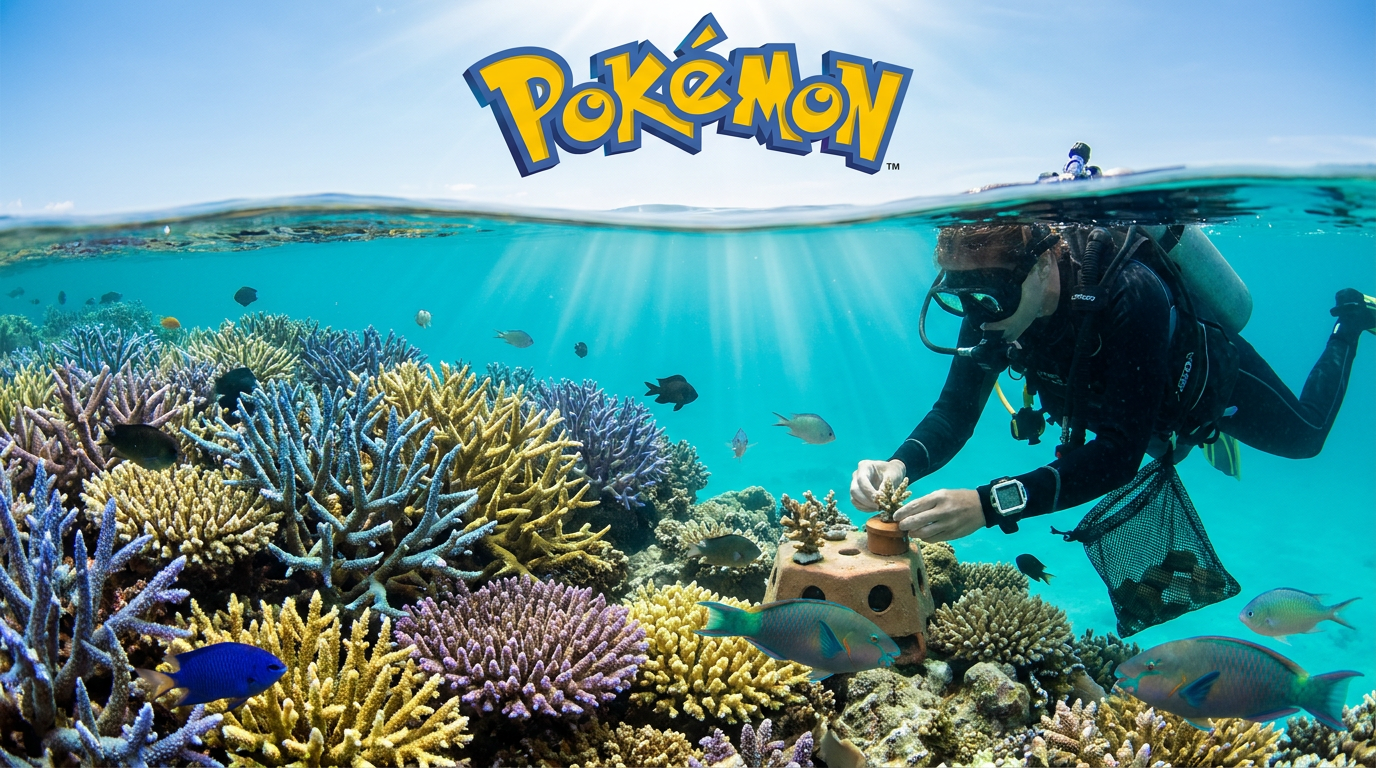
- Restoration Technologists
- Advocate for active human intervention, using bioengineering, acoustics, and accelerated growth to rebuild degraded reefs.
- Marine Conservationists
- Focus on identifying and protecting naturally resilient reef refugia to serve as global seed banks.
- Climate Scientists
- Emphasize that while restoration buys time, long-term reef survival strictly depends on halting global carbon emissions.
What's not represented
- · Local coastal fishing communities
- · Eco-tourism operators
Why this matters
Coral reefs support a quarter of all marine life and provide food and coastal protection for over half a billion people. These technological breakthroughs offer a viable roadmap to save these foundational ecosystems from extinction, shifting the global narrative from despair to actionable recovery.
Key points
- A June 2026 study identified 165,000 square kilometers of climate-resilient coral reefs across 71 countries, tripling previous estimates.
- Conservationists plan to use these resilient zones as living seed banks to preserve genetic diversity.
- Micro-fragmentation techniques are accelerating the growth of slow-building massive corals by up to 50 times their natural rate.
- Acoustic enrichment—playing healthy reef sounds underwater—is successfully attracting coral larvae to settle in degraded areas.
The traditional narrative around coral reefs has long been one of inevitable decline, with rising ocean temperatures driving mass bleaching events that leave vibrant ecosystems barren. However, a wave of recent scientific discoveries is shifting the paradigm from passive observation to active, high-tech restoration. Marine biologists are increasingly deploying a suite of unconventional technologies—from acoustic manipulation to accelerated cloning—to rebuild what has been lost.[1][2]
The most significant shift in this conservation strategy arrived in June 2026, when a landmark global study identified more than 165,000 square kilometers of climate-resilient coral reefs across 71 countries. This discovery tripled previous estimates of surviving reef habitats, offering a rare note of optimism for one of the ocean's most threatened environments.[1][2]
Led by the Wildlife Conservation Society and Macquarie University, the research utilized machine learning and decades of ocean data to map these zones with unprecedented precision. These areas act as "climate refugia"—pockets of the ocean where local upwellings, deep-water currents, or unique geography naturally buffer corals from the worst effects of global warming.[1][3]
Conservationists view these resilient zones as living seed banks. By fiercely protecting these specific 165,000 square kilometers from immediate local threats like overfishing, coastal development, and agricultural runoff, scientists hope to preserve the genetic diversity required to eventually repopulate adjacent, heavily damaged ecosystems.[3]

But protecting existing reefs is only half the equation. To actively rebuild the structural foundation of degraded areas, marine biologists are deploying a technique known as micro-fragmentation, which fundamentally alters the speed at which reefs can be grown.
Historically, restoring massive, boulder-like coral species—such as brain, star, and boulder corals—was considered highly impractical. These foundational species naturally grow at a glacial pace of just a few millimeters per year, meaning a damaged reef could take centuries to recover its structural integrity.[6]
Pioneered by researchers at the Mote Marine Laboratory, micro-fragmentation bypasses this biological speed limit. The process involves using a specialized diamond band saw to cut donor corals into microscopic fragments, often just one to five polyps in size. This severe physical trauma triggers an extraordinary, life-saving healing response within the animal.[6]
As the tiny fragments prioritize urgent tissue repair, their cell division accelerates dramatically. When these genetically identical clones are placed near each other on an artificial substrate in a nursery or directly on the reef, they grow and fuse back together, expanding at 25 to 50 times their natural rate.[6]

As the tiny fragments prioritize urgent tissue repair, their cell division accelerates dramatically.
While micro-fragmentation successfully builds the physical calcium-carbonate structure of a reef, scientists must also convince the broader ecosystem of fish and invertebrates to return to the newly planted habitats. This is where "acoustic enrichment" enters the restoration toolkit.
A healthy coral reef is a remarkably noisy environment, echoing with a constant chorus of crackling snapping shrimp and the low-frequency grunts of territorial fish. Degraded or bleached reefs, by contrast, are eerily silent, lacking the auditory cues that marine life relies upon.[4]
Researchers at the Woods Hole Oceanographic Institution have demonstrated that free-floating coral larvae actually rely on these complex soundscapes to navigate the open ocean. By lowering waterproof speakers into degraded reef zones and broadcasting the recorded sounds of a vibrant ecosystem, scientists can artificially guide larvae to settle in targeted restoration areas.[4]
In recent field tests, settlement rates for certain coral species were significantly higher in acoustically enriched zones compared to silent control sites. The underwater playback systems essentially trick the drifting larvae into believing they have found a thriving, safe neighborhood to permanently attach themselves to.[4]

Beyond physical growth and acoustic recruitment, the ultimate test for any restored reef is its ability to survive the next inevitable marine heatwave. To address this vulnerability, laboratories are turning to "assisted evolution" and the cultivation of so-called super corals.
At facilities like Arizona State University's Coral Lab, researchers subject coral fragments to thermal conditioning—a process akin to a stress-test boot camp. By exposing corals to controlled, sublethal doses of heat in laboratory tanks, scientists trigger epigenetic changes that bolster the animals' thermal tolerance before they are outplanted into the ocean.[7]
Similarly, researchers are identifying naturally heat-resistant corals thriving in extreme environments, such as the unusually warm, semi-enclosed lagoons of French Polynesia. These naturally adapted specimens are being studied and crossbred to produce offspring with superior genetic resilience to warming waters, ensuring that restored reefs are built for the climate of the future.[5]
Despite these profound breakthroughs, restoration technologists acknowledge the sheer scale of the logistical challenge. Cultivating corals in land-based nurseries, conditioning them, and outplanting them by hand is highly labor-intensive and expensive, making it difficult to match the vast footprint of global reef degradation.
Furthermore, while micro-fragmentation, acoustic enrichment, and thermal conditioning can buy crucial time for these ecosystems, they are not a substitute for addressing the root cause of ocean warming.
Climate scientists consistently caution that if global temperatures exceed 2 degrees Celsius above pre-industrial levels, even the most resilient super corals will eventually succumb to thermal stress. The ultimate success of these high-tech interventions relies entirely on humanity's parallel ability to drastically reduce greenhouse gas emissions.[2][5]
How we got here
2018
An initial global study identifies 50 specific coral reefs that show strong resilience to climate change.
2021
Researchers demonstrate that micro-fragmentation can successfully be adapted for direct in-ocean application.
Oct 2024
Woods Hole Oceanographic Institution publishes expanded findings proving acoustic enrichment works across multiple coral species.
Jun 2026
A landmark mapping project reveals 165,000 square kilometers of climate-resilient reefs, tripling previous estimates of surviving habitats.
Viewpoints in depth
Marine Conservationists
Focus on identifying and protecting naturally resilient reef refugia to serve as global seed banks.
This camp argues that the most efficient way to ensure the survival of coral ecosystems is to identify and fiercely protect 'climate refugia'—areas naturally buffered from extreme warming. By securing these 165,000 square kilometers from local stressors like overfishing and agricultural runoff, they believe nature can preserve the necessary genetic diversity. These protected zones would act as living seed banks, naturally exporting larvae to repopulate adjacent, degraded reefs once global temperatures stabilize.
Restoration Technologists
Advocate for active human intervention, using bioengineering, acoustics, and accelerated growth to rebuild degraded reefs.
Technologists argue that passive conservation is no longer sufficient given the rapid pace of ocean warming. They champion aggressive, hands-on interventions—such as micro-fragmentation, thermal conditioning, and acoustic enrichment—to artificially accelerate reef recovery. This perspective views reefs as ecosystems that can be engineered and managed, emphasizing that human innovation is required to help corals adapt faster than natural evolutionary processes allow.
Climate Scientists
Emphasize that while restoration buys time, long-term reef survival strictly depends on halting global carbon emissions.
While supportive of restoration efforts, climate researchers consistently warn against viewing these technologies as a panacea. They point out that even 'super corals' have thermal limits, and bioengineering cannot outpace unchecked global warming. From this viewpoint, micro-fragmentation and acoustic enrichment are merely life-support systems that buy humanity a brief window of time; the only permanent solution is a drastic and immediate reduction in global greenhouse gas emissions.
What we don't know
- Whether the high costs and labor-intensive nature of active restoration can be scaled up enough to match the global rate of reef degradation.
- Exactly how long 'super corals' can withstand sustained marine heatwaves if global temperatures surpass the 2-degree Celsius threshold.
- The long-term ecological impacts of artificially mixing coral genetics across different ocean regions.
Key terms
- Micro-fragmentation
- A restoration technique where corals are cut into tiny pieces to trigger a rapid healing response, accelerating their growth up to 50 times the natural rate.
- Acoustic enrichment
- The practice of playing recorded sounds of a healthy reef through underwater speakers to attract coral larvae and fish to a degraded area.
- Climate refugia
- Specific geographic areas that remain relatively buffered from the extreme effects of climate change, allowing species to survive and potentially repopulate other regions.
- Thermal conditioning
- Exposing corals to controlled, sublethal heat stress in a laboratory to build their resilience against future marine heatwaves.
- Coral bleaching
- A stress response where corals expel the symbiotic algae living in their tissues, turning them white and leaving them vulnerable to starvation and disease.
Frequently asked
Can we rebuild reefs fast enough to save them?
Techniques like micro-fragmentation have accelerated coral growth by up to 50 times, making it possible to restore slow-growing species in months rather than decades. However, the sheer scale of global reef loss means restoration must be paired with aggressive climate action.
How does sound help coral reefs grow?
Free-floating coral larvae use the sounds of healthy reefs—like snapping shrimp and fish grunts—to find suitable places to settle. Playing these sounds through underwater speakers can increase larval settlement rates by up to seven times.
What are 'super corals'?
Super corals are specific coral colonies that have demonstrated a natural or laboratory-induced ability to survive unusually high ocean temperatures without bleaching.
Will these technologies work if the oceans keep warming?
Only up to a point. While thermal conditioning and resilient seed banks buy crucial time, scientists warn that if global warming exceeds 2°C, even the toughest corals will likely succumb to the heat.
Sources
Source coverage
7 outlets
3 viewpoints surfaced







[1]Oceanographic MagazineMarine Conservationists
Reef relief: Scientists map 165000km² of climate resilient coral
Read on Oceanographic Magazine →[2]ReutersMarine Conservationists
Scientists identify 64,000 sq miles of coral reef capable of surviving climate crisis
Read on Reuters →[3]Bangkok PostMarine Conservationists
Study sparks hope for 'climate-resistant' coral reefs
Read on Bangkok Post →[4]Woods Hole Oceanographic InstitutionRestoration Technologists
WHOI researchers reinforce acoustic enhancement as a reef restoration method
Read on Woods Hole Oceanographic Institution →[5]Science AdvancesClimate Scientists
Super corals could help buy time for reefs in a warming world
Read on Science Advances →[6]Mote Marine LaboratoryRestoration Technologists
Coral Fragmentation: Key to Reef Restoration
Read on Mote Marine Laboratory →[7]Arizona State UniversityRestoration Technologists
Coral Reef Restoration: Heat-Resistant Super Corals to Fight Coral Bleaching
Read on Arizona State University →
Every angle. Every day.
Get environment stories with full source coverage and perspective breakdowns delivered to your inbox.