
OLED vs. Mini-LED: The Definitive 2026 TV Buying Guide
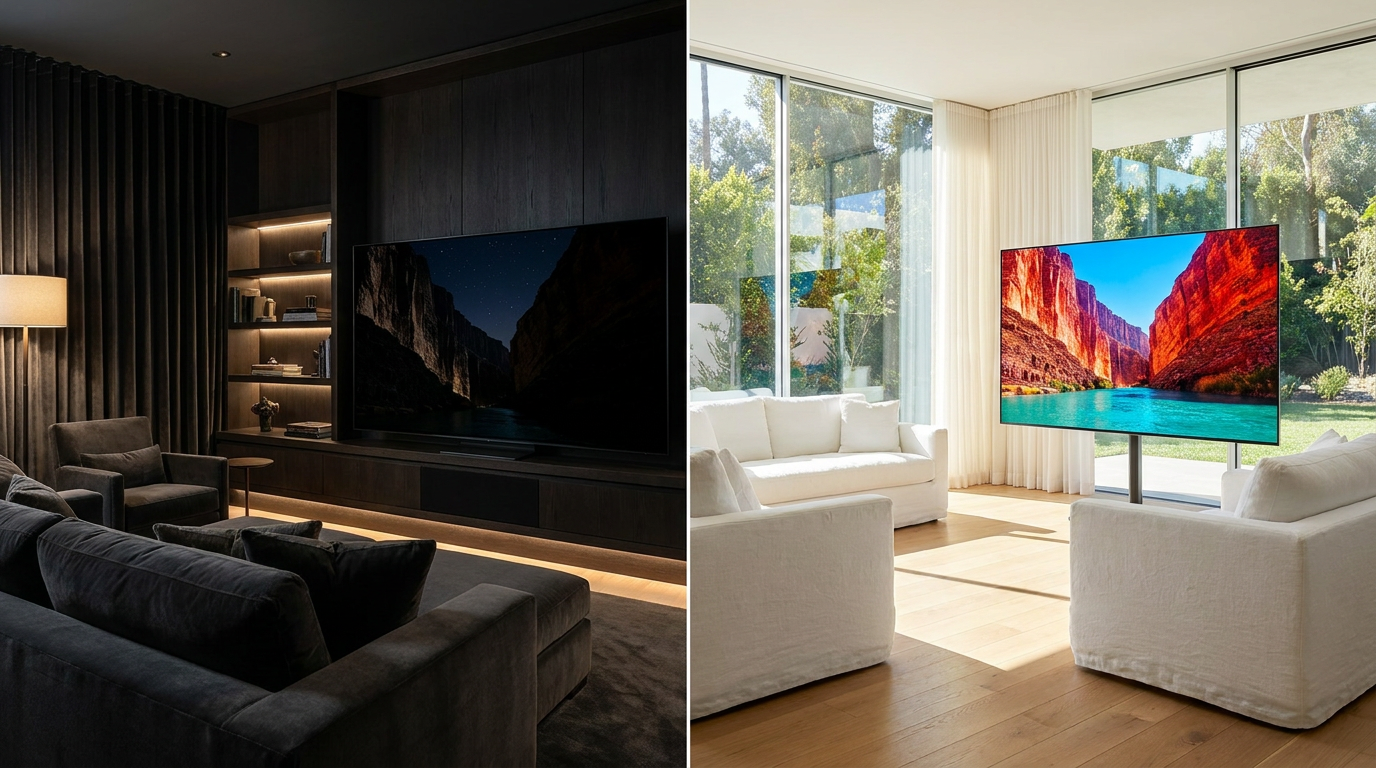
As Mini-LED technology achieves unprecedented brightness and OLED panels push the boundaries of pixel-level contrast, the 2026 television market offers two distinct paths to premium picture quality. The right choice depends entirely on your room's lighting, your budget for large screens, and your tolerance for visual trade-offs.
By Factlen Editorial Team
- Living Room Pragmatists
- Advocates for raw brightness, versatility, and cost-effective large screens in everyday viewing environments.
- Cinematic Purists
- Advocates for prioritizing perfect black levels and infinite contrast for the ultimate movie-watching experience.
- Competitive Gamers
- Advocates focused on input lag, motion clarity, and the durability of the panel during marathon sessions.
What's not represented
- · Projector Enthusiasts
- · Budget LCD Buyers
Why this matters
A premium television is a multi-year investment that dictates how you experience movies, sports, and games. Choosing the wrong panel technology for your specific room lighting and viewing habits can result in thousands of dollars spent on a screen that either washes out in the sun or distracts you in the dark.
Key points
- OLED panels offer perfect black levels and infinite contrast by turning off individual pixels.
- Mini-LED TVs utilize thousands of backlight zones to achieve massive peak brightness levels.
- OLED is the definitive choice for dark-room cinematic viewing and perfect shadow detail.
- Mini-LED excels in bright, sunlit living rooms and offers better value at 85-inch sizes.
- OLED carries a slight risk of burn-in with static images; Mini-LED is immune to burn-in.
- Mini-LED can suffer from 'blooming,' where light bleeds around bright objects on dark backgrounds.
The 2026 television landscape is dominated by two acronyms that fundamentally dictate the viewing experience: OLED and Mini-LED. While both represent the pinnacle of modern display technology, they achieve their stunning picture quality through entirely different engineering philosophies. Choosing between them is no longer a simple matter of identifying the "best" TV on the market; it requires an honest assessment of your living space, your viewing habits, and the specific visual trade-offs you are willing to accept.[8]
The core technological difference lies in how these screens generate light. An OLED (Organic Light-Emitting Diode) panel features over 8.2 million self-illuminating pixels in a 4K display, meaning each individual dot creates its own light and color. Conversely, Mini-LED relies on a traditional LCD panel that is illuminated from behind by thousands of microscopic LED lights, which are grouped into distinct "dimming zones" that brighten or darken based on the scene.[1][4]
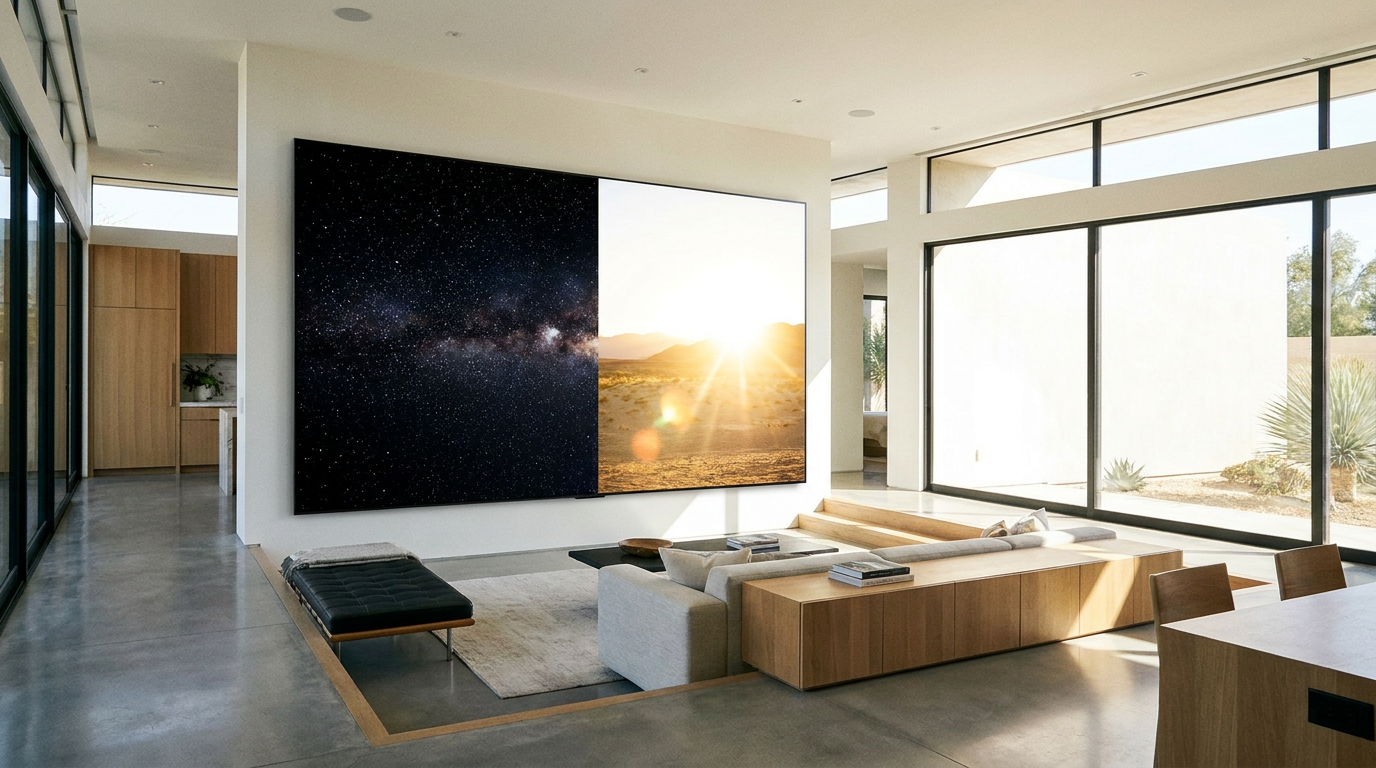
The Case For OLED rests entirely on pixel-level perfection. Because an OLED television does not use a backlight, it can turn off individual pixels completely when displaying dark scenes. This mechanical capability results in perfect, inky black levels and an infinite contrast ratio. When a starship flies across a pitch-black galaxy, the stars are piercingly bright, while the space around them emits absolutely zero light.[3][7]

The Evidence for OLED is undeniable in clinical testing. Independent display analysts consistently award OLED panels perfect scores for black uniformity and contrast. These tests confirm that OLEDs exhibit zero "haloing" or "blooming"—the distracting glow that often bleeds around bright objects on dark backgrounds. For cinematic viewing in a light-controlled environment, this precision makes OLED the undisputed reference standard.[1][8]
The Case Against OLED centers on brightness limitations and the specter of burn-in. While 2026 panels utilizing Micro Lens Array (MLA) and QD-OLED technology are brighter than ever, they still cap out around 1,000 to 1,500 nits in small highlights, and their sustained full-screen brightness drops significantly. Furthermore, static elements like news tickers or gaming HUDs carry a slight, albeit heavily mitigated, risk of permanent image retention over thousands of hours of use.[2][3]
The Case For Mini-LED is built on unapologetic brightness and sheer scale. By utilizing thousands of independent dimming zones, these televisions can punch through the harshest glare of a sunlit living room. They do not suffer from the aggressive automatic brightness limiters that dim OLED screens during bright, full-screen scenes like hockey games or snow-covered landscapes, and they are entirely immune to permanent burn-in.[4][6]
The Evidence for Mini-LED is measured in raw luminance and massive dimensions. Flagship 2026 models are now hitting peak brightness levels of 4,500 nits or more, allowing HDR highlights—like explosions or direct sunlight—to physically dazzle the viewer. Furthermore, manufacturing efficiencies allow Mini-LEDs to scale up to 100 and 115 inches without the astronomical, five-figure price premiums associated with supersized OLED panels.[3][6]

The Evidence for Mini-LED is measured in raw luminance and massive dimensions.
The Case Against Mini-LED is the blooming compromise. Even with 10,000 dimming zones, the backlight cannot match the pixel-level precision of an OLED. Because a single dimming zone still illuminates hundreds of pixels at once, the television must compromise when a bright object sits immediately next to a dark background, resulting in a faint but noticeable halo effect.[1][7]
The Evidence against Mini-LED becomes apparent during specific viewing scenarios. Viewers watching movies with bright white subtitles on cinematic black bars will often notice a glowing aura around the text. Additionally, Mini-LED panels generally suffer from narrower viewing angles; if you sit off-center in a wide living room, the colors may wash out and the blooming effect becomes significantly more pronounced.[1][2]
The Gaming Trade-off presents a split decision for console and PC enthusiasts. OLED offers near-instantaneous pixel response times, virtually eliminating motion blur in fast-paced competitive shooters. However, Mini-LED provides total peace of mind for MMO and RPG players who leave static user interfaces on screen for hours, while delivering blindingly bright HDR pop for daytime gaming sessions.[1][6]
The 2026 Innovations show the gap between the two technologies narrowing. The introduction of RGB Mini-LED technology is replacing traditional white backlights with dedicated red, green, and blue diodes, resulting in unprecedented color saturation that rivals QD-OLED. Simultaneously, OLED manufacturers continue to refine heat-syncs and algorithms to safely push their panels to higher sustained brightness levels.[4][5]

Ultimately, OLED fits well when the primary viewing environment is a light-controlled room or a dedicated basement home theater. It is the definitive choice for cinephiles who prioritize perfect shadow detail, infinite contrast, and accurate color reproduction in dark scenes. If your evening routine involves turning off the lamps to watch prestige television or sci-fi films, OLED provides an unmatched, reference-quality experience.[7][8]
Conversely, OLED does not fit when the television is placed in a sun-drenched room with uncovered windows, or when the household leaves static news channels running for eight hours a day. The lower full-screen brightness will struggle to overcome heavy daytime glare, and the persistent static logos of news networks introduce an unnecessary risk of permanent image retention over several years.[2][8]
Mini-LED fits well when the television serves as a daytime living room centerpiece. It excels for households that watch a mix of sports, news, and casual daytime programming, effortlessly punching through ambient sunlight. It is also the superior choice for buyers seeking an immersive 85-inch or larger screen, offering massive, high-quality displays without breaking the bank.[4][8]
However, Mini-LED does not fit when the buyer is a home theater purist who watches letterboxed movies in pitch-black conditions and cannot tolerate any backlight blooming. If a faint halo around white subtitles or a slightly washed-out image when viewing from a sharp side angle will distract you from the film, the mechanical limitations of an LCD backlight will likely prove frustrating.[1][8]

How we got here
2013
The first consumer OLED TVs hit the market, establishing a new benchmark for perfect black levels.
2019
Mini-LED technology is introduced, shrinking traditional backlights to dramatically increase dimming zones and contrast.
2024
OLED manufacturers introduce Micro Lens Array (MLA) and QD-OLED tech to significantly boost peak brightness.
2026
RGB Mini-LEDs arrive, replacing white backlights with dedicated red, green, and blue diodes for unprecedented color saturation.
Viewpoints in depth
Cinematic Purists
Advocates for prioritizing perfect black levels and infinite contrast for the ultimate movie-watching experience.
For this camp, the television is a portal to the director's intent. They argue that the slightly lower peak brightness of an OLED is a non-issue in a properly light-controlled room. To a purist, even the most advanced Mini-LED algorithm cannot compensate for the distracting 'halo' effect around subtitles or starfields, making pixel-level light control the only acceptable standard for prestige television and film.
Living Room Pragmatists
Advocates for raw brightness, versatility, and cost-effective large screens in everyday viewing environments.
This perspective acknowledges that most people do not watch TV in a pitch-black basement. Pragmatists argue that Mini-LED's ability to punch through afternoon sunlight makes it the superior everyday choice. Furthermore, they emphasize the value proposition: for the price of a standard 65-inch OLED, a buyer can often secure an 85-inch Mini-LED, arguing that sheer size and brightness deliver a more impactful upgrade for sports and casual viewing.
Competitive Gamers
Advocates focused on input lag, motion clarity, and the durability of the panel during marathon sessions.
Gamers are split based on their specific habits. Competitive players lean toward OLED for its near-instantaneous pixel response time, which eliminates motion blur in fast-paced shooters. However, MMO and RPG players who leave static user interfaces on screen for hours often prefer Mini-LED, as it completely removes the anxiety of permanent burn-in while delivering blindingly bright HDR explosions.
What we don't know
- Whether Micro-LED technology will become affordable enough to replace both OLED and Mini-LED before the end of the decade.
- Exactly how long the newest generation of QD-OLED panels can run at maximum brightness before experiencing degradation.
Key terms
- Blooming (or Haloing)
- A visual artifact where light spills from a bright object into the surrounding dark areas of the screen, common on backlit TVs.
- Local Dimming
- A technology that divides a TV's backlight into distinct zones that can independently dim or brighten to improve contrast.
- Nits
- A unit of measurement for screen brightness; a higher number indicates a brighter display capable of fighting room glare.
- Burn-in
- Permanent image retention where a faint ghost of a static image (like a channel logo) remains visible on the screen forever.
Frequently asked
Which TV technology is better for a bright living room?
Mini-LED is significantly better for bright rooms. Its backlight can produce much higher peak brightness to cut through window glare, whereas OLED panels can look dim in direct sunlight.
Do OLED TVs still suffer from permanent burn-in?
While the risk has been drastically reduced by modern pixel-shifting and cooling technologies, OLEDs can still experience burn-in if static images (like news tickers) are displayed for thousands of hours.
Why are Mini-LED TVs cheaper at larger sizes?
Manufacturing large LCD panels is a mature, highly efficient process. Producing flawless OLED panels at 83 inches or larger remains difficult and expensive, resulting in a massive price premium.
Which is better for PlayStation 5 or Xbox Series X gaming?
Both are excellent, but they serve different needs. OLED offers near-instant response times for competitive shooters, while Mini-LED provides burn-in immunity for static gaming HUDs.
Sources
Source coverage
8 outlets
3 viewpoints surfaced








[1]RTINGSCompetitive Gamers
Mini LED vs OLED: Which TV Technology is Better?
Read on RTINGS →[2]CNETLiving Room Pragmatists
Mini-LED vs. OLED: Which TV Tech Is Better?
Read on CNET →[3]What Hi-Fi?Cinematic Purists
Mini LED vs OLED: which TV screen technology is better?
Read on What Hi-Fi? →[4]CurrysLiving Room Pragmatists
OLED vs Mini LED: what's the difference?
Read on Currys →[5]SamsungLiving Room Pragmatists
Mini LED vs. OLED: What is the difference?
Read on Samsung →[6]Factory Brands DirectLiving Room Pragmatists
Mini-LED vs OLED: The 2025/2026 TV Showdown
Read on Factory Brands Direct →[7]Jeff RauseoCinematic Purists
The Ultimate TV Buying Guide for 2025/2026
Read on Jeff Rauseo →[8]Factlen Editorial TeamCompetitive Gamers
Synthesis by Factlen editorial team
Read on Factlen Editorial Team →

Every angle. Every day.
Get shopping stories with full source coverage and perspective breakdowns delivered to your inbox.