
Looking Back at the 2026 T20 World Cup: India's Historic Three-Peat and a Tournament of Shattered Records
India cemented a white-ball dynasty by defending their T20 World Cup title on home soil, capping off a tournament defined by unprecedented batting milestones.
By Factlen Editorial Team
- Indian Cricket Establishment
- Celebrates the historic three-peat, the success of the home soil advantage, and the redemption arcs of key players.
- Global Cricket Analysts
- Focuses on the evolution of T20 batting, the shattered run-scoring records, and the shifting tactical paradigms.
- International Observers
- Highlights the success of the expanded 20-team format, the underdog stories, and the global footprint of the tournament.
What's not represented
- · Associate nation boards seeking more funding after proving their competitiveness.
- · Domestic league franchises looking to recruit the tournament's breakout stars.
Why this matters
The 2026 tournament not only established India as the undisputed dominant force in modern Twenty20 cricket but also fundamentally shifted the sport's tactical baseline, proving that totals well over 200 are now the standard expectation on the global stage.
Key points
- India defeated New Zealand by 96 runs to win their third T20 World Cup title.
- India became the first team to defend the title and win on home soil.
- Sanju Samson was named Player of the Tournament with 321 runs.
- Pakistan's Sahibzada Farhan broke the single-edition run record with 383 runs.
- India's 255/5 in the final was the highest total ever in a T20 World Cup championship match.
- The tournament featured seven individual centuries, signaling a shift toward higher-scoring matches.
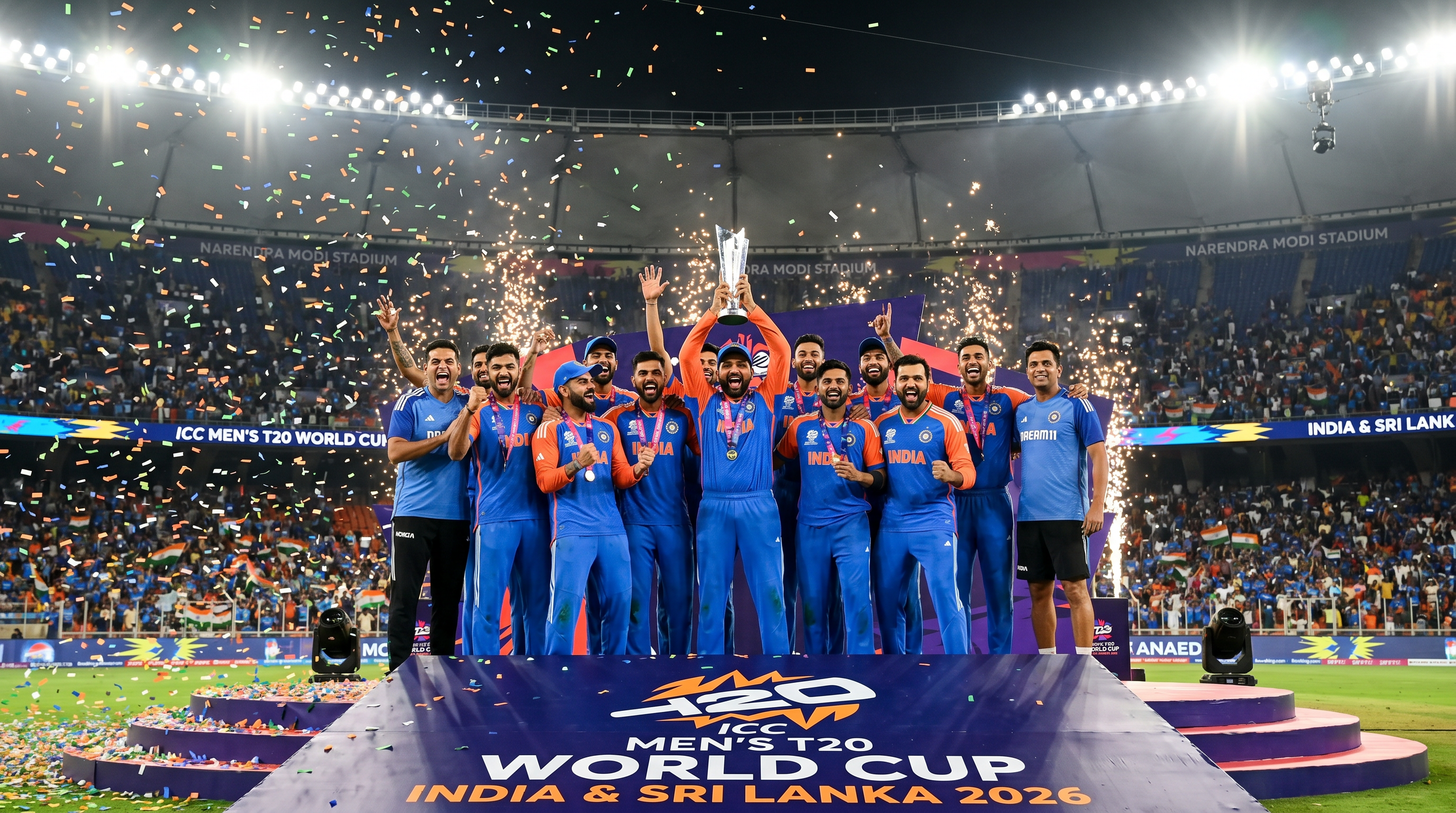
The dust has settled on the 2026 ICC Men's T20 World Cup, and the history books have been comprehensively rewritten. Over a month of high-octane cricket across India and Sri Lanka culminated in a defining moment at the Narendra Modi Stadium in Ahmedabad, where India secured a 96-run victory over New Zealand. The triumph marked a series of unprecedented milestones: India became the first nation to win three T20 World Cup titles, the first to successfully defend the trophy, and the first to lift the cup on home soil.[1][2]
The final itself was a masterclass in modern Twenty20 batting. Propelled by an aggressive top order, India posted a staggering 255 for 5—the highest total ever recorded in a T20 World Cup final. The innings was anchored by Sanju Samson, whose blistering 89 off 46 deliveries set the tone, while explosive contributions from Abhishek Sharma and Ishan Kishan pushed the game beyond New Zealand's reach. Faced with an insurmountable target, the Black Caps folded for 159, unable to withstand the pressure of the occasion and the precision of the Indian attack.[1][3]
Despite the lopsided final, New Zealand's journey to the championship match was a testament to their enduring consistency in white-ball cricket. The Black Caps navigated a grueling Super Eight schedule and a tense semifinal to reach their second T20 World Cup final, relying on the tactical acumen of captain Mitchell Santner and the explosive top-order striking of Tim Seifert. Seifert finished as the tournament's second-highest run-scorer with 326 runs, consistently providing the aggressive starts that allowed New Zealand to dictate terms against formidable opponents.[1][4]

At the heart of India's title defense was the remarkable redemption arc of Sanju Samson. Entering the tournament as a fringe squad member, the wicketkeeper-batter transformed into the undisputed Player of the Tournament. Samson amassed 321 runs across the campaign, delivering crucial half-centuries in the Super Eight stage against the West Indies, the semifinal against England, and the final against New Zealand. His ability to accelerate in high-stakes knockout matches provided the backbone for India's historic run.[3][5]
At the heart of India's title defense was the remarkable redemption arc of Sanju Samson.
While the batters commanded the headlines, India's bowling unit executed with ruthless efficiency. Jasprit Bumrah, named Player of the Match in the final for his devastating spell of 4 for 15, finished as the tournament's joint-leading wicket-taker alongside spinner Varun Chakravarthy, with both claiming 14 dismissals. Bumrah's extraordinary economy rate of 6.21 throughout the tournament underscored his status as the premier fast bowler in the world, capable of strangling opposition lineups in the most pressure-filled environments.[1][5]
Beyond the host nation's dominance, the 2026 edition will be remembered as a watershed moment for T20 batting. The tournament was a veritable run-fest, featuring seven individual centuries and a barrage of shattered records. Pitches across the subcontinent offered true bounce and short boundaries, allowing batters to redefine what constitutes a par score in the shortest format of the game. Analysts noted that teams consistently targeted totals well in excess of 200, shifting the tactical paradigm of the sport.[4][6]

The most spectacular individual batting feat belonged to Pakistan's Sahibzada Farhan. Despite his team's earlier exit, the opening batter amassed an astonishing 383 runs in just seven matches, eclipsing Virat Kohli's long-standing single-edition record of 319 runs set in 2014. Farhan became the first player to hit two centuries in a single T20 World Cup, punishing bowling attacks with a strike rate hovering around 160. His historic campaign earned him a spot at the top of the run-scoring charts and cemented his arrival as a global superstar.[4][6]
The expanded 20-team format also delivered the thrilling upsets and underdog narratives that define the best global tournaments. Zimbabwe provided one of the shocks of the decade by defeating heavyweights Australia in the Super Eight stage, driven by the all-round heroics of Brian Bennett. Meanwhile, 19-year-old Canadian batter Yuvraj Samra etched his name into the record books by scoring 110 against New Zealand during the group stages, becoming the youngest player ever to register a century in a T20 World Cup. These moments validated the push to grow the game globally.[6]

As the cricketing world looks ahead to the 2028 edition in Australia and New Zealand, the legacy of the 2026 tournament is firmly established. It proved that the 20-team format can deliver both Cinderella stories and elite, high-stakes competition. For India, the victory cements a dynasty, capping off a golden era of white-ball cricket. For the rest of the world, the tournament has set a new, towering benchmark for aggressive batting and tactical execution in the Twenty20 arena.[2][4]
How we got here
Feb 2026
The expanded 20-team tournament kicks off across venues in India and Sri Lanka.
Group Stage
Pakistan's Sahibzada Farhan hits two centuries, eventually breaking the all-time tournament run record.
Super Eights
Zimbabwe pulls off a historic upset victory over Australia to shake up the knockout bracket.
March 8, 2026
India defeats New Zealand by 96 runs in Ahmedabad to secure their third T20 World Cup title.
Viewpoints in depth
The Champions' View
India's perspective on cementing a white-ball dynasty.
For the Indian camp, the 2026 victory represents the culmination of a multi-year project to dominate the shortest format. Winning a third title—and defending their 2024 crown on home soil—validates their aggressive batting philosophy and deep talent pool. The emergence of Sanju Samson as a reliable big-match player and the sustained brilliance of Jasprit Bumrah have given the team a sense of invincibility, setting a towering standard for future generations.
The Record Breakers
The analytical focus on the tournament's unprecedented run-scoring.
Cricket statisticians and analysts view the 2026 edition as a paradigm shift in Twenty20 batting. Sahibzada Farhan's staggering 383-run haul and the seven individual centuries scored across the tournament indicate that batters are no longer constrained by traditional pacing. With pitches offering true bounce and teams batting deeper than ever, analysts argue that the baseline for a competitive score has permanently shifted, forcing bowling attacks to innovate or face obsolescence.
The Global Expansion
The impact of the 20-team format on emerging cricket nations.
For international observers and emerging nations, the tournament was a resounding endorsement of the ICC's decision to expand the field to 20 teams. Zimbabwe's stunning upset over Australia and the record-breaking century by Canada's 19-year-old Yuvraj Samra proved that associate and lower-ranked nations can compete on the biggest stage. This expanded footprint is seen as vital for the sport's global growth, providing crucial exposure and funding to developing cricketing markets.
What we don't know
- Whether the ICC will continue to expand the tournament beyond 20 teams for future editions.
- How bowling strategies will evolve to counter the new baseline of 200+ run totals.
- If India's aging core of white-ball specialists will transition out before the 2028 tournament.
Key terms
- Twenty20 (T20)
- A short, fast-paced format of cricket where each team bats for a single innings restricted to a maximum of 20 overs.
- Super Eight
- The second group stage of the tournament, where the top eight teams from the initial groups compete for semifinal spots.
- Economy Rate
- The average number of runs a bowler concedes per over bowled, a key metric of effectiveness in T20 cricket.
Frequently asked
Who won the 2026 T20 World Cup?
India won the tournament, defeating New Zealand by 96 runs in the final in Ahmedabad.
Who was the Player of the Tournament?
India's Sanju Samson won the award after scoring 321 runs, including a crucial 89 in the final.
Who scored the most runs in the 2026 edition?
Pakistan's Sahibzada Farhan finished as the top run-scorer with 383 runs, breaking Virat Kohli's single-edition record.
Sources
Source coverage
6 outlets
3 viewpoints surfaced






[1]The GuardianInternational Observers
India retain T20 World Cup with 96-run final win over New Zealand
Read on The Guardian →[2]Al JazeeraInternational Observers
All our updates as India become T20 World Cup champions for the third time
Read on Al Jazeera →[3]The Indian ExpressIndian Cricket Establishment
ICC T20 World Cup Player of the Tournament winners: Sanju Samson wins award for 2026 edition with record-breaking show
Read on The Indian Express →[4]Hindustan TimesGlobal Cricket Analysts
T20 World Cup 2026 Most Runs: Sahibzada Farhan Tops T20 World Cup 2026 Most Runs
Read on Hindustan Times →[5]RediffIndian Cricket Establishment
Jasprit Bumrah, Sanju Samson, Ishan Kishan and Hardik Pandya named in ICC's Team of 2026 T20 World Cup
Read on Rediff →[6]Olympics.comGlobal Cricket Analysts
Most runs in T20 World Cup 2026: Know highest run scorers and list of top batters
Read on Olympics.com →

More in sports
See all 6 stories →Women's Soccer
Women's Football Hits $3 Billion Revenue Milestone as Global Fanbase Surges
0 sources

Tactics
Tiki-Taka 2.0: Inside Spain's Tactical Evolution for the 2026 World Cup
0 sources

Preview
England's 2026 World Cup Outlook: Inside Thomas Tuchel's High-Stakes Group L Campaign
0 sources

College Baseball
Troy Trojans Complete Historic Cinderella Run to Reach First Men's College World Series
0 sources

Every angle. Every day.
Get sports stories with full source coverage and perspective breakdowns delivered to your inbox.