
How the Dallas Wings Built a WNBA Title Contender Around Paige Bueckers and Azzi Fudd
After years of mediocrity, the Dallas Wings have emerged as a 2026 WNBA championship threat, fueled by back-to-back No. 1 picks and a strategic roster overhaul.
By Factlen Editorial Team
- Franchise Management
- Focuses on the front office's deliberate strategy to surround young draft picks with established veterans.
- Tactical Analysts
- Highlights the coaching staff's decision to move Paige Bueckers to the primary point guard position to unlock the offense.
- Player Development Advocates
- Emphasizes the rare advantage of drafting two players with extensive collegiate chemistry.
What's not represented
- · Opposing Western Conference coaches tasked with scheming against the new Dallas offense.
- · Long-time Dallas Wings fans who endured the franchise's decade of mediocrity.
Why this matters
The Wings' rapid ascent demonstrates how combining elite collegiate chemistry with strategic veteran acquisitions can instantly transform a struggling professional franchise, offering a blueprint for team-building in the WNBA's new era.
Key points
- The Dallas Wings have transformed into a 2026 WNBA title contender after years of struggling.
- The turnaround is anchored by back-to-back No. 1 overall draft picks Paige Bueckers (2025) and Azzi Fudd (2026).
- Dallas aggressively added veteran defensive presence in the offseason, signing Alanna Smith and Alysha Clark.
- Moving Bueckers to the primary point guard role has unlocked the team's offense and maximized spacing.
- The new starting lineup has posted a dominant +29 plus-minus rating in its first five games together.
For much of the past decade, the Dallas Wings were mired in a frustrating cycle of WNBA mediocrity. Despite consistently boasting individual scoring champions and making occasional, short-lived playoff appearances, the franchise had secured only one postseason series victory since 2010. The team often felt stuck in transition, unable to build a cohesive roster capable of challenging the league's elite. But as the 2026 season approaches its midway point, the narrative in Arlington has abruptly and emphatically shifted. Sitting comfortably with a winning record and showcasing a dynamic, high-powered offense that overwhelms opponents, the Wings have transformed from a forgettable lottery team into a legitimate championship contender.[1][2][6]
The foundation of this rapid and remarkable turnaround was laid across two consecutive Aprils, beginning with a stroke of lottery luck. In 2025, Dallas selected University of Connecticut superstar Paige Bueckers with the No. 1 overall pick, hoping she would become the face of the franchise. Bueckers delivered a sensational debut campaign, averaging 19.2 points and 5.4 assists per game to run away with the WNBA Rookie of the Year award. However, her individual brilliance on the offensive end could not mask the team's glaring structural flaws and lack of depth. The Wings suffered through a dismal season, enduring a crushing 10-game losing streak and finishing near the absolute bottom of the league standings, proving that one superstar guard was not enough to fix a broken system.[2][4][6]
That painful losing season, while difficult for the fanbase to endure, yielded a franchise-altering reward: the No. 1 overall pick in the 2026 WNBA Draft. With that highly coveted selection, Dallas drafted Azzi Fudd, Bueckers' former UConn teammate and the 2025 NCAA Final Four Most Outstanding Player. The selection masterfully reunited one of the most prolific backcourts in recent collegiate history, pairing two players who had already logged 49 games together and won a national championship. Instead of drafting for positional need, the Wings prioritized elite talent and established chemistry, betting that the collegiate magic between Bueckers and Fudd would translate directly to the professional ranks.[2][6]

The decision to draft Fudd was not made on a whim, but rather as the culmination of an exhaustive scouting process. 'Since the moment we secured the No. 1 pick, we set out on a plan to be deliberate, thorough, with intention,' Wings General Manager Curt Miller told reporters during the team's media day ahead of the season. 'We traveled all over the world watching this incredible draft class, but it all came back always to Azzi.' Miller and the front office recognized that pairing Fudd's lightning-quick release and perimeter shooting with Bueckers' court vision would create an offensive backcourt that opposing defenses would struggle to contain.[4]
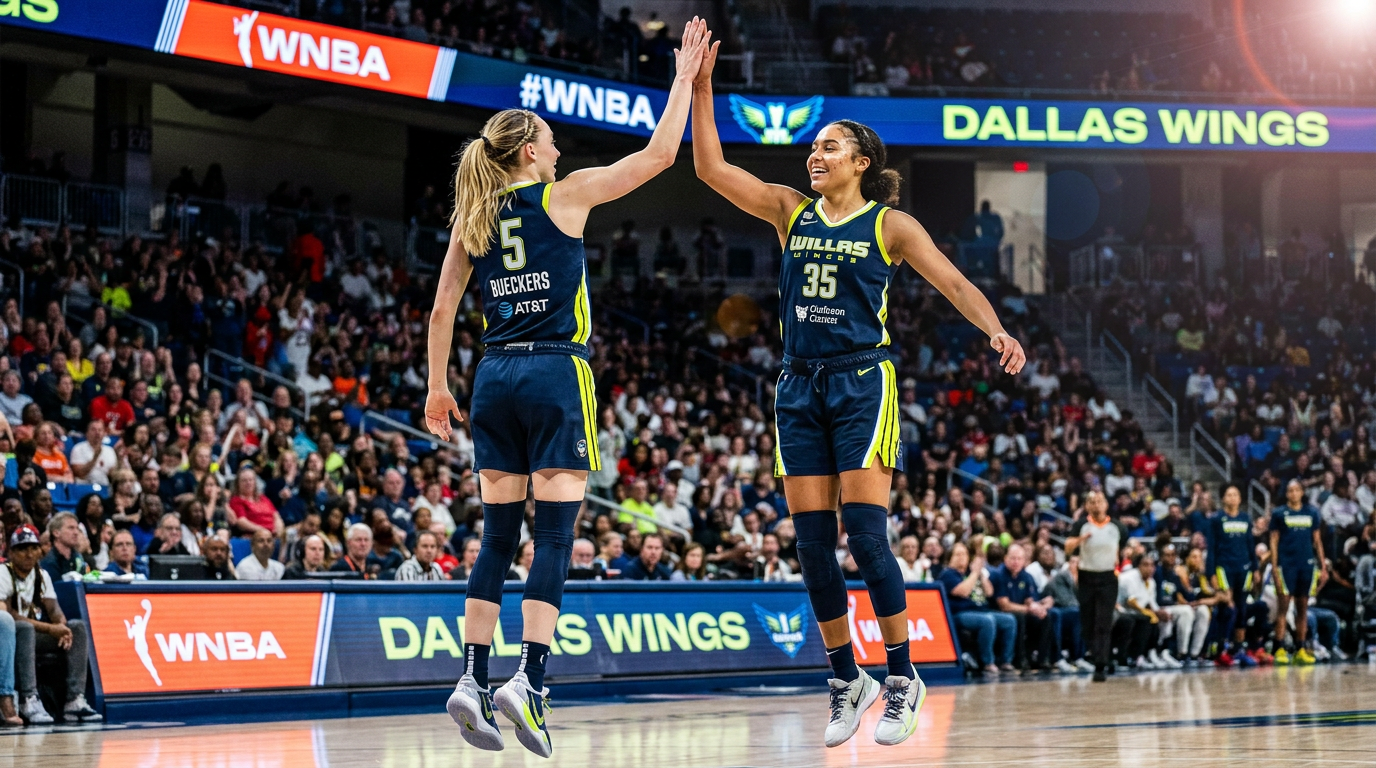
The built-in chemistry between the two young guards has translated seamlessly to the professional level, immediately validating the front office's strategy. Because they spent years learning each other's tendencies, preferred spots on the floor, and shooting rhythms in college, the typical rookie adjustment period has been virtually eliminated. Bueckers noted that their extensive experience playing together allows them to bypass the growing pains that usually accompany a newly formed backcourt pairing. When they step onto the court, they already know exactly where the other will be, allowing the Wings to run complex offensive sets with a level of fluidity rarely seen in a team relying so heavily on first- and second-year players.[3][4]
But drafting Fudd was only one piece of the complex puzzle required to build a true contender. The Wings' front office astutely recognized that a young, offensively gifted backcourt needed significant veteran insulation to survive the grueling, physical nature of a 40-game WNBA season. During the condensed free-agency period, Dallas aggressively addressed its glaring frontcourt deficiencies, determined to surround their young stars with players who could do the dirty work in the paint and provide reliable defensive stops. They knew that without rebounding and rim protection, even the most explosive offense would eventually falter against the league's bigger, more physical frontlines.[2][5]

But drafting Fudd was only one piece of the complex puzzle required to build a true contender.
To solve this issue, the team signed Alanna Smith, the 2025 WNBA Co-Defensive Player of the Year, to anchor the paint and provide elite rim protection. They also added experienced post player Jessica Shepard to bolster their rebounding numbers, and brought in three-time WNBA champion Alysha Clark to inject championship DNA and defensive versatility into the locker room. These targeted acquisitions provided the necessary rebounding and defensive structure that Dallas sorely lacked during Bueckers' rookie season. By bringing in battle-tested veterans who understand what it takes to win in the postseason, the Wings created a balanced roster capable of winning games on both ends of the floor.[1][2][5]
The final catalyst for the Wings' 2026 surge was a crucial tactical adjustment made by the coaching staff. Early in the season, Dallas experimented with various backcourt configurations, trying to find the optimal balance of scoring and distribution. But the offense truly unlocked and reached its terrifying potential when the coaching staff handed Bueckers the keys as the primary, on-ball point guard. By moving her away from an off-ball scoring role and trusting her to initiate the offense, Dallas maximized her elite court vision and decision-making abilities, forcing defenses to react to her every move.[3]
Moving Bueckers on the ball paid immediate and spectacular dividends for the entire roster. Over a pivotal five-game stretch following the tactical adjustment, Bueckers averaged 20.4 points, 6.8 assists, and 4.4 rebounds, while shooting a highly efficient 52.5 percent from the floor. More importantly, the Wings went 4-1 during that span, with the offense operating at a blistering pace that left opposing defenses scrambling to recover. The shift allowed Bueckers to dictate the tempo of the game, finding her teammates in their preferred shooting pockets while still aggressively hunting her own shot when the defense collapsed.[3]

Tactical analysts covering the team quickly noted that giving Bueckers more control of the offense made Dallas exponentially more dynamic. While she was certainly productive playing off the ball during her rookie season, her impact as the primary creator maximizes the spacing for the rest of the roster. When Bueckers drives into the paint, she draws multiple defenders, which in turn creates wide-open perimeter looks for elite shooters like Fudd. This domino effect has transformed the Wings from a team that relied on isolated scoring bursts into a cohesive offensive machine that moves the ball with purpose and precision.[3]
That enhanced spacing is particularly beneficial for veteran guard Arike Ogunbowale. The dynamic scorer, who led the WNBA in points per game in previous seasons, no longer has to shoulder the entire offensive burden or force contested shots against double-teams. With defenses now forced to respect Bueckers' playmaking and Fudd's lightning-quick release from the perimeter, Ogunbowale has found significantly cleaner driving lanes and higher-quality looks at the basket. The presence of two elite offensive threats alongside her has allowed Ogunbowale to play more efficiently, picking her spots and attacking closeouts rather than having to create something out of nothing on every possession.[1][2][6]
The statistical results of this newly configured starting unit are nothing short of staggering. The five-player lineup featuring Bueckers, Ogunbowale, Fudd, Maddy Siegrist, and Shepard posted a dominant +29 plus-minus rating through their first five games playing together. By contrast, the team's original starting group early in the season had operated at a significant deficit, struggling to find a rhythm on either end of the court. This massive statistical swing validates the coaching staff's adjustments and proves that the Wings have finally found a combination of players whose skill sets perfectly complement one another.[3]

The on-court turnaround has also completely revitalized the fanbase in Arlington. After years of sparse crowds, tempered expectations, and frustrating rebuilds, the College Park Center is experiencing a massive surge in attendance and energy. The arrival of Fudd, combined with the league's new collective bargaining agreement that substantially escalated rookie salaries and increased overall visibility, has placed Dallas squarely at the center of the WNBA's explosive growth in 2026. Fans are flocking to see the reunion of the UConn stars and the high-octane offense they have brought to Texas, turning home games into must-see events.[2][5]
While the grueling WNBA season is far from over and tougher tests undoubtedly lie ahead, the Wings have firmly established themselves in the upper echelon of the Western Conference. By pairing generational collegiate talent with strategic veteran acquisitions and smart tactical adjustments, Dallas has provided a masterclass in how to rapidly rebuild a professional basketball franchise. For a team that spent the better part of a decade searching for an identity and a winning formula, the Wings have finally found one: they are young, they are fast, and they are built to win championships right now.[1][5][6]
How we got here
April 2025
The Dallas Wings select UConn star Paige Bueckers with the No. 1 overall pick in the WNBA Draft.
September 2025
Bueckers wins WNBA Rookie of the Year, but the Wings finish near the bottom of the league standings.
February 2026
Dallas signs 2025 Co-Defensive Player of the Year Alanna Smith and three-time champion Alysha Clark in free agency.
April 2026
The Wings draft Azzi Fudd No. 1 overall, reuniting her with former UConn teammate Bueckers.
May 2026
Dallas opens the 2026 season with a revamped lineup and immediately establishes itself as a title contender.
Viewpoints in depth
Franchise Management
Focuses on the front office's deliberate strategy to surround their young draft picks with established veterans.
From a management perspective, the Wings' turnaround is a testament to aggressive roster construction. General Manager Curt Miller and the front office recognized that relying solely on young draft picks, even generational talents like Bueckers and Fudd, was not a viable path to a championship. By actively pursuing battle-tested veterans like Alanna Smith and Alysha Clark during the condensed free-agency period, management ensured the team had the defensive structure and locker-room leadership required to compete immediately.
Tactical Analysts
Highlights the coaching staff's decision to move Paige Bueckers to the primary point guard position.
Basketball analysts point to a specific X's and O's adjustment as the catalyst for the Wings' offensive explosion. Early in the season, the team struggled to find a rhythm, but moving Paige Bueckers to the primary, on-ball point guard role changed the geometry of the court. This tactical shift allowed Bueckers to dictate the pace and draw multiple defenders, which in turn created wide-open perimeter looks for Azzi Fudd and cleaner driving lanes for Arike Ogunbowale, maximizing the spacing for the entire roster.
Player Development Advocates
Emphasizes the rare advantage of drafting two players with extensive collegiate chemistry.
Those focused on player development argue that the Wings bypassed the typical WNBA rebuilding timeline entirely because of the built-in chemistry between their two stars. Bueckers and Fudd played 49 games together at UConn, winning a national championship and learning each other's exact tendencies. Advocates note that this extensive shared experience eliminated the steep learning curve most rookie backcourts face, allowing Dallas to run complex offensive sets from day one as if the duo had been playing professionally for years.
What we don't know
- Whether the young backcourt can maintain its high offensive efficiency during the physical intensity of the WNBA playoffs.
- How the team will manage its salary cap in future seasons when both Bueckers and Fudd are eligible for maximum contract extensions.
- If the veteran frontcourt acquisitions can remain healthy through the entirety of the grueling 40-game season.
Key terms
- Plus-Minus
- A basketball statistic that measures the point differential for a team while a specific player or lineup is on the court.
- Point Guard
- The player responsible for running the team's offense, calling plays, and distributing the ball to teammates.
- Collective Bargaining Agreement (CBA)
- The contract between the WNBA and its players' union that dictates salary caps, rookie scale contracts, and working conditions.
Frequently asked
Who did the Dallas Wings draft in 2026?
The Wings selected UConn guard Azzi Fudd with the No. 1 overall pick in the 2026 WNBA Draft.
Why did the Wings struggle in 2025?
Despite Paige Bueckers winning Rookie of the Year, the 2025 team lacked frontcourt depth and defensive consistency, leading to a losing record.
Who is the general manager of the Dallas Wings?
Curt Miller serves as the Executive Vice President and General Manager of the Dallas Wings.
Sources
Source coverage
6 outlets
3 viewpoints surfaced






[1]ESPNTactical Analysts
From forgettable WNBA franchise to title contender...
Read on ESPN →[2]The GuardianPlayer Development Advocates
Azzi Fudd selected No 1 overall by Dallas Wings in WNBA draft
Read on The Guardian →[3]The Wings BulletinTactical Analysts
A simple but key strategy has fueled the recent success of the Dallas Wings
Read on The Wings Bulletin →[4]AP NewsFranchise Management
Bueckers, Fudd reunite in Dallas with high expectations
Read on AP News →[5]Fox 4 NewsFranchise Management
Dallas Wings finalize 2026 roster
Read on Fox 4 News →[6]WNBA.comPlayer Development Advocates
Dallas Wings Select Azzi Fudd No. 1 Overall In 2026 WNBA Draft
Read on WNBA.com →

Every angle. Every day.
Get sports stories with full source coverage and perspective breakdowns delivered to your inbox.