
How the Brain Learns to Read: The Cognitive Science Transforming Elementary Education
Neuroimaging and cognitive science have revealed that the human brain is not naturally wired to read. This biological reality is driving a massive shift in education, replacing guessing-based literacy programs with evidence-backed phonics instruction.
By Factlen Editorial Team
- Cognitive Neuroscientists
- Researchers studying the biological mechanisms of learning and language.
- Structured Literacy Advocates
- Educators and parents pushing for systematic, evidence-based reading instruction.
- Balanced Literacy Defenders
- Proponents of an instructional philosophy focused on literature immersion and contextual cues.
What's not represented
- · Publishers of legacy balanced literacy curricula
- · Veteran teachers transitioning between instructional methods
Why this matters
For decades, millions of children struggled to read because schools relied on instructional methods that contradicted how the human brain actually learns. The shift toward the evidence-based 'Science of Reading' is transforming classrooms, offering a proven pathway to literacy that empowers all students—especially those with dyslexia—to succeed.
Key points
- The human brain is not naturally wired to read and must repurpose visual and language centers.
- Orthographic mapping allows the brain to turn decoded words into instantly recognizable sight words.
- Guessing words based on context or pictures bypasses the brain's ability to map and store words.
- Systematic phonics instruction is proven to be the most effective way to teach reading.
- Explicit instruction physically changes the brain structure of children with dyslexia.
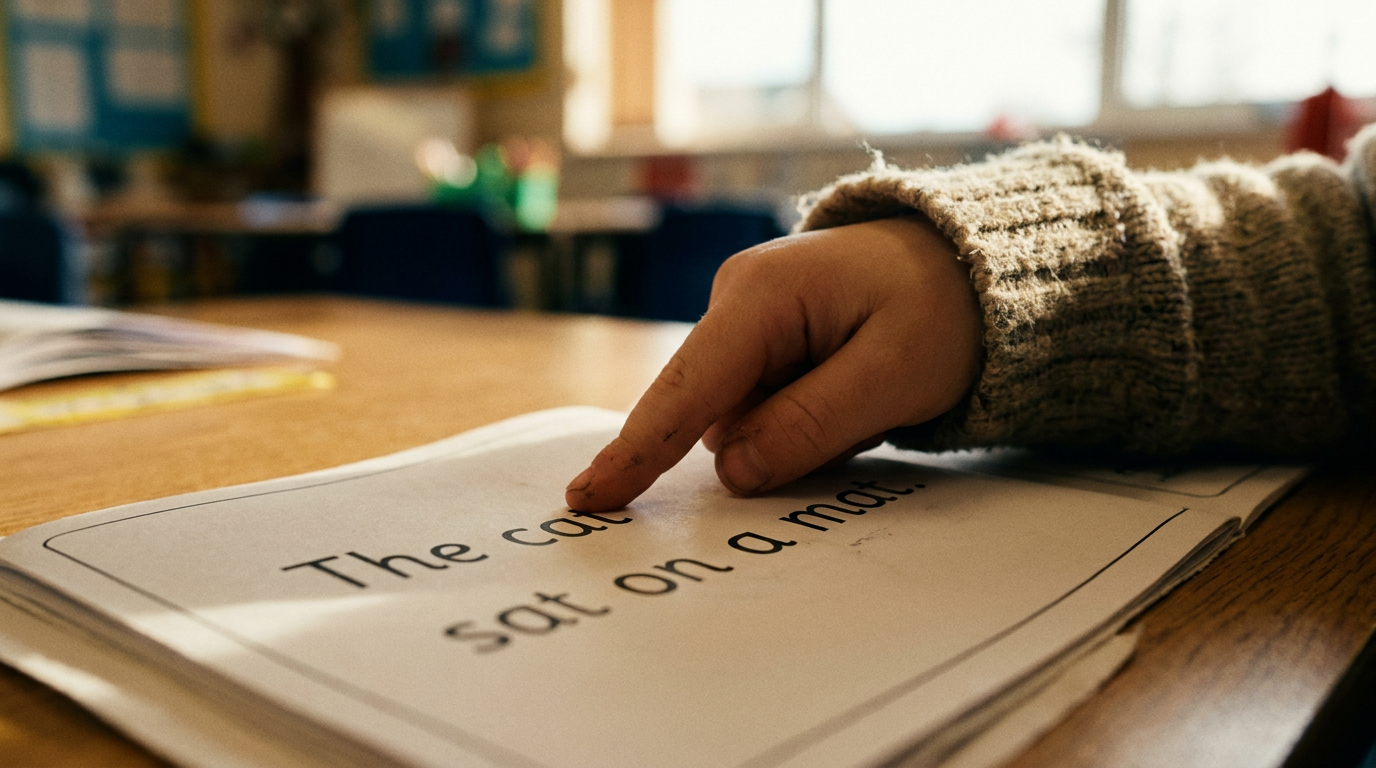
Across the English-speaking world, a quiet revolution is rewriting the rules of the elementary school classroom. For decades, educators debated the best way to teach children to read, a conflict famously dubbed the "Reading Wars."[6]
The core of the debate pitted "balanced literacy"—a philosophy emphasizing literature immersion and contextual guessing—against explicit phonics instruction. Today, an overwhelming body of evidence has declared a winner, fundamentally changing how teachers approach the written word.[5][6]
The victor is a framework broadly known as the "Science of Reading." It is not a specific curriculum or a single textbook, but rather a comprehensive body of research drawn from cognitive psychology, neuroscience, and linguistics that explains exactly how humans acquire literacy.[2][5]
To understand why the Science of Reading has become the gold standard, one must first understand a fundamental biological truth: the human brain was never designed to read.[2][3]
Spoken language is a natural, evolutionary adaptation. Human beings have been speaking for tens of thousands of years, and infants naturally absorb the language spoken around them simply through passive exposure and social interaction.[2]
Writing, however, is a recent human invention, dating back only about 5,500 years. Because there is no innate "reading center" in the brain, the brain must physically rewire itself to translate abstract visual symbols into meaningful sounds.[2]

Neuroimaging studies have mapped exactly how this rewiring occurs. When a child learns to read, they must build a neural bridge between the visual cortex, which recognizes shapes and lines, and the language centers that process speech and meaning.[2][4]
This process relies heavily on the parieto-temporal region of the brain, which handles word analysis and the "sounding out" of letters. As children practice connecting letters to sounds—a process known as decoding—they strengthen these vital neural pathways.[2][3]
Over time, repeated decoding triggers a cognitive process called "orthographic mapping." This is the mechanism by which a word moves from being a puzzle that must be painstakingly sounded out to a recognized "sight word" stored in the occipito-temporal region of the brain.[2][5]
Once a word is orthographically mapped, the brain recognizes it instantly, in a fraction of a second, without needing to consciously decode it. This automaticity, which researchers call the lexical pathway, is the hallmark of fluent reading.[5]
Once a word is orthographically mapped, the brain recognizes it instantly, in a fraction of a second, without needing to consciously decode it.
This neurological reality exposes the fatal flaw in the "balanced literacy" approach, which dominated education for decades. Balanced literacy often relied on the "three-cueing" system, which taught children to guess unknown words rather than sound them out.[3][5]
Under the three-cueing model, if a child encountered a difficult word, teachers were trained to ask: "What makes sense here?" or "Look at the picture—what could that word be?" The focus was on context and syntax rather than the letters on the page.[5]
Cognitive scientists point out that guessing based on context is actually the hallmark of a struggling reader, not a proficient one. When children guess, they bypass the orthographic mapping process entirely.[3][5]
Without mapping the specific letter-sound correspondences, the child's brain fails to store the word for future automatic recognition. They might guess correctly on one page because of an illustration, but fail to recognize the exact same word on the next page when the picture is gone.[3]

The evidence against guessing strategies and in favor of explicit instruction is overwhelming. As far back as the year 2000, the congressionally mandated National Reading Panel reviewed thousands of studies and concluded that systematic phonics instruction was highly effective and vastly superior to whole-language approaches.[1][5]
The panel identified five essential pillars of reading instruction: phonemic awareness (the ability to hear and manipulate sounds in spoken words), phonics (connecting sounds to letters), fluency, vocabulary, and reading comprehension.[1][5]

Despite this evidence, balanced literacy remained entrenched in teacher training programs until recently. The current shift has been driven largely by parents of children with dyslexia, who found that their children were failing to learn under the guessing model and demanded evidence-based interventions.[3][5]
For children with dyslexia, the brain's phonological processing centers operate less efficiently. They require highly explicit, systematic, and repetitive phonics instruction to build the necessary neural pathways, and MRI studies show that proper instruction actually changes the physical structure of their brains over time.[3][4]
Yet, researchers emphasize that the Science of Reading is not just for students with learning disabilities. While a small percentage of children might deduce the rules of English phonics on their own, explicit instruction benefits all students, giving them a faster and more reliable path to literacy.[1][3]
As states and nations increasingly mandate evidence-based reading instruction, the focus is shifting from philosophical debates to practical implementation. By aligning classroom practices with the biological realities of the brain, educators are working to ensure that every child gains access to the written word.[5][6]
How we got here
1997
The U.S. Congress convenes the National Reading Panel to assess the effectiveness of different reading instruction methods.
April 2000
The National Reading Panel releases its landmark report, concluding that systematic phonics instruction is highly effective.
2000s–2010s
Despite the scientific consensus, 'balanced literacy' and the three-cueing system remain the dominant instructional models in most elementary schools.
2020s
A grassroots movement led by parents and cognitive scientists prompts widespread legislative changes, forcing schools to adopt 'Science of Reading' curricula.
Viewpoints in depth
Cognitive Neuroscientists
Researchers studying the biological mechanisms of learning and language.
Neuroscientists emphasize that reading is an unnatural act that requires the brain to repurpose existing structures. Through fMRI scans and structural imaging, they have demonstrated that proficient reading relies on building a 'lexical pathway' via orthographic mapping. From this biological perspective, instructional methods that encourage guessing actively hinder the brain's ability to forge the necessary neural connections between visual symbols and phonetic sounds.
Structured Literacy Advocates
Educators and parents pushing for systematic, evidence-based reading instruction.
This camp, which includes many parents of children with dyslexia, argues that literacy is a fundamental civil right that has been denied to millions of students by flawed teaching methods. They advocate for explicit, sequential instruction in phonemic awareness and phonics, pointing to decades of meta-analyses showing that structured literacy is the only reliable way to ensure all children—regardless of their background or learning differences—become fluent readers.
Balanced Literacy Defenders
Proponents of an instructional philosophy focused on literature immersion and contextual cues.
Historically dominant in teacher training programs, balanced literacy advocates believed that children would naturally absorb reading skills if surrounded by rich, engaging literature. They promoted the 'three-cueing' system, encouraging students to use context, syntax, and pictures to identify unknown words. While this camp has lost significant ground to scientific evidence in recent years, some defenders still caution that an overemphasis on rote phonics drills could strip the joy and comprehension out of early reading experiences.
What we don't know
- How quickly all teacher-training programs at the university level will update their curricula to reflect the cognitive science.
- The long-term impact of the pandemic on the reading proficiency of students who missed foundational phonics instruction in early grades.
Key terms
- Orthographic Mapping
- The cognitive process by which the brain permanently stores the connection between a word's spelling, its pronunciation, and its meaning, allowing for instant recognition.
- Phonemic Awareness
- The ability to identify and manipulate the individual sounds, or phonemes, in spoken words.
- Decoding
- The act of translating printed letters into sounds in order to read a word.
- Three-Cueing System
- A widely discredited instructional method that encourages children to guess unknown words using context, pictures, or sentence structure rather than sounding them out.
Frequently asked
Is English too irregular for phonics to work effectively?
While English has many irregular spellings, about 84% of English words follow predictable phonetic patterns. Cognitive scientists note that learning these foundational rules makes it much easier for the brain to memorize the exceptions.
What is the difference between phonemic awareness and phonics?
Phonemic awareness is the auditory ability to hear and manipulate individual sounds (phonemes) in spoken language, without looking at letters. Phonics is the instructional practice of connecting those spoken sounds to specific written letters (graphemes).
Why did schools use balanced literacy if the science didn't support it?
Balanced literacy grew out of a well-intentioned desire to make reading enjoyable and natural, mimicking how children learn to speak. However, it gained popularity before neuroimaging could definitively prove that the brain processes written text very differently than spoken language.
Sources
Source coverage
6 outlets
3 viewpoints surfaced





[1]National Institutes of HealthStructured Literacy Advocates
Report of the National Reading Panel: Teaching Children to Read
Read on National Institutes of Health →[2]Reading RocketsCognitive Neuroscientists
The Cognitive Science of Reading and the Brain
Read on Reading Rockets →[3]Child Mind InstituteStructured Literacy Advocates
How Do We Learn to Read? The Science of Decoding
Read on Child Mind Institute →[4]Cognitive Neuroscience SocietyCognitive Neuroscientists
Structural Brain Changes During Reading Acquisition
Read on Cognitive Neuroscience Society →[5]Australian Education Research OrganisationStructured Literacy Advocates
The Cognitive Science Behind How Students Learn to Read
Read on Australian Education Research Organisation →[6]Factlen Editorial TeamBalanced Literacy Defenders
Synthesis by Factlen editorial team
Read on Factlen Editorial Team →


Every angle. Every day.
Get education stories with full source coverage and perspective breakdowns delivered to your inbox.