
How Splitboarding Engineered a Human-Powered Backcountry Revolution
Advances in splitboard technology and avalanche safety education are transforming snowboarding from a lift-dependent resort activity into an accessible, human-powered wilderness pursuit.
By Factlen Editorial Team
- Backcountry Enthusiasts
- Value the physical challenge, freedom from crowds, and access to untouched snow that splitboarding provides.
- Avalanche Safety Educators
- Emphasize that the freedom of the backcountry must be paired with rigorous scientific training and risk mitigation.
- Environmental Advocates
- View human-powered recreation as a necessary shift away from the carbon-intensive infrastructure of traditional ski resorts.
What's not represented
- · Traditional resort operators
Why this matters
By bypassing expensive, energy-intensive ski resorts, splitboarding democratizes access to winter wilderness while offering a profound cardiovascular workout and fostering environmental stewardship.
Key points
- Splitboarding allows riders to ascend mountains under their own power, bypassing ski resorts.
- The board splits into two skis for the ascent and reconnects into a snowboard for the descent.
- Climbing skins use directional friction to provide grip on the snow while hiking uphill.
- The sport requires rigorous cardiovascular exertion and comprehensive avalanche safety education.
For decades, snowboarding was inextricably linked to the mechanical infrastructure of the ski resort. Riders relied on diesel-powered chairlifts, groomed runs, and expensive day passes to access the snow. But in recent years, a quiet revolution has reshaped the sport, driven by a desire for untouched powder, cardiovascular fitness, and a deeper connection to winter ecology.[6]
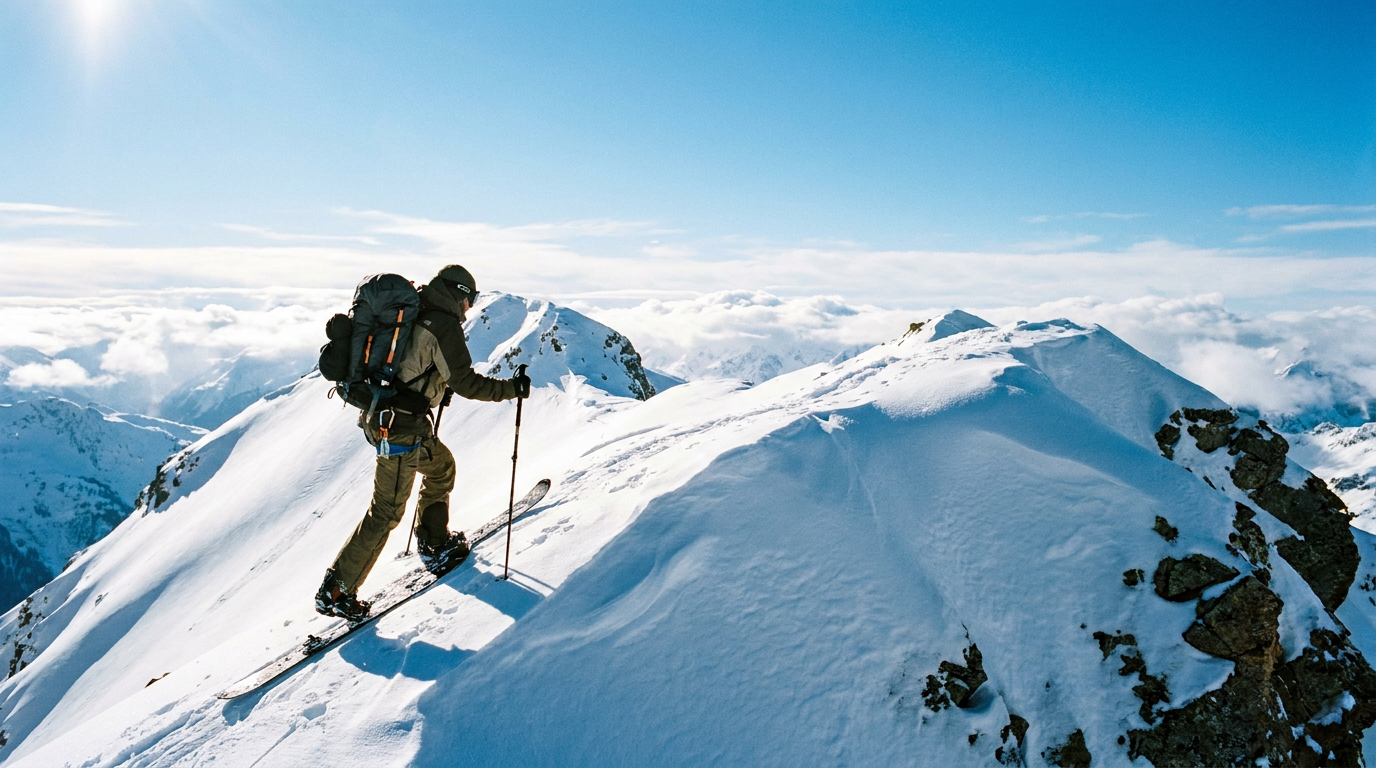
The catalyst for this shift is the modern splitboard—a snowboard engineered to split down the middle into two ski-like halves. This allows riders to ascend snow-covered mountains under their own power, bypassing the resort entirely. Once at the summit, the halves are reconnected, transforming back into a traditional snowboard for the descent.[1]
While the concept of the splitboard dates back to the early 1990s, early iterations were notoriously clunky, heavy, and prone to mechanical failure. Today, aerospace-grade materials, carbon fiber layups, and precision-milled aluminum hardware have closed the performance gap. Modern splitboards ride with the same torsional stiffness and responsiveness as solid snowboards, making the backcountry more accessible than ever.[1][6]
The mechanics of the ascent rely on a specialized piece of equipment known as climbing skins. These are strips of fabric—typically made from mohair, nylon, or a blend of both—that adhere to the base of the splitboard halves using a specialized, cold-resistant glue.[1]
The fibers on the climbing skins are angled directionally. When the rider glides the ski forward, the fibers lie flat, allowing smooth movement. When weight is applied backward, the fibers bristle and grip the snow, preventing the rider from sliding downhill. This directional friction is the mechanical heart of human-powered winter travel.[1]

Bindings also undergo a radical transformation during the transition from 'tour mode' to 'ride mode.' In tour mode, the bindings are mounted on hinges at the toe, allowing the rider's heel to lift naturally with each stride, mimicking the biomechanics of cross-country skiing.[1]
When the rider reaches the peak, the transition begins. The skins are peeled off and stowed in a backpack. The two halves of the board are locked together using specialized hooks and clips that pull the seam tight. Finally, the bindings are slid onto a puck system that spans the two halves, locking the board into a rigid, unified platform ready for the descent.[1][6]
The two halves of the board are locked together using specialized hooks and clips that pull the seam tight.
Beyond the mechanical ingenuity, splitboarding has surged in popularity due to its profound physiological benefits. Unlike lift-served snowboarding, which is primarily an anaerobic, gravity-fed activity, splitboarding is a rigorous cardiovascular workout.[3]
Ascending a mountain in deep snow requires sustained, low-intensity aerobic exertion, often keeping the athlete in a 'Zone 2' heart rate for hours. Studies in wilderness medicine indicate that backcountry touring can burn upwards of 600 to 1,000 calories per hour, depending on the incline, snow conditions, and the weight of the rider's pack.[3]

This shift from passive transport to active ascent fundamentally changes the psychology of the sport. Riders report a heightened sense of accomplishment and a deeper appreciation for the terrain when every vertical foot of the descent has been earned through physical labor.[3][6]
However, leaving the controlled environment of a ski resort introduces significant environmental hazards, most notably avalanches. The backcountry is unpatrolled and unmitigated, meaning there are no ski patrollers dropping explosives to trigger controlled slides.[2]
Consequently, the rise of splitboarding has necessitated a parallel boom in avalanche safety education. Organizations like the American Avalanche Association emphasize that specialized gear is useless without the scientific literacy to read the snowpack.[2]
Every backcountry rider must carry a holy trinity of safety equipment: an avalanche transceiver (beacon), a collapsible probe, and a metal snow shovel. The beacon emits a continuous radio frequency; if a rider is buried, their partners switch their beacons to 'search' mode to pinpoint the signal beneath the snow.[2][5]

But the primary goal of avalanche science is avoidance. Modern splitboarders are trained to analyze weather history, wind patterns, and temperature gradients to identify weak layers within the snowpack. State-run agencies provide daily forecasts, acting as a critical daily reference for backcountry travelers.[5]
The environmental implications of human-powered recreation are also driving the sport's growth. As climate change threatens winter snowpacks globally, many snowboarders are seeking ways to reduce their carbon footprint.[4]
Splitboarding eliminates the need for the massive energy consumption associated with running chairlifts, grooming trails, and pumping water for artificial snowmaking. Advocacy groups highlight human-powered touring as a more sustainable model for winter recreation, fostering a community that is intimately invested in protecting fragile alpine ecosystems.[4][6]

Ultimately, the splitboarding explainer is a story of empowerment. By combining clever engineering, rigorous safety science, and human endurance, the sport has unlocked millions of acres of public land. It has transformed snowboarding from a consumer experience into a holistic, wilderness-immersed discipline.[6]
How we got here
Early 1990s
The first commercial splitboards are developed, though they are heavy and mechanically complex.
2010s
Advances in carbon fiber and precision aluminum hardware make splitboards as responsive as solid snowboards.
2020s
Backcountry touring experiences a massive boom as riders seek outdoor alternatives to crowded resorts.
Viewpoints in depth
Backcountry Enthusiasts
Riders who prioritize the physical challenge and untouched terrain over the convenience of resorts.
For backcountry purists, the appeal of splitboarding lies in the concept of 'earning your turns.' By removing the mechanical assistance of chairlifts, the sport transforms into a holistic endurance challenge. Enthusiasts argue that the slow, methodical ascent fosters a deeper connection to the mountain environment and makes the eventual descent far more rewarding. The physical exertion is seen not as a barrier, but as a core benefit of the discipline.
Avalanche Safety Educators
Professionals focused on mitigating the inherent risks of unpatrolled winter wilderness.
Safety educators stress that the technological accessibility of splitboarding must be matched by scientific literacy. Because the backcountry lacks the explosive avalanche mitigation performed at resorts, riders are entirely responsible for their own safety. Educators advocate for mandatory training courses, such as those provided by AIARE, teaching riders how to read snowpack layers, understand weather history, and execute complex companion rescues using beacons and probes.
Environmental Advocates
Groups promoting human-powered recreation as a sustainable alternative to carbon-intensive ski infrastructure.
As climate change shortens winter seasons and reduces snowpacks, environmental advocates view splitboarding as a vital shift in how humans interact with alpine ecosystems. Traditional ski resorts require massive energy inputs for chairlifts, lodge heating, and artificial snowmaking. In contrast, human-powered touring leaves a negligible carbon footprint. Advocates argue that this intimate, low-impact interaction with nature naturally cultivates a community of passionate climate stewards.
What we don't know
- How traditional ski resorts will adapt their business models as more riders migrate to the backcountry.
- Whether future advancements in binding technology will eventually make splitboards lighter than traditional solid snowboards.
Key terms
- Splitboard
- A snowboard that separates down the middle into two ski-like halves for uphill travel, and reconnects for downhill riding.
- Climbing Skins
- Strips of directional fabric attached to the bottom of the board during the ascent to provide grip on the snow.
- Avalanche Transceiver
- A wearable radio device that emits a signal, allowing partners to locate a buried rider in the event of an avalanche.
- Tour Mode
- The configuration of the splitboard where the halves are separated and bindings are hinged at the toe for walking uphill.
Frequently asked
Do I need special boots for splitboarding?
Most modern splitboard bindings are designed to work with standard snowboard boots, though specialized backcountry boots offer stiffer soles and better articulation for hiking.
How hard is it to transition the board?
With practice, transitioning a splitboard from tour mode to ride mode takes only a few minutes. It involves removing the skins, clipping the halves together, and sliding the bindings onto the pucks.
Is splitboarding a good workout?
Yes. Ascending a mountain on a splitboard is a rigorous cardiovascular workout that can burn between 600 and 1,000 calories per hour, keeping the rider in a sustained aerobic zone.
Sources
Source coverage
6 outlets
3 viewpoints surfaced






[1]REI Co-opBackcountry Enthusiasts
Intro to Splitboarding: Gear and Techniques
Read on REI Co-op →[2]American Avalanche AssociationAvalanche Safety Educators
Backcountry Safety and Snowpack Science
Read on American Avalanche Association →[3]Wilderness & Environmental MedicineBackcountry Enthusiasts
Physiological Demands of Alpine Touring and Splitboarding
Read on Wilderness & Environmental Medicine →[4]Protect Our WintersEnvironmental Advocates
Human-Powered Recreation and Climate Advocacy
Read on Protect Our Winters →[5]Colorado Avalanche Information CenterAvalanche Safety Educators
Snowpack Tracking and Backcountry Travel
Read on Colorado Avalanche Information Center →[6]Factlen Editorial TeamEnvironmental Advocates
Synthesis by Factlen editorial team
Read on Factlen Editorial Team →


Every angle. Every day.
Get sports stories with full source coverage and perspective breakdowns delivered to your inbox.