
How Satellite SOS on Smartphones is Transforming Off-Grid Travel Safety
The integration of satellite messaging into everyday smartphones is eliminating cellular dead zones, offering a new safety net for remote travelers while pushing dedicated rescue devices to adapt.
By Factlen Editorial Team
- Casual Travelers & Tech Optimists
- Argue that smartphone satellite integration democratizes safety for the vast majority of people.
- Search & Rescue Professionals
- Emphasize that while phones are a great backup, they lack the ruggedness required for extreme emergencies.
- Dedicated Hardware Advocates
- Value purpose-built devices for their passive tracking and truly global network coverage.
What's not represented
- · Emergency dispatch operators managing the influx of non-critical satellite SOS calls.
- · Cellular network providers facing disruption from direct-to-device satellite communication.
Why this matters
The ability to call for help or coordinate logistics without cellular service empowers travelers to explore remote areas safely, fundamentally changing the risks associated with off-grid road trips, hiking, and sailing.
Key points
- Modern smartphones from Apple and Google now include built-in satellite SOS capabilities.
- The technology connects directly to Low Earth Orbit satellites, bypassing terrestrial cell towers.
- New updates allow for non-emergency text messaging and roadside assistance via satellite.
- Search and rescue teams warn that smartphones lack the battery life and durability of true rescue beacons.
- Dedicated Personal Locator Beacons (PLBs) still offer superior global coverage and specialized homing signals.
- Competition from smartphones is forcing dedicated hardware companies to offer more flexible subscription plans.
The concept of the "dead zone" is rapidly disappearing from the modern travel experience. For decades, venturing beyond the reach of terrestrial cellular towers meant stepping off the grid entirely, leaving hikers, sailors, and remote road-trippers vulnerable in the event of an emergency. If a vehicle broke down on a deserted stretch of highway or an injury occurred on a backcountry trail, the only options were to self-rescue or hope a passerby would eventually cross paths. That paradigm is undergoing a fundamental shift.
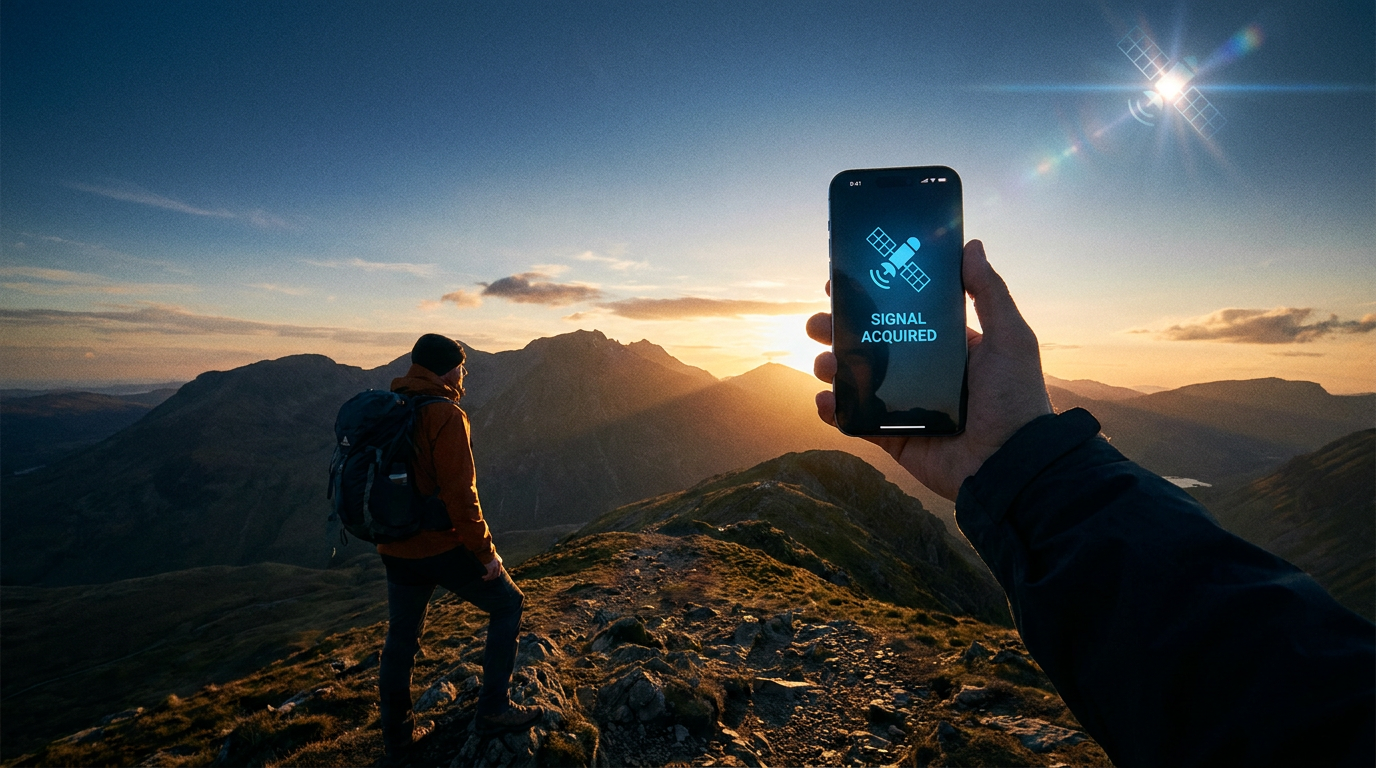
Today, the safety net has expanded dramatically, and millions of people are unknowingly carrying a powerful satellite communicator in their pockets. The integration of satellite technology into everyday consumer smartphones has democratized off-grid safety, offering a robust lifeline to casual travelers who would never have considered purchasing specialized rescue equipment. This quiet revolution is transforming how we approach travel safety, turning the smartphone into an essential piece of wilderness survival gear.[8]
The shift began in earnest when Apple introduced Emergency SOS via satellite for the iPhone 14 lineup, and the momentum has since accelerated across the entire mobile industry. Google quickly followed suit by integrating similar emergency satellite connectivity into its Pixel 8 series, while Qualcomm's Snapdragon Satellite technology has paved the way for broader Android adoption. Furthermore, major cellular carriers like T-Mobile are actively rolling out direct-to-device satellite texting capabilities in partnership with Starlink, ensuring that the technology is not limited to a single ecosystem.[3][4][6]
To understand the magnitude of this shift, it is helpful to look at the mechanism behind the technology. Traditional cellular networks rely on terrestrial towers, which are inherently limited by line-of-sight, geography, and infrastructure costs. When a traveler drops behind a mountain ridge or sails too far from the coast, the radio signal simply cannot reach the tower. Satellite messaging bypasses this terrestrial bottleneck entirely by connecting directly to constellations of Low Earth Orbit (LEO) satellites passing overhead.[8]

Apple's system, delivered in partnership with Globalstar, provides a clear example of how this mechanism operates in practice. When a user triggers an SOS outside of cellular range, the phone's interface guides them to point the device at a satellite traveling through space at roughly 16,000 miles per hour. Because the bandwidth is incredibly narrow, the phone compresses the user's location and medical data into a tiny text packet. Under clear skies, this connection typically takes less than 15 seconds, relaying the distress signal down to a custom ground station and routing it directly to emergency dispatchers.[6]
The capabilities of these systems are rapidly expanding beyond life-or-death emergencies to handle everyday travel disruptions. Recognizing that not every off-grid problem requires a helicopter rescue, Apple recently partnered with AAA to offer roadside assistance via satellite. This allows stranded drivers to request a tow truck, a jump-start, or fuel delivery from remote highways where cell service drops out, bridging the gap between a minor inconvenience and a dangerous situation.[7]
Similarly, the recent rollout of iOS 18 and new Android operating system updates has introduced non-emergency satellite texting. Travelers can now send standard text messages, emojis, and location updates to friends and family while entirely off the grid. This feature allows backpackers to check in at the end of the day or coordinate pickup times with air charter services, fundamentally changing the logistics of remote travel.[3][4]
Similarly, the recent rollout of iOS 18 and new Android operating system updates has introduced non-emergency satellite texting.
Search and Rescue (SAR) professionals acknowledge the profound and largely positive impact of this technology. According to the Colorado Search and Rescue Association, the barrier to calling for help is now lower than ever before. Because nearly everyone carries a smartphone, SAR teams are seeing an increase in calls from casual weekend hikers who find themselves in unexpected trouble, allowing responders to intervene before a situation deteriorates into a fatal exposure incident.[1]
However, SAR teams and wilderness survival experts are quick to issue a critical caveat: a smartphone is an outstanding backup tool, but it is not a true replacement for a dedicated Personal Locator Beacon (PLB) or a rugged satellite messenger. While the convenience of a smartphone is undeniable, relying on a multi-purpose consumer device as a primary lifeline introduces several critical points of failure in an extreme emergency.[1][5]
The primary vulnerability of any smartphone in the backcountry is its battery life. A phone that is constantly searching for a non-existent cellular signal, taking photographs, and running GPS mapping applications will drain its battery rapidly, especially in cold weather. In stark contrast, a dedicated device like the Garmin inReach is designed to remain powered off or in a low-power tracking mode, allowing it to last for weeks on a single charge and ensuring it is ready when disaster strikes.[1]
Durability is another critical factor that separates consumer electronics from rescue hardware. Real-world emergencies rarely happen in ideal conditions; they often involve high winds, freezing temperatures, heavy rain, or deep-water immersion. While modern smartphones boast impressive water resistance, true PLBs are built from the ground up to survive extreme shock, operate in sub-zero temperatures, and withstand deep-water submersion without failing.[5]

Network coverage also creates a distinct dividing line between the two tiers of devices. Smartphone satellite features currently rely on networks like Globalstar or Starlink, which are limited by regional regulatory approvals and the proximity of terrestrial ground stations. As a result, smartphone SOS is currently available in a limited number of regions, primarily covering North America, parts of Europe, Japan, and Australia.[4][6]
Dedicated devices, particularly those utilizing the Iridium network or the international Cospas-Sarsat system, offer true global coverage. Whether a traveler is sailing across the middle of the Pacific Ocean, trekking through the Himalayas, or exploring the polar ice caps, a dedicated PLB or high-end satellite messenger can establish a connection and transmit a distress signal.[5]
Furthermore, true PLBs possess a distinct technological advantage when it comes to the final stages of a physical rescue. When activated, a PLB transmits on a dedicated 406 MHz international rescue frequency and simultaneously broadcasts a 121.5 MHz homing signal. This localized homing beacon allows search and rescue helicopters to track a victim down to the final few meters, even in dense forest canopy or zero-visibility weather—a feature entirely absent from smartphones.[5]

Despite these differences, the intense competition from "free" smartphone SOS features is forcing the dedicated hardware market to adapt and become more consumer-friendly. In a direct response to market pressures, Garmin recently updated its subscription model, allowing users with suspended plans to trigger an SOS for up to 12 months without paying a reactivation fee, bridging the financial gap for users weighing a dedicated communicator against their phone.[2]
Ultimately, the convergence of consumer smartphones and satellite technology is a massive win for global travel safety. Smartphones provide an excellent, highly accessible backup for the everyday traveler, effectively eliminating the danger of the casual dead zone. Meanwhile, dedicated PLBs and satellite messengers remain the undisputed primary lifeline for those pushing the boundaries of remote exploration, ensuring that no matter how far off the grid we travel, help is never entirely out of reach.[8]
How we got here
Nov 2022
Apple launches Emergency SOS via satellite on the iPhone 14 lineup.
Oct 2023
Google introduces satellite connectivity for emergency services on the Pixel 8 series.
Sep 2024
Apple expands satellite features in iOS 18 to include non-emergency text messaging.
Jun 2025
Garmin eliminates reactivation fees and allows SOS on suspended plans to compete with smartphones.
Viewpoints in depth
Casual Travelers & Tech Optimists
Argue that smartphone satellite integration democratizes safety for the vast majority of people.
This camp celebrates the elimination of the 'dead zone' for everyday users. They point out that most people who get lost or stranded are casual weekend hikers or road-trippers who would never invest hundreds of dollars in a dedicated satellite beacon. By building SOS capabilities directly into the devices people already carry, tech companies have created a ubiquitous safety net that lowers the barrier to rescue and provides immense peace of mind without requiring specialized training or expensive monthly subscriptions.
Search & Rescue Professionals
Emphasize that while phones are a great backup, they lack the ruggedness required for extreme emergencies.
Rescue coordinators acknowledge that smartphone SOS is a massive leap forward, but they warn against over-reliance. They highlight that real-world emergencies often involve freezing temperatures, heavy rain, and physical trauma—conditions that quickly drain a smartphone's battery or render its touchscreen unusable. Furthermore, SAR teams rely on the localized 121.5 MHz homing signals broadcast by true Personal Locator Beacons to pinpoint victims in dense canopy or bad weather, a feature smartphones simply do not possess.
Dedicated Hardware Advocates
Value purpose-built devices for their passive tracking and truly global network coverage.
Outdoor enthusiasts and off-grid professionals argue that a multi-purpose consumer device is a critical point of failure in the backcountry. They favor dedicated satellite messengers like the Garmin inReach because these devices offer passive 'breadcrumb' tracking, allowing family members to monitor their progress and dispatch help even if the user is incapacitated. Additionally, they point out that dedicated devices utilize networks like Iridium, which offer true pole-to-pole global coverage, whereas smartphone satellite features are currently restricted by regional ground stations and regulatory borders.
What we don't know
- When smartphone satellite coverage will achieve true global reach, as current services are limited by regional ground stations and regulatory approvals.
- Whether Apple and Google will eventually charge monthly subscription fees for their satellite messaging services once the initial free periods expire.
Key terms
- Low Earth Orbit (LEO)
- Satellites orbiting relatively close to Earth that provide faster communication with lower latency than traditional geostationary satellites.
- Personal Locator Beacon (PLB)
- A dedicated, rugged emergency device that transmits a distress signal on a regulated international rescue frequency.
- Homing Signal
- A localized radio frequency (typically 121.5 MHz) broadcast by PLBs that allows search and rescue helicopters to pinpoint a user's exact location in the final stages of a rescue.
- Passive Tracking
- A feature on dedicated satellite messengers that automatically drops digital breadcrumbs of a user's location at set intervals, allowing others to monitor their progress.
Frequently asked
Do I need a subscription to use my iPhone's satellite SOS?
Apple currently offers the service for free for the first two years after activating a compatible device, and has historically extended this free period for early adopters.
Will my Android phone work with satellite messaging?
Recent models like the Google Pixel 8 series and devices using newer Qualcomm Snapdragon chips support satellite SOS, with broader texting capabilities rolling out via carriers like T-Mobile.
Can I use smartphone satellite features anywhere in the world?
No, smartphone satellite coverage is currently regional (primarily North America, parts of Europe, Japan, and Australia) depending on the manufacturer's specific satellite partnerships and ground stations.
Why do search and rescue teams still recommend dedicated beacons?
Dedicated devices offer significantly longer battery life, rugged waterproofing, true global coverage, and specialized homing frequencies that allow helicopters to pinpoint a location.
Sources
Source coverage
8 outlets
3 viewpoints surfaced








[1]BackpackerSearch & Rescue Professionals
Can your cell phone replace a satellite beacon in the backcountry?
Read on Backpacker →[2]The TrekDedicated Hardware Advocates
Garmin Adds Free SOS Access for Suspended inReach Plans
Read on The Trek →[3]CyberGuyCasual Travelers & Tech Optimists
Android Satellite Messaging Options
Read on CyberGuy →[4]TidBITSCasual Travelers & Tech Optimists
T-Mobile and Starlink Launch T-Satellite
Read on TidBITS →[5]Ocean SignalSearch & Rescue Professionals
rescueME PLB1 vs iPhone Emergency SOS: Which Device Should You Really Trust?
Read on Ocean Signal →[6]AppleCasual Travelers & Tech Optimists
Emergency SOS via satellite available today on iPhone 14 lineup
Read on Apple →[7]AAACasual Travelers & Tech Optimists
AAA Roadside Assistance via satellite
Read on AAA →[8]Factlen Editorial TeamDedicated Hardware Advocates
Synthesis by Factlen editorial team
Read on Factlen Editorial Team →


Every angle. Every day.
Get travel stories with full source coverage and perspective breakdowns delivered to your inbox.