
How Interior Design Physically Changes Your Brain Chemistry
Neuroscientists are using brain scans to prove that our homes are constant health interventions, revealing how room shapes, lighting, and textures actively lower stress and boost cognitive function.
By Factlen Editorial Team
- Neuroscientists & Researchers
- Focus on the biological metrics, fMRI data, and measurable health outcomes triggered by spatial design.
- Design Practitioners
- Focus on applying scientific principles to create beautiful, functional, and emotionally intelligent spaces.
- Factlen Editorial Synthesis
- Bridges the gap between clinical neuroscience and practical home application for the general reader.
What's not represented
- · Low-income housing advocates discussing the accessibility of biophilic design
- · Urban planners applying these principles to public spaces
Why this matters
Humans spend roughly 90% of their lives indoors. Understanding how lighting, shapes, and textures physically alter your nervous system empowers you to design a home that actively reduces anxiety and improves your daily focus.
Key points
- Neuroaesthetics is the study of how the brain responds to beauty and spatial design.
- Brain scans reveal that rounded, curvilinear shapes activate the brain's reward centers.
- Biophilic design, which incorporates nature, lowers cortisol and improves cognitive test scores.
- Cool-toned lighting boosts alertness, while warm-toned lighting promotes relaxation and sleep.
- Thoughtful interior design functions as a continuous, preventative health intervention.
Humans spend approximately 90% of their lives indoors, yet we rarely consider how the walls around us are actively shaping our brain chemistry. When you walk into a room and instantly feel a sense of calm or a sudden surge of anxiety, it is not just a matter of personal taste or aesthetic preference. It is a measurable, biological response to your environment.[6]
Welcome to the rapidly expanding field of neuroaesthetics—the scientific study of how the brain and nervous system respond to beauty, architecture, and design. For decades, interior design was treated as a purely visual or stylistic endeavor, governed by fleeting trends and subjective opinions. Today, researchers are proving that our environments function as continuous health interventions.[6]
The shift from subjective art to hard science gained mainstream visibility when Google partnered with the International Arts + Mind Lab at Johns Hopkins University to create an exhibition called "A Space for Being." The interactive installation was designed to prove that different aesthetic experiences directly impact human physiology.[1]
Before entering the exhibit, visitors were equipped with custom wristbands containing biometric sensors. As they moved through three rooms with subtly contrasting lighting, sounds, scents, and textures, the sensors tracked their heart rates, skin conductivity, and body temperatures. The data revealed that people's bodies reacted dramatically to different spatial cues, often contradicting what they consciously claimed was their favorite room.[1]

The researchers noted that the installation provided scientific proof that design choices matter on a cellular level. What we choose to surround ourselves with actively alters our wellbeing, proving that thoughtful architecture is not merely a status symbol, but a biological necessity.[1]
At the core of neuroaesthetics is the evolutionary understanding that our brains are constantly scanning our surroundings for cues of safety, resource abundance, and comfort. When an environment signals safety, our nervous system down-regulates, lowering blood pressure and reducing the production of stress hormones like cortisol.[6]
Dr. Anjan Chatterjee, director of the Penn Center for Neuroaesthetics, has conducted extensive research on how specific architectural features affect neural processes. By placing participants in functional magnetic resonance imaging (fMRI) machines, his team has been able to observe the brain's real-time reactions to various interior layouts.[3]
Anjan Chatterjee, director of the Penn Center for Neuroaesthetics, has conducted extensive research on how specific architectural features affect neural processes.
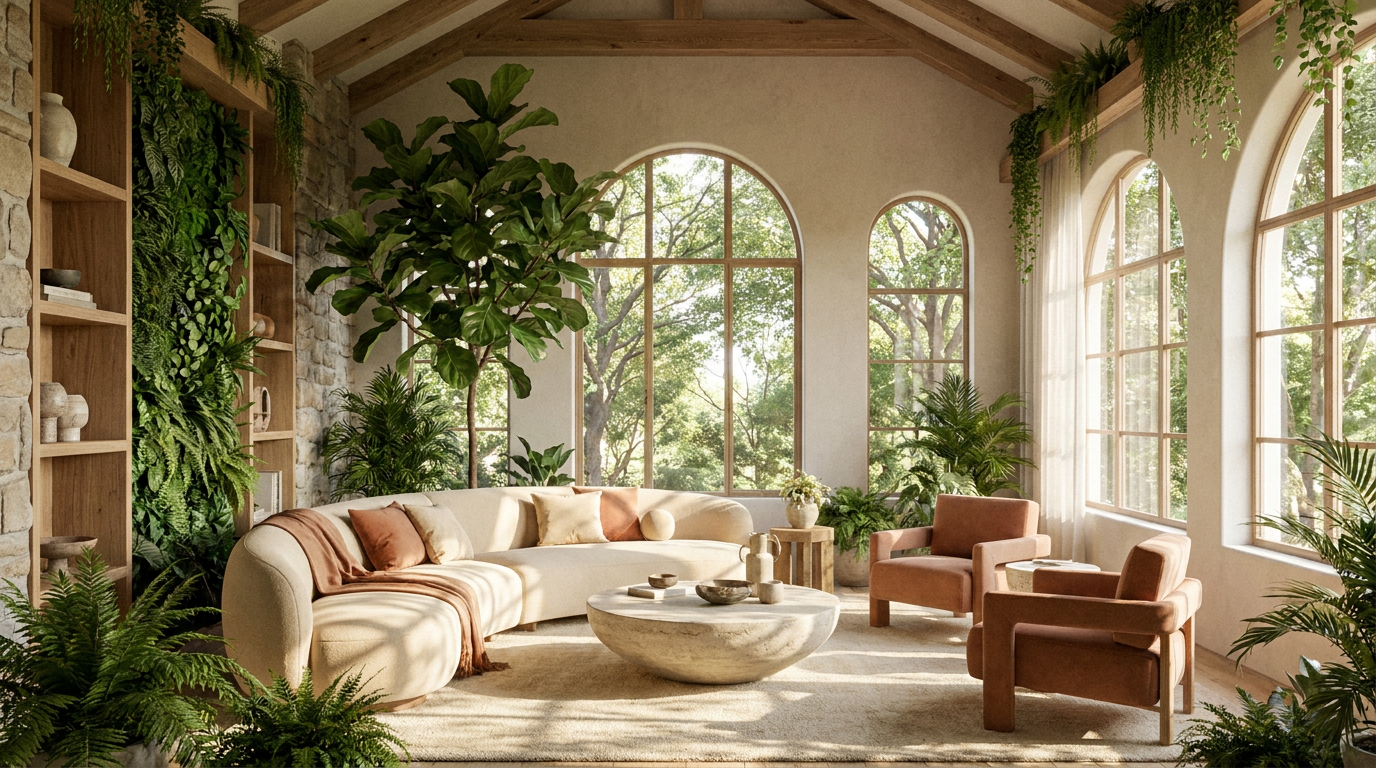
In one landmark study, participants were shown hundreds of images of interior spaces. Chatterjee's team found that spaces featuring high ceilings, large windows, and curvilinear, rounded shapes consistently activated the ventromedial prefrontal cortex—a key region of the brain's reward and pleasure system. Finding a space beautiful triggers a neurological reward similar to looking at a loved one.[3]

Conversely, sharp angles, harsh lighting, and enclosed spaces can trigger low-level stress responses, signaling the brain's ancient threat-detection networks. This evolutionary preference heavily informs "biophilic design," an architectural approach that integrates natural elements into the built environment to soothe the nervous system.[3][4]
According to research published by the National Institutes of Health, exposure to natural light, wood grains, and indoor vegetation directly lowers blood pressure, reduces chronic pain perception, and improves cognitive functioning. The brain recognizes organic materials as evolutionary safe havens, generating an unconscious sense of refuge.[4]
The benefits of biophilic design are highly functional, extending far beyond emotional comfort. Studies tracking cognitive performance have found that occupants in green-certified, biophilic buildings score significantly higher on cognitive tests than those in conventional, sterile buildings. Interactions with natural design elements actively support the areas of the brain critical for memory and emotional regulation.[5]

Even the tactile experience of a room plays a therapeutic role. Design practitioners note that the brain instantly interprets surface qualities through visual texture. Plush, layered textiles imbue a space with a sense of warmth and enveloping safety, while sleek, hard surfaces signal utility and alertness. Layering these textures intentionally allows a designer to set the emotional undertone of a room.[2]
Lighting is perhaps the most potent neuroaesthetic tool available in a home. Our brains are exquisitely sensitive to light, which governs our circadian rhythms. Cool-toned light—measuring 4000 Kelvin and above—mimics midday sunshine. This suppresses melatonin production, sharpens focus, and boosts productivity, making it ideal for a home office.[6]

On the other hand, warm-toned light between 2700K and 3000K, which carries amber and red hues, has the exact opposite effect. It promotes relaxation, encourages social connection, and supports the evening wind-down our bodies require for restorative sleep. Using the wrong color temperature at the wrong time of day actively fights our biology.[6]
Ultimately, neuroaesthetics empowers us to view our homes not just as shelters or aesthetic showcases, but as active participants in our mental and physical health. By aligning our living spaces with our innate biological preferences, we can engineer environments that actively heal, focus, and restore us.[6]
How we got here
1990s
Advances in brain scanning technology allow researchers to measure physiological responses to beauty in real-time.
Early 2000s
Neuroscientist Semir Zeki formally coins the term 'neuroaesthetics' to describe the neural mechanisms of aesthetic experiences.
2015
Major studies confirm that biophilic design measurably improves cognitive function and lowers stress.
2019
Google and Johns Hopkins debut 'A Space for Being' at Milan Design Week, proving biometric responses to interior design.
2025
New research links biophilic design directly to brain plasticity and enhanced memory regulation.
Viewpoints in depth
The Clinical Perspective
How neuroscientists measure the brain's reaction to architecture.
For researchers, interior design is no longer a soft science. By utilizing fMRI machines and biometric sensors, neuroscientists can track exactly how blood flow changes in the brain when a person enters a room. They view the built environment as a continuous health intervention, noting that chronic exposure to poor lighting or sharp, aggressive architecture can elevate baseline cortisol levels, while biophilic spaces actively reduce cardiovascular stress.
The Designer's Perspective
Translating biometric data into everyday living spaces.
Architects and interior designers are using neuroaesthetic data to move beyond fleeting trends. Instead of choosing colors based on the 'Pantone Color of the Year,' evidence-based designers select palettes, textures, and layouts based on the intended emotional outcome of a room. A bedroom is optimized for melatonin production with warm lighting and soft acoustics, while a home office utilizes cool light and natural wood grains to sustain directed attention.
What we don't know
- How long the cognitive benefits of a biophilic space last after a person leaves the environment.
- The exact degree to which personal cultural background alters a person's neurological response to specific shapes and colors.
Key terms
- Neuroaesthetics
- The scientific study of how the brain and nervous system respond to beauty, art, and architectural design.
- Biophilic Design
- An architectural approach that connects occupants to nature through natural light, plants, and organic materials to improve health.
- Ventromedial Prefrontal Cortex
- A region of the brain associated with processing risk, fear, and reward, which activates when we experience beautiful spaces.
- Circadian Rhythm
- The body's internal 24-hour clock that regulates sleep and wakefulness, heavily influenced by the color temperature of lighting.
- fMRI
- Functional Magnetic Resonance Imaging, a brain-scanning technique used to observe how different room designs affect neural activity.
Frequently asked
What is the easiest way to apply neuroaesthetics at home?
Maximize natural light, introduce indoor plants, and use warm-toned lighting in the evening to support your circadian rhythm.
Do room shapes really affect my mood?
Yes. Brain imaging shows that curvilinear, rounded shapes activate the brain's pleasure centers more than sharp, rectangular edges.
Can interior design improve focus?
Studies show that incorporating natural elements like wood textures and greenery can lower cortisol levels and significantly improve cognitive performance.
What color temperature is best for a home office?
Cool-toned light (4000K and above) mimics midday sunshine, which suppresses melatonin and boosts alertness for focused work.
Sources
Source coverage
6 outlets
3 viewpoints surfaced






[1]DezeenDesign Practitioners
Google explores neuroaesthetic design with A Space for Being installation in Milan
Read on Dezeen →[2]Design PatakiDesign Practitioners
The Alchemy of Neuroaesthetics in Interior Design
Read on Design Pataki →[3]BrainFacts.orgNeuroscientists & Researchers
The Neuroaesthetics of Architecture
Read on BrainFacts.org →[4]National Institutes of HealthNeuroscientists & Researchers
Biophilic Interior Design and Therapeutic Outcomes
Read on National Institutes of Health →[5]Global Wellness InstituteNeuroscientists & Researchers
Biophilic Design: Healthy Buildings, Healthy Brain
Read on Global Wellness Institute →[6]Factlen Editorial TeamFactlen Editorial Synthesis
Synthesis by Factlen editorial team
Read on Factlen Editorial Team →
Every angle. Every day.
Get home stories with full source coverage and perspective breakdowns delivered to your inbox.